eBook - ePub
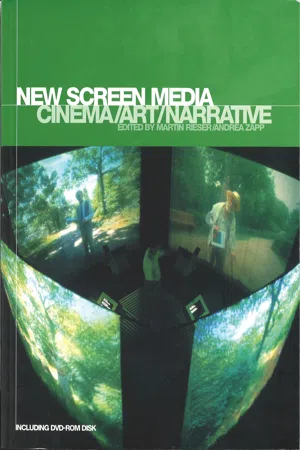
New Screen Media
Cinema/Art/Narrative
- 267 pages
- English
- ePUB (mobile friendly)
- Available on iOS & Android
eBook - ePub
About this book
This text presents the work of cultural theorists and philosophers of new media, together with the perspectives of artists experimenting with different interactive models critically examining their own practice. The book proposes the use of new critical tools for discussing new media forms.
Information
PART ONE
ORIENTATIONS: HISTORY AND THEORY
Spreadsheets, Sitemaps and Search Engines
Why Narrative is Marginal to Multimedia and Networked Communication, and Why Marginality is More Vital than Universality
Sean Cubitt
I
Media Studies both benefits from and is overdetermined by its double origin, among sociologists increasingly convinced of the centrality of communication to modernity, and among literary schools diminishingly persuaded of the relevance of past literatures to the lived experience and likely futures of their students and themselves. The clash of cultures has been immensely fruitful. But the dialectic of humanities and social sciences approaches has occasionally broken down: one critical example is the failure of ‘ethnographic’ audience studies to square off with qualitative and statistically-based analysis of audiences (though see the forthcoming work of Andy Ruddock), leaving a yawning gap between micro-studies of ‘real people’ and macro-studies of whole populations. Studies of the new media are beginning to bridge the gap through the wide-scale interactive dialogues that have begun to break down the impasse. A second unfortunate effect has been the felt necessity to preface any methodological proposal with a diatribe against whatever the author perceives as the previous dominant discourse in the discipline (see Gauntlett’s introduction to his otherwise useful web.studies).1 One thinks here of Barry Salt’s attack on Screen, maintained long past its polemical sell-by date in the second edition of Film Style and Technology,2 or Bordwell and Carroll’s assault on interpretative criticism. The vitality of the field – since this is a necessarily interdisciplinary zone – depends, on the contrary, on the recognition of what has been achieved to date, even as we test and contest the premises, principles and, increasingly of late, the objects that constitute it. In this vein, I do not want here to decry the achievements of narratological analysis, or to claim that it has no place in critical understandings or creative dispositions in computer-mediated communications. Rather, I want to suggest that narrative is only one among several modes of organisation characteristic of new media, that this has an impact on certain universalist claims for narrative analysis, and that one crucial measure of value, the relation to narrative models, therefore does not hold good in assessing new media texts and practices. On the other hand, I also want to point up the importance of narrative’s temporal imagination in a spatialised world of communication, and insist that its very marginality allows it a special role, which otherwise it could not occupy.
There are three particular discourses of narrative that need to be reassessed if we are to grasp the nettle of new media’s temporalities. The first is the notion that almost any mode of human culture can be understood as narrative. In this discourse, we read of the essentially narrative form of memory, of history, of myth, of news, of psychology, of politics and of science. While such literary readings of non-literary discourses can be illuminating (for example the analyses offered in In Dora’s Case by Bernheimer and Kahane),3 the claim underlying this discourse is that all human activity is fundamentally structured like a story. Yet some key narratological analyses demonstrate that even apparently narrative forms (the myth and the western among them: see especially Lévi-Strauss and Wright) are better understood as structures, spatial rather than temporal formations.4 This spatialisation of narrative analysis anticipated the spatial turn of cultural analysis, prominent in the work of geographers like Lefebvre, and Harvey in cultural studies.5 At the same time, however, the geographical imagination altered the terms under which narrative could be deemed central to human experience. A journey, for example, may be recorded in a more or less picaresque narrative, but it may also be transcribed as a map or a geographical information system.
A second objection to the universalist claim for narrative analysis is that it restricts itself to a more or less strictly chronological model of temporal experience. There is only an apparent contradiction between this chronological critique and the criticism of spatialisation. The chronological narrative proposes to us a protagonist who always occupies a perpetual present (without which such effects as suspense and expectation would be impossible) as a point moving along a line whose dimensions have however already been mapped: the protagonist of the chronological narrative is caught in a story whose beginning and end have already been determined, and which therefore constructs story time as the unfolding of destiny rather than the passage from past certainty into an uncertain future. This sense of preordination constructs narrative as timeline, as a spatial organisation, and its protagonists as variants moving through rule-governed moves, as in a game of chess. That this is in itself a specific and historical expression of Western culture is only one aspect of its imperialist gesture. The other lies in its negation of the plurality of modes of consciousness and discursive formations through which we experience the present. As I hope to show, alternative modes of temporality are particularly important in the study of digital media.
The second discourse in which narrative takes a central position derives from Lyotard’s critique of the grand récit or ‘master narrative’ as that characteristic of modern culture whose loss marks the entry into the post-modern.6 Lyotard and his later acolytes make three critical errors. Firstly, there is a failure to register the most significant political and communicative discourses of the late twentieth century: post-coloniality, feminism and the green movement. More forgivably, Lyotard wrote too early to confront the emergence of ‘techno-boosterism’ as a worldwide cultural discourse running directly counter to his thesis. Nonetheless, discourses of technology, anti-imperialism, gender and ecology pose an empirical challenge to the observation that the ‘narratives’ of progress, emancipation and truth have ceased to exercise the political and social aspirations of contemporary society. Born of the betrayal of such aspiration by the Parti Communiste de la France in 1968, the bitter anti-Marxism of key post-modern theorists like Lyotard, Baudrillard, Virilio and Deleuze does not validate the attempt to ascribe to modernity an exclusively and uniquely narrative foundation, nor the insistence on the failure of the form.
The third weakness of the argument, again crucial to the critique offered in this chapter, is the confusion surrounding the definition of narrative as a necessarily teleological form. Certainly, Marxism has historically pointed towards the future as the site of the ‘realm of freedom’, which the third volume of Das Kapital moots as the beginning of history after the ‘pre-history’ of class war.7 Equally, certainly Stalinism (and to a lesser extent Leninism) posited a definite content for the realm of freedom. But both Trotskyism and the new political movements of the late twentieth century paint a picture of the future without definite content, even when the future is imaged as the result of a stark and immediate choice, as so often is the case in the more impetuous shades of green. The difference is that between faith and hope, teleology and eschatology. In this way, the critique of the grand récit misinterprets progressive politics as Aristotelian narratives with a beginning, a middle and an end. Not only do such political movements not define themselves in terms of conclusion: their goals are not even necessarily conceived of as states of equilibrium. Instead, the discourse of the End is peculiar to post-modernism itself, and to post-structuralists like Barthes, Baudrillard and Lyotard, with the only difference being that each awards himself the Hegelian privilege of reading history from the vantage point of its (successful or unsuccessful) conclusion. By thus deploying a narrative strategy to emphasise the twin issues of narrative’s centrality and its conclusion, the critique of the grand récit entered a circular logic that defeats its attempt to present itself as a philosophical account of the social world.
The third discourse significant to the current analysis belongs at once to avant-garde critiques of narrative and to the implicit evaluative frameworks of media studies. Vanguardist criticism received an immense fillip from the writers associated with Tel Quel in the late 1960s and early 1970s, those associated with Cahiers du Cinéma and Cinéthique in the same period and the translations that became available in the pages of Screen, New Left Review, SubStance and other small journals in the mid-1970s. In common with earlier avant-gardes, the poststructuralists around Boulez, Sollers, Resnais and Godard instigated an attack on the dominant culture. Identifying narrative as a characteristic of the dominant, they proposed anti-narrative, alongside anti-illusionism, as a key strategy for radical art practice. As vanguardist strategy this was fruitful. But as the language in which it had been couched became accepted as the basis for North Atlantic ‘theory’, the terms of the narrative/anti-narrative distinction became normative. On the one hand, narrative was assumed to be dominant, while on the other opposition to dominance has been taken as an assumed but rarely explicit criterion of evaluation. Production practices, texts and reading strategies are praised for being oppositional, resistant or subversive. Yet all these terms not only assume domination but also define themselves exclusively in relation to it. Thus, oppositional practices become dependent on the dominant they oppose. In the immediate context, anti-narrative defines itself through its dependency on narrative. This has two consequences. Firstly, narrative once again becomes universal by assimilating all aberrations from itself as merely oppositional. Secondly, the possibility of alternative forms, rather than simply oppositional ones, is elided. Put more formally, narrative/anti-narrative is a binary opposition incapable of producing a new term beyond their polarity. The emergence of alternative media forms, by contrast, demands not dualism but a dialectical understanding capable of producing something new. The themes critiqued here – of universal narrative, the end of grand narrative and anti-narrative – share the paradox that narrative analysis produces a static and spatial model in place of a dynamic and temporal one. Is it possible or desirable for narrative to regain a place in the critical and practical vocabulary of the emergent media? I believe so, but under a new guise, that takes account of the fact that narrative is no longer – if indeed it ever was – the central mode of modern communication.
II
The very universality claimed for narrative indicates the poverty of the category as a historical tool. Although, as Williams observes, the rise of the popular press, film, radio and television has led to the proliferation of narrative texts way beyond the experience of earlier generations, the larger history of modernity is better traced through its more fundamental innovations.8 The remarkable persistence of narrative in twentieth-century media can only be apprehended as remarkable if we apprehend the environment in which it is now performed: a landscape of other modes of documentation and dissemination. Crucial among them are forms of data storage and retrieval that are not structured in time, as is the narrative, but in space. Modernity’s key social formations–capitalism, the state and imperialism – cannot be imagined without the data systems on which they depend: book-keeping, record-keeping and cartography.
In their digital forms, spreadsheets, databases and geographical information systems are core facets of new media usage, an importance underlined by their significance to the history of workplace computing. Moreover, the convergence of these three core systems in popular packages like Microsoft Office and AppleWorks indicates a far higher degree of integration than that claimed for sound, image and text in multimedia and networked communications. The lack of emphasis on workplace media is a legacy of the division of labour executed between sociology and cultural studies in the late 1960s and early 1970s; largely motivated by the slogan ‘the personal is the political’. Feminist criticism of the exclusivity of class analysis derived from work as object of study led the turn towards the more gender-oriented, less class-defined politics of the domestic and of leisur...
Table of contents
- Cover
- Title Page
- Contents
- Notes on Contributors
- List of Artworks on the DVD-ROM
- List of Illustrations
- Acknowledgements
- Preface
- Foreword: An Age of Narrative Chaos?
- Structural Over view: Cinema, Art and the Reinvention of Narrative
- Part One: Orientations: History and Theory
- Part Two: Explorations: A New Practice
- Glossary
- Bibliography
- Index
- New Screen Media – Operating the DVD-ROM
- eCopyright
Trusted by 375,005 students
Access to over 1.5 million titles for a fair monthly price.
Study more efficiently using our study tools.
Frequently asked questions
Yes, you can cancel anytime from the Subscription tab in your account settings on the Perlego website. Your subscription will stay active until the end of your current billing period. Learn how to cancel your subscription
No, books cannot be downloaded as external files, such as PDFs, for use outside of Perlego. However, you can download books within the Perlego app for offline reading on mobile or tablet. Learn how to download books offline
We are an online textbook subscription service, where you can get access to an entire online library for less than the price of a single book per month. With over 1.5 million books across 990+ topics, we’ve got you covered! Learn about our mission
Look out for the read-aloud symbol on your next book to see if you can listen to it. The read-aloud tool reads text aloud for you, highlighting the text as it is being read. You can pause it, speed it up and slow it down. Learn more about Read Aloud
Yes! You can use the Perlego app on both iOS and Android devices to read anytime, anywhere — even offline. Perfect for commutes or when you’re on the go.
Please note we cannot support devices running on iOS 13 and Android 7 or earlier. Learn more about using the app
Please note we cannot support devices running on iOS 13 and Android 7 or earlier. Learn more about using the app
Yes, you can access New Screen Media by Martin Rieser, Andrea Zapp, Martin Rieser,Andrea Zapp in PDF and/or ePUB format, as well as other popular books in Media & Performing Arts & Film History & Criticism. We have over 1.5 million books available in our catalogue for you to explore.