- 144 pages
- English
- ePUB (mobile friendly)
- Available on iOS & Android
eBook - ePub
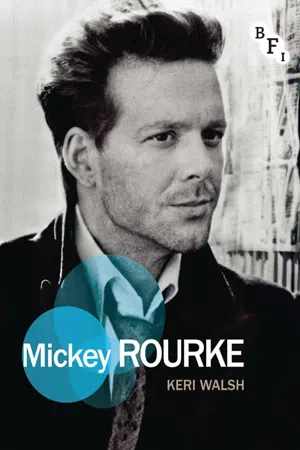
Mickey Rourke
About this book
'Rebel', 'oddball' and 'Uncle Mickey': just three of the many conflicting labels Mickey Rourke has 'earned' over his remarkable career in the limelight. His public persona, moving from actor to boxer to actor, is not easy to define: making it all the more intriguing, and making Keri Walsh's study an unique and fascinating addition to the 'Film Stars' series.
Information
1 METHOD ACTOR
If you don’t got dreams, Bagel, you got nightmares.
Boogie Sheftell, Diner
Rourke emerged as a star by playing variations on a type the film critic Richard Dyer has called ‘the sad young man’. In his essay ‘Coming Out as Going In’, Dyer uses the career of Montgomery Clift as the chief example of this figure in cinema. ‘The sad young man’ is a young man on the threshold of discovering his homosexuality. He forms a counterpoint to the ‘angry young man’ of the 1950s typified by such figures as Richard Burton’s Jimmy Porter in Look Back in Anger (1958) or Marlon Brando’s Johnny Strabler in The Wild One (1953). In Dyer’s formulation, ‘the sad young man image is frozen on the moment before “becoming” or knowing that one “is” a queer’. Dyer suggests that the image – found also in pulp and literary fiction, and dating at least as far back as the Romantic poets – is ‘an important element in highly public star images such as Montgomery Clift, Sal Mineo, James Dean’, and he notes ‘the strong sense of the sad young man’s desirability to heterosexual women’. This desirability comes partly from the sad young man’s femininity, but also from his withdrawal, his complexity and his sensitivity. ‘The sad young man is a figure of romance/pornography’, notes Dyer, a point that is crucial for comprehending Rourke’s career at the beginning of the 1980s and beyond.1
The early Rourke always hovered on this threshold, lyrical, mysteriously distracted, ultimately unavailable. He was defined by his fluidity, and he could engage sexual attention from all directions, holding out a rich sense of sexual possibility. In a memorably charged scene in Diner, for instance, his character throws his head back to drink a stream of sugar provocatively from a dispenser, thereby bringing a conversation about his friend’s virginity to a homoerotic halt. But he was also a figure of foreclosure, and of a sense that time was running out, and that moving definitively to ‘adulthood’ would involve losses and compromises that might be too hard to bear. Rourke’s films of the early 1980s suggest a range of unhappy futures – none of them beyond the closet – for the sad young man. In Body Heat, his future is jail. In Diner, the possibility of a normative heterosexual future is floated, but Rourke’s love object is far enough out of his league to make it seem unlikely. In Rumble Fish, his character dies at the hands of police, while in The Pope of Greenwich Village (1984) it becomes apparent that sentimental bonds between men might be able to compensate for, and maybe even coexist with, the pressures of heterosexuality, fatherhood and failed relationships with women.
In all of his early roles, Rourke played characters suspended for longer than felt comfortable in the period between adolescence and adulthood. He played characters who weren’t interested in living up to the cultural scripts that awaited them. Diner highlighted Rourke’s femininity as the key source of his success with women, but also, and increasingly, as a source of shame that must be covered up. Vincent Canby noticed this dynamic when he called Rourke in Diner ‘the most interesting of the lot’ and explains that ‘Boogie (Mickey Rourke), who works as a hairdresser by day, is deeply in debt to the bookies, and pretends to be studying law by night, in this way to neutralise some of the more unpleasant associations that attach to the reputation of male hairdressers’.2 Levinson leaves Boogie’s future unknown, but at the film’s end (in an attempt to contain his femininity and recklessness with money), he is rescued by a town elder and father figure (a friend of his mother’s) from his gambling debts, and offered a more suitably masculine job in construction. Boogie accepts this temporarily, but warns his mother’s friend that he can’t be relied on to stick around for long, because (as he explains cryptically) ‘You know, I got plans.’
‘I see you had a misspent youth’, Elizabeth Taylor tells pool shark Montgomery Clift in George Stevens’s A Place in the Sun (1951). Watching the film in his high-school English class, Rourke was captivated by Clift’s presence and would study his acting closely, introducing similar qualities into his performances in Diner and Rumble Fish.3 Rourke was often compared to Brando in the early days of his career, but a comparison with Clift seems most appropriate, since Rourke was introspective and introverted like Clift, rather than earthy and uninhibited like Brando. Steve Vineberg identifies the qualities Clift brings to his role in A Place in the Sun as ‘forceful erotic charge’ combined with ‘laconic expressiveness’, and a ‘gift for communicating the feelings of a hypersensitive and inarticulate character’.4 These are the qualities that inspired Rourke’s version of Method.
Clift’s performances of the late 1940s and early 1950s were defining moments in Method acting style. ‘Method acting’ is a complex notion that means many things, and about which many actors, directors and audiences have strong feelings. It is a form of realist acting, and today many teachers use the broader term ‘Stanislavski-based system’ to refer to the kinds of approaches that are popularly deemed ‘Method’. In popular culture, the term ‘Method’ evokes an American acting tradition that goes from John Garfield through Dean, Clift and Brando to De Niro, Pacino, Hoffman and beyond. In this sense, ‘Method’ refers both to a loose set of rubrics governing preparation for a role, and also to the creative communities surrounding certain influential teachers such as Lee Strasberg (of the Actors Studio) and Stella Adler (of The Stella Adler Studio of Acting). Keeping in mind that ‘Method acting’ encompasses different approaches, and also that it is only one strain of Stanislavski-based acting, I will try to delineate some of the ways in which Rourke’s career is recognisably ‘Method’.
Method acting has frequently been the source of satire for the lengths its actors go to ‘live’ a role, from tales of De Niro’s twelve-hour taxi-driving shifts in preparation for his role as Travis Bickle, to Hoffman’s epic runs before filming scenes for Marathon Man (1976). It was Hoffman’s jogs that sparked Laurence Olivier’s apocryphal remark, ‘Why not try acting? It’s a lot easier.’ Well, why not try ‘acting’ in this conventional sense? Because practitioners of the Method strive for verisimilitude, seeking to narrow the gap between art and life as much as possible. In a study of the acting style and its practitioners, Steve Vineberg has compiled a useful list of its governing features.5 Privileging displays of genuine emotion, Method acting uses the personal experiences of the actor as the material from which performances are drawn. In keeping with the ideas developed by Konstantin Stanislavski at the Moscow Art Theatre at the turn of the twentieth century, it makes use of improvisation and spontaneity. Typically, Method acting preparation aims at inner transformations and insights, and is not vocational or directed toward any particular kind of performance (in fact, the process-oriented nature of the work at the Actors Studio confused Rourke – he wondered why so few of his fellow members worked professionally as actors). Method performers strive for intimate communication between themselves and other actors in a scene. They make frequent use of physical objects as props, as a form of both naturalism and symbolism. They also have a tendency to describe the craft as more than a job, as a quasi-religious or mystical devotion to the process of finding truth in the theatre. This last factor, in combination with Method’s attraction to objects, perhaps helps to explain the fetishism that has accumulated around the acting style.
In Method acting, the use of the personal life and experiences of the actor is key, as opposed to ‘technique’ learned or transmitted from one performer to another (as in traditions like ballet, for instance, where the individuality of performers is less important than their discipline to the form). As Stanislavski put it, ‘The form and setting will vary according to the play, but the actor’s human emotions, which run parallel to the feelings of the role, must remain alive. They must not be faked or replaced by something else, some convoluted actors’ trick.’6 In a Method performance, you don’t try to become someone else, but to find ways of connecting your own experiences to those of your character. Developing a character, Method actors typically begin inside themselves and work outward, an inversion of the classical British style (Laurence Olivier always worked by preparing the physical appearance of a character first – he knew he had found his character when he found the right nose). As a student of Sandra Seacat and then as a member of the Actors Studio, Rourke learned Method principles such as improvisation, acting ‘as if’, and ‘living the role’ by conducting deep research into characters (and he still draws on these techniques: for his performance as Whiplash in Iron Man 2 [2010], for instance, Rourke visited a Russian prison). Method acting is the foundation of all Rourke performances, both as a technique and as a recurring set of themes and preoccupations: the family, social class, abuse and abandonment, heterosexuality and its discontents, and the emotional upheavals of failed masculinity.
The most significant controversy in Method acting pedagogy is based around the rift between its two most influential teachers, Stella Adler and Lee Strasberg, and the relative importance that should be placed on ‘affective memory’ (sometimes called ‘emotion memory’) in acting. Affective memory is a style of calling up the past through the contemplation of objects or experiences, and deploying those recovered emotions for the purposes of developing a character and generating emotional truths in performance. Based on Rourke’s comments about his manner of working (for instance, he has mentioned having his first acting breakthrough while contemplating a pair of boxing shoes), it seems that he follows a non-dogmatic version of the Strasberg school. His studies with Sandra Seacat appear to have included variations on Strasberg’s ‘emotion memory’ exercises. In an interview about Elia Kazan, Seacat remarked:
I did an affective memory at the Actors Studio years ago, after which Lee Strasberg said, ‘Now that’s an affective memory. Darling, tell them how you did it.’ When I explained my process, Strasberg replied, ‘That’s not how you do an affective memory! But that’s what the Method is all about. It’s a way of work!’ You find your own way of carrying out your own and your character’s internal truth – within your body, mind, and soul.7
The foundational personal experiences through which Rourke found himself as an actor involved his relationship with his father. ‘It is your own individual experiences, which you bring to the role from the real world that give it life’, wrote Stanislavksi, and to develop as a Method actor, Rourke had to muster the courage to revisit his own past.8 Near the beginning of his career, with Seacat’s encouragement, Rourke made the kind of difficult emotional odyssey that characterises Method practice, when he travelled to Schenectady, New York, to seek out his father, Philip Rourke. This emotional courage was necessary to prepare for an important audition. He described his reunion with his father to James Lipton during his appearance on Inside the Actors Studio:
| LIPTON: | How did you find him? |
| ROURKE: | This is the part that’s really weird. We used to go eat, when we were little, in this hamburger place, White Castle, so I walked up State Street and I walked into the White Castle … |
| LIPTON: | State Street where? |
| ROURKE: | Schenectady, upstate. And I sat down, I had a hamburger, and I was just lookin’ around at the people that were sitting there, and I seen this one dude, and I was looking at his back and his hands, I don’t know, there was something familiar, I said ‘fuck, he’s right here when I walked in.’ And he got up and walked out the door, and I couldn’t move, my legs weren’t going, and I watched, he stayed at the red light twice, and then I walked out, I remember we were like the same size, and I didn’t want to be the same size, so I walked in the gutter. I looked up at him and I said, ‘Are you duh-duh-duh,’ and he said, ‘Yeah.’ And then he said to me, he had sunglasses on, and he says, ‘I always knew you’d come one day.’ We went across the street, we spoke for seven, um, about seven hours, and he gave me fifty bucks and bought me pork chops and mashed potatoes and sauerkraut and he had twenty-two screwdrivers, and that was the last I ever seen him.9 |
As Rourke tells the story, this excursion was aimed directly at gaining the emotional insights he would need for his audition to play Brick in an Actors Studio production of Tennessee Williams’s Cat on a Hot Tin Roof, the story of a powerful, disapproving father and the son who can’t live up to his expectations.
If Rourke’s career has been Method in its technique and guiding artistic principles, it has also been Method in a pop-cultural sense: he has enthusiastically embraced the trappings of the Method actor in the popular imagination, from white undershirts to motorcycles to bongo drums, a set of signifiers that announces working-class identity, bohemianism and primitivism. His career has also been highly influenced by the Method’s fascination with ethnicity. Rourke has played a variety of roles within the ethnic spectrum of New York’s boroughs (Jewish, Irish, Italian, Polish) and has also drawn upon his Florida upbringing to flirt with the culturally charged figure of the white Southerner.
The theme of abandoning fathers supplied the material for most of the memorable parts of Rourke’s early career. He has played both sides of the relationship: the abandoned son (Rumble Fish, Diner, Homeboy, Bullet), and the abusive and/or abandoning father (Rape and Marriage, The Pope of Greenwich Village, Angel Heart, The Wrestler). The pursuit of one’s true parentage is a particularly Freudian theme, and Rourke is indeed a Freudian (and Sophoclean) actor. In Angel Heart, he acts out the incestuous plot of Oedipus in reverse, when he unknowingly has sex with his own daughter. Guilt is one of his major preoccupations, particularly the guilt of the bystander or fellow abused child in an abusive home. The unusual amount of consistency in Rourke’s roles indicates that he has taken care to select scripts that matter to him personally and that speak to his interests and strengths as an actor.
Love in the Hamptons (1976)
Rourke’s first appearance on screen was in the amateur production Love in the Hamptons, Tom Folino’s short film based on a 1972 New Yorker story of the same name by Elaine Mueller. This half-hour film is about two workers in a hotel bar who begin an affair: an abused wife (Sandy), played by Mary Armstrong, and a younger man (Swede) who wants to save her, played by Rourke. Love in the Hamptons gives us our first glimpse ...
Table of contents
- Cover
- Title Page
- Contents
- Acknowledgments
- Introduction
- 1. Method Actor
- 2. Softcore Star
- 3. Fighter
- 4. Icon
- Notes
- Bibliography
- Filmography
- Index
- List of Illustrations
- eCopyright
Trusted by 375,005 students
Access to over 1.5 million titles for a fair monthly price.
Study more efficiently using our study tools.
Frequently asked questions
Yes, you can cancel anytime from the Subscription tab in your account settings on the Perlego website. Your subscription will stay active until the end of your current billing period. Learn how to cancel your subscription
No, books cannot be downloaded as external files, such as PDFs, for use outside of Perlego. However, you can download books within the Perlego app for offline reading on mobile or tablet. Learn how to download books offline
Perlego offers two plans: Essential and Complete
- Essential is ideal for learners and professionals who enjoy exploring a wide range of subjects. Access the Essential Library with 800,000+ trusted titles and best-sellers across business, personal growth, and the humanities. Includes unlimited reading time and Standard Read Aloud voice.
- Complete: Perfect for advanced learners and researchers needing full, unrestricted access. Unlock 1.5M+ books across hundreds of subjects, including academic and specialized titles. The Complete Plan also includes advanced features like Premium Read Aloud and Research Assistant.
We are an online textbook subscription service, where you can get access to an entire online library for less than the price of a single book per month. With over 1.5 million books across 990+ topics, we’ve got you covered! Learn about our mission
Look out for the read-aloud symbol on your next book to see if you can listen to it. The read-aloud tool reads text aloud for you, highlighting the text as it is being read. You can pause it, speed it up and slow it down. Learn more about Read Aloud
Yes! You can use the Perlego app on both iOS and Android devices to read anytime, anywhere — even offline. Perfect for commutes or when you’re on the go.
Please note we cannot support devices running on iOS 13 and Android 7 or earlier. Learn more about using the app
Please note we cannot support devices running on iOS 13 and Android 7 or earlier. Learn more about using the app
Yes, you can access Mickey Rourke by Keri Walsh in PDF and/or ePUB format, as well as other popular books in Media & Performing Arts & Film History & Criticism. We have over 1.5 million books available in our catalogue for you to explore.