- 78 pages
- English
- ePUB (mobile friendly)
- Available on iOS & Android
eBook - ePub
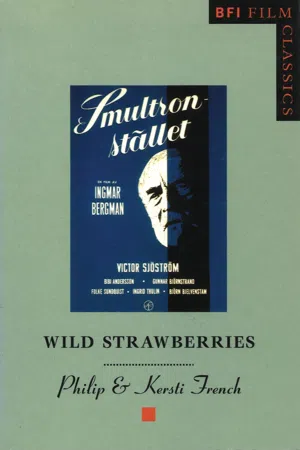
Wild Strawberries
About this book
Wild Strawberries (1958) is probably Ingmar Bergman's most personal film and one which explores his relation to the history of Swedish cinema. Philip and Kersti French give a detailed account of Bergman's powerful and intense direction of the film. They set the film firmly in the context of Swedish life and culture. The authors also trace connections with the plays of August Strindberg, and the paintings of Edvard Munch and Carl Larsson.
Information
1

SJÖSTRÖM AND BERGMAN
Wild Strawberries brings together the dominant figure of the Swedish cinema's Golden Age and the pre-eminent figure of its second flowering. They could almost be considered the film's joint auteurs.
The Golden Age of the Swedish cinema began in 1913, lasted a decade, and was overwhelmingly the creation of two charismatic, strikingly handsome directors, Victor Sjöström (1879–1960) and Mauritz Stiller (1883–1928). They were, as actors and producers, men of the theatre and neither had much in the way of formal education. Both worked for the company that produced, distributed and exhibited their films. It had been founded in 1905 and became known as Svensk Bio in 1909. In 1919 it merged with its chief rival AB Skandia, and took the name by which it is still known, Svensk Filmindustri (SF). Sjöström and Stiller frequently worked with the same cameraman, the masterly Julius Jaenzon (1885–1961), who styled himself J. Julius, and sometimes with his brother, Henrik. Five of Sjöström's finest films and three of Stiller's were based on novels by Selma Lagerlöf, who in 1909 became the first woman (and the first Swede) to win the Nobel Prize for literature. Like Sjöström, she was a native of and devoted to the largely rural province of Värmland.
Sjöström acted in most of his own movies as well as several of Stiller's. With his large head and square thrusting jaw he was a forceful presence, and he soon became a popular star. His films dealt with social injustice, prejudice, redemption, revenge and eternal love, frequently in rural and historical settings making extensive use of natural locations, and more often than not the tone and conclusion were tragic. By the early 1920s his renown was matched only by Griffith and Chaplin, who called him 'the greatest director in the world'.1 Thus the Swedish cinema as a presence on the world scene (though not as a local industry) came to an abrupt end when Sjöström went to Hollywood in 1923, and Stiller followed him there the following year, accompanied by Greta Garbo, the star of his masterpiece, Gösta Berlings Saga (The Atonement of Gösta Berling).
Sjöström's name was changed by his Hollywood employers to Seastrom and, working in a country where he had spent several years as a child and mastered the language, he thrived, making such silent classics as He Who Gets Slapped (1924), The Scarlet Letter (1926) and The Wind (1928), the second and third of these starring Griffith's discovery, Lillian Gish. The Wind, however, possibly his greatest film, proved a box-office disaster. He directed Garbo in The Divine Woman (1929), of which no print is known to exist, and made one sound movie, A Lady in Love (1929), before returning to Sweden for good at the age of fifty. Stiller, on the other hand, did not prosper in Hollywood, putting his name to a mere three films, one of which, The Street of Sin (1928), was completed by Josef von Sternberg. He died at the age of forty-five, shortly after directing the musical Broadway on the Stockholm stage.
Sjöström directed only two further films – The Markurells of Wadköping (1930) in Sweden and Under the Red Robe (1936) in Britain – neither of them a critical or commercial success. He continued to work in the cinema as an actor and resumed the successful theatrical career that had been set aside when he went to America.
In 1942, at the age of sixty-three, Sjöström was recalled to his old company when the scholarly Carl Anders Dymling (1898–1961), as head of Sveriges Radio the equivalent figure to the BBC's Sir John Reith, was appointed Managing Director of Svensk Filmindustri. Dymling brought in Sjöström as SF's Artistic Manager and both men were to play a role in the cinematic career of Ingmar Bergman.
Born in the university town of Uppsala in 1918, Bergman grew up in Stockholm where his father, Erik Bergman, a Lutheran pastor of ferociously intimidating mien, was appointed vicar of the fashionable Hedvig Eleonora church and later, apparently through the personal intervention of the Swedish Queen Viktoria, who had heard him preach there, made chaplain of the Royal Hospital, Sofiahemmet. After graduating from Stockholm University, Bergman continued to pursue his passionate interest in the theatre and attempted to establish himself as a writer. An amateur production of a play of his was seen by Stina Bergman, head of the script department at SF, and she engaged him as a reader and adapter. The widow of the distinguished playwright and novelist Hjalmar Bergman (no relation to Ingmar), she and her husband were among Sjöström's closest friends and had accompanied him to Hollywood in 1923. This was not, however, a happy time for young Ingmar Bergman. He was making little progress as an author, had cut himself off from his overbearing parents and, despite being nearly penniless, had embarked on the first of his five marriages. Sixteen years later this first wife, Else Fisher, would be the choreographer on The Seventh Seal and would play the hero's mother as a young woman in the final flashback of Wild Strawberries.
For a couple of years, Bergman's screenplay Hets (frenzy) had been lying around the studio until there was a sudden demand for a suitable script to be directed by Alf Sjöberg as part of a programme of prestigious pictures to mark the twenty-fifth anniversary of the founding of SF. It is not without a certain piquancy that Bergman and Sjöström should have been brought together to celebrate a genuine Silver Jubilee and that their association should reach its peak in a fictional Golden Jubilee. In October 1943, Sjöström gave a press conference announcing SF's forthcoming project, a report of which in the Stockholm newspaper Social-Demokraten is probably the first public mention of Bergman in relation to cinema.2
Ingmar Bergman has written a screenplay, which will be put into production after the comedy His Official Fiancée. His original story is called Frenzy; it deals with the pressures of exams in a school's final year and with the relationship between teacher and pupil in a Stockholm high school. Experimentally inclined, but obviously written with talent, in Sjöström's opinion.
It is a mark of Sjöström's respect for Bergman that when he was asked by the press for some words of appreciation of the Danish writer Kaj Munk following his murder by the Nazis in early 1944 (Sjöström had appeared the previous year in a film of Munk's play Ordet, directed by Gustaf Molander), he asked the young writer to prepare a draft for him.
Sjöström took a close interest in Frenzy (1944) and it became the major film of the SF jubilee and the most celebrated Swedish movie of the decade. While it was in production, the 26-year-old Bergman was appointed Artistic Director of the City Theatre of Helsingborg, a town on the south coast of Sweden, separated only by a narrow strip of water from Elsinore in Denmark. It lies between Gothenburg and Malmö (although a great deal closer to the latter), and these three places were to be the centres of his theatrical work over the next fifteen years. He was the youngest person ever to hold this post.
In the summer of 1945, after a hectic season producing ten plays at Helsingborg, Bergman returned to SF in Stockholm to direct his first movie, Crisis, based on a Danish play not of his own choosing. It proved an unrelievedly painful experience and the picture turned out a critical and financial disaster. That Bergman didn't abandon the project was due to the support of Dymling (who suggested he start all over again after the first three weeks) and Sjöström (who kept turning up with practical advice and encouragement). Sjöström noted in his diary: 'Touchy moments with Ingmar Bergman, who is extremely sensitive and lets himself be easily thrown off balance.'3 As Bergman recalls it:4
He grabbed me firmly by the nape of my neck and walked me like that back and forth across the asphalted area outside the studio, mostly in silence, but suddenly he was saying things that were simple and comprehensible. You make your scenes too complicated ... Work more simply. Film the actors from the front. They like that and it's best that way. Don't keep having rows with everyone. They simply get angry and do a less good job.

(I. to r.) Ingmar Bergman, Bibi Andersson, Victor Sjöström and cameraman Gunnar Fischer on location
The firm hand of Sjöström must have reminded Bergman of his father, and indeed there is a certain physical resemblance between these two stern, moustachioed men. It is also the case that Sjöström's own father, though never ordained, became a domineering religious zealot.
Bergman was subsequently exiled from SF and made his next three pictures for other companies. These first four films were in the poetic-realist manner of the prewar work of Julien Duvivier and Marcel Carné. On his return to SF he showed that he had fallen under the influence of Italian neo-realism, and his fourth film back there reunited him with Victor Sjöström. In Till Glädje (To Joy, 1949), Sjöström plays a celebrated conductor, father figure to a wilful violinist and his musician wife, members of the same symphony orchestra in Helsingborg. The picture manifestly reflects Bergman's career in the theatre, his experience of parenthood, the breakdown of his second marriage, and the tug between domestic life and artistic vocation. It is also the third of his sixteen collaborations, all of them in black-and-white, with Gunnar Fischer, an outstanding cinematographer who joined SF in 1936 as an assistant to Julius Jaenzon. In addition, as Peter Cowie has pointed out, To Joy is the first of Bergman's pictures to exploit the particular luminous quality of the light of the Swedish summer, and in his view contains more cinematic poetry than the sum of his previous films.5
Nearly ten years would pass before Bergman and Sjöström worked together again – in 1957 on Wild Strawberries. By that time Bergman had entered the third stylistic phase of his career, which he attributes in part to his discovery of German Expressionism during a sojourn in Paris in 1949 when he haunted both the Comédie Française and the Cinémathèque. This became a marked influence in Gycklarnas Afton (Sawdust and Tinsel, 1953), the first of his films that might be considered a masterpiece and the first to attract serious attention outside Scandinavia. Two Swedish directors, Gustaf Molander (1888–1973) and Alf Sjöberg (1903–80), created reputable bodies of work between the silent Golden Age and the 1950s, and Bergman wrote screenplays for both of them. But the second flowering of the Swedish cinema can be said to date from the early 1950s – from Sjöberg's Fröken Julie (Miss Julie), which won the Palme d'Or at Cannes in 1951, Arne Mattsson's Hon dansade en sommar (One Summer of Happiness, 1951), Arne Sucksdorff's Det Stora Äventyret (The Great Adventure, 1953), and Bergman's Sawdust and Tinsel.
2
A SWEDISH ODYSSEY
Wild Strawberries begins with Professor Eberhard Isak Borg, Professor Emeritus of Bacteriology at, presumably, the Karolinska Institute in Stockholm, speaking rather smugly about his life, as the camera pans around the elegant book-lined study of the comfortable Stockholm apartment he shares with his 74-year-old housekeeper of many years, Miss Agda, and a Great Dane that is unnamed and goes unremarked upon. As he announces himself as a misanthropic loner, apparently content with a life apart from a somewhat distasteful humanity, the camera picks up framed photographs of people we will meet later on – his 96-year-old mother, his son Evald, his daughter-in-law Marianne, his long-dead wife Karin. We also see a chess set, which in the context of Bergman's career, a year after The Seventh Seal, hints at another encounter with Death. Isak Borg is a 78-year-old widower; Evald, his only child, a lecturer in medicine at the University of Lund, is 38 – the same ages respectively of Victor Sjöström and Ingmar Bergman when the movie was made. Isak, we learn later, is the fourth oldest of ten brothers and sisters, all but himself now dead.
Borg's initials, EIB, are the ...
Table of contents
- Cover Page
- Title Page
- Contents
- Acknowledgments
- 1 Sjöström and Bergman
- 2 A Swedish Odyssey
- 3 The Background, the Foreground
- 4 The Times, The Reputation
- Notes
- Credits
- Bibliography
- eCopyright
Trusted by 375,005 students
Access to over 1.5 million titles for a fair monthly price.
Study more efficiently using our study tools.
Frequently asked questions
Yes, you can cancel anytime from the Subscription tab in your account settings on the Perlego website. Your subscription will stay active until the end of your current billing period. Learn how to cancel your subscription
No, books cannot be downloaded as external files, such as PDFs, for use outside of Perlego. However, you can download books within the Perlego app for offline reading on mobile or tablet. Learn how to download books offline
Perlego offers two plans: Essential and Complete
- Essential is ideal for learners and professionals who enjoy exploring a wide range of subjects. Access the Essential Library with 800,000+ trusted titles and best-sellers across business, personal growth, and the humanities. Includes unlimited reading time and Standard Read Aloud voice.
- Complete: Perfect for advanced learners and researchers needing full, unrestricted access. Unlock 1.5M+ books across hundreds of subjects, including academic and specialized titles. The Complete Plan also includes advanced features like Premium Read Aloud and Research Assistant.
We are an online textbook subscription service, where you can get access to an entire online library for less than the price of a single book per month. With over 1.5 million books across 990+ topics, we’ve got you covered! Learn about our mission
Look out for the read-aloud symbol on your next book to see if you can listen to it. The read-aloud tool reads text aloud for you, highlighting the text as it is being read. You can pause it, speed it up and slow it down. Learn more about Read Aloud
Yes! You can use the Perlego app on both iOS and Android devices to read anytime, anywhere — even offline. Perfect for commutes or when you’re on the go.
Please note we cannot support devices running on iOS 13 and Android 7 or earlier. Learn more about using the app
Please note we cannot support devices running on iOS 13 and Android 7 or earlier. Learn more about using the app
Yes, you can access Wild Strawberries by Philip French,Kersti French in PDF and/or ePUB format, as well as other popular books in Médias et arts de la scène & Film et vidéo. We have over 1.5 million books available in our catalogue for you to explore.