- 77 pages
- English
- ePUB (mobile friendly)
- Available on iOS & Android
eBook - ePub
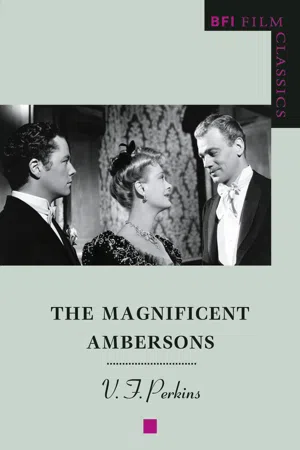
The Magnificent Ambersons
About this book
V.F. Perkins explores Orson Welles' genius in directing actors, his intricate weaving of his own narration in and around the drama, and his unsurpassed use of the long take to capture the fines nuance of expression and unspoken feeling. For Perkins The Magnificent Ambersons 'has as many marvellous shots, scenes, ideas, performances as most film-makers could hope to achieve in an entire career'. Second only to Citizen Kane in work, this film can never be seen as he intended it, after being heavily cut by RKO studio. However, it remains a remarkable picture of dynastic ruin and social change.
Information
1
. . . . . . . . . . . . . . . . . . . . . . . . . .
PRODUCTION AND DESTRUCTION
A study of The Magnificent Ambersons will keep speaking of it as a ruin and treating it as one of the great tragedies of movie history. I recognise that, in the state to which its owners reduced it, the picture careers between brilliance and banality, its very worst scenes being the ones that RKO Pictures imposed to wrap the story’s finish in rose-tinted cellophane. But my main concern will be with Orson Welles’ film as one of cinema’s glories – an incisive, moving, generous and thrillingly accomplished work. I shall not spend too long on the studio’s part in first enabling and then wrecking the production.
An efficient outfit would not have made the film at all. After the first unhappy previews in March 1942, the company president George Schaefer wrote a gutless letter to Welles complaining that there had been particular trouble with the Pomona audience that had gone to the Fox Theatre to see The Fleet’s In: ‘In Pomona we played to the younger element … who contribute the biggest part of the revenue. If you cannot satisfy that group, you just cannot bail yourself out with a $1,000,000 investment.’1
Schaefer should have seen it coming. Welles delivered what we must suppose he had promised, a remarkably close adaptation of Booth Tarkington’s 1918 Pulitzer prized novel. All the problems that the film encountered were predictable if anyone at RKO had taken the trouble to read The Magnificent Ambersons. Tarkington interwove a family saga with social history at the turn of the century so as to portray the rise of a mid-western American city – Indianapolis in all but name. His ‘study of a triumphant family becoming submerged’ was a hazardous subject for a movie. It required the reconstruction of an extravagant way of life that would first be displayed and then traced through the transformations caused by the rise of the automobile. The setting alone made it a difficult and inevitably an expensive project.
Early estimates on Welles’s Ambersons script put the production cost at close to one million dollars. Welles undertook to cut back. But the final figure that Schaefer presented for his board’s approval, agreed in September 1941, was above $850,000. The decision was remarkable. RKO Pictures was once more in a state of near-bustitude, having emerged from receivership as recently as January 1940. Now like other Hollywood companies it was suffering the effects of the war in Europe in the reduction of its foreign earnings. But it was less able to withstand that loss because of its films’ poor performances at the US box office. A crisis in mid-1941 had necessitated borrowings to keep the studio in operation. One of the conditions of a three million dollar loan had been an undertaking to set $750,000 as the upper limit for all production.2
At the top of the studio’s scale you would expect to find starry properties packed with commercially promising ingredients and supplied, above all, with a clear and gripping emotional line. Tarkington’s novel tells a story of failure and frustration; its key events are deaths, and disappointments passively endured. His text carries a warning against dramatisation; a young audience in the theatre would, he says, be ‘not only scornfully amused but vaguely angered’3 by his tale of middle-aged romance between the prospering car manufacturer Eugene Morgan and the widowed Isabel Minafer (née Amberson), heiress to a declining fortune.
While that is the novel’s most appealing relationship the main thread of the narrative is carried by Isabel’s only child, George, the product of her loveless marriage to the pallidly respectable Wilbur Minafer. Adored and indulged by his mother George grows up in idleness with an arrogant conviction of superiority that makes the townsfolk long for his ‘come-upance’ [sic]. As a young man, George falls for Eugene’s daughter Lucy. But when his father’s death frees Isabel to respond to Eugene’s love, George is outraged. On a pretext supplied by Aunt Fanny Minafer’s report of a gossiping slight on Isabel’s reputation, he turns Eugene from the house, and breaks with Lucy to take his mother abroad, away from Eugene and from the imagined interest of the townsfolk. Thwarted in this late hope of romantic fulfilment, Isabel wastes away. She dies essentially of a broken heart.
There are two unavoidable issues. Why is Isabel’s union with Eugene so vile a prospect for her son? Why can Isabel, threatened with heart-break, not bring herself to face George down and insist on her own right to happiness? Answering these questions in ways that adequately motivate the key events required the clear and forceful presentation of the bond between a young man and his mother in its least attractive and potentially most embarrassing aspects. The actions and motives are not hard to credit. The threat was that audiences might not be willing to understand, and might retreat from discomfort into impatience or contempt.
In addition a time span of about twenty-five years presented difficulties in casting, performance and make-up to compound the awkwardness of a bumpy construction whose stops and starts might break, or kill, dramatic momentum. It may have been reasonable to rely on Welles’ genius to solve those problems. But the ending of Tarkington’s novel was another matter, a desperate patch-up that had to bring Isabel’s voice across from the Spirit World in order to promote a reconciliation between Eugene and a George ennobled by adversity. Tarkington had contrived the semblance of a happy ending, for a story whose logic would not go that way. Injured by an automobile in a street accident, the pauper George received hospital visits first from a radiant Lucy with ‘ineffable eyes’, then – following ghostly guidance – from her father. We were left with the assurance that the romance was on again, and that that was a good thing. Finally Isabel’s love was allowed an unearthly consummation, and her death was to some degree undone, by having Eugene realise that in forgiving George he ‘had been true at last to his true love, and that through him she had brought her boy under shelter again. Her eyes would look wistful no more.’
It seems extraordinary that any studio head would schedule a major production without having satisfied himself that solutions had been found for this Tarkington Problem. Since fidelity was, at the end, impossible the adaptation would need to invent a finale that would be actable and powerful, plausible but not flatly depressing. The earlier, silent, version of Tarkington’s tale that Vitaphone released in 1925 as Pampered Youth had evidently found its answer in a radical departure from the novel’s events as well as from its title.
In 1939 Welles had done a radio digest of The Magnificent Ambersons with his Mercury Theatre on the Air for a broadcast in the Campbell Playhouse series. He had both narrated and taken, with intermittent conviction, the role of George. At the end Eugene (Walter Huston) had soliloquised a letter to the dead Isabel. That device allowed the play to present, but avoided the need for it to enact, the events of Tarkington’s conclusion – minus, of course, the séance. A clever device for radio, but no good for the cinema.
George Schaefer listened to a recording of the broadcast and agreed on The Magnificent Ambersons as the property for Welles’ second film. He fell asleep during the playback, or so Welles claimed. The claim is plausible because nothing indicates that Schaefer raised the questions about the finale that the broadcast would surely have provoked, even in an executive with so marked a lack of movie sense. It seems that Welles was without a resolution for the Tarkington Problem when in the fall of 1941 the production was okayed. The shooting script carried a version of the radio ending but there is evidence that Welles was unconvinced by it. The storyboards drawn by Joe St. Amon4 to visualise the first draft screenplay are extensive and detailed but they run out at the point where George is a stretcher case about to be taken to hospital. Since the storyboards were an important element in the preparation of the physical production their absence suggests that Welles was not yet ready to commit himself to an ending.
He had spent July–August 1941 writing the screenplay, having borrowed King Vidor’s yacht for the purpose. He had performed a remarkable cut-and-paste job on Tarkington’s text, drawing on the novelist’s spectacular gifts for dialogue with flavour and monologue with character and colour. No doubt the work was propelled by ideas on casting. There can never have been any question – it must have been one of the attractions of the material – that the plum roles of Eugene Morgan and Aunt Fanny Minafer would go to Joseph Cotten and Agnes Moorehead, members of the Mercury group who had come to Hollywood with Welles. Another of the gang, Ray Collins, would be perfect for George’s Uncle Frank on-screen as in the broadcast.
Since Welles was not seeking a powerful star from outside his group for any of the main roles – for Isabel, say, or Lucy Morgan or George – the project escaped one of the more gruelling disciplines of Hollywood production where scripts were routinely reassessed and reworked to make the leading roles attractive to suitable actors with box-office pull. The part of George went to Tim Holt, a contract player at RKO whose B-Westerns were a regular source of profit. From an artistic viewpoint Holt was an inspired choice, and perhaps Schaefer was pleased to see the casting budget held down here, as in the hiring of newcomer Anne Baxter for Lucy and of Dolores Costello, a star of the silents persuaded out of retirement to play Isabel.
But there were two further results. On a risky project RKO was going well beyond its budgetary ceiling with no slice of the expenditure allocated to the star salaries that might secure a basic element of box-office appeal. A specific consequence was that there would be no injection of star charisma to offset the objectionable aspects of the leading character and that George Minafer would be likely to stand at the film’s centre as an unvarnished figure of youthful self-obsession: maladroit, self-righteous, humourless and insensitive – like many of us at that (or any) age, but not what we expect of a movie hero nor of the object of the leading ladies’ affections.
In his scrutiny of the Ambersons project Schaefer may have been distracted by relief at seeing Welles engaged with a subject that threatened neither contemporary relevance nor political embarrassment. In April 1941, with turmoil obstructing the release of Citizen Kane, he had turned down Welles’ script for a Mexican-set thriller (The Way to Santiago) whose villains were local fascists in league with the Nazis. Turn of the century Indiana would have looked much more comfortable, and the novel offered the kind of prestige investment that Schaefer favoured, often to the studio’s cost.5
Shooting started on 28 October 1941, after five weeks in which Welles rehearsed his cast. A month later an assembly was made of three scenes. One of them was that of the great winter ball in the Amberson mansion, a section that would display the film’s virtuosity in presenting the lavishness of the Amberson mode of life. Alongside this, representing the bleaker and more strident aspect of the film, were two later scenes: one in which George embarrasses the family by discourtesy to Eugene during after-supper conversation (‘Automobiles are a useless nuisance...’); the other the subsequent encounter on the great staircase between George and his aunt in which Fanny lets slip strategically that a romance between Isabel and Eugene is causing gossip round the town, and then goes into panic at the force of George’s reaction.
The show reels were screened for Schaefer and the man whom he had made the baffling decision to appoint as production chief on the west coast, Joseph Breen (until recently the Hollywood censor). On 3 December (four days before the bombing of Pearl Harbour took the USA into the Second World War) Schaefer cabled Welles with his response:
Your current picture … is chock full of heart-throbs, heartaches and human interest. From a technical standpoint it is startling … I am very happy and proud of our association. Congratulations and best wishes.
Completely absent was any cautionary note about expense. The scenes reviewed would have given clear indication of the factors that were going to result in overruns on the schedule and the budget: the intricate and necessarily laborious approach that made the camerawork startling, and the extended construction of the sets – most fully displayed in the ball scene – that accommodated the choreography of action and viewpoint. The cable is from a man so delighted with the results that he has no room for pettifogging quibbles over cost. That is a fine attitude for a filmmaker, but ominously inappropriate in a studio chief.
Principal photography was completed towards the end of January 1942. At some point, during rehearsal or while shooting, Welles hit on an amazing solution to the Tarkington Problem. He would have Eugene pay a visit to Fanny in her mean little rooming house to tell her what has happened at the hospital and how he feels. The ‘happy ending’ news of reconciliation between George and Lucy, and Eugene’s conviction of final truth to his true love, would be bracketed within a culminating instance of Eugene’s insensitivity to Fanny and Fanny’s consequent inability to share in his wistful sense of fulfilment. As filmed, Agnes Moorehead’s participation in the exchange was so minimal that the scene became virtually a monologue for Eugene punctuated and punctured with dissonant elements – the creaking of Fanny’s rocking chair and the distant playing on a phonograph record of a comic vaudeville patter.
We shall never see this. We can read the dialogue and a shot-by-shot description in the continuity script that Robert L. Carringer has edited as The Magnificent Ambersons A Reconstruction.6 And in one of the few really indispensable books on the movies – This is Orson Welles, edited by Jonathan Rosenbaum7 – we have Welles’ remarks to evoke the mood:
If only you’d seen how [Agnes Moorehead] wrapped up the whole story at the end.… Jo Cotten goes to see her after all those years in a cheap boarding house and there’s just nothing left between them at all. Everything is over – her feelings and her world and his world; everything is buried under the parking lots and the cars.… And there were all these awful old people roosting in this sort of half old folks’ home, half boarding house. They’re playing cards in the background, and others are listening to that record, with the elevated clanking by.… That’s what it was all about – the deterioration of personality, the way people diminish with age, and particularly with impecunious old age. The end of the communication between people, as well as the end of an era.… I wish the film at least existed.
That the film does not exist is due to a chain of circumstances some of which seem likely to remain obscure. We know that Welles rushed to conclusion his work on this movie and his many other commitments in order to undertake a goodwill filming mission to Brazil at the request of Schaefer and of the US government. He worked on a rough cut wi...
Table of contents
- Cover Page
- Title Page
- Contents
- Dedication
- 1. Production And Destruction
- 2. Magificence – Dew-Bright Morning
- 3. Transtion
- 4. Falling Apart
- 5. Loss
- Notes
- Credits
- Bibliography
- eCopyright
Trusted by 375,005 students
Access to over 1.5 million titles for a fair monthly price.
Study more efficiently using our study tools.
Frequently asked questions
Yes, you can cancel anytime from the Subscription tab in your account settings on the Perlego website. Your subscription will stay active until the end of your current billing period. Learn how to cancel your subscription
No, books cannot be downloaded as external files, such as PDFs, for use outside of Perlego. However, you can download books within the Perlego app for offline reading on mobile or tablet. Learn how to download books offline
Perlego offers two plans: Essential and Complete
- Essential is ideal for learners and professionals who enjoy exploring a wide range of subjects. Access the Essential Library with 800,000+ trusted titles and best-sellers across business, personal growth, and the humanities. Includes unlimited reading time and Standard Read Aloud voice.
- Complete: Perfect for advanced learners and researchers needing full, unrestricted access. Unlock 1.5M+ books across hundreds of subjects, including academic and specialized titles. The Complete Plan also includes advanced features like Premium Read Aloud and Research Assistant.
We are an online textbook subscription service, where you can get access to an entire online library for less than the price of a single book per month. With over 1.5 million books across 990+ topics, we’ve got you covered! Learn about our mission
Look out for the read-aloud symbol on your next book to see if you can listen to it. The read-aloud tool reads text aloud for you, highlighting the text as it is being read. You can pause it, speed it up and slow it down. Learn more about Read Aloud
Yes! You can use the Perlego app on both iOS and Android devices to read anytime, anywhere — even offline. Perfect for commutes or when you’re on the go.
Please note we cannot support devices running on iOS 13 and Android 7 or earlier. Learn more about using the app
Please note we cannot support devices running on iOS 13 and Android 7 or earlier. Learn more about using the app
Yes, you can access The Magnificent Ambersons by V.F. Perkins in PDF and/or ePUB format, as well as other popular books in Media & Performing Arts & Film & Video. We have over 1.5 million books available in our catalogue for you to explore.