eBook - ePub
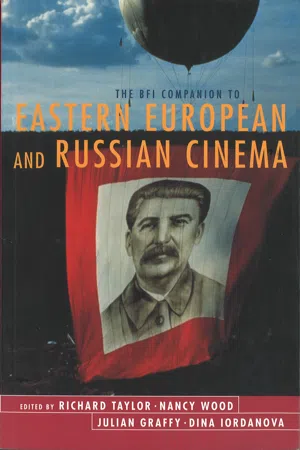
The BFI Companion to Eastern European and Russian Cinema
- 296 pages
- English
- ePUB (mobile friendly)
- Available on iOS & Android
eBook - ePub
The BFI Companion to Eastern European and Russian Cinema
About this book
This work maps the rich, varied cinema of Eastern Europe, Russia and the former USSR. Over 200 entries cover a variety of topics spanning a century of endeavour and turbulent history from Czech animation to Soviet montage, from the silent cinemas dating back to World War I through to the varied responses to the conflicts in the former Yugoslavia. It includes entries on actors and actresses, film festivals, studios, genres, directors, film movements, critics, producers and technicians, taking the coverage up to the late 1990s. In addition to the historical material of key figures like Eisenstein and Wadja, the editors provide separate accounts of the trajectory of the cinemas of Eastern Europe and of Russia in the wake of the collapse of communism.
Information
A
| Abdrashitov, Vadim Yu. | Kharkov, Ukraine [USSR] 1945 |
Russian director. In 1974 Abdrashitov graduated from VGIK*, where he had studied in the workshop of Mikhail Romm* and Lev Kulidzhanov*. In constant collaboration with the scriptwriter Alexander Mindadze, he made a series of films analysing the official institutions and the moral ambiguities of the late Soviet era. In Slovo dlya zashchity/Submission for the Defence (1977), Povorot/The Turning Point (1978), Okhota na lis/Fox Hunting (1980), and Ostanovilsya poezd/A Train Stopped (1982) personal crisis forces the hitherto conformist protagonist into moral reassessment. In the allegorical Parad planet/Parade of the Planets (1984) a group of army reservists enters a mysterious ‘other’ world. Plyumbum, ili opasnaya igra/Plumbum, or A Dangerous Game (1986) is another parable of the dangers of blind conformism, this time in a teenage boy. In Sluga/The Servant (1988), a conductor picks up a hitchhiker and, as their roles are reversed, layers of Soviet corruption are revealed. After two less successful films, Armavir (1991), in which the sinking of a Soviet liner forces the passengers to reassess their lives, and P’esa dlia passazhira/Piece for Passenger (1994), Abdrashitov and Mindadze returned triumphantly to form with Vremya tantsora/Time of the Dancer (1997), their contribution to a recent cycle of films meditating on the Chechen and other Caucasian wars. Three friends settle on land won in a war in which two of them fought but despite the idyllic southern setting, a mounting sense of omen assails them and their families, and the film ends in anguish and tragedy, offering a bleak diagnosis of the possibilities available in contemporary Russia. The film was nominated for five Nikes, the Russian Oscars, winning two, and won the Grand Prix at the leading Russian film festival, the Sochi Kinotavr, in 1998. JG
| Abuladze, Tengiz E. | Kutaisi, Georgia [USSR] 1924 – Tbilisi, Georgia 1994 |
Georgian director. Abuladze studied at the Rustaveli Theatrical Institute in Tbilisi (1943–6) and then at VGIK*, in the workshop of Sergei Yutkevich*. In 1947, under the influence of Ivan Groznyi/Ivan the Terrible, he and a fellow student, Revaz Chkheidze, wrote to Eisenstein* asking for work: he told them to complete their studies first. Abuladze graduated in 1953 and returned to Tbilisi, where he joined the Gruziafilm studios. His first films were documentaries, co-directed in 1954 with Chkheidze. In 1955 they co-directed Lurdzha Magdany/Magdana’s Donkey, which won the Best Short Film award at Cannes in 1956. Abuladze’s later films include Chuzhie deti/Other People’s Children (1958), set in contemporary Tbilisi; Ya, babushka, Iliko i Illarion/I, Grandmother, Iliko and Illarion (1963), a tragi-comedy set in a mountain village; and Ozherel’e dlya moyei lyubimoi/A Necklace for my Beloved (1973). But his reputation rests on a trilogy of philosophical films concerned with questions of good and evil, life and death. Vedreba/The Prayer (Russian title Mol’ba) (1968), based on the poems of Vazha Pshavela, is an epic tale of love, hatred and revenge, shot in black-and-white in the harsh Georgian landscape. Natris Khe/The Wishing Tree ((Russian title Drevo zhelaniya) (1977) is set in a Georgian village before the Revolution and concerns the dreams and aspirations of a beautiful young girl and a man’s search for the legendary tree that can make dreams come true. The third film of the trilogy, Monanieba/Repentance (Russian title Pokayanie) (1984) is one of the most important films of the perestroika period. It tells the story of the death of an old man of power, Varlam Aravidze, and the refusal of a woman, Ketevan Barateli, to let his corpse rest in peace. At the woman’s trial the evil past is revealed and confusion is sown among Aravidze’s surviving family, especially his son Abel (played by the same actor Avtandil Makharadze) and his grandson. Varlam Aravidze is given the physical features of Hitler, Mussolini, Beria and Stalin to turn him into a composite dictator, and Abuladze uses anachronism (blending medieval knights and Rubik cubes) to point to the universality of his parable, but the film is also decked with the realities of the Soviet 1930s. Repentance was written for Georgian television in 1981–2, and shot in late 1983 and early 1984. It was finally released in Tbilisi in October 1986, after support from Eduard Shevardnadze, then the Soviet Foreign Minister, later President of Georgia. It was also the first film to benefit from the intervention of the Conflict Commission established by the Union of Filmmakers* after their Fifth Congress in May 1986. It was released in Moscow in January 1987, and then shown widely throughout the Soviet Union and the rest of the world. Repentance is over-long and its stylistic confusion links it to the contradictory moods of the mid-1980s but it is a brilliantly acted and sometimes deeply moving evocation of the seductions of power. JG
AGIT-FILMS
Soviet short films, also known as ‘agitki’. Produced during the Civil War of 1917–21, these films were simple in form and straightforward in content and dealt with topical matters of politics, production, health and hygiene. They were primarily intended for exhibition through the network of agit-trains touring the frontlines and areas recently recaptured from the White forces.
Agit-films were a temporary solution to an emergency problem: they were a short cut to resolving communication difficulties between rulers and ruled and provided valuable experience in film-making – especially in montage* as a method of using scant resources economically – for a new generation of directors such as Lev Kuleshov* and Dziga Vertov*, who worked together on the ‘October Revolution’ agit-train. RT
ALBANIA
Until World War II, isolated and largely illiterate Albania possessed about twenty cinemas in the main towns, showing exclusively imported material. The only cinematic evidence of prewar Albania is in a few foreign newsreels and travelogues. The communist regime of Enver Hoxha (1944–85) nationalised the cinema in 1947, and immediately began using it for propaganda by making two newsreels with Soviet assistance. Moscow was largely responsible for the building of the Shqiperia e re/New Albania film studio in Tirana, and was virtually the only source of equipment and technical skills. Its construction, begun in 1952, allowed a steady production of newsreels, and documentaries such as Rruga e lavdishme/The Glorious Road (1952). Soviet director Sergei Yutkevich’s* Skanderbeg (1954), about Albania’s medieval national hero, was partly put together in the Albanian studio, and presented for political reasons as a Soviet-Albanian co-production. It helped confirm film as a mass medium, and by the mid-1950s there was an annual audience of five million for the hundred or so cinemas (from a population of c. three million), including mobile units for rural areas.
Until 1958, features were almost entirely from the Soviet Union and Eastern Europe. The first Albanian feature, Tana (1958), directed by Kristaq Dhamo and starring Tinka Kurti, relied on the modest documentary tradition in its handling of the collectivisation of the countryside. Hysen Hakani’s Debatik/Communist Youth (1961), on the resistance of children during the Italian occupation of 1938–43, set a pattern for storylines based on this period and subject. The break with Moscow in 1960, and growing political and cultural isolationism, made it necessary to increase domestic production. This was hampered by the loss of most foreign assistance, though there were enough Moscow-trained technicians and directors to begin to develop an autonomous film industry and provide some training at the Tirana Higher Institute of Arts. Only one film a year was made until the late 1960s, but then production rose steadily to about twelve features annually in the early 1980s.
Hoxha’s insistence on sticking to a Stalinist line of ideological struggle, and his refusal to follow Soviet revisionism, turned Albania into a bastion of Socialist Realist* film production. Every film was obliged to perform some political task, though in the special context of Albanian history. With slow television development, film had a key role, along with schools and various state institutions, in promulgating not merely the propaganda of class struggle but a ‘socialist morality’. In particular this meant the central role of the ‘positive hero’ – the ‘new man’ educated by the Party. This pattern is firmly established in Dhimitër Anagnosti and Viktor Gjika’s Komisari i drites/Commissar of the Light (1966), in which a man returns to his home village after the liberation in 1944 to fight against the local priest and landowner, and a counterrevolutionary brigade, but whose greatest achievement is to set up the first school in the village and to inspire pupils. Anagnosti’s other main films include Cuca e maleve/The Mountain Girl (1974), a ballet showing the strong influence of Chinese ‘heroic’ opera; Lulëkuqet mbi mure/Red Poppies on Walls (1976), starring Kadri Rashi and dynamically describing a children’s rebellion against a fascist schoolmaster; the satirical comedy Perralle nga e kaluara/A Tale from the Past (1988); and Kthimi i ushtisë së vdekur/Return of the Dead Army (1989).
Ibrahim Mucaj and Kristaq Mitro portray collective heroism in Dimeri i fundit/The Last Winter (1976), where a group of village women put up resistance to occupation during World War II. Viktor Gjika achieves a subtler political approach with strong performances in Rrugë të bardha/White Roads (1974), where the ‘new man’ is a sympathetic contemporary figure struggling for love and against snowdrifts. Gjika’s sensitivity for images, music and dramatic development can also be seen in Gjeneral gramafoni/The General Gramophone (1977), which shows the struggle to preserve Albanian folk music during the Italian occupation. Yje mbi Drin/Stars above the Drin (1977, dir. I. Zhabjaku) shows the final phase of almost complete ideological isolationism, the enemies now the Chinese ‘revisionists’ conspiring to destroy a hydro-electric plant. Kujtim Çashku and Piro Milkani’s Ballë për b allé/Face to Face (1979), starring Sulejman Pitarka, has a conspiracy theme set around the departure of the Russians in 1960. With a significant annual production, a wider range of subjects could now be covered. In the record year of 1984, seven of the fourteen features dealt with contemporary subjects, while most of the rest were set in or around World War II. Productions included comedies, children’s films and films based on ancient history and folklore. But as an Albanian delegate said at a Balkan film festival, whatever the subject matter every effort had to be made to omit ‘sentimentality, physiological and moral anomalies, pornography, sadism, psychological and Freudian dimensions, naturalism and individualism’.
Cinema screens increased to 450 in 1975, and attendances reportedly reached twenty million, with a carefully chosen selection of heavily censored and selectively subtitled French, Italian and other European films. In 1978 a modernisation of the film studio began, but lack of access to the latest technology made it a limited project. The first colour feature, made with East German assistance, appeared in 1974. By the 1980s, most films were in colour and processing quality improved, though remaining relatively poor. Production of short documentaries increased to about thirty annually by the mid-1980s, mostly devoted to propaganda, scientific and educational subjects, and the activities of Hoxha. Occasional full-length documentaries, like Kujtime te vegjëlisë/Memories of Childhood (1985), were usually homages to Hoxha. Leading woman director Xhanfize Keko made a series of features about and for children, notably Beni ecen vete/Beni’s First Steps (1978). Cartoon and puppet films were first made in the 1970s, and production reached about twelve films annually in the 1980s; worthy of note are Zogu pushbardhe/The Fluffy White Chick (1984–5), a popular children’s series, and Plumb ballit/Bullet in the Head (1985), a grotesque satire on traitors. Television began in 1969, producing the only films shown at the biennial national film festival in Tirana. Most notable is Vladimir Prifti’s Udha e shkronjave/The Path of Letters (1982), starring Sander Proci. Attempts to export Albanian films have been very limited, though a few foreign festival prizes were won by children’s and documentary films. The national film archive contains 5,000 titles. The literary monthly Nentori and the weekly Drita publish film reviews and other film news.
The collapse of Hoxha’s successor Ramiz Alia’s regime (1990–2), and economic paralysis, reduced feature production to five films in 1990, and almost nothing since. Saimir Kumbaro’s Vdekja e kalit/Death of the Horse (1992) is the major exception, an intense evocation of the fate of the individual under totalitarianism. The younger generation of talented film actors, as well as many others in the industry, are scattered outside Albania. Cinemas currently remain open, despite their difficulties in obtaining international releases (which are nonetheless often shown in pirated form on Albanian television), offering a mix of genres never before seen in Albania, including Greek soft-porn comedies and Japanese action films. The Minister of Culture in the post-1992 government is director Dhimitër Anagnosti, reflecting the important role of film personnel during...
Table of contents
- Cover
- Title Page
- Contents
- Acknowledgments
- Contributors
- General Introduction
- Introduction to Eastern European Cinema
- Introduction to Russian Cinema
- Entries
- Bibliography
- eCopyright
Trusted by 375,005 students
Access to over 1.5 million titles for a fair monthly price.
Study more efficiently using our study tools.
Frequently asked questions
Yes, you can cancel anytime from the Subscription tab in your account settings on the Perlego website. Your subscription will stay active until the end of your current billing period. Learn how to cancel your subscription
No, books cannot be downloaded as external files, such as PDFs, for use outside of Perlego. However, you can download books within the Perlego app for offline reading on mobile or tablet. Learn how to download books offline
Perlego offers two plans: Essential and Complete
- Essential is ideal for learners and professionals who enjoy exploring a wide range of subjects. Access the Essential Library with 800,000+ trusted titles and best-sellers across business, personal growth, and the humanities. Includes unlimited reading time and Standard Read Aloud voice.
- Complete: Perfect for advanced learners and researchers needing full, unrestricted access. Unlock 1.5M+ books across hundreds of subjects, including academic and specialized titles. The Complete Plan also includes advanced features like Premium Read Aloud and Research Assistant.
We are an online textbook subscription service, where you can get access to an entire online library for less than the price of a single book per month. With over 1.5 million books across 990+ topics, we’ve got you covered! Learn about our mission
Look out for the read-aloud symbol on your next book to see if you can listen to it. The read-aloud tool reads text aloud for you, highlighting the text as it is being read. You can pause it, speed it up and slow it down. Learn more about Read Aloud
Yes! You can use the Perlego app on both iOS and Android devices to read anytime, anywhere — even offline. Perfect for commutes or when you’re on the go.
Please note we cannot support devices running on iOS 13 and Android 7 or earlier. Learn more about using the app
Please note we cannot support devices running on iOS 13 and Android 7 or earlier. Learn more about using the app
Yes, you can access The BFI Companion to Eastern European and Russian Cinema by Richard Taylor, Nancy Wood, Julian Graffy, Dina Iordanova, Richard Taylor,Nancy Wood,Julian Graffy,Dina Iordanova in PDF and/or ePUB format, as well as other popular books in Media & Performing Arts & Film History & Criticism. We have over 1.5 million books available in our catalogue for you to explore.