- 78 pages
- English
- ePUB (mobile friendly)
- Available on iOS & Android
eBook - ePub
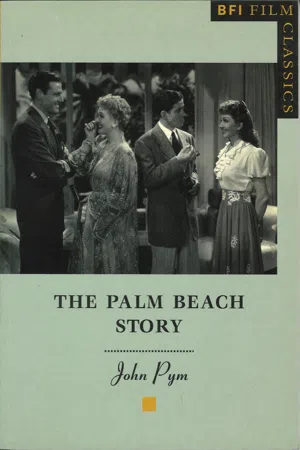
The Palm Beach Story
About this book
Working for Paramount in the 1940s playwright and scriptwriter Preston Sturges directed a succession of exceptional comedies of which the 'Palm Beach Story' is perhaps the finest. Pym's account recreates the subtlety and a dazzling energy of this near perfect film. In the BFI FILM CLASSICS series.
Trusted by 375,005 students
Access to over 1.5 million titles for a fair monthly price.
Study more efficiently using our study tools.
Information
1

TANGOVILLE-SUR-MER
In August 1914 the French Army advanced towards the heart of Germany and the Germans wheeled through Belgium confident that Paris would soon be theirs; meanwhile, in faraway California, the Keystone Film Company released a fusillade of five new Chaplin shorts, including The Property Man, one of the earliest movies (if not the earliest movie) Chaplin directed himself. As the combatants on the Western Front prepared to lock horns, sixty miles west of the Franco–Belgian border, in Deauville, a tall fifteen-year-old American schoolboy named Preston Sturges was happily occupying himself as the summer manager (and sole employee) of the new seaside branch of Maison Desti, his mother's Paris-based cosmetics business.
Born of Irish ancestry in Quebec in 1871, Preston's mother Mary Dempsey had grown up in Chicago without material advantages. By 1914, however, having dispensed with three husbands, she'd migrated to Europe as the factotum of the restless American dancer Isadora Duncan. Mary Desti, as she now styled herself, was a mercurial woman with artistic aspirations whose adult life was punctuated by a number of impulsive actions, some of which, like the cosmetics enterprise, flared and burned brightly (for a while at least), thanks to the force of her personality – and the generosity of her second husband, the Chicago stockbroker Solomon Sturges, who despite their divorce bestowed money and kindness on Mary for the rest of her life.
Ilias Pasha, the father of Mary's third husband Vely Bey, had been physician to the Turkish tyrant Abdul Hamid (Abdul the Damned), and it was through him that Maison Desti came into being. After the sultan's deposition in 1909, Ilias moved to Paris to be near his son and his son's wife (and his step-grandson Preston, Solomon Sturges' adoptive son, although in fact the child of Mary's first marriage to a wastrel named Edmund Biden – who much later tried to wheedle repayment from Preston for sums he, Biden, had advanced for treatment of one of his son's childhood illnesses ... ), and it was there in Paris that Mary one day asked her father-in-law for advice on a facial rash. Ilias Pasha produced a cream that, he claimed, was in common use throughout the harems of Turkey. It also smoothed away wrinkles. This cream, it turned out, was no snake oil, and Mary decided forthwith that she must find a way to market the 'Secret of the Harem' – subsequently renamed Youth Lotion.
She acquired premises on rue de la Paix, as well as the back-up for a cosmetics production line, and her initial idea was to call the business Maison D'Este. (She believed herself to be a descendant of the Este family, via Mary of Modena, the devout, quick-witted and proud wife of James II of England.) The Paris branch of the high-falutin' Estes took a different view, however, and threatened a lawsuit. Maison 'Desti' got round the difficulty: and thus Mary's personality was – leaving aside her attachments to Biden, Sturges and Vely Bey – at least doubly remade.
Glass bottles from Venice held her new scents, the Paris box manufacturer Tolmer designed containers for Desti products, and Baccarat and Lalique sold her crystal bottles and alabaster jars [Donald Spoto records]. Rouges and face powders completed her line of products, and soon the Maison Desti was doing brisk business – so brisk in fact, that in October [1912] Mary hustled Preston off to New York for a selling trip, where B. Altman and Company bought ten thousand dollars' worth of her products. Soon after, a manufacturer offered Mary a deal to distribute her cosmetics with his perfumes. She distrusted him, however, and rejected his offer – to her perpetual regret, for the man's name was Coty.1
In 1914 Mary struck a deal with the owner of the fashionable Paris restaurant Ciro's, who'd rented a house for the season in the new resort of Deauville in Normandy. Maison Desti was to occupy the ground floor of Ciro's building, the restaurant would operate on the first floor, and Preston, the manager of the cosmetics shop, who was then at school in Switzerland, would sleep above the restaurant, where he was to take all his meals. The little town of Deauville was then, Sturges recalled, 'the most fashionable playground in the world'.
Billionaires were ten cents a dozen. The beach and the casino and racetrack spilled over with dukes, barons, deposed kings, maharajahs, politicians, statesmen, newspaper owners, several Rothschilds, opera stars, generals, admirals, celebrated actors, notorious actresses, vaudeville performers, gigolos [the list continues with another eighteen types] and, kept or loose, the prettiest women in the world.2
It's too much to claim that what Sturges absorbed in those few months at Deauville in 1914 deeply affected his relatively brief, but hugely successful and handsomely rewarded career as a fully-fledged Hollywood writer–director, but there is, I think, something congruent and moving about Preston's experiences in the summer of 1914, a few miles from what were soon to become the battlefields of Flanders, and what he would be doing twenty-seven years later, at the very height of his creative powers, on the eve of the Japanese attack on Pearl Harbor and America's entry into the Second World War. In both the summer of 1914 and the winter of 1941–2, in the weeks when he was hammering out The Palm Beach Story as an employee of Paramount Pictures, Sturges lived a curiously cocooned existence: surrounded by gaiety and excess on the eve of the First World War, and recreating with adornments the idea of another millionaires' playground on the eve of the Second.
In 1914 Chaplin's 'property man' was performing his business in a vaudeville theatre 'peopled with grotesque and unreasonably temperamental artists':3 Sturges, meanwhile, was acting as props man (as well as stage manager and leading actor) in another dramatic endeavour, the showcase theatre of Maison Desti.
All of the beau monde – and the less beau, too – got up late in Deauville. Everybody got up late in Deauville, except me. I rose at 5:30, put on an old pair of pants and a sweater, picked up a quick cup of coffee and a croissant from Ciro's early morning cook, who was starting to build his soups, and snuck down to the shop. I dusted it, swept it out thoroughly, polished the brass, washed the windows, then hustled back upstairs and got back in bed.
At 10:30, I came down again, this time officially. Wondrously decked out in white flannel trousers, brown-and-white shoes, a tan gabardine jacket with a belt in the back, and a carnation in my buttonhole, I dropped into the shop. Assuring myself, by running a suspicious finger along the shelves, that the night porter had done his work efficiently, I retired to Ciro's to enjoy an exotic breakfast.4
A composite photograph of Preston Sturges taken later that year in New York ('five views for a quarter') shows an assured young man in a double-breasted dinner jacket, his left hand tucked into his jacket pocket and his right hand lying on the round table at which he's seated.5 A smile is starting to form at the corner of his mouth, his thick dark hair is brushed up from his forehead, his features are angular and slightly over-pronounced, and his carriage is naturally erect. What one doesn't gain from this immensely attractive informal study is the authority of Preston Sturges' height, but what is conveyed, unmistakably, is the sitter's debonair style and dash.
In Deauville that summer Preston had passed for nineteen, and even formed a liaison with an attractive older girl on the strength of this minor deception, until Mary, who'd come on a weekend visit, spoiled the party by commenting to the girl, 'Isn't he big for fifteen?' The theme of The Palm Beach Story – if a featherweight romantic comedy can really be said to have anything so deep-dish as a theme – is summed up by the heroine, Claudette Colbert, in a retort to her husband: 'You have no idea what a long-leggèd gal can do without doing anything.' Preston wasn't exactly that long-leggèd gal, but he had as a youth that punchy self-confidence which can, in its own way, it seems, achieve practically anything.
As an adolescent [Sturges recalled], I only knew a few of [Deauville's] celebrities to speak to, but I knew most of them by sight, which was useful when they came into the Desti establishment. I did know Mother's friend, Jules Bache, the banker, and Maurice and Florence Walton, the great ballroom dancers, and Elsie Janis, and Bayo, the world's greatest tango dancer, and Irene Bordoni, and Tod Sloan, and Kid McCoy, and Frank Moran ...
The darling of all these people and the uncrowned King of Deauville was the son of an Auvergnat grocer, a tiny little man who looked like a jockey. His real name was Goursat, but under the signature of Sem he had become the world's most extraordinary caricaturist. To be ridiculed by Sem was a great honor. His albums of drawings, beginning with Tangoville-surMer, which celebrated the heyday of Deauville, are collectors' items and perfectly remarkable. Everybody who was anybody is there, instantly recognizable and hilariously drawn. It is difficult to prove how truly phenomenal he was because caricature is an evanescent pursuit, the one form of portraiture which demands of the viewer complete familiarity with the features of the victims. With the passage of time, their faces are nearly always forgotten. Sem was by far the greatest talent in this anteroom of the arts I have ever seen during my lifetime.6
Sturges himself was to become something more than a caricaturist – something more than a Chaplin or a Sem – but underlying many of his characters, all the characters indeed of The Palm Beach Story, with the exception of the two principals, are the exact lines of fluid caricature. Preston's buried caricatures have not, however, suffered the fate of the once-living subjects of Sem's sketches, or the somehow unknowable figures, swathed in pathos, of Chaplin's gallery. His great rush of comic characters have not dwindled over the years; on the contrary they have if anything become more desperately and more recognisably alive.
2
THE PALM BEACH STORY
Two years before Preston spent his happy summer in Deauville, Adolph Zukor, a Hungarian émigré to the United States, who'd prospered in the New York and Chicago fur trade (he invented a new type of neck clasp), and then in the penny arcades of Philadelphia and Boston, founded the Engadine corporation to introduce imported films to American audiences. His first picture was Queen Elizabeth (Les Amours de la Reine Elisabeth, 1912, directed by Louis Mercanton), with the legendary but by then 60-year-old Sarah Bernhardt. On the back of this success, Zukor developed a film production company featuring 'Famous Players in Famous Plays'. Thirty years later, after the customary mergers, acquisitions and vicissitudes of Hollywood, Famous Players had become Paramount Pictures, one of the industry's 'big seven' individually distinctive studios.
Paramount established its reputation in the 1920s, having on its books such stars as John Barrymore and Rudolph Valentino; Pola Negri, Clara Bow and Douglas Fairbanks. Cecil B. DeMille's parti-coloured version of The Ten Commandments (1923) was the greatest of Paramount's silent money-makers. The transition to sound caused a dip in the studio's upward progress, but by the mid-30s, when a shadow began to fall across civilised life in Europe, an influx of outstanding talent from Germany and Austria (notably Josef von Sternberg, Ernst Lubitsch and Billy Wilder) helped to consolidate Paramount's style and fortunes. The catchphrase 'Paris Paramount' – and all that implied in terms of lightness of touch and continental sophistication – suggested that the mythical studio re-creation was somehow more authentic, beautiful and perhaps, to American eyes, more appealing than Paris, France. Gary Cooper and Ray Milland as well as the more down-to-earth and bigger-than-life stars Mae West and W. C. Fields set Paramount's tone, together with those beautiful no-nonsense women Jean Arthur and Claudette Colbert.
The Palm Beach Story (first titled 'Is Marriage Necessary?' and later 'Is That Bad?') was written by Preston Sturges in two consecutive drafts between the beginning of September and the end of November 1941. From 1937 to '42, Sturges – who had found his way to California via success as a Broadway playwright – employed as secretary a well-educated young man named Edwin Gillette, and it was Preston's habit to call Gillette, often late at night, to take down the dialogue of his scripts as he paced about, playing all the parts. The second version of the screenplay, which corresponds to the completed film in most particulars, is dated 21 November – three days before shooting began on Stage Seven at Paramount studios. The budget was nearly a million dollars: the two stars with their names above the title, Claudette Colbert and Joel McCrea, receiving $150,000 and $60,000 respectively.
The film turned out to be the fifth in the run of eight movies which Preston wrote and directed for Paramount between 1940 and 1946. The Great McGinty, Christmas in July (both 1940), The Lady Eve (1941) and Sullivan's Travels (1942) preceded it; and The Miracle of Morgan's Creek, Hail the Conquering Hero (both 1944) and The Great Moment (1946) followed. Sullivan's Travels, the serio-comic story of a Hollywood director (Joel McCrea) who is fed up with making comedies and determined to find out what poverty is really like, opened in London on 2 January 1942, while The Palm Beach Story was still in production. Twelve days later Sturges threw an immense party for the opening of a new floor at his loss-making restaurant, The Players, on Sunset Boulevard.
No producer is listed for The Palm Beach Story (as was customary at Paramount during this period), although Paul Jones is credited as associate producer, the role he'd fulfilled on Preston's four previous pictures. The art director Hans Dreier and his colleague Ernst Fegté, both highly experienced German-born designers, were slated to work on t...
Table of contents
- Cover Page
- Title Page
- Contents
- Acknowledgments
- 1 Tangoville-sur-Mer
- 2 The Palm Beach Story
- 3 Rich Millionaires
- 4 Invisibility
- 5 The Shadow of War
- 6 Trains, Gadgets and Planes
- 7 Married Love
- 8 Tom and Gerry
- 9 Vietnam
- Notes
- Credits
- Bibliography
- eCopyright
Frequently asked questions
Yes, you can cancel anytime from the Subscription tab in your account settings on the Perlego website. Your subscription will stay active until the end of your current billing period. Learn how to cancel your subscription
No, books cannot be downloaded as external files, such as PDFs, for use outside of Perlego. However, you can download books within the Perlego app for offline reading on mobile or tablet. Learn how to download books offline
Perlego offers two plans: Essential and Complete
- Essential is ideal for learners and professionals who enjoy exploring a wide range of subjects. Access the Essential Library with 800,000+ trusted titles and best-sellers across business, personal growth, and the humanities. Includes unlimited reading time and Standard Read Aloud voice.
- Complete: Perfect for advanced learners and researchers needing full, unrestricted access. Unlock 1.5M+ books across hundreds of subjects, including academic and specialized titles. The Complete Plan also includes advanced features like Premium Read Aloud and Research Assistant.
We are an online textbook subscription service, where you can get access to an entire online library for less than the price of a single book per month. With over 1.5 million books across 990+ topics, we’ve got you covered! Learn about our mission
Look out for the read-aloud symbol on your next book to see if you can listen to it. The read-aloud tool reads text aloud for you, highlighting the text as it is being read. You can pause it, speed it up and slow it down. Learn more about Read Aloud
Yes! You can use the Perlego app on both iOS and Android devices to read anytime, anywhere — even offline. Perfect for commutes or when you’re on the go.
Please note we cannot support devices running on iOS 13 and Android 7 or earlier. Learn more about using the app
Please note we cannot support devices running on iOS 13 and Android 7 or earlier. Learn more about using the app
Yes, you can access The Palm Beach Story by John Pym in PDF and/or ePUB format, as well as other popular books in Media & Performing Arts & Film History & Criticism. We have over 1.5 million books available in our catalogue for you to explore.