Jack Clayton's gothic masterpiece The Innocents, though not a commercial success on its release in 1961, has been hailed as one of the greatest psychological thrillers of all time. Dividing reviewers with its ambiguous depiction of ghosts, the film ignited a debate about the aesthetics of horror which still rages today.
In this stimulating introduction to The Innocents, Sir Christopher Frayling traces the film from its genesis in the original novel The Turn of The Screw by Henry James, via contemporary critical contexts and William Archibald's 1950 stage adaptation of the same name, to the screenplay by William Archibald, Truman Capote and John Mortimer. Drawing on unpublished material from Jack Clayton's archive – including Capote's handwritten drafts for the film – and interviews with Deborah Kerr, Freddie Francis, and John Mortimer, Frayling explores how this classic ghost story came to life on screen.
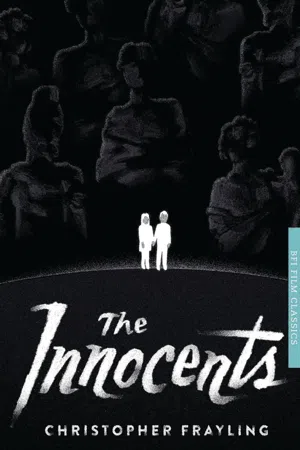
This special edition features original cover artwork by Matthew Young.
- 115 pages
- English
- ePUB (mobile friendly)
- Available on iOS & Android
eBook - ePub
The Innocents
About this book
Information
1 A Canterbury Tale
On the late afternoon of Thursday, 10 January 1895, sitting by the fire in the drawing room of the ‘grand old’ country residence of the Archbishop of Canterbury Edward White Benson at Addington Place, near Croydon, South London, the novelist Henry James was told a ghost story.4 He was feeling depressed about the fate of his play Guy Domville, which had had a humiliating first night at the St James Theatre. The two men, author and archbishop, had been lamenting the fact that ‘the good, the really effective and heart-shaking ghost stories appeared all to have been told’. True, there was the ‘new type’ of story, the ‘“psychical” case’ as Henry James put it, ‘washed clean of all queerness as by exposure to a flowing laboratory tap’, but this showed little promise as literature. The more the story was given respectability by psychical researchers, ‘the less it seemed of a nature to raise the dear old sacred terror’. At this point in the conversation, the Archishop recalled – ‘in the spirit of recreation’ – a story which had made a deep impression on him as a young man, many years before, when he’d heard it from a lady to whom ‘it had been reported’. The story was garbled and disjointed, the shadow of a shadow – ‘my friend’s old converser had lost the thread’ – the Archbishop had forgotten some of the details, and it was told at third hand, but to Henry James that made it all the more appealing. As listener, he could fill in the many gaps with his ‘unbridled imagination’, and reflect on whose voice to trust. Two days later, he wrote in his private notebook:
Note here the ghost story told me at Addington … the mere vague, undetailed, faint sketch of it – being all he had been told (very badly and imperfectly) by a lady who had no art of relation, and no clearness: the story of the young children (indefinite number and age) left to the care of servants in an old country-house, through the death, presumably, of parents. The servants, wicked and depraved, corrupt and deprave the children; the children are bad, full of evil, to a sinister degree. The servants die (the story vague about the way of it) and their apparitions, figures, return to haunt the house and children, to whom they seem to beckon, whom they invite and solicit, from across dangerous places, the deep ditch of a sunk fence, etc. – so that the children may destroy themselves, lose themselves, by responding, by getting into their power. So long as the children are kept from them, they are not lost; but they try and try and try, these evil presences, to get hold of them. It is a question of the children ‘coming over to where they are’. It is all obscure and imperfect, the picture, the story, but there is a suggestion of strangely gruesome effect in it. The story is to be told – tolerably obviously – by an outside spectator, observer.

Archbishop Benson giving Henry James the original idea for ‘The Turn of the Screw’, from a drawing by Max Beerbohm (© National Trust/Charles Thomas)
Ever since Henry James’s Notebooks were first published in 1947, commentators have been searching for the origin of this mysterious story, or half a story. Some have suggested that it was just as likely that James was inspired to write his own ghost story by articles in Proceedings of the Society for Psychical Research – with which his brother William was closely associated at the time. Others that the Canterbury tale must be lost in the mists of time. Others still that the tale was a cover for the author’s own inventiveness – and that he was slightly ashamed of creating his own ghost story from scratch, especially one about the corruption of children. The novelist E. F. Benson, the Archbishop’s son, could not remember his father ever telling it – which may have been because he was thought to be too young and impressionable. But in 2010, in his study A Natural History of Ghosts, Roger Clarke made the plausible suggestion that it originated with the haunting of a remote Tudor manor-house at Hinton Ampner in Hampshire, in the early 1770s.5 This haunting took the form – among other manifestations – of knocking at the doors, the recurring sound of a woman’s silk dress in the corridor and lobby outside the nursery, heavy footsteps, the sighting of a man in a ‘drab coloured suit’ prowling outside and at the window – a man who resembled the late Lord’s dishonest steward (or butler) – a loud murmuring, and someone, presumed to be a woman, trying to push open the nursery door. The tenant of the house, Mrs Mary Ricketts – whose husband was often away on business in Jamaica, leaving her in charge of a complicated household – put up with all this for six years of interrupted sleep, then moved the family out. The manor-house was demolished in 1793. Everyone there claimed to have heard the sounds, and some to have glimpsed the two apparitions – though not everyone had seen or heard the same things – except Mary Ricketts’s three children, all under ten, two boys and a girl. They said they had seen and heard nothing, and had no idea what their mother was experiencing. She saw it as her prime duty to protect them – from whatever or whoever was haunting the entrance of the nursery. Eventually, Mrs Ricketts carefully wrote down as many of the details as she could remember, for the private benefit of her children and grandchildren. She also confided in various friends, senior figures in the Anglican Church with whom she was close at the time. An edited version of the Hinton Ampner documents found its way into the Proceedings of the Society for Psychical Research of April 1893: the commentary concluded that the apparition at the window did indeed seem to be that of a dead, dishonest servant. So by January 1895, the story had become a ‘psychical case’ as well as being a strangely gruesome yarn, and there were various routes by which it could have reached Archbishop Benson in garbled form.
Henry James revisited the Canterbury tale some two and a half years after he first heard it. As he later recalled, he had been ‘asked for something seasonable by the promoters of a periodical dealing in the time-honoured Christmas-tide toy [and] bethought myself at once of the vividest little note for sinister romance that I had ever jotted down’.6 The periodical in question, Collier’s, had a new editor, and was keen to reverse falling sales by commissioning well-known writers. The ‘sinister romance’ was still on Henry James’s mind, ready to be ‘wrought … into fantastic fiction’. What had particularly fascinated him about it, to judge by his Notebook, was why the apparitions of the wicked and depraved servants wanted to ‘get hold of’ the children ‘from across dangerous places’. What might really have been going on? The Turn of the Screw was first published as a twelve-part serial in the American Collier’s Weekly (27 January–16 April 1898), then in slightly revised book form in The Two Magics (October 1898), along with another novella called Covering End. As Henry James was to recall:
it is a piece of ingenuity pure and simple, of cold artistic calculation, an amusette [piece of child’s play] to catch those not easily caught (the ‘fun’ of the capture of the merely witless being ever so small), the jaded, the disillusioned, the fastidious.
Literary critics, who are indeed on the whole ‘not easily caught’, have been arguing about the meaning and purpose of The Turn of the Screw, and its place in Henry James’s oeuvre, ever since it first appeared. Precision was never his purpose. It, too, opens on a storytelling session on a Thursday night, round a fire in an old house in winter – this time on Christmas Eve.7 Someone has related to the assembled company a story about a ghost that appears to a little boy. ‘If the child gives the effect another turn of the screw,’ asks a man called Douglas (we don’t know if it is his first or surname), ‘what do you say to two children?’/‘We say of course that two children give two turns. Also that we want to hear about them.’ Douglas reads the story from a manuscript bound in faded red (he will not trust his memory), written by his sister’s governess, a woman ‘awfully clever and nice’ – the youngest of several daughters of a country parson from a ‘poor scant house’ in Hampshire – who has been dead for twenty years. The manuscript recalls events that she claimed happened to her long before, when she was twenty. Douglas was clearly attracted to her, even though she was ten years his senior. The Turn of the Screw is written from a transcript of the manuscript made by the narrator (of uncertain gender) much later. This elaborate explanation takes up the whole of the first instalment, a third-hand narrative based on memories from around forty years earlier: ‘The shadow of a shadow’ – a phrase that reappears in the story.
So the standard ‘discovered manuscript’ prologue to a Christmas ghost story becomes, in Henry James’s version, an essay on the nature of authorship, on the point of view of the writer and the narrator, and indeed of the story itself. Does the story tell us as much about the narrator as about anything else? The prologue also makes clear that after the events described in the manuscript, the nameless governess became ‘the most agreeable woman I’ve ever known in her position; she’d have been worthy of any whatever’. And yet, at the time, she had convinced herself that the two children at Bly in Essex – Flora aged eight, and Miles aged ‘scarce ten’ – were being possessed by the evil spirits of the dead valet and the previous governess. Curiouser and curiouser.
2 Ghosts and Critics
The publication of The Turn of the Screw led to strong reactions. Early reviews treated it as a straightforward Christmas ghost story, with a repulsive though not gross theme, redeemed by Henry James’s polite and graceful prose style: ‘that art of suggestion’, said The New York Times, ‘which Mr James has employed before so fantastically that it has been more irritating than a flood of words could be, here plays its part with consummate effect’.8 Instead of observing the drama at arm’s length, said others, the reader became subtly enmeshed in it. This story was in a different league to those vulgar ghost stories ‘with sudden shocks, with clanking chains and veiled ladies in white, and clammy atmospheres’. It was a ‘spiritual adventure’, ‘profoundly ethical’ about ‘the problem of evil’ and ‘spiritual defilement’, illustrating ‘a profound moral law’. Henry James had succeeded against the odds in making it even seem sadly beautiful:
He creates the atmosphere of the tale with those slow, deliberate phrases which seem fitted only to differentiate the odours of rare flames. Seldom does he make a direct assertion, but qualifies and negatives and double negatives, and then throws in a handful of adverbs, until the image floats away upon a verbal smoke.
Others, while admiring the literary style – and the welcome lack of precision – were put off by the theme: the possession of two angelic children by evil spirits who want to relive their sensual relationship through the children. James ‘is by no means a safe author to give for a Christmas gift’, said Ainslie’s Magazine; while The Bookman added, ‘we have never read a more sickening, a more gratuitously melancholy tale’. Also, it was felt by some that the elaborate portico of the story, the prologue, was ‘needlessly awkward’. The Independent saw The Turn of the Screw as ‘an outrage upon the holiest and sweetest fountain of human innocence’, a nasty insult to the ‘pure and trusting nature of children’.
But the consensus was that, like it or not, this story ‘does indeed give an extra “turn of the screw” beyond anything of the sort that fiction has yet provided’. And that Henry James was likely – at last – to reach a popular American readership. Many made a point of differentiating the novella from ‘the ordinary ghost story’.
Virginia Woolf, writing in December 1921, agreed: ‘Henry James’s ghosts have nothing in common with the violent old ghosts … They have their origin within us.’ She, of course, would not be seen dead reading the more vulgar, brash type of story:
Perhaps it is the silence that first impresses us. Everything at Bly is so profoundly quiet. The twitter of birds at dawn, the far-away cries of children, faint footsteps in the distance stir it but leave it unbroken … it makes us strangely apprehensive of noise … That courtly, worldly, sentimental old gentleman can still make us afraid of the dark.
Oddly, M. R. James – writer of classic Edwardian ghost stories in scholarly settings, the template for the popular modern genre – was not a fan of The Turn of the Screw. He, like Henry James, preferred ‘reticence’ to ‘blatancy’, and distanced himself from the reports published by earnest psychical researchers, preferring ‘the literary ghost’; and although he usually described the physical manifestations of haunting in his stories (fabric, hair, teeth, arms), spiced with many Gothic adjectives, he, too, preferred to leave ‘a loophole for natural explanations’. And he saw ghost stories as tales about the past in the present. But he had no time at all for sex in ghost stories (‘a fatal mistake … sex is tiresome enough in the novels, in a ghost story … I have no patience with it’). This might explain why, in M. R. James’s best-known Some Remarks on Ghost Stories (The Bookman, December 1929), although he praised all the authors he admired (Scott, Dickens, Le Fanu, E. F. Benson), he failed to include Henry James on the list, or even to mention his name. Instead, he concluded his Remarks by writing, tersely: ‘I will only ask the reader to believe that, though I have not hitherto mentioned it, I have read The Turn of the Screw.’ And that was that.
Henry James himself, in response to letters about his novella, on three occasions referred to it rather defensively as a ‘pot-boiler’ and a ‘jeu d’esprit’. But then again, in an aside made some eight years later, he wrote that the pot-boiler could represent ‘in the lives of all artists, some of the most beautiful things ever done by them’. In reply to a Dr Waldstein, author of The Subconscious Self (1897), who had interpreted The Turn as ‘suggestive and significant’ in its presentation of ‘things … fantastic’, he wrote:
I can only rather blush to see real substance read into them … But, of course, where there is life, there’s truth, and the truth was at the back of my head … my bogey-tale dealt with things so hideous that I felt that to save it at all it needed some infusion of beauty or prettiness.
F. W. H. Myers, a founder member of the Society for Psychical Research, evidently sought some clarification from the author about the contact between the children and the apparitions – as if The Turn was ‘a psychical case’, maybe. James elegantly evaded the question, while flattering ...
Table of contents
- Cover Page
- Title Page
- Contents
- Introduction: The Perils of Pauline
- 1. A Canterbury Tale
- 2. Ghosts and Critics
- 3. In the Drawing Room
- 4. Turning the Screw
- 5. The Innocents
- 6. Release
- Notes
- Credits
- eCopyright
Trusted by 375,005 students
Access to over 1.5 million titles for a fair monthly price.
Study more efficiently using our study tools.
Frequently asked questions
Yes, you can cancel anytime from the Subscription tab in your account settings on the Perlego website. Your subscription will stay active until the end of your current billing period. Learn how to cancel your subscription
No, books cannot be downloaded as external files, such as PDFs, for use outside of Perlego. However, you can download books within the Perlego app for offline reading on mobile or tablet. Learn how to download books offline
Perlego offers two plans: Essential and Complete
- Essential is ideal for learners and professionals who enjoy exploring a wide range of subjects. Access the Essential Library with 800,000+ trusted titles and best-sellers across business, personal growth, and the humanities. Includes unlimited reading time and Standard Read Aloud voice.
- Complete: Perfect for advanced learners and researchers needing full, unrestricted access. Unlock 1.5M+ books across hundreds of subjects, including academic and specialized titles. The Complete Plan also includes advanced features like Premium Read Aloud and Research Assistant.
We are an online textbook subscription service, where you can get access to an entire online library for less than the price of a single book per month. With over 1.5 million books across 990+ topics, we’ve got you covered! Learn about our mission
Look out for the read-aloud symbol on your next book to see if you can listen to it. The read-aloud tool reads text aloud for you, highlighting the text as it is being read. You can pause it, speed it up and slow it down. Learn more about Read Aloud
Yes! You can use the Perlego app on both iOS and Android devices to read anytime, anywhere — even offline. Perfect for commutes or when you’re on the go.
Please note we cannot support devices running on iOS 13 and Android 7 or earlier. Learn more about using the app
Please note we cannot support devices running on iOS 13 and Android 7 or earlier. Learn more about using the app
Yes, you can access The Innocents by Christopher Frayling in PDF and/or ePUB format, as well as other popular books in Media & Performing Arts & Film & Video. We have over 1.5 million books available in our catalogue for you to explore.