- 232 pages
- English
- ePUB (mobile friendly)
- Available on iOS & Android
eBook - ePub
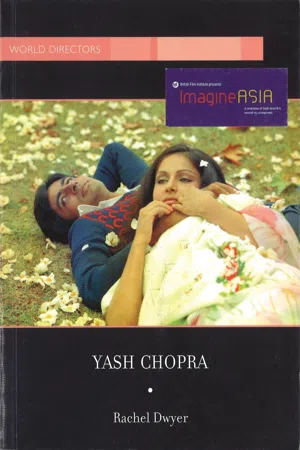
Yash Chopra
About this book
As a charismatic director in the Indian film industry, Chopra's name is synonymous with the glamour of the romantic film and a certain style within Indian culture. Spanning four decades, his directed features include some of the classic films of Indian film history, such as 'Deewaar' and 'Kabhi Kabhie'. His directorial career began in 1959 with 'Dhool Ka Phool' and he has been a major producer since 1973, consolidating his success in the 1990s with a series of huge box office hits including 'Dilwale Dulhaniya Le Jayenge'. He has also worked in other Hindi movie genres, directing action movies such as 'Mashaal' and a thriller, 'Darr'. This book discusses in depth his work with the Hindi megastar Amitabh Bachanan in films such as 'Deewaar', 'Trishul', 'Kala Patthar' and 'Silsila' and how, in his transformation of the look of mainstream cinema in 'Dil To Pagal Hai' and other films, Yash Chopra has proved to be a tireless innovator within a mainstream tradition. The author integrates this analysis with information about the man and his work, based on interviews with Yash Chopra, his family, his colleagues, his stars, his contemporaries and major critics that include views from Amitabh Bachchan, Shahrukh Khan, Shashi Kapoor and Sri Devi. A study of a top contemporary Indian film director, Rachel Dwyer's book also examines the influence on Chopra of predecessors such as Raj Kapoor and how his own legacy can be seen in such films as 'Kuch Kuch Hota Hai' and younger directors such as Karan Johar and Aditya Chopra.
Information
Edition
1One
Yash Chopra: Cinema and Biography
Biography
India has a long history of 'lives'. Some Sanskrit texts describe the nature and behaviour of gods and goddesses in order to explain the cosmos, while others narrate the lives of heroes and heroines, often members of royal dynasties, in terms of ideals and exemplary characters, within the tight conventions of Sanskrit poetics.1 The medieval bhakti (devotional) movement gave rise to hagiographic lives of the sants (saints), which are still narrated to gatherings of devotees as examples of devotional, although not always exemplary, lives.2 Texts produced in the Mughal and other courts of medieval India recount the lives of the kings and their courtiers, many for the glorification of the institutional office which that person held. Nineteenth-century lives are fascinating as these various traditions of 'lives' are elaborated by new ideas about the person/individual/self, and I suspect there is a wide gap between texts of lives and the imagination of what a life or a person is, even in the individual, let alone in wider society.3
How can one leap from this type of biography, of 'great men',4 to the world of cinema? One cannot, yet one must, given that there has been so little attention paid to the life stories of the 'great' men and women in the Hindi cinema industry, who are thought of as 'commercial' rather than 'creative'. There are lives of Ray and other 'art' film-makers and of those in the Hindi film industry who are regarded as more artistic5 and hence more capable of being 'auteurs'.6 Hence it is not surprising there is no official 'life' of Yash Chopra, who works within the paradigm of mainstream Hindi cinema. Many of these recent biographies are reminiscences, by the author or by people who knew the person, tied together by unstated ideas on work and the person on loosely-conceived romantic ideas about the creative artist. They can for the most part be viewed as extensions of the gossip circulated by film magazines.7 Since Yash Chopra, though well-known and powerful, is not a star, less gossip attaches to him than to his actors. Although this gossip is held to be true, it remains unproven and I have chosen not to follow it up.
The debates on questions of authorship are long-running and inconclusive, as the balance swings between material determinism (economic, technological, ideological) and conflicting ideas on subjectivity.8 I remain undecided. As Hollywood directors, notably John Ford, were admitted as auteurs to the pantheon of the great, so Yash Chopra could be regarded as an auteur. However, the idea of the director as author is so overburdened with ideas of romantic creativity and infatuation, that I should prefer to avoid its use. In the everyday world, Yash Chopra is regarded as a force, whether as a stylist, as the expositor of a genre (the romance), or simply as a brand name.
Lives in films
Yash Chopra creates lives in his films and it is to these indirect expressions of his attitudes I now turn. The only complete life story in a Yash Chopra film is shown in Deewaar, which was based on a bound script,9 where childhood shapes the (anti-)hero's life, as he is branded a criminal with the tattoo 'Mera baap chor hai '/' My father is a thief. We follow his life until his death.
Yash Chopra's films show a belief in the force of destiny or fate, in particular in love, where the couple are made for one another. This is seen clearly in his most recent film, Dil to pagal hai/The Heart is Crazy (DTPH) (1997), where the hero and heroine are linked by a series of coincidences even before they have met.
Most of the films are set around the key moments of love and romance. The romantic couple meet, they often have to face a dilemma arising from previous commitments or family duties, then are reconciled to the wishes of their families. Throughout the films, the clear message is that love and fun are located in family and in relationships.
Although I have disavowed a search for Yash Chopra within his films, there are some performances or characters which are designed as reflections of him as a person. The hero often manifests features of Yash Chopra the man. For example, Shahrukh told me that he took the stammer in Darr from Yash Chopra's own stammer; Shahrukh's emotional outburst in DTPH, when he quarrels with Madhuri over her inability to perform as he wishes, is strongly reminiscent of Yash Chopra's behaviour. Although I could give more examples of this, instead I will consider one film, Kabhi kabhie/Sometimes (1976) in which I believe two of the heroes are more clearly autobiographical.
One case where Yash Chopra seems to have drawn on a real life story is in Kabhi kabhie, where the character of Amit draws on the life and poetry of Yash Chopra's close friend, Sahir Ludhianvi, who wrote all the lyrics for Yash Chopra's films from the first film in 1959 until his death in 1980. Before Yash Chopra came to Bombay in 1951, he was a fan of Sahir's as a college student in Jalandhar and said he used to walk around with a book of Sahir's poetry. On arriving in Bombay, his brother, B.R. Chopra, who was already established in the film industry, thought Yash Chopra might be excited to meet some stars. Yash Chopra says he wanted to meet Sahir more than anyone. They became friends straight away, and that friendship remained close until Sahir's death 3o years later. Yash Chopra never lost his admiration for his friend, accepting without judgment his personal problems and his depression. Sahir had written the lyrics for Guru Dutt's Pyaasa/The Desirer (1957), where the role of the hero, the poet Vijay, is said by many to be based on Sahir himself. Sahir also wrote the lyrics for Kabhi kabhie, in which Amitabh Bachchan plays a poet who gives up his poetry to become a businessman in self-defeating sorrow after the marriage of his beloved, writing only one bitter version of his most famous poem, dedicated to her, after their separation. It is only in the closing scenes that he writes an optimistic version of an earlier, sad poem, and the happy ending of the film is ensured. The character played here is the poet as Yash Chopra would wish to see him, his unhappiness stemming his creativity, which returns as he achieves happiness. There certainly seems to be an element of Yash Chopra's desire to be a poet in this portrayal. Yet many people have remarked how the character played by Shashi Kapoor, who married Amitabh's beloved, is so like Yash Chopra, an energetic, cheerful man but a frustrated poet. His open and frank relationship with his son in the film prefigures Yash Chopra's relationships with his own sons, who were very young at the time of the film, and indeed with young people in general. The film's ultimate solution lies in the pragmatic, non-romantic acceptance of one's spouse and family, whatever their merits.
The private view
Yash Chopra finds it hard to tell his life story, although he is happy to recount anecdotal stories of incidents in his life.10 Although he has written stories for his films, Yash Chopra never writes about himself; but there are two autobiographies by men from similar backgrounds whose lives followed different trajectories. These are fellow Punjabi Khatris, and fellow Arya Samajis who were displaced by the Partition, actor Balraj Sahni and civil servant Prakash Tandon. Their books shed much light on the social milieu of which Yash is a product.
Balraj Sahni (1913–73) was known for his commitment to the political theatre movement IPTA (Indian People's Theatre Association) and for film acting, where he often played the role of the displaced peasant, and/or the victim of Partition. In Yash Chopra's first colour film, Waqt/Time (1965), he played the father of three boys whose family was separated by an earthquake. It requires little imagination to read the family's displacement from the Punjab to Delhi and its final reunion in Bombay as a metaphor for the Partition. Sahni, like his younger brother, Bhisham,11 was also a writer. Balraj wrote first in English but later in Punjabi. Although he lived in Bombay for much of his life, his heart remained in the Punjab. His later writing was in Punjabi and he used to go to Punjab for his holidays and toured villages with a theatre group. Before his death he was planning to return to live in Punjab. Sahni's age is close to that of Yash Chopra's elder brother, B.R. Chopra. Like B.R. Chopra, he had studied English Literature at Government College, Lahore and shared with the elder Chopra a commitment to social change through the arts. His autobiography, Balraj Sahni by Balraj Sahni (1979), is very external, containing little about his feelings, even those on the death of his first wife. His time in London with the BBC is rather glossed over. This is a book about the individual, the creative person, a close-up rather than a wider shot. It is nevertheless important in giving us insights into the way that life stories – even of a person whose psychological awareness was evident in his acting–are not easy to verbalise in writing, for reasons we can only imagine – was interiority seen as a breach of privacy? Did he simply lack descriptive skills? He clearly saw his life story as linear, valuing his childhood memories for nostalgic reasons, for being his first memories rather than because of the emotional significance of childhood, or because they showed how he moved away from the lifestyle and values of his Khatri, Arya Samaji origins, similar to those of the Chopras.
Prakash Tandon's Punjabi Century12 is the work of a great descriptive writer who became a successful businessman and bureaucrat. His nostalgia for his youth, his historical awareness and his ability to connect the specific and personal with wider social events make this a fascinating insight into a Punjabi childhood. He includes the personal and the interior in this narrative, making it both specific to him as well as representative of the life histories of many. He deploys western literary narrative techniques and makes his life story flow smoothly, in a continuous chronicle. This is the work of a skilled writer not just recollections.
Clearly, Yash Chopra would not see his life nor tell it in an identical manner to these two authors, but I think their attitudes are informative. Tandon in particular fills a number of gaps in Yash Chopra's story of his family background. Yash Chopra does not keep a journal, but he writes occasionally, mainly verse, that he later destroys without sharing with anyone. Verse is his preferred medium for thinking about the individual, as he often uses verse to recollect moments in his life or recapitulate his thoughts. One of his great regrets in life is that he is not a poet. He reads little prose apart from the English-language press, which he devours avidly, while his favourite poet is still Sahir Ludhianvi.
Friends and relations
Yash Chopra tells his life story in fragments which I have pieced together. There is only one point which he asked me to emphasise, namely certain key relationships. Not those with his parents, but those he has with his older brother, B.R. Chopra, his lyricist, Sahir, his friend, Kiddy and with his family.
'Family, films and food', is his motto. Yash's absolute priority is his nuclear family, his wife, Pamela and his two sons, Aditya and Uday. He is not a demonstrative person, and his relations with them can appear formal to an outsider, yet it is clear that there is a great deal of communication between them all. Yash rarely talks about Pam in public, as is traditional, but says she has always been the ideal wife. She runs the household with a firm hand, dealing with staff, business colleagues, family and friends. She organises the whole of Yash's life, from what he wears to what he eats. The only time I have ever seen Yash dispirited was when she was seriously ill. He immediately cancelled all work and flew with her to New York, where he stayed during her treatment. He was very emotional when it proved successful:

Yash and Pamela Chopra on set
Pam is my dearest friend, we are so close. She knows me inside out. my weaknesses and my strengths. When she had cancer I was so miserable. The fear of losing her was terrible. The three of us supported her emotionally, did what we could, because we can't do anything without her. We're disorganised, we're dependent on her, we're spoilt. She's a fantastic girl. The way she looked after me when I was sick, I can do anything for her. She's made me very happy, but I don't know if I've made her happy. I'm ready to do anything for her. She bowled me over, I'm floored. She is so organised, my work is because of her. The way she looks after our units when we're abroad is unbelievable. She's intelligent, smart and a good wife. She can do most things better than me.
Aditya's relations with his father are partly professional, and it can seem that he is the one in charge. Aditya is tense, focused and obsessive about films and cricket, whereas Uday's nature is very relaxed, apart from in regard to his fitness training. They are very respectful to their parents, elders and guests and spend most of their time with a small group of friends, many of whom are also involved with films or were with them at school or college. The family is very close-knit and they prefer to spend as much time together as possible.
Yash's great friends in the 1970s were Deven Verma, who has had small roles in many of Yash's films, and Shashi Kapoor who acted in Yash's films for 20 years. Yash still has good relations with them, but his great friend Kiddy Chadha is like family. They met when Yash was in the UK for the release of Waqt in 1965 and have been close ever since. They speak on the phone every day and always stay with each other in London or Bombay. Kiddy, like Yash, is from Lahore, and emigrated to the UK about 40 years ago. He is a very wealthy businessman, with no intellec...
Table of contents
- Cover Page
- Title Page
- Contents
- Foreword
- Acknowledgments
- Preface
- 1 Yash Chopra: Cinema and Biography
- 2 From Assistant to Director
- 3 The Founding of Yash Raj Films
- 4 The Amitabh Bachchan Films
- 5 The Lean Years
- 6 Romantic Films
- 7 Production
- Appendix: Reflections
- Notes
- Bibliography
- Filmography
- Index
- ecopyright
Trusted by 375,005 students
Access to over 1.5 million titles for a fair monthly price.
Study more efficiently using our study tools.
Frequently asked questions
Yes, you can cancel anytime from the Subscription tab in your account settings on the Perlego website. Your subscription will stay active until the end of your current billing period. Learn how to cancel your subscription
No, books cannot be downloaded as external files, such as PDFs, for use outside of Perlego. However, you can download books within the Perlego app for offline reading on mobile or tablet. Learn how to download books offline
Perlego offers two plans: Essential and Complete
- Essential is ideal for learners and professionals who enjoy exploring a wide range of subjects. Access the Essential Library with 800,000+ trusted titles and best-sellers across business, personal growth, and the humanities. Includes unlimited reading time and Standard Read Aloud voice.
- Complete: Perfect for advanced learners and researchers needing full, unrestricted access. Unlock 1.5M+ books across hundreds of subjects, including academic and specialized titles. The Complete Plan also includes advanced features like Premium Read Aloud and Research Assistant.
We are an online textbook subscription service, where you can get access to an entire online library for less than the price of a single book per month. With over 1.5 million books across 990+ topics, we’ve got you covered! Learn about our mission
Look out for the read-aloud symbol on your next book to see if you can listen to it. The read-aloud tool reads text aloud for you, highlighting the text as it is being read. You can pause it, speed it up and slow it down. Learn more about Read Aloud
Yes! You can use the Perlego app on both iOS and Android devices to read anytime, anywhere — even offline. Perfect for commutes or when you’re on the go.
Please note we cannot support devices running on iOS 13 and Android 7 or earlier. Learn more about using the app
Please note we cannot support devices running on iOS 13 and Android 7 or earlier. Learn more about using the app
Yes, you can access Yash Chopra by Rachel Dwyer in PDF and/or ePUB format. We have over 1.5 million books available in our catalogue for you to explore.