- 248 pages
- English
- ePUB (mobile friendly)
- Available on iOS & Android
eBook - ePub
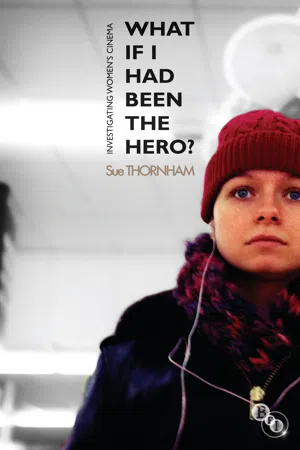
About this book
Sue Thornham's study explores issues in feminist filmmaking through an examination of a wide range of films by women filmmakers, ranging from the avant-garde to mainstream Hollywood, and from the 1970s to the present day, discussing directors including Sally Potter, Jane Campion, Julie Dash, Patricia Rozema and Lynne Ramsay.
Information
Chapter One
‘WHAT IF I HAD BEEN THE HERO?’
We live our lives through texts. They may be read or chanted, or experienced electronically, or come to us, like the murmurings of our mothers, telling us what conventions demand. Whatever their form or medium, these stories have formed us all; they are what we must use to make new fictions, new narratives.
(Carolyn Heilbrun, 1988, p. 37)
In Thriller (1979), Sally Potter’s interrogation of Puccini’s classic operatic melodrama La Bohème, Mimi, the female victim-heroine become investigator, asks in voice-over: ‘Would I have preferred to be the hero?’ In the attic space, which is the film’s mise en scène, the camera shows us Mimi, wearing jacket, tutu and patterned trousers, supporting the figure of Rudolpho, the opera’s artist-hero, who is dressed only in ballet skirt. He is held by Mimi ‘in arabesque’, the classical ballet position which is, E. Ann Kaplan tells us, ‘the most perfect form that the female form can take’ (1983, p. 157), but one which works only if the woman is unable to move. Holding Rudolpho thus, she turns to camera, and the action is replayed, ending in a freeze-frame. Still in voice-over, Mimi rephrases her question: ‘What if I had been the subject of this scenario instead of its object?’ In Potter’s film, the question does not produce the reversal of narrative subject/object that the inverted arabesque suggests. The image is self-evidently absurd, and the response from the extra-diegetic Mimi is laughter. Instead, her voice begins to find answers to the questions she has posed throughout the film. In the romance narrative, her death was inevitable: ‘Without my death … I would have become a mother. I would have had to work even harder. … I would have become an old woman.’ Her function in the story was ‘to be young, single and vulnerable, with a death that served their desire to be heroes’.
Mimi’s doubled question, ‘What if I had been the hero/subject?’ is one which has haunted feminist film theory. For Patricia Mellencamp it takes the form, first, of a personal story, a ‘Once upon a time’. ‘When I was a young girl’, she writes, ‘I wanted to be a boy … I was too restless and impatient for femininity, which was quiet, unobtrusive, dull … Boys moved through space. Girls stayed in place. Boys never looked back. Girls waited’ (1995, p. 1). In a footnote, she adds:

Thriller (1979): Rudolfo ‘in arabesque’
When I was a girl, reading alone for weeks in the summer, surrounded by sacks of library books, was my greatest pleasure. First came fairy tales, … then mysteries … I still want to be a detective and have adventures – which might explain my fondness for movies; analyzing narrative … is detection. I have always wanted to be the hero, never the princess who waits or is adored. (Ibid., p. 292)
Later in the book, Mellencamp applies the distinction to feminist film-making. Echoing Mimi’s conclusions, she writes that such films,
expand the contours of female subjectivity … when the enunciation shifts into women’s minds and into history (which includes our experience and memory), we cease thinking like victims and become empowered, no matter what happens. ‘Being the hero’ is a state of being as well as action. Being the hero is, precisely, not being the victim. (Ibid., p. 257, original emphasis)
Elsewhere, in a curious though clearly overdetermined error, she amends the conclusion of Jane Campion’s The Piano (1993), attributing its final lines to an imaginary poem by Thomas Hood called ‘What If I Had Been the Hero?’, instead of to their actual source, Hood’s ‘Silence’.
Other feminist theorists have posed the question in less autobiographical terms, though for all of them there is clearly something personal at stake. Laleen Jayamanne, who like Mellencamp calls herself ‘a female academic investigator’, notes, for example, that ‘I prefer to use the phrase female hero because the structural connotations of the term heroine make the woman named by it a figure in need of rescue, while agency is synonymous with the hero function’ (2001, pp. 207, 281, original emphasis). Finally, Teresa de Lauretis clarifies just what is at stake, structurally, in Mimi’s question:
Opposite pairs such as inside/outside, the raw/the cooked, or life/death appear to be merely derivatives of the fundamental opposition between boundary and passage; and … all these terms are predicated on the single figure of the hero who crosses the boundary and penetrates the other space. In doing so the hero, the mythical subject, is constructed as human being and as male; he is the active principle of culture, the establisher of distinction, the creator of differences. Female is what is not susceptible to transformation, to life or death; she (it) is an element of plot-space, a topos, a resistance, matrix and matter. (1984, p. 119, original emphasis)
Mimi’s question, then, is more than a matter of terminology, of will, or even of subjectivity. De Lauretis suggests that the identifications male-hero-human/female-obstacle-boundary-space are built into the structures of narrative itself, so that when we do find ourselves within a ‘female genre’, we find that its narratives subordinate time to space, dealing, as Tania Modleski says, ‘with people who are trapped in their world’ (1999, p. 10). At the same time, it is a question that, however urgent for the feminist film theorist, must be tackled by the woman film-maker if she is to engage with narrative – and how can she not, even if what she produces is, as with Potter’s Thriller, a form of anti-narrative.
This book, then, is about some of the answers that women film-makers have found to Mimi’s question. In this opening chapter, however, I shall tease out in rather more detail the implications of the question itself: the conditions under which I, the female subject, might be the hero, and the further questions I might then encounter. These questions will concern narrative and subjectivity, gender and authorship, and fantasy and desire.
BEING THE HERO
For Teresa de Lauretis, as we have seen, ‘being the hero’ is also, as it was for Mimi, to be subject, the maker of meaning rather than its object. But such a ‘mythical subject’, she writes ‘must be male’. His archetype is Oedipus, whose heroic quest is for self-knowledge, to be accomplished by means of the narrative’s female figures. When finally achieved, such self-knowledge is also a realisation of loss – of what de Lauretis calls ‘an initial moment, a Paradise lost’ (1984, p. 125), again associated with a female figure, the mother. In the hands of Freud, this narrative becomes the story of Everyman’s passage into adulthood and culture.
It is little wonder, then, that feminist critics, like Mimi, have been suspicious of the role of hero, however attractive. Feminism, writes Meaghan Morris, ‘is not easily adapted to heroic progress narratives’ (1998, p. xv), and like Cora Kaplan, she calls for a ‘different temporality’ in the feminist narrative, and what Kaplan calls ‘a more complicated, less finished and less heroic psychic schema’ (Kaplan, 1986, p. 227). The female action hero in film has been viewed with ambivalence at best. Catherine Constable talks of ‘the valorisation of masculinity which underpins the current ascendance of [this] ostensibly feminist prototype’ (2005: 190), and Carol Clover famously analyses the ‘final girl’ of the slasher movie as a stand-in for the adolescent male viewer: ‘We are, as an audience, in the end “masculinized” by and through the very figure by and through we were earlier “feminized.” The same body does for both, and that body is female’ (1992, p. 59).
We cannot, these writers insist, simply change the gender of the hero if narrative itself, or at least its dominant – its heroic – forms, is masculine, its function to produce the subject as male. Yet if I am to be the subject of the (my) narrative, I must also be the subject of its actions or events. If I am merely the subject of narration (the one the story is about), while not being the subject of its actions,1 or if I begin as the subject of the story’s actions but end as their object, I will have remained within Modleski’s ‘female genres’, ‘trapped within (my) world’. My subjectivity may have been produced as complex: my narration might have revealed a split subjectivity; in briefly becoming the subject of the story’s actions I might have transgressed the codes of femininity; the story’s closure, bringing my return to the status of object, may be uneasy, or tragic. But in all these cases I will have remained within what Nancy Miller calls heroinism (1988, p. 88). If I am to be the hero, then, I must transgress some dominant narrative codes, and the psychoanalytic structures that they reproduce. The story of which I am subject will be neither Freud’s Oedipal journey nor its feminine equivalent, reproduced in ‘female genres’, in which the girl who is to become a woman must relinquish not only her desire for the mother but desire itself, so that her story, too, becomes a question of his desire.
A story, writes de Lauretis, ‘is always a question of desire’ (1984, p. 112). If narrative is a quest for meaning, as she suggests, then desire is written into its elements of process and temporality, and manifest in its plot. If I am to be the hero, then, I must be the one who desires. In Patricia Mellencamp’s autobiographical narrative (1995), desire is identified with fantasy (wanting ‘to be a boy/a hero’), with fairytale and film, and with investigation. This desire, then, is more complex than it looks. Initially, it seems to echo that described in Laura Mulvey’s account of the ‘transvestite’ identifications of the female viewer/reader of popular narratives. The story’s ‘grammar’, writes Mulvey, means that the viewer’s narrative identification must be placed with its desiring hero. For the female viewer, this produces a particular form of pleasure: the adult woman, now firmly fixed within the codes of femininity, finds in this identification a temporary release from these codes, through a fantasised regression to the pre-Oedipal ‘active’ phase of development which is shared by both sexes. Its very ‘transvestite’ nature, however, means that this is both a guilty and a temporary pleasure, realised only in fantasy: a ‘fantasy of “action” that correct femininity demands should be repressed’ (1989b, p. 37). But this pleasure is one which Mulvey locates in the viewer/reader. How, then, are we to also find it in the film, as Mellencamp suggests is possible? Mulvey’s essay finds an answer in the figure of the tomboy-hero, the figure in the text who enacts Freud’s journey to passivity: active and desiring at the narrative’s outset, but either happily landed on the shores of femininity at its close, or the victim of a more brutal narrative closure when this proves impossible. Like Mellencamp, this figure is also often an investigator. We can find her in Clover’s ‘final girl’ of the slasher movie, who is an active investigator precisely because she has not yet achieved full femininity. In Clarice Starling, protagonist of Jonathan Demme’s 1991 film, Silence of the Lambs, we can find her more mainstream incarnation. Despite Clover’s dismissal of the film – she calls it a ‘slasher movie for yuppies’ (1992, p. 232) – it is a film which Mellencamp wants to celebrate. It is ‘epistemophilia’ (the desire to know), not scopophilia (voyeurism) which drives Starling, she writes, and what she investigates is ‘male subjectivity and sexual perversion’. She is, therefore, the hero:
Starling uses her brains and sheer courage more than her body. Neither she nor the film exploits her appearance. Her body is strong, not agitated. From her opening and menacing jog, she is alone and becomes stronger. Surrounded by good and bad fathers, she uses her very smart mind; she is not dominated by fear or dependency or inadequacy. She is not rescued, she rescues, in the end. (Mellencamp, 1995, p. 142)
Despite her attractiveness, however, it seems to me that Starling remains Mulvey’s tomboy-hero. The victim she rescues is the woman she refuses to/has not yet become: the fully feminine woman who has completed the Freudian journey and has thereby become the victim. The close of the film, like many such closures,2 signals the impossibility of Starling’s position. At the FBI graduation ceremony, with its virtually all-male congregation, Starling exchanges looks with her female class-mate, who is then drawn into posing for a photographed embrace with one of her male colleagues. Starling’s active gaze shifts to her FBI ‘father’, Crawford. The camera holds for a long time on a close-up of their handshake: firmly clasped hands are positioned centre frame, each edged by a white shirt cuff and the sleeve of a dark suit. ‘Your father would have been proud today,’ says Crawford, and Starling grins shyly. Then she steps outside the celebration to take a telephone call. It is from Lecter, and, framed against the white-painted brick wall of the corridor, she peers round the doorway as if to locate his voice, in a shot that echoes her earlier pursuit of Buffalo Bill in the dark cellar. The reverse shot, however, shows us not Lecter but Crawford, a darker and much more ambiguous figure now as, in the distance, he leaves the celebration. Our final shot of Starling is from a high angle with the camera zooming out, seeming to pin her against the corridor wall. Small, uncertain and anxious, she repeatedly whispers, ‘Dr Lecter?’ into the silence of the empty corridor. There is, the shot suggests, no place for her to occupy in the postgraduation world. She refuses to be claimed for femininity like her female colleague, but she is no longer a girl, and she cannot after all take up the masculine position (the position of the father) which the handshake suggested. Neither girl nor, in the terms of the film, mature woman, caught between masculinity and femininity, she cannot simply, as Mellencamp suggests she will, enter ‘the arena of male subjectivity, law enforcement’ and ‘control’ it (ibid.).

The Silence of the Lambs (1991): Starling and Crawford shake hands
Mellencamp’s investigative desire, however, does not end with maturity: ‘I still want to be a detective’, she says. For Potter’s Mimi, too, becoming the investigator also means becoming the fully adult hero-subject. ‘I am trying to remember’, she says, looking back on her life-story: ‘Did I die? Was I murdered? … What does it mean?’ Yet as investigating subjects, both Mimi and Mellencamp are positioned outside the filmic narrative, asking, ‘What does it mean?’ In The Woman at the Keyhole, Judith Mayne argues that what characterises the narratives of the feminist films she discusses is that they ‘share the desire to appropriate forms of narrative associated with the classical cinema to the representation of female desire’ (1990, p. 85). It is a curious formulation which reflects the difficulty of the enterprise she is proposing. In it, desire is positioned outside the film, as the desire for a representation, and also, but far less certainly, inside the film, as the representation of female desire. Clearly, such narratives will not exhibit the easy fit between temporal movement and narrative resolution on the one hand, and the constitution of subjectivity and production of meaning on the other, that is evident in the Oedipal narrative and that Mellencamp wants to claim for Starling’s story. They will be more uneasy, perhaps off-centre, since in speaking their desire they must, in Mayne’s words, ‘speak simultaneously of what the classical cinema represents and what it represses’ (ibid.). They must, that is, articulate a female desire that is both investigative and the mark of an adult subjectivity.
THE HERO’S LOSS
For the male hero-subject, argues de Laur...
Table of contents
- Cover
- Title Page
- Contents
- Acknowledgments
- Introduction
- Part One: Questions
- Part Two: Explorations
- Conclusion: Unfinished Business
- Postscript
- Notes
- Bibliography
- Index
- List of Illustrations
- eCopyright
Trusted by 375,005 students
Access to over 1.5 million titles for a fair monthly price.
Study more efficiently using our study tools.
Frequently asked questions
Yes, you can cancel anytime from the Subscription tab in your account settings on the Perlego website. Your subscription will stay active until the end of your current billing period. Learn how to cancel your subscription
No, books cannot be downloaded as external files, such as PDFs, for use outside of Perlego. However, you can download books within the Perlego app for offline reading on mobile or tablet. Learn how to download books offline
Perlego offers two plans: Essential and Complete
- Essential is ideal for learners and professionals who enjoy exploring a wide range of subjects. Access the Essential Library with 800,000+ trusted titles and best-sellers across business, personal growth, and the humanities. Includes unlimited reading time and Standard Read Aloud voice.
- Complete: Perfect for advanced learners and researchers needing full, unrestricted access. Unlock 1.5M+ books across hundreds of subjects, including academic and specialized titles. The Complete Plan also includes advanced features like Premium Read Aloud and Research Assistant.
We are an online textbook subscription service, where you can get access to an entire online library for less than the price of a single book per month. With over 1.5 million books across 990+ topics, we’ve got you covered! Learn about our mission
Look out for the read-aloud symbol on your next book to see if you can listen to it. The read-aloud tool reads text aloud for you, highlighting the text as it is being read. You can pause it, speed it up and slow it down. Learn more about Read Aloud
Yes! You can use the Perlego app on both iOS and Android devices to read anytime, anywhere — even offline. Perfect for commutes or when you’re on the go.
Please note we cannot support devices running on iOS 13 and Android 7 or earlier. Learn more about using the app
Please note we cannot support devices running on iOS 13 and Android 7 or earlier. Learn more about using the app
Yes, you can access What If I Had Been the Hero? by Sue Thornham in PDF and/or ePUB format, as well as other popular books in Media & Performing Arts & Film & Video. We have over 1.5 million books available in our catalogue for you to explore.