- 96 pages
- English
- ePUB (mobile friendly)
- Available on iOS & Android
eBook - ePub
Stagecoach
About this book
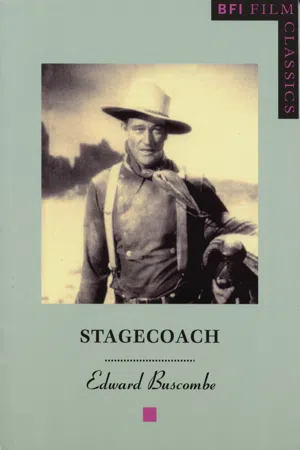
John Ford's Stagecoach, starring John Wayne in the part that made him a star, remains the most famous Western ever made. Shedding new light on an old favourite, this is an enjoyable account of how the film got made, combined with a careful scene-by-scene analysis, a wealth of illustrations and the most complete credits yet assembled.
Information
I
It’s one of the most stunning entrances in all of cinema. We hear a shot, and cut suddenly to Ringo standing by the trail, twirling his rifle. ‘Hold it,’ cries the unmistakable voice of John Wayne. The camera dollies quickly in towards a tight close-up – a rarity for Ford, whose preferred method of shooting was to plonk the camera down four-square and move the actors around it. So fast is the dolly in that the operator can’t quite hold the focus. But as the camera settles securely on Wayne’s sweat-stained face Buck, agog with the anticipation of excitement to come, calls out, ‘Hey look, it’s Ringo!’
Ringo is dressed in jeans, with the trouser bottoms rolled up and worn outside his boots. He wears army-style braces, a neckerchief and a placket-front shirt, which has a kind of panel buttoned on it. Wayne was to make this style of shirt his trademark, and Jane Gaines has suggested that it gives the wearer a kind of fortified or armoured look, reinforcing the authoritarian aura of the mature Wayne persona.1 By 1938 there were two distinct styles of Western costume in the movies. One derived originally from the flamboyant outfits affected by such real-life Western self-publicists as George Armstrong Custer and Buffalo Bill Cody, who went in for elaborately fringed buckskin jackets, thigh-length boots and shoulder-length hair. Mingled with the influence of Mexican vaqueros, rodeo cowboys and the fantasies of showbiz, this style had been brought to a peak of extravagance in the 1920s by Tom Mix, whose sartorial flourishes were to be adopted wholesale by the singing cowboys of the later 1930s.
But there was another vital if less exuberant tradition, best exemplified in the early 1920s by William S. Hart. Though in some ways as stylised a performer as Mix, Hart claimed his films took a more realistic look at the old West. Characteristically his costume is more functional than fancy; it favours, in its use of gauntlets and heavy leather chaps, the protective rather than the ornamental.
Wayne, in Stagecoach and in all his subsequent Westerns, was squarely in the Hart tradition. But we are getting ahead of ourselves. His entrance is neither the beginning of Stagecoach, nor the start of Wayne’s career. Though with the benefit of hindsight we are astonished by how young Wayne looks – fresh-faced almost – he was in fact already past thirty by this time. Born Marion Michael Morrison in Iowa in 1907, he had entered the University of Southern California on a football scholarship in 1926. While working as a prop man at the Fox studio during the vacation, he met John Ford and was given a bit part in Ford’s Hangman’s House (1928), his first credited role. The following year saw his first speaking part in Ford’s Men Without Women. His big break came in 1930 when, now John Wayne, he was given the lead in Raoul Walsh’s epic Western The Big Trail. Though the delivery of his lines is not always certain – few actors were confident in those very early days of sound – Wayne certainly looked the part. For those who know only the weather-beaten and rather portly figure of his later years, it might be hard to recognise the willowy and indeed beautiful young man he was then.
The Big Trail was not a box-office success, and though this was scarcely Wayne’s fault he was condemned, on the principle that you are only as good as your last picture, to spend almost a decade on Poverty Row, eking out a living on a succession of cheap action pictures. For nearly ten years Wayne – or more often his double, Yakima Canutt – leaped aboard speeding trains, jumped out of aeroplanes and endured unspeakable privations in the French Foreign Legion. And he made Westerns, dozens of them, for Warners, Monogram and Republic. In some of them he even sang, dubbed in an implausible gravelly bass by Smith Bellew.
Of course what constitutes a living is relative. Wayne’s rock-bottom point was his contract with Monogram, where he made $2,500 a picture and completed eight Westerns in 1933. You could live pretty well on $20,000 a year in the 1930s. But it wasn’t the big time. Throughout the 1920s and 1930s there were (at least) two Hollywoods. There was the world of MGM, Paramount and the other major studios, each making fifty or so major features a year starring two or more of their galaxy of talent, the glittering cynosures of international renown such as Greta Garbo, Marlene Dietrich, Clark Gable or Ronald Colman. And then there was Poverty Row, the fly-by-night studios trying to squeeze a profit out of films produced at knock-down prices, for the specialised theatre circuits which catered for rural audiences in the South and West, or else shown as the lower half of a double bill. During the 30s the collapse at the box office caused by the Depression had led exhibitors to seek out any gimmick to lure patrons back. Bingo, popcorn, free gifts, all were tried. An enduring legacy was the double bill, in which audiences got two pictures for the price of one. A host of minor studios rushed to cash in on the opportunity this provided, supplying product for the lower, or ‘B’, half of the programme. Thus was born the B-Western, the dusty vineyard in which John Wayne laboured throughout his early manhood.

John Wayne and Marguerite Churchill in The Big Trail
Wayne’s career showed that it was possible to make the leap up from the lower depths into the sunlit pastures of stardom, but for the most part the two worlds kept themselves apart, two parallel industries supplying product for two polarised markets. Wayne’s last film before Stagecoach was Red River Range, one of the ‘Three Mesquiteers’ series Republic had based on the novels of William Colt MacDonald. After he had finished working with Ford, Wayne went straight back to finish his contract with Republic, appearing in The Night Riders and three further films in the ‘Three Mesquiteers’ series. Republic held back the release of these until after Stagecoach appeared, hoping to take advantage of their leading man’s advancement. They suspected, rightly, that this would be John Wayne’s last appearance in series Westerns.
II
John Ford, by contrast, had been a top-notch film director for twenty years. His career had evolved through a number of distinct stages. He had begun in a milieu pretty much like that which Wayne inhabited during the 30s, the world of the series Western. Working as Jack Ford (he did not become ‘John Ford’ until Cameo Kirby in 1923), he had gained a little experience as an actor, mostly in pictures directed by his brother, Francis. In 1917 he became a director himself, and for the next ten years he made mostly action films, many of them Westerns starring Harry Carey, Hoot Gibson or Tom Mix. The summation of the early Ford Western was The Iron Horse, an epic story of the building of the transcontinental railroad which Ford directed for Fox in 1924.
After this Ford was to direct only one more Western, Three Bad Men in 1926, before embarking on Stagecoach. In the second half of the 20s and in the 30s, while keeping his hand in with action pictures like Men Without Women and Airmail, and an occasional comedy like Riley the Cop, Ford also became adept at melodramas such as Arrowsmith, made for Sam Goldwyn in 1931. Then in 1935 came another change of direction with The Informer, an arty and heavily atmospheric drama of Irish republicanism, based on the novel by Liam O’Flaherty. It won Ford numerous critical awards and a new reputation as a director of important films based on prestigious works of literature. In 1936 he followed with Mary of Scotland, taken from the play by Maxwell Anderson, and The Plough and the Stars, from Sean O’Casey’s play. Even if his next picture, Wee Willie Winkie with Shirley Temple, was hardly classic material, Ford’s reputation at the time he came to make Stagecoach had risen far above his lowly origins in the series Western.
A sure indication of his status at the end of the 1930s is the fact that Ford was being courted by David O. Selznick, one of the best-connected, most ambitious and respected producers in Hollywood, just a year or two away from his greatest triumph, Gone With the Wind. Selznick had not the remotest interest in the world of the series Western. What he saw in Ford was a director of quality pictures. Ford had first come into contact with Selznick through his involvement with Merian C. Cooper, the celebrated producer and co-director of King Kong. Cooper had formed a great admiration for Ford in the mid-30s while the latter was working at RKO, where Cooper had succeeded Selznick as vice-president in charge of production in 1933. Cooper had also formed a company named Pioneer with his friend John Hay (‘Jock’) Whitney, a wealthy New Yorker whose cousin, C.V. Whitney, would later produce Ford’s masterpiece The Searchers with Cooper. In 1933 Pioneer had signed a contract with Technicolor to make eight feature films in the new three-colour Technicolor process.2 Then, in 1936, Cooper threw in his lot with Selznick and merged Pioneer with Selznick International. An ambitious programme of pictures was announced, several of them in colour. Since Ford was already under contract to Pioneer, his contract was taken over by the new company.
Ford and Selznick could not get along. Two equally strong-willed but utterly different personalities, they rubbed each other up the wrong way from the beginning. Cooper’s account of the abortive attempt by Selznick to secure Ford’s services is instructive:
I thought Jack Ford was the very best director alive, so when Jock Whitney and I formed Pioneer, one of the first things I did was to make a deal with Ford to direct two pictures at $85,000 a picture. ... In the deal I made with David [Selznick] and Jock Whitney, I was to be vice-president of Selznick International. I was to pick my own pictures and have full authority for producing them, with David to have veto power of any picture I picked if he thought it would be a money loser, but with nothing to say once the picture was agreed to. Now about this time, Ford had read a short story in Collier’s magazine called ‘Stage to Lordsburg’, which he bought the rights to and told me he wanted to make a picture of. ... Ford wanted John Wayne for the lead; I didn’t know Wayne but I ran several pictures in which he appeared, The Big Trail and a couple of the ‘Three Mesquiteers’ pictures he’d done at Republic, and I agreed with Ford that he was perfect. I knew Claire Trevor, and Ford and I settled on her for the girl, and I told Ford to go ahead and verbally commit for both Wayne and Trevor, and then we went up to David Selznick’s house for dinner to tell him about the picture, which we called Stagecoach.
To my surprise, David was not impressed. First he said we had no big name stars and secondly ‘it was just another Western’. He said we’d do a lot better if we did a classic. ... Ford and I both jumped David hard on this. Jack Ford can state a case as well as anybody when he wants to take the time to do it; I’m not too bad myself, and over coffee, we argued that this was a classic Western with classic characters and we finally convinced him and got the go ahead. But the very next morning, David called and asked us to come in and see him and the very first thing he says was that he had given our ‘Western’ ‘deep thought’ and it was his studied conclusion that the picture would not ‘get its print costs back’ unless we put stars into the two leads. ... He thought we woul...
Table of contents
- Cover Page
- Title Page
- Contents
- Acknowledgments
- ’:Stagecoach’
- Notes
- Credits
- Bibliography
- eCopyright
Trusted by 375,005 students
Access to over 1.5 million titles for a fair monthly price.
Study more efficiently using our study tools.
Frequently asked questions
Yes, you can cancel anytime from the Subscription tab in your account settings on the Perlego website. Your subscription will stay active until the end of your current billing period. Learn how to cancel your subscription
No, books cannot be downloaded as external files, such as PDFs, for use outside of Perlego. However, you can download books within the Perlego app for offline reading on mobile or tablet. Learn how to download books offline
Perlego offers two plans: Essential and Complete
- Essential is ideal for learners and professionals who enjoy exploring a wide range of subjects. Access the Essential Library with 800,000+ trusted titles and best-sellers across business, personal growth, and the humanities. Includes unlimited reading time and Standard Read Aloud voice.
- Complete: Perfect for advanced learners and researchers needing full, unrestricted access. Unlock 1.5M+ books across hundreds of subjects, including academic and specialized titles. The Complete Plan also includes advanced features like Premium Read Aloud and Research Assistant.
We are an online textbook subscription service, where you can get access to an entire online library for less than the price of a single book per month. With over 1.5 million books across 990+ topics, we’ve got you covered! Learn about our mission
Look out for the read-aloud symbol on your next book to see if you can listen to it. The read-aloud tool reads text aloud for you, highlighting the text as it is being read. You can pause it, speed it up and slow it down. Learn more about Read Aloud
Yes! You can use the Perlego app on both iOS and Android devices to read anytime, anywhere — even offline. Perfect for commutes or when you’re on the go.
Please note we cannot support devices running on iOS 13 and Android 7 or earlier. Learn more about using the app
Please note we cannot support devices running on iOS 13 and Android 7 or earlier. Learn more about using the app
Yes, you can access Stagecoach by Edward Buscombe in PDF and/or ePUB format, as well as other popular books in Media & Performing Arts & Film & Video. We have over 1.5 million books available in our catalogue for you to explore.