- 96 pages
- English
- ePUB (mobile friendly)
- Available on iOS & Android
eBook - ePub
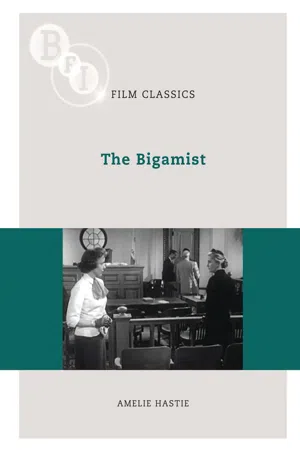
The Bigamist
About this book
Directed by the actor/film-maker Ida Lupino, The Bigamist (1953) is the story of Harry Graham, a salesman travelling between two towns and two wives. In its portrayal of Harry's 'double life', the film takes on a double life of its own, hovering as it does between two genres. Telling the story through Harry's voice-over, yet eschewing the iconic character of the femme fatale, Lupino's film reveals and recasts film noir as male melodrama par excellence. In its rendering of this emotionally paralysed man, The Bigamist is a fascinating study of the post-War male.
A collaborative affair, The Bigamist was written and produced by Lupino's ex-husband Collier Young, co-starring his current wife, Joan Fontaine, as bride number one, with Lupino in a turn as bride number two. The last of five films that Lupino directed for the independent production company that she co-founded, The Filmakers, it was notably the only film of its period with a woman director who also played a starring role.
Amelie Hastie explores the film in the context of Lupino's personal and professional history. This is a film, Hastie argues, that reveals the changing structure of Hollywood film production in light of the emergence of independent studies; it delineates the life and exemplifies the work of one of only two women directors in the 'Classical' Hollywood era; and it provides a complex commentary on the fantasies and fear of mid-century domestic life in the USA.
Amelie Hastie is Associate Professor of Film and Digital Media at the University of California, Santa Cruz. She is the author of Cupboards of Curiosity: Women, Recollection and Film History (2007).
Information
1 Lupino’s Familial Milieu
British-born Ida Lupino began her career as an actress, following the family tradition on each parent’s side. She started off in bit parts in British productions and then moved to the USA in 1933 in order to accept a contract with Paramount, which lasted for four years. In 1940 she took a contract with Warner Bros. that lasted another seven years and with whom she made a total of thirteen films, many of which were critically and financially successful both for the studio and the actress and two of which were wartime star packages. Warner Bros. contracts, however, were notoriously strict, including clauses warning actors they would be suspended if they turned down a role the studio offered them. Bette Davis was well known for her battles with Warner Bros., frequently turning down roles and leaving the studio to recast parts it had designated for her. Lupino described herself, then, as the ‘poor man’s Bette Davis’, for she recognised that Warners could easily slot her into pictures Davis didn’t want. She might also be described, though, as the female Humphrey Bogart, with whom she starred in two early Warner Bros. films (They Drive By Night [1940] and High Sierra [1941]), as they reportedly had similar on-screen and off-screen personas.2 Lupino was certainly known on screen and on sets as fiercely independent; this characteristic was marked both in her ability to renegotiate her contract so that she could appear in four outside pictures a year and in her repeated refusals to take on roles that she felt were not right for her at Warner Bros. These refusals meant that she was also repeatedly put on suspension at the company; though this did not greatly affect her financially, for she still won radio gigs and parts in other studio films, it did appear to sour her view of the studio system.
Lupino was thus primed to go industrially independent. Relieved of her Warner Bros. contract in 1947, in 1948 she both married film executive Collier Young and merged with Emerald Productions with Young and Anson Bond.3 She directed her first film, Not Wanted, in 1949, at the age of thirty-one. The next year, Young and Lupino split with Bond and founded the Filmakers; throughout its history the company was known for collaborative film-making, with a stable set of actors as well as producers, directors and musicians. Screenplays were often co-scripted, and members of the Filmakers team appeared to alternate the various roles played on set. While Lupino and Young divorced soon after the founding of their company and Lupino married actor Howard Duff in 1951, the two remained close collaborators.

Lupino at the camera
The Bigamist developed in the midst of Lupino’s prime as director and her maturation as a film actress. It is significant, too, for its broader place in film history, as the only film in the ‘Classical’ Hollywood era directed by a woman who is also one of its stars (a feat not even many male directors achieved at the time). It also signals the beginning of a shift both for the Filmakers and Lupino. The last film that Lupino directed for the company (and the penultimate film she directed overall), it was the first that the Filmakers distributed, a decision that was part of the reason for the eventual dissolution of the company. Shortly after the production of this work Lupino herself moved largely into the television industry, first as actress and then director. While she began acting in high-profile series such as Four Star Playhouse (1952–6) and the self-reflexive comedy Mr Adams and Eve (1957–8) (a Desilu production, in which she appeared alongside husband Howard Duff as a pair of movie stars), she was primarily hired to direct adventure and crime series. Her work on television programmes such as The Untouchables (1959–63), Have Gun Will Travel (1957–63) and Bonanza (1959–73) is evidence of her association with male-centred texts, led by the success of her directed film The Hitch-Hiker (1953) and, arguably, The Bigamist. In such a differently structured industry, however, Lupino essentially lost her authorial control as a director, instead becoming a respected yet mainly transient hired hand. Her work as a director was matched by many of the roles she eventually played on television. Her guest appearances in the 1960s and 1970s increasingly took on mournful or just plain campy qualities, such as the aging star (The Twilight Zone [‘The 16mm Shrine’, 1959], Charlie’s Angels [‘I Will Be Remembered’, 1977]) or the pushy wife (Batman [‘The Entrancing Dr Cassandra’, 1968], Columbo [‘Swan Song’, 1974]). While she and Young reportedly discussed founding a new film studio over the years – this time to be named for her father, Stanley Productions – it was never to be, and she was hired to direct her last picture, The Trouble with Angels, a Hayley Mills vehicle which takes place in a Catholic Girls School (and the homosocial world of the ‘Sisterhood’) in 1966.
The specifics of the 1953 production of The Bigamist also remark on Lupino’s familial (and industrial) milieu. The seventh of nine films the Filmakers made, it was scripted and produced by Lupino’s former husband Young. It starred Edmond O’Brien as ‘the bigamist’ (Harry Graham), Young’s current wife Joan Fontaine as Graham’s first wife Eve, Lupino as his ‘second’ wife (Phyllis Martin) and Edmund Gwenn as Mr Jordan, the man who discovers Harry’s secret. Even these scant details of its production suggest its significance to film history: it marks the multiple roles of ‘author’ Lupino played throughout her career (director and actor, as well as producer and screenwriter); it reveals a maturation of the company’s output; and it displays the fascinating backstory to the collaborative team comprising Lupino and Young’s production company. The film continued to be defined by this association over time: more than a decade later, at the time of Collier Young’s death, a photo appeared alongside his obituary in the Los Angeles Times which recalled this scenario, setting Young with eyes downcast between Fontaine and Lupino, who appear in rapt conversation with one another.
Certainly almost every contemporaneous review of the film mentioned these unique familial connections. One article, ‘Wife No. 2 Directs Wife No. 3 in Play’, from Hollywood Citizen News, focuses entirely on this issue. Accompanied by a photograph that shows both Ida and Joan smiling at Collier as he appears to be saying something amusing (surely taken from the same batch from which the image accompanying Young’s obituary was drawn), the article describes the partnership as friendly, a knowing joke between all the players involved. ‘Oh, Ida and I are old friends,’ says Fontaine; and the reporter informs her readers: ‘Collier and Joan also are godparents of Ida and Howard’s baby.’4 Showing Fontaine to be a good sport about the whole business, the writer quotes her description of a fantasy in which her sister (Olivia De Havilland), her sister’s ex-husband (Marcus Goodrich) and her own first husband (Brian Aherne) could replace some of the current players. She goes on, ‘We really tried to get Louis Hayward (Ida’s first mate) to do a bit as a bus driver but he wouldn’t.’5 Obviously, while the three – Fontaine, Lupino and Young – were publicly seen on friendly terms, the casting is still a provocative one. It functions as the most explicit instance of the film’s self-reflexive nature – in this case, reflecting, indirectly, on ‘bigamy’ itself or at least providing a commentary on modern marriage.6
The Filmakers was known for its production of ‘social issue’ and/or ‘realist’ films. Though perhaps only tangentially a ‘social issue’ film on the surface (in spite of what the judge suggests, it’s hard to believe that bigamy was a plague on the nation in the 1950s), The Bigamist’s tone is similar to previous works by the company, even if its general subject matter may seem more outrageous or less socially conscious than prior productions. It therefore marks continuities with and divergences from Lupino’s other films for the company. Most significantly, perhaps, like the company’s most well-known film, The Hitch-Hiker (a claustrophobic crime drama that follows a hitch-hiker quietly terrorising the two men who have picked him up), it registers a significant shift from the company’s focus on women-centred stories, as well as social issues that centre around women’s bodies, to a narrative focused on a man’s point of view. Unlike The Hitch-Hiker, however, which has no major female characters (but which is also concerned with gender and with heterosexual imperatives of the time), The Bigamist lodges this man’s story squarely between two women. To investigate this film is thus to understand Lupino’s career and the ways in which it was set within an important historical juncture that marked changes in the way films were made and seen.
2 Filmakers: The Troubles with Authorship
Ida Lupino’s production company was formed and developed through a constellation of significant circumstances and contexts – industrial, ideological and personal. The Bigamist specifically is a crystallisation of the company’s output and a model of the historical circumstances at work in mid-century American independent film production. During the company’s seven years in business, for instance, two major US Supreme Court decisions were made which greatly impacted film production (one coming the year before the making of The Bigamist). The year 1948, in which Lupino co-founded Emerald Productions, was the same in which the Supreme Court ruling in United States vs Paramount Pictures ceased the monopoly on film distribution and exhibition enjoyed by the major studios. In 1950, when Lupino and Young left Emerald Productions and formed the Filmakers, they left the family tie of the original appellation, derived from Lupino’s mother’s maiden name. But this new name was perhaps more appropriate, its plural descriptive of the company’s working process. In a sense echoing the dissolution of monopolies in the bigger studios, Filmakers worked via a collaborative system, rather than one based on rigid hierarchies. Screenplays were often co-scripted, and members of the Filmakers team alternated the various roles played on set. Though Collier Young was most frequently credited as producer of the company’s output, Lupino herself was routinely screenwriter, producer, director, star, or some combination thereof.
In addition, the company utilised a stable set of actors, as well as of producers, directors and musicians. In its first couple of years, the company launched new actors who appeared in a number of films. Ingénue Sally Forrest, for instance, stars in Not Wanted, Never Fear (1949) and Hard, Fast and Beautiful (1951), and newcomer Keefe Brasselle plays opposite her in both Not Wanted and Never Fear, with a return appearance in Mad at the World in 1955.7 While Edmond O’Brien had previously starred in The Hitch-Hiker, The Bigamist presented the most star-studded cast of any of the company’s features in its inclusion of Fontaine, Lupino and Edmund Gwenn. The only outing in a Filmakers production for Fontaine and Gwenn, it was Lupino’s second of three starring roles (after Beware My Lovely [1952] and just preceding Private Hell 36 [1954]). The level of talent among the cast was likely a strategic move, given that The Bigamist was the first film that the Filmakers distributed itself. The company thus drew on its strengths and even more extensive familial connections to cast the film. In fact, Fontaine’s mother and Collier Young also play bit roles in the film (a family practice carried over from earlier works, in which Lupino’s sister Rita played minor roles in three films).
This form of collaboration at the level of production, echoed in casting, was partly a result of the Paramount decision of 1948. That is, the company fitted into a growing trend at the time: vertical integration by the five major studios (RKO, Paramount, Loew’s, 20th Century-Fox and Warner) now prohibited, independent studios rose up in earnest. Between 1946 and 1956, the number of independent film companies climbed from 70–165,8 and by 1958 65 per cent of Hollywood films were made by independent companies.9 Ironically, sometimes the independent companies sought a partial level of integration previously monopolised by the major studios, such as the Filmakers’ turn to distribution with The Bigamist. (Because it at least partially accounted for the company’s eventual demise, this venture revealed that exhibition – which the company did not control – is perhaps ultimately the key to vertical integration.) Yet while clearly part of an emerging movement as well as some of the very conventions which the independent movement opposed, the Filmakers also appears to have been relatively unique in its consistent structure and teamwork, not least because one of its major players was the only woman directing in Hollywood at this time.
In the midst of the Filmakers’ heyday, in 1952, the ‘Miracle decision’ was reached by the US Supreme Court, extending the First Amendment to protect films. In fact, historian Garth Jowett notes that the 1948 ruling bore significant connections to the change in the First Amendment. Concerning the Paramount decision, he writes, ‘It was in the process of deliberating these economic issues that Justice William O. Douglas asserted for the Court, “We have no doubt that moving pictures, like newspapers and radio, are included in the press whose freedom is guaranteed by the First Amendment.”’10 Thus, during the same period that financial monopolies were lessened in the film industry, so was the strict monopoly of the Production Code Administration (PCA). Such a shift would have perhaps an even greater impact on the output of the Filmakers, known as it was for tackling controversial social issues. In 1952, the First Amendment was officially extended to protect films, and the PCA began to relax its guidelines.
Both the PCA’s ongoing influence and its lessening of charges are evident in the construction of the original screenplay on which The Bigamist was based. The original story was by Larry Marcus and Lou Schor, who received the go-ahead for their project – then called ‘Two Loves Have I’ – in May 1952. Their correspondence with the PCA office suggests the authors wrote the story with Joseph Breen’s office in mind. The initial response to the authors noted that it appeared ‘to meet the basic requirements of th...
Table of contents
- Cover Pages
- Title Page
- Dedication
- Contents
- Acknowledgments
- Preface
- 1. Lupino’s Familial Milieu
- 2. Filmakers: The Troubles with Authorship
- 3. The Bigamist, or The Troubles with Harry
- 4. Two Loves Have I
- 5. Film Criticism and the Question of Legibility
- Postscript: Upon Leaving the Movie Theatre, On the Bus
- Notes
- Credits
- Bibliography
- eCopyright
Trusted by 375,005 students
Access to over 1.5 million titles for a fair monthly price.
Study more efficiently using our study tools.
Frequently asked questions
Yes, you can cancel anytime from the Subscription tab in your account settings on the Perlego website. Your subscription will stay active until the end of your current billing period. Learn how to cancel your subscription
No, books cannot be downloaded as external files, such as PDFs, for use outside of Perlego. However, you can download books within the Perlego app for offline reading on mobile or tablet. Learn how to download books offline
Perlego offers two plans: Essential and Complete
- Essential is ideal for learners and professionals who enjoy exploring a wide range of subjects. Access the Essential Library with 800,000+ trusted titles and best-sellers across business, personal growth, and the humanities. Includes unlimited reading time and Standard Read Aloud voice.
- Complete: Perfect for advanced learners and researchers needing full, unrestricted access. Unlock 1.5M+ books across hundreds of subjects, including academic and specialized titles. The Complete Plan also includes advanced features like Premium Read Aloud and Research Assistant.
We are an online textbook subscription service, where you can get access to an entire online library for less than the price of a single book per month. With over 1.5 million books across 990+ topics, we’ve got you covered! Learn about our mission
Look out for the read-aloud symbol on your next book to see if you can listen to it. The read-aloud tool reads text aloud for you, highlighting the text as it is being read. You can pause it, speed it up and slow it down. Learn more about Read Aloud
Yes! You can use the Perlego app on both iOS and Android devices to read anytime, anywhere — even offline. Perfect for commutes or when you’re on the go.
Please note we cannot support devices running on iOS 13 and Android 7 or earlier. Learn more about using the app
Please note we cannot support devices running on iOS 13 and Android 7 or earlier. Learn more about using the app
Yes, you can access The Bigamist by Amelie Hastie in PDF and/or ePUB format, as well as other popular books in Media & Performing Arts & Film History & Criticism. We have over 1.5 million books available in our catalogue for you to explore.