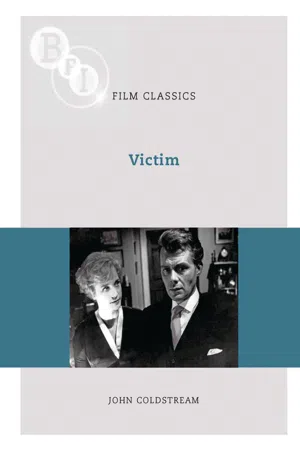
Victim (1961) was a landmark in the history both of the cinema and of British society. This modest black-and-white thriller, produced by Michael Relph and directed by Basil Dearden, tackled explicitly the existing law governing homosexual offences, and in doing so eased the path towards partial decriminalisation in 1967. It was also a key moment in the life of its star, Dirk Bogarde, who, despite the risk to his box-office appeal, seized upon the role of a compromised barrister. In doing so, he shed the mantle of matinée idol and soon afterwards embarked on a more fulfilling career in the intellectual cinema.
John Coldstream's intimate study of Victim examines in detail the background to the production, focusing especially on the relationship between the film-makers, the screenwriters and the censor, John Trevelyan, whose participation at the script stage was crucial to its development. Half a century after its original release, one looks in vain to find Victim in the spasmodic surveys dedicated to identifying the greatest films of all time. However, as Coldstream argues, its recognition as a classic is more than justified by the vital contribution it made to gay cultural history and by its status as 'a movie that mattered'.
eBook - ePub
Victim
About this book
Information
1 The Backstory
Concealment was the order of the day.
On 3 October 1957 Janet Green wrote to the Rank Organisation’s story editor at Pinewood Studios. The previous two years had seen no fewer than four of her works released into British cinemas as either an original screenplay or an adaptation of a play, and now she was toying with possibilities for a new project. One was ‘a romantic story set against a pirate-Eastern atmosphere with a bit of Christianity thrown in’. Another, ‘a murder, blackmail idea amongst Nice People, set against a kind of Gleneagles background’.2 Neither had been worked through, but in each there was, she thought, something ‘tellable’. The first, perhaps mercifully, came to nothing. The second was, I believe, the germ that would develop four years later as Victim. Homicide would yield to suicide; the Gleneagles setting would give way to a building site and the Inns of Court; but Nice People – some, anyway – would occupy the foreground. And, crucially, blackmail remained the theme. So what was the trigger that caused her, and her husband John McCormick, to focus on that vicious and corrosive offence; that act of psychological, rather than physical, terrorism, which carries the real risk of collateral damage to a victim’s family?

Sir John Wolfenden (courtesy of Getty Images)
Four weeks earlier, on 4 September, Sir John Wolfenden had delivered to Parliament the report of his Committee on Homosexual Offences and Prostitution. This body had been established in the summer of 1954 by the then Home Secretary, Sir David Maxwell Fyfe, when the atmosphere enveloping the relevant law was highly charged. He himself believed that ‘homosexuals in general are exhibitionists and proselytisers and are a danger to others, especially the young’.3 In both 1953 and 1954 well over two thousand men in England and Wales were prosecuted for homosexual offences – none with more salacious headlines than Edward, Lord Montagu of Beaulieu, his second cousin Michael Pitt-Rivers and the Daily Mail diplomatic correspondent Peter Wildeblood. They were all gaoled, having been caught up in what the British press described as Maxwell Fyfe’s ‘new drive against male vice’. As Wildeblood recorded in his 1955 memoir, Against the Law,4 the clampdown had its roots in the flight to Russia in 1951 of the British spies Donald Maclean and Guy Burgess and the ‘strong United States advice to Britain to weed out homosexuals – as hopeless security risks – from important Government jobs’. He was citing a despatch in the Sydney Morning Telegraph by its London correspondent, Donald Horne, about a ‘Scotland Yard plan to smash homosexuality in London’, headed by a new Commissioner of the Metropolitan Police, Sir John Nott-Bower, who was said to believe that Britain was threatened by a homosexual conspiracy. He not only pledged to ‘rip the cover off all London’s filth spots’, but also ‘swung into action on a nation-wide scale’ by enlisting the support of local police throughout England to increase the number of arrests for homosexual offences. For many years, reported the well-informed, blunt-penned Mr Horne, ‘the police had turned a blind eye to male vice. They made arrests only when definite complaints were made from innocent people, or where homosexuality had encouraged other crimes. They knew the names of thousands of perverts – many of high social position and some world famous – but they took no action.’ Now, wrote Horne, ‘they are making it a priority job’.
That story appeared on 25 October 1953. A fortnight earlier the writer Rupert Croft-Cooke – biographer of Oscar Wilde’s ‘Bosie’, Lord Alfred Douglas – had been tried for offences involving two sailors and was sentenced to nine months. On the twenty-first, at West London magistrates’ court, one John Gielgud, described on the charge sheet as ‘a clerk’, had pleaded guilty to persistently importuning male persons for an immoral purpose. ‘See your doctor the moment you leave here,’ said the magistrate, Mr E. R. Guest. ‘If he has any advice to offer take it, because this conduct is dangerous to other men, particularly young men, and is a scourge in this neighbourhood. I hear something like 600 of these cases every year, and I begin to think they ought to be sent to prison as they were in the old days when there were many less of them.’ The fine he handed down, £10, was a fleabite for someone who was said in court to earn £1,000 a year. Immeasurably more painful was the publicity that ensued; after all, in the recent Coronation Honours List the forty-nine-year-old actor had been awarded a knighthood for his services to the theatre. Eight months later, Alan Turing, inventor of the machine that helped to break the Enigma codes in World War II, bit into an apple containing potassium cyanide rather than live with the continuing shame, and the chemical castration, that followed his conviction for gross indecency.
Much has been written and spoken about a ‘climate of fear’ that had spread among homosexuals at all levels of society before Wolfenden began his deliberations. It was true to some extent. Many of the more worldly wise would avoid trouble by keeping to their own, choosing a congenial milieu for their work, steering clear of the public lavatories and, above all, being discreet. In the capital there was an ambivalence in the attitude of the police. While cracking down hard on ‘cottaging’, they left alone the well-known haunts such as the leathery Coleherne and the Boltons in West London, and the theatrical Salisbury and Fitzroy in the West End. In the case of the last, this was perhaps not altogether surprising: the Fitzroy’s ceiling was studded with darts, attached to each of which was a small pouch containing money destined for the Police Benevolent Fund. It was, therefore, not such an unremittingly bleak period as is sometimes suggested. Nevertheless, there was undoubtedly a climate of concern, if not of fear. Sir Gerald Kaufman, a former Shadow Home Secretary,5 recalls it as ‘oppressive and severe, and concealment was the order of the day. It was particularly distasteful that the whole future of a man’s life could depend on whether the police picked on him or not – and why the police picked on him and how the police picked on him.’ The greater the prominence of a homosexual who fell foul of the law, the greater the prospect of public ignominy, social stigma, domestic havoc and the ruination of a career. And the greater the prominence, the greater the attraction for a potential blackmailer.
The Wolfenden Report referred to the fact that Clause 11 of the Criminal Law Amendment Act of 1885, which had extended greatly the reach of the law governing gross indecency, became known familiarly after the MP for Northampton, Henry Labouchère. He introduced it at a late stage in the legislative process, unaware of the full implications which led to its being labelled by a Recorder the ‘Blackmailer’s Charter’. Most victims were, naturally, hesitant about alerting the authorities to their misfortunes, so figures were unreliable; however, the Committee felt that the existing legislation afforded the blackmailer ‘opportunities which the law might well be expected to diminish’. So the principal recommendation of the thirty put forward – that homosexual acts between consenting adults in private should be decriminalised – would at least help to reduce those opportunities.
There was enough prejudice, or perceived rectitude, to ensure that the passage to the Statute Book would be stormy. This was clear in the weeks immediately following publication of the Report. Whereas the Oxford Union voted by one of the largest majorities in its history in favour of reform, the British Federation of Psychologists declared that it did ‘not agree that the law should be altered to condone homosexual behaviour of any type’.6 Lord Denning took issue with the Committee’s assertion that ‘morals are not the law’s business’. On the contrary, he said, ‘It is impossible to draw a hard and fast line between crime and sin … Without religion there can be no morality and without morality there can be no law.’7 Hellfire and damnation held no terrors these days, he lamented when the Report first came under scrutiny in the House of Lords; ‘the law should condemn this evil for the evil it is, but the judges should be discreet in their punishment of it’.8 By contrast, the Earl of Huntingdon said that the proposed reform would put an end to the use of the police as agents provocateurs; would ‘bring relief to thousands of men in positions of prominence, trust and responsibility whose lives are frustrated and under a continual cloud’; and, most important, ‘prevent the danger of blackmail. That is a crime we all deplore – a most odious one – and homosexuality is a most rewarding field for the blackmailer. A man of great ability, intelligence and integrity, in a high position in business, law, politics, anywhere you like, who commits an indiscretion may be subject for ever after to the blackmailer and his attack.’ The law, the Earl had been surprised to find, was ‘more concerned with punishing sexual irregularity than with punishing the blackmailer’.9 Yet when Maxwell Fyfe – who by now had been translated from Home Secretary to Lord Chancellor as Viscount Kilmuir – said, with pained restraint, that the Government did not think that the general sense of the community was with the Committee in the ‘most far-reaching and widely discussed’ of its proposals, he was greeted with cheers.10
It was a febrile atmosphere, then, in which Janet Green took her first tentative step towards addressing the subject. If she, like many others, was already perturbed by the treatment afforded to Lord Montagu, the ebb and flow of the public debate that Wolfenden provoked was more than enough stimulus for a writer and libertarian, one who took as her exemplar the even-handed John Galsworthy. Chairing a conference of the Howard League for Penal Reform in the days after Janet Green had posted her letter to Pinewood, Sir Norman Birkett, a former Lord of Appeal, said that even if no new legislation ensued, ‘I think we can console ourselves with the view [that] there has been an advance; the subject can never be quite the same again.’11 Here was a cause that Green could legitimately and profitably espouse. Not immediately, however, because another ‘hot topic’, race relations, was about to capture her attention. In any case, how ready were our film-makers to tackle full-on the matter that dared not speak its name? By convention they had exercised extraordinary caution – not because of any diktat from the Censor, but because they feared public opprobrium. In the theatre, Coward (especially with A Song at Twilight), Maugham, Emlyn Williams (whose Accolade has happily been rediscovered) and, above all, Rattigan practised the art of concealment with brilliant finesse. However, if not a wind, a brisk breeze of change was beginning to blow – to such an extent that in November 1958 the Lord Chamberlain, Lord Scarborough, announced a change of policy towards homosexuality on the stage. He had already that year allowed – with no little distaste in his own office – Shelagh Delaney’s A Taste of Honey, described by Colin MacInnes as ‘the first English play I’ve seen in which a coloured man, and a queer boy, are presented as natural characters, factually, without a nudge or shudder’.12 Scarborough wrote to the chairman of the Theatres’ National Committee:
This subject is now so widely debated, written about and talked of that its complete exclusion from the stage can no longer be regarded as justifiable. In future, therefore, plays on this subject which are sincere and serious will be admitted, as will references … which are necessary to the plot and dialogue, and which are not salacious or offensive.
This decision was greeted by George Devine, artistic director of the English Stage Company, as ‘marvellous, and a big step in the right direction’. It would give licence to British writers on a subject of human importance and ‘allow us to do any foreign plays on the subject which we ought to see under conditions which are not hypocritical’.13
The issue of Films and Filming for May 1958 – the same month that A Taste of Honey opened at Joan Littlewood’s Theatre Royal, Stratford East – carried a piece by Denis Duperley and Geoff Donaldson headed ‘Will Britain See These Films?’. The Censor might soon be faced with:
an important decision – whether or not to approve the showing in Britain of films making honest drama of homosexuality, a subject which the British Board of Film Censors has always regarded as taboo unless it has been cloaked with the delicacy of Minnelli’s Tea and Sympathy, or the obscurity of Hitchcock’s Rope or Ray’s Rebel Without a Cause.
Two projected imports from the Continent were discussed. One, from Germany and titled Anders als du und ich (Different from You and Me) (1957), involved an attempt by anxious parents to ‘str...
Table of contents
- Cover Page
- Title Page
- Contents
- Acknowledgments
- Introduction
- 1. The Backstory
- 2. The Story
- 3. Action
- 4. Reaction
- 5. Reverberation
- Notes
- Credits
- Select Bibliography
- eCopyright
Trusted by 375,005 students
Access to over 1.5 million titles for a fair monthly price.
Study more efficiently using our study tools.
Frequently asked questions
Yes, you can cancel anytime from the Subscription tab in your account settings on the Perlego website. Your subscription will stay active until the end of your current billing period. Learn how to cancel your subscription
No, books cannot be downloaded as external files, such as PDFs, for use outside of Perlego. However, you can download books within the Perlego app for offline reading on mobile or tablet. Learn how to download books offline
Perlego offers two plans: Essential and Complete
- Essential is ideal for learners and professionals who enjoy exploring a wide range of subjects. Access the Essential Library with 800,000+ trusted titles and best-sellers across business, personal growth, and the humanities. Includes unlimited reading time and Standard Read Aloud voice.
- Complete: Perfect for advanced learners and researchers needing full, unrestricted access. Unlock 1.5M+ books across hundreds of subjects, including academic and specialized titles. The Complete Plan also includes advanced features like Premium Read Aloud and Research Assistant.
We are an online textbook subscription service, where you can get access to an entire online library for less than the price of a single book per month. With over 1.5 million books across 990+ topics, we’ve got you covered! Learn about our mission
Look out for the read-aloud symbol on your next book to see if you can listen to it. The read-aloud tool reads text aloud for you, highlighting the text as it is being read. You can pause it, speed it up and slow it down. Learn more about Read Aloud
Yes! You can use the Perlego app on both iOS and Android devices to read anytime, anywhere — even offline. Perfect for commutes or when you’re on the go.
Please note we cannot support devices running on iOS 13 and Android 7 or earlier. Learn more about using the app
Please note we cannot support devices running on iOS 13 and Android 7 or earlier. Learn more about using the app
Yes, you can access Victim by John Coldstream in PDF and/or ePUB format, as well as other popular books in Media & Performing Arts & Film History & Criticism. We have over 1.5 million books available in our catalogue for you to explore.