- 208 pages
- English
- ePUB (mobile friendly)
- Available on iOS & Android
eBook - ePub
About this book
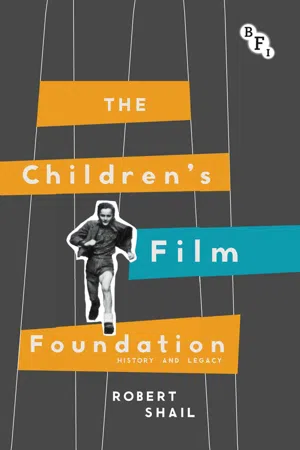
From the 1950s to the 1980s the Children's Film Foundation made films for Saturday morning cinema clubs across the UK - entertaining and educating generations of British children. This first history of this much-loved organisation provides an overview of the CFF's films, interviews with key backstage personnel, and memories of audience members.
Information
1 The Story of the Foundation
The story of the Children’s Film Foundation spans four decades and provides a fascinating snapshot of social and cultural change in Britain, particularly in relation to evolving attitudes towards children and childhood. In their films, those at the CFF tried to address children in their own terms and at eye level, but often ended up reflecting their own conceptions of childhood as much as they responded to the children’s viewpoint. Along the way issues such as class, gender roles and ethnic diversity were reflected in the Foundation’s output, albeit largely unconsciously, with the CFF sometimes lagging behind the wider society and then rushing to catch up in its later years. The Foundation’s story also reveals much about the changing nature of film production in Britain as the organisation drew on personnel from the industry both behind and in front of the camera. Changes in the financial structure of the industry and the vagaries of various governments in their attitude to cinema are reflected in its history. The rapidly growing impact of television was another key factor, with the Foundation initially keeping its distance but eventually being forced to acknowledge the altered environment in which it worked, a fact finally reflected in its metamorphosis into the Children’s Film and Television Foundation in the early 1980s. Just as it needed to update its storytelling methods over the course of thirty-five years, the images it created mirrored a nation’s changing fortunes, seen at first in the 1950s still recovering from the deprivations of war and then experiencing successive economic fluctuations. The comparatively empty streets of the postwar era are soon filled with parked cars, as high-rise blocks appear on former bombsites and are then demolished themselves to make way for newer developments. Short back-and-sides is replaced by long hair for both sexes, and shirts and ties disappear as flared jeans become de rigueur. A whole history of everyday life is played out for us in the grain of these films.
This is the story of a unique institution, much imitated subsequently around the world, but pioneering in its own way. The stories it chose to tell reached succeeding generations of British children and those beyond the UK, leaving a mark into adulthood. The following account draws on archival materials and press coverage of the Foundation held by the British Film Institute. Some of the Foundation’s records still remain unexamined and awaiting full access but the materials currently available yield more than sufficient sources to construct a detailed account of its work.
Children’s cinema before the CFF
In order to understand how the Children’s Film Foundation came into being we need to briefly trace the development of children’s film-going in Britain through to the 1940s. In doing so we can see how pressures grew on the industry to regulate the way it catered to a young audience and provided a context for the creation of the CFF. According to Terry Staples, whose book All Pals Together: The Story of Children’s Cinema (1997) remains an invaluable guide to the history of children’s film-going in the UK, the first screenings specifically devoted to children can be traced back to at least 1900.1 As he puts it, ‘the showmen’s approach was straightforwardly commercial and exploitative’, with marketing specifically directed at the target audience. Children’s screenings began to proliferate as cinema managers realised that this was an advantageous way of making use of an auditorium in timeslots that would otherwise be empty. This explains in part the tendency to screen films for children on Saturday mornings, generally an idle time for most cinemas. The other reason was that it was a time when most children were free to attend; screenings on a Sunday morning would have been likely to provoke disapproval from church groups. School holidays could provide further screening opportunities. The more formal organisation of a regular Saturday morning screening specifically for children, rather than an ad hoc arrangement, is usually credited to the Granada chain and began in 1927.
An early aspect of these screenings, which was to become crucial for the creation of the CFF, was the insufficient care taken by some cinema managers regarding both the content of the screenings and, on occasions, the actual organisation of them. Failures in the latter led to a series of appalling accidents, including one during a touring cinema show at the Harvey Institute in Barnsley on Saturday, 11 January 1908, where sixteen children suffocated to death in a mêlée on a stairwell. The problem persisted unabated right through the 1920s until the worst cinema disaster involving children took place on 31 December 1929 at the Glen, Paisley when seventy-five children died in a panic following a minor fire in the projection booth; only one member of staff was supervising the screening at the time. These disasters brought public attention to the unregulated nature of children’s screenings. As the 1930s progressed, and such incidents fortunately ceased, these understandable anxieties were overtaken by concerns about the content of the shows.
Staples meticulously charts the increasing furore over what was being screened to children from 1909 through to the early 1940s. This concern was initially voiced via local authorities using the Cinematograph Act of 1909, which had actually been designed to improve physical safety in cinema buildings, to refuse licences on issues of programme content, thereby widening the remit of the Act to include the moral health of patrons. An attempt by the industry to challenge this was defeated in the High Court with the consequence that the floodgates were opened to a range of individuals and pressure groups who besieged their local licensing authorities with complaints over the screening of material they saw as inappropriate.2 Many of the organisations pushing for reform had a specific religious agenda and focused on what they saw as the untoward effects of cinema on the behaviour of children. They were particularly alarmed at what they perceived as the increasing lack of respect shown by youngsters towards traditional values and those in authority. It is certainly the case that there were cinema managers who paid little attention to what was screened at the children’s shows, often simply shifting films over from their general screenings without much thought. The ‘U’ certificate issued by the British Board of Film Censors (BBFC),3 now often associated specifically with children’s films, was then widely used for any film which did not fall into the only other available category, the ‘A’ certificate, which served to indicate content more suitable for adults. The result was that the content of ‘U’ films could be very varied. However, the objections raised often reveal more about the anxieties of the adult groups making them than the actual nature of the films. A common target, for example, was the increasingly large number of films coming into the UK from the US whose only sin appears to have been that they weren’t British.4
A series of public inquiries into the content of children’s screenings followed and continued throughout the interwar era. One of the first was undertaken by the National Council for Public Morality in 1917 and focused on children in London. Its report actually came down on the side of the industry, making only gentle recommendations that more films be made with children specifically in mind. The arrival of sound at the end of the 1920s seemed to intensify concern and no fewer than five different inquiries were mounted in London, Birmingham, Sheffield, Birkenhead and Edinburgh. These inquiries were largely inconclusive, resulting in often contradictory recommendations but, as Terry Staples shows, critics of children’s screenings could select from the different reports the elements which seemed to support their case and use them judiciously to further their cause.5 This included some Conservative MPs who kept the controversy rumbling on across the decade. However, the only two concrete regulatory changes to take place were a Home Office circular in 1933, which urged cinemas in England and Wales to display film classifications more prominently and a recommendation to the BBFC to introduce a new category for horror films, the ‘H’ certificate, which it duly instigated.
Nonetheless, by the late 1930s some producers and exhibitors had started to respond to the general climate of approbation by making and/or showing films aimed exclusively at children. A good number of these were sponsored or organised by religious groups but they also included the Granada chain run by Sidney Bernstein. This scheme only ran for just over a year between 1928 and 1929 across a handful of cinemas in London – it seems to have petered out due to the unpopularity of the selected films – but it was effectively a model for the system which would be supported by the CFF from 1951 onwards. Ironically, the most influential model for the development of children’s screenings in the UK actually came from the US in the form of the Mickey Mouse Club. The particular innovation of the Club, which was subsequently franchised in Britain, was the inclusion in its programmes of a mix of short and feature items, along with competitions and other entertainments often overseen by a compere. Care was taken to select films designed to appeal to the intended audience and potential criticism was offset by such conceits as beginning every screening with the singing of the national anthem. Crucially, the Mickey Mouse Club both appeased the moral campaigners and provided a new stream of revenue for cinemas.
A number of British cinema chains began to ape this format, including the Union circuit. This was then taken over by the ABC cinema chain, which developed Union’s clubs into the ABC Minors from 1937 onwards. Many of the respondents to the audience survey which I carried out for this study (see Chapter 4) could still recite word for word the song of the ABC Minors club:
We are the boys and girls well known as
Minors of the ABC,
And every Saturday all line up
To see the films we like and shout aloud with glee,
We like to laugh and have our sing-song
Just a happy crowd are we-e
We’re all pals together
We’re Minors of the ABC!
The success of the ABC Minors, with its membership cards, sing-alongs, prizes and well-selected programmes, soon led to imitations from other chains such as Gaumont. The Odeon chain tried its own version but then took the expedient step of simply licensing the American Mickey Mouse Clubs for the UK market. It was during this period, and through the years of World War II, that the basic format for the Saturday morning clubs solidified into a formula. The elements which made this up will be discussed later in this chapter.
The development of an organised system of children’s film screenings during the 1930s indicated the commercial viability of such a model but did little to stop the flow of criticism or the plethora of public inquiries, which ran on well into the 1940s.6 Characteristic of these is an article published in The Times in 1946 written by the sociologist J. P. Mayer. Many of Mayer’s criticisms were the same as had been voiced for the previous twenty years, but a key one was his assertion that simply not enough films were being made with a specific audience of children in mind.7 Further regionally based reports followed, along with more letters to The Times, and a conference organised in part by the British Film Institute. Concerns were intensified by the more general focus of the press in the immediate postwar period on the problem of juvenile delinquency. The debate eventually reached the House of Commons in the winter of 1946, although there remained no consensus over what action, if any, should actually be taken. There appears to have been little desire within government for any form of legislative intervention.
The industry itself, however, was increasingly keen to forestall such an eventuality and therefore took steps to respond to the public criticism. Central to this response was J. Arthur Rank who, by the early war period, had acquired ownership of the Gaumont chain to put alongside his Odeons, giving him a national network of cinemas totalling 600, most of which had Saturday children’s clubs. In 1943 he established the unified Odeon National Cinema Club with its motto of ‘Uplift with a smile’ and Mickey Mouse was banished. With his background as a Methodist and a Sunday School teacher, it is perhaps unsurprising that he recognised the clubs’ potential as a moral beacon, as well as the commercial possibilities. As Geoffrey Macnab puts it, Rank ‘wanted to entertain the youngsters, lure them to the cinema at a tender age so that the habit stuck … thereby helping to bolster his box-office receipts’, while also being keen ‘to inculcate youth with “good Christian values”’8. The new clubs the Rank Organisation created had their own song and a creed printed on the back of membership cards which included telling the truth, obeying your p...
Table of contents
- Cover
- Title Page
- Dedication
- Contents
- Acknowledgments
- Introduction
- 1. The Story of the Foundation
- 2. The Films
- 3. The Personnel
- 4. The Audience
- 5. The Legacy – The Children’s Media Foundation
- Conclusion
- Appendix 1: Production Chronology
- Appendix 2: Further Reading
- Appendix 3: The Cinemas
- Index
- eCopyright
Trusted by 375,005 students
Access to over 1.5 million titles for a fair monthly price.
Study more efficiently using our study tools.
Frequently asked questions
Yes, you can cancel anytime from the Subscription tab in your account settings on the Perlego website. Your subscription will stay active until the end of your current billing period. Learn how to cancel your subscription
No, books cannot be downloaded as external files, such as PDFs, for use outside of Perlego. However, you can download books within the Perlego app for offline reading on mobile or tablet. Learn how to download books offline
Perlego offers two plans: Essential and Complete
- Essential is ideal for learners and professionals who enjoy exploring a wide range of subjects. Access the Essential Library with 800,000+ trusted titles and best-sellers across business, personal growth, and the humanities. Includes unlimited reading time and Standard Read Aloud voice.
- Complete: Perfect for advanced learners and researchers needing full, unrestricted access. Unlock 1.5M+ books across hundreds of subjects, including academic and specialized titles. The Complete Plan also includes advanced features like Premium Read Aloud and Research Assistant.
We are an online textbook subscription service, where you can get access to an entire online library for less than the price of a single book per month. With over 1.5 million books across 990+ topics, we’ve got you covered! Learn about our mission
Look out for the read-aloud symbol on your next book to see if you can listen to it. The read-aloud tool reads text aloud for you, highlighting the text as it is being read. You can pause it, speed it up and slow it down. Learn more about Read Aloud
Yes! You can use the Perlego app on both iOS and Android devices to read anytime, anywhere — even offline. Perfect for commutes or when you’re on the go.
Please note we cannot support devices running on iOS 13 and Android 7 or earlier. Learn more about using the app
Please note we cannot support devices running on iOS 13 and Android 7 or earlier. Learn more about using the app
Yes, you can access The Children's Film Foundation by Robert Shail in PDF and/or ePUB format, as well as other popular books in Mezzi di comunicazione e arti performative & Film e video. We have over 1.5 million books available in our catalogue for you to explore.