- 192 pages
- English
- ePUB (mobile friendly)
- Available on iOS & Android
eBook - ePub
About this book
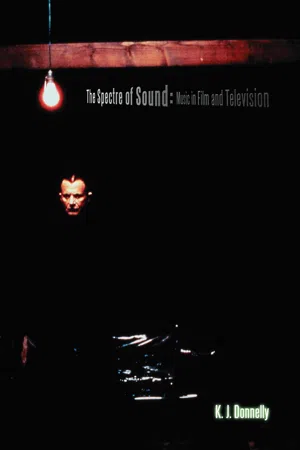
This book is a major new study - dealing with notions of film music as a device that desires to control its audience, using a most powerful thing: emotion. The author emphasises the manipulative and ephemeral character of film music dealing not only with traditional orchestral film music, but also looks at film music's colonisation of television, and discusses pop music in relation to films, and the historical dimensions to ability to possess audiences that have so many important cultural and aesthetic effects. It challenges the dominant but limited conception of film music as restricted to film by looking at its use in television and influence in the world of pop music and the traditional restriction of analysis to 'valued' film music, either from 'name' composers' or from the 'golden era' of Classical Hollywood. Focusing on areas as diverse as horror, pop music in film, ethnic signposting, television drama and the soundtrack without a film- this is an original study which expands the range of writing on the subject.
Information
Chapter 1
Overview – 'Birdie Sings, Music Sings'
The vast majority of us already know much about film music, even if we never take any notice of it. We can recognise musical clichés, the jaunty tune that appears during a happy scene, the sombre dirge that accompanies a funereal situation. These have become internalised in us to the point that we never really think about them. Yet music on film and television increasingly has become a subject of general interest and of commerce. Now it is possible to buy CDs of old theme tunes and old film scores that have never before been available, while many films and television programmes include the release of musical recordings as an essential part of their production. Apparently, soundtrack album sales increased threefold during the 1990s.1 This is even more remarkable, as it has taken place against a background of consistently falling record sales overall. While I am interested in film music – and to a lesser degree its close cousin television music – as soundtrack CDs, existing outside films as cultural items and commodities in their own right, I am most interested in screen music as a unique phenomenon 'inside' films and television. It is the only element of film that emanates from outside the film's diegetic world, its 'reality'. As such, it can seem like an artificial element, a vestige from the past or a sop to the MTV generation's desire to watch pop videos in the middle of films.
This book's central concern is with film and television music as scores (also known as underscores, background music, incidental music, non-diegetic music) rather than as featured music performed on screen.2 It focuses on how music works as a subtle medium of manipulation, which, while not consciously registered, undoubtedly exerts a considerable influence on film and television audiences. I am interested in music's apparent but consistently underrated role of invoking emotion in the viewer, where it becomes the carrier of the audience's primary reactions and emotional frailty. Consequently, I am concerned with how film music constitutes a system of control based on its ability to affect audiences in a significant manner,3 and to assent to or validate their emotional reactions.4 Sound and music have been central components of behaviour-control techniques and experiments, and deserve a sustained study of the aesthetics and effects of music applied to moving images. This would be a massive project; more sustained than I intend to offer here. I am an aesthetic historian who is interested principally in the way that film and television music is all-pervading and aims to control the audience in its psychological processes, its symbolic undercurrents and through its status as one of the most potent forms of non-verbal communication.
As music can appear ephemeral, emotional and irrational, attempts to account for what it does and how are invariably unsatisfactory. It is far easier to talk about its mechanics and 'rules' of construction than deal with its 'psychic life', as a living organism that touches the emotions of its listeners. As Caryl Flinn rightly notes, 'The problem facing film music scholars is how to talk concretely and specifically about the effects generated by a signifying system that is so abstract.'5 I am not simply interested in describing the music and film, delineating how they were composed, shot and put together. Someone else can outline that process if they so desire. I am concerned with the fact that the combination of music and the moving image is always more than the sum of its parts. It is never merely the vital aspects of the shots and the music; they become a totally different genus when unified. It matters to me how film music works and why it is effective, and how far it can be interpreted as an ethos or aesthetic that is based primarily on the notion of effect. This study will be historically inspired, looking at music accompanying the moving image as an object that has transformed over time, although I will be concerned primarily with the phenomenon of film music, a more unchanging aspect of the overall mechanism.6 A notable aspect of this is its central role in manifesting and maintaining the authority of film narration, while being a paramount device for attempting to control and discipline the audience in a most subtle manner. Yet while film music traditionally has been conceived as part of narration, working for film narrative, in some ways it would be better to see it as part of the film's repository of special effects.
I hope this book will go some way towards allowing a re-conception of cinema and television as sonic media. Developments in film sound over the past few decades have extended film music's spatial distance from other sounds, thereby giving it more prominence, a sense of unity and, most importantly, integrity. Increasingly, this has rendered the diegetic/non-diegetic divide irrelevant, in that music now often occupies a distinct space of its own anyway. In addition to this, technological and aesthetic developments have resulted in the 'musicalising' of sound more generally. Sound designers use musical instruments (synthesizers, samplers) and equipment, and now rethink sound design less in terms of a 'realistic' sound mimesis, and more as an aesthetic possibility – therefore, in more musical terms. This is hardly surprising, as music is all about organised sound, as exemplified by avant-garde music of the mid- and late 20th century. The fact that music predates established sound design meant that it had a whole technical language available for use in film, including ideas and aesthetics as well as hardware.
Some readers may have difficulty with my approaches to film and television, and to music in this book. This is preferable, however, to the sort of indifference that regularly greets safe scholarly works of data. This book is not, for instance, an appreciation of great film music, a sociological analysis of film music, a close look at the construction of music that has appeared in or been written for films, a production history, an account of context and reception or a description of the notes and how they were played. Whole areas of film music are left out of this book. Instead, it provides a 'long shot', allowing the sort of synoptic view unavailable to detailed analysis, rather than the predominant 'close-up' of many preceding film music studies. It is a rumination, an investigation of some of the elusive and fascinating aspects of screen music. Its grounding is in the concrete aesthetic facets of music in relation to the screen (and the screen in relation to music). Some of the investigations may be 'incomplete' or partial – however, this does not aim to be a full account, but rather intends to touch on many, but not all, areas of film music, in a manner that will stimulate rather than foreclose debate.
Aesthetic Power
In an episode of The Twilight Zone entitled 'A Piano in the House' (1962, CBS), Barry Morse plays a misanthropic theatre critic who buys a player piano for his wife. As it plays different pieces of music (such as Debussy's Clair de lune and Brahms's Lullaby), people begin to act unusually and reveal their true feelings, their demeanours changed by the particular character of the music. While screen music is perhaps not quite this persuasive, unquestionably it aspires to be so. There are correspondences with the way that television advertisements endeavour to influence us, changing our behaviour and regulating us to suit their purposes. As a form of control, this is not a pyrrhic, heavy-handed Orwellian Big Brother, but simply a desire to induce particular audience behaviour. At least, this is usually the case. Certainly, screen culture is equally aware of music's power. In the opening episode (entitled 'Arrival') of the cult British television serial, The Prisoner (1966–7, ITC), there is a moment that self-consciously foregrounds the process of screen music, commenting both on the phenomenon and convention of incidental music. A large hatch opens, allowing Number Six (Patrick McGoohan) to see his 'new home' for the first time. As he enters the apartment, some saccharine orchestral music starts, quietly at first, as he reads a welcome note and peruses a map that provides no information about the possibility of escape from 'the Village'. Ths could easily be the sort of non-diegetic background 'filler' music that audiences have been accustomed to hearing when a sequence is devoid of dialogue.7 However, slowly it begins to dawn on us, the audience, that Number Six can hear the music too.8 The music takes on a more anempathetic character,9 trying to drown the concerned state of the only character on screen with a soup of sweet strings that persists and begins to grow in volume. Clearly becoming more perturbed by the music, Number Six begins searching for its point of origin. After a brief search, he locates the speaker that appears to be the diegetic source of the music. He lifts it above his head, smashes it on the floor and then stamps on it, breaking it into pieces. The music persists, unaffected by his attack. It clearly has its origin elsewhere. We, the audience, are as confused as Number Six. A maid enters the flat and he shouts at her, 'Where's it coming from? How do you stop it?' When she replies that she does not know, he interrupts her with the demand, 'Who runs this place?' This sequence demonstrates our ambiguous and uncertain relationship with screen music. The Prisoner has dramatised our position as the audience, illustrating our assumptions about background music, its insinuation into our minds, and our inability to understand why and from whence it attempts to control us. This emblematises screen music as control, and as an integral element of the oblique focus of the whole television series on control, power, mind games, disciplining and surveillance.10
There can be no doubt that music is a powerful force that attempts to configure its hearers. Tia DeNora notes that music 'serves to organize its users'11 and that
music may imply and, in some cases, elicit associated modes of conduct. To be in control, then, of the soundtrack of social action is to provide a framework for the organization of social agency, a framework for how people perceive (consciously or subconsciously) potential avenues of conduct. This perception is often converted into conduct per se.12
This could almost be a description of film music: the social aspects of music's power are redoubled in the cinema. Royal S. Brown notes that we cannot ignore the manipulative aspect of film music,13 wh...
Table of contents
- Cover Page
- Title Page
- Contents
- Acknowledgments
- Chapter 1: Overview – 'Birdie Sings, Music Sings'
- Chapter 2: The Demon of Film Music
- Chapter 3: The Anti-Matter of Film Music: The Shining
- Chapter 4: The Accented Voice: Ethnic Signposts of English, Irish and American Film Music
- Chapter 5: Demonic Possession: Horror Film Music
- Chapter 6: Music on Television 1: Music for Television Drama
- Chapter 7: Music on Television 2: Pop Music's Colonisation of Television
- Chapter 8: Soundtracks without Films
- Chapter 9: Loose Ends and Last Words
- Bibliography
- Index
- eCopyright
Trusted by 375,005 students
Access to over 1.5 million titles for a fair monthly price.
Study more efficiently using our study tools.
Frequently asked questions
Yes, you can cancel anytime from the Subscription tab in your account settings on the Perlego website. Your subscription will stay active until the end of your current billing period. Learn how to cancel your subscription
No, books cannot be downloaded as external files, such as PDFs, for use outside of Perlego. However, you can download books within the Perlego app for offline reading on mobile or tablet. Learn how to download books offline
Perlego offers two plans: Essential and Complete
- Essential is ideal for learners and professionals who enjoy exploring a wide range of subjects. Access the Essential Library with 800,000+ trusted titles and best-sellers across business, personal growth, and the humanities. Includes unlimited reading time and Standard Read Aloud voice.
- Complete: Perfect for advanced learners and researchers needing full, unrestricted access. Unlock 1.5M+ books across hundreds of subjects, including academic and specialized titles. The Complete Plan also includes advanced features like Premium Read Aloud and Research Assistant.
We are an online textbook subscription service, where you can get access to an entire online library for less than the price of a single book per month. With over 1.5 million books across 990+ topics, we’ve got you covered! Learn about our mission
Look out for the read-aloud symbol on your next book to see if you can listen to it. The read-aloud tool reads text aloud for you, highlighting the text as it is being read. You can pause it, speed it up and slow it down. Learn more about Read Aloud
Yes! You can use the Perlego app on both iOS and Android devices to read anytime, anywhere — even offline. Perfect for commutes or when you’re on the go.
Please note we cannot support devices running on iOS 13 and Android 7 or earlier. Learn more about using the app
Please note we cannot support devices running on iOS 13 and Android 7 or earlier. Learn more about using the app
Yes, you can access The Spectre of Sound by Kevin Donnelly in PDF and/or ePUB format, as well as other popular books in Media & Performing Arts & Film & Video. We have over 1.5 million books available in our catalogue for you to explore.