- 240 pages
- English
- ePUB (mobile friendly)
- Available on iOS & Android
eBook - ePub
About this book
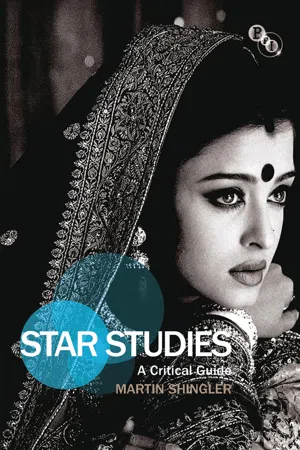
Martin Shingler presents the mother volume for Palgrave's Film Stars series in three easily-navigable chapters in which he provides a summative and instructive account of star studies for today's film student. Via a critical evaluation of the work of leading film scholars, he provides a convincing argument for howthis important area of film studies has evolved. Building on this, he offerssome new directions for star scholarship, and ends by offering the film student a useful set of themes and issues for his or her own investigation. 'Star Studies' is the perfect companion for the student who wishes to foster further research on stardom across a wide range of contexts, from national cinemas, to mainstream and marginal cinemas, to different historical periods and beyond.
Trusted by 375,005 students
Access to over 1.5 million titles for a fair monthly price.
Study more efficiently using our study tools.
Information
1 STAR STUDIES: MAPPING OUT THE FIELD OF STAR SCHOLARSHIP WITHIN FILM STUDIES
Introduction
Film stars attract attention. They also play a seminal role in the production and marketing of movies, often accounting for a large proportion of a film’s budget. Stars are used to secure funding for films due to the belief that they make a significant contribution to the potential profitability of movies in an otherwise unpredictable market. Many films are produced as ‘star vehicles’, showcasing the star’s talent, capitalising on both their acting skills and their public persona. Stars are so vital to the overall operation and success of the film industry that their popularity is closely and systematically monitored. ‘Bankable’ stars are highly sought after and excessively well remunerated. Many of the world’s top stars have a large international fan-base, while most of the major film-making countries have produced stars of international standing. Some stars have even been used to represent national characteristics within the global economy of the mass media, their fame extending well beyond the confines of the cinema via newspaper and magazine journalism, the internet, and television and radio appearances. Tabloid newspapers and lifestyle magazines are heavily dominated by images, stories and speculation about film stars, as are television chat shows and internet websites.

Susan and God (1940), starring Joan Crawford (on right) with Rose Hobart (on left) in gowns by Adrian
Given the importance of stardom within the film industry and popular culture generally, it is not surprising that the academic study of stars has become one of the most important branches of film studies. This area of film scholarship has proliferated since the publication of Richard Dyer’s Stars in 1979, this book precipitating a ‘seismic shift in the way in which star studies were perceived’ (Hollinger 2006: 35). Dyer’s combination of semiotics and sociology produced the ‘star text’ and stimulated considerable interest in star images across films, publicity and promotional materials. Meanwhile, Dyer’s Heavenly Bodies: Film Stars and Society (1987) drew increasing attention to the interpretive activities of audiences, mainstream and marginal (e.g., the black and gay communities), with its illuminating case studies of Marilyn Monroe, Paul Robeson and Judy Garland. The first anthologies of star studies appeared in 1991 in Britain and the United States, Christine Gledhill’s Stardom and Jeremy Butler’s Star Texts, both containing extracts of Dyer’s work as well as essays inspired by his approach. These collections promoted high-level scholarship on stars, demonstrating that star studies had become a legitimate area of academic enquiry.
This chapter provides an overview of the key works within star studies, highlighting the major trends within this branch of film studies, charting the way in which it became increasingly international, moving from theory to history and from the general (i.e., stardom as an industrial and cultural phenomenon) to the specific (i.e., case studies of particular stars). The focus here is less on stars and more on the academic literature about stars and stardom. While outlining the key themes and methodology of Richard Dyer’s ground-breaking book, this chapter also considers the work of scholars that preceded and influenced Stars, as well as discussing the contribution of scholars that have subsequently advanced research on stardom.
Star studies
While the origins of star studies as a distinctive branch of film studies can be traced back to the late 1970s, the following decades represented a rich and volatile period of growth and development, one that finally settled into a period of consolidation at the end of the 90s. Prior to this consolidation, star studies was fragmented, its methods and terminology being contested, as numerous leading exponents sought to stake out their own territory.1Writing in 1998, Jeremy Butler stated that star studies was ‘still in a rather embryonic state’ (Butler 1998: 352). This was the year that a new edition of Dyer’s Stars was published, while a section on stardom was included in The Oxford Guide to Film Studies (edited by John Hill and Pamela Church Gibson, 1998). Star studies really came of age, however, at the start of the twenty-first century. In 2000, a section on stars was included in The Film Studies Reader (edited by Joanne Hollows, Peter Hutchings and Mark Jancovich), while Paul McDonald’s The Star System, Ginette Vincendeau’s Stars and Stardom in French Cinema and Ulrike Sieglohr’s edited collection Heroines without Heroes augmented an expanding body of literature on stars and stardom. The latter two publications, along with Bruce Babington’s edited collection British Stars and Stardom (2001), were instrumental in broadening the international scope of star studies by raising the profile of European stars and identifying the distinguishing characteristics of stardom in specific national contexts. Indeed, Babington’s book set its face squarely against the ‘Hollywoodcentric film theorists’ in an effort to undermine the orthodox accounts that had assumed that the characteristics of the Hollywood star system pertained equally in other national contexts (Babington 2001: 3).
In the twenty-first century the ‘Hollywoodcentric’ approach to star studies has slowly broken down, with some of the most original work being produced by European scholars on European stars, from Erica Carter’s Dietrich’s Ghosts (2004) to Tytti Soila’s edited collection Stellar Encounters (2009).2 The latter, in particular, draws together a diverse selection of essays on European film stars, including those of Greece, Finland and Scandinavia, in a bid to redress the Anglo-American bias. In addition to challenging the notion of Hollywood as the originator of the star system, this book focuses largely on the relationship between stars and nationhood, the ways in which stars embody national characteristics and represent specific moments within a nation’s history. Meanwhile, research on non-western stars has appeared in published collections,3 culminating in the first major publications in English devoted exclusively to non-western stars: most notably, Neepa Majumdar’s Wanted Cultured Ladies Only! Female Stardom and Cinema in India, 1930s–1950s (2009) and Chinese Film Stars (edited by Mary Farquhar and Yingjin Zhang, 2010). While the former extends the work of Richard Dyer with a detailed and authoritative examination of female stardom in Indian sound cinema prior to 1960, the latter provides an historical account of stars from various Chinese territories (including Taiwan and Hong Kong), from the silent era through to the end of the first decade of the twenty-first century, with many of its contributors subjecting the images of Chinese stars to a Dyerian analysis.
In order to be selective and focused, a number of star studies have used case studies as the basis for exploring various aspects of stardom, such as Karen Hollinger’s The Actress (2006), Jeanine Basinger’s The Star Machine (2007) and Mia Mask’s Divas on Screen (2009). The increasing amount of material available on stars by the end of the 1990s gave star scholars greater scope to focus their research on more detailed investigation into the work, image and appeal of a single star. This is certainly part of the rationale behind the Star Decades: American Culture/American Cinema series edited by Adrienne L. McLean and Murray Pomerance for Rutgers University Press.4 These books consist of between ten and twelve chapters written by different authors, each examining the work of a star or combination of stars within a particular decade. The stars included here are taken to be representative of Hollywood cinema and American culture of the time, with each volume offering a wide-ranging look at various types of star for a specific era. Within a short space of time, this series of books has dramatically expanded the range of scholarship on Hollywood stars from the silent, classical, post-studio and contemporary periods.
Academic books devoted to the examination of the work, image and appeal of an individual star, however, still remain something of a rarity in film studies. Adrienne L. McLean’s Being Rita Hayworth: Labor, Identity, and Hollywood Stardom (2005) is a notable exception, one that has been highly influential in various ways, paving the way for the gradual expansion of the single star study within academic publishing. This investigation into the discursive nature of the films, image, publicity, performances and business interests of the popular star of Hollywood musicals and crime melodramas of the 1940s and 50s, Rita Hayworth, expanded Richard Dyer’s work on star images, publicity and promotion, making more extensive use of archival materials than previous studies of the star (i.e., using scrapbooks, press books, fan magazines and newspaper reviews from various archives and libraries). A significant part of the project was the re-evaluation of Hayworth’s talents as a performer (i.e., as an actress, singer and dancer) through detailed scrutiny of her screen performances but also by investigating her working relationships with choreographers. This provided detailed examination of female stardom in classical Hollywood that challenged many of the established claims about Hayworth, establishing her professionalism and autonomy.
In 2007, Lisa Downing and Sue Harris stated that, ‘very few single case studies existed in the field of academic publishing’ (Downing and Harris 2007: 11).5 They suggested that one of the main reasons for this was the widespread publication of nonacademic books on film stars, noting that many film academics were concerned to distinguish their work from industry-based, fan-based and biographical material. Nevertheless, they insisted that studies devoted to the work of a single star provide a useful way of reading star images. A single star case study, they point out, enables one to examine the work of a star both in and beyond their own national cinema, in relation to a variety of directors, and across a body of work that appeals to a range of audiences. It also enables a scholar to detect and explore ‘the developments, breaks and lines of continuity that constitute her image over the course of a career’ (Downing and Harris 2007: 8). Thus, in their own book, they note that a ‘careful look at [Catherine] Deneuve as star image, both on-screen and off-screen, over a period of forty years, reveals previously undiscussed instances of prescience, lines of continuity and ignored fractures in her trajectory’ (ibid.). Since the publication of their book, other single star studies have been published (e.g., Amy Lawrence’s The Passion of Montgomery Clift, 2010a), while many more are anticipated as part of the British Film Institute’s Film Star series.
Star studies before Stars
Richard Dyer’s Stars brought together numerous studies of film stardom, along with work on gender and film, synthesising and advancing existing claims, while introducing his own ideas.6 A number of the key studies upon which he drew had emerged in Europe (most notably, France) in the late 1950s and early 60s, including Roland Barthes’s Mythologies and Edgar Morin’s Les Stars, both published originally in French in 1957. Susan Werner has observed that Morin’s study initially generated little interest from scholars in contrast to Roland Barthes’s, although it received new attention and admiration in the 1990s (Werner 2007: 27). Morin borrowed freely from anthropology as well as Marxist theory in order to understand how film stars operated as myths within modern technological and urban societies, and his work on stars has been seen as a response to massive and rapid cultural changes in postwar France, a situation in which French stars played a major social role in the popular negotiation of the various contradictions resulting from the clash and co-existence of modernity and tradition (Gaffney and Holmes 2007b: 8). The major theme resonating throughout Les Stars is the mythic nature of stardom. For Morin, stardom is a myth produced by the reality of twentieth-century human history but ‘it is also because human reality nourishes itself on the imaginary to the point of being semi-imaginary itself’, hence his claim that ‘stars live on our substance and we on theirs’ (Morin 2005: 148). ‘Ectoplasmic secretions of our own being, they are immediately passed down the production lines of the great manufacturers who deploy them in galaxies stamped with the most distinguished trademarks’ (ibid.).
Morin describes stars as monstres sacrés (sacred monsters), venerated public individuals above or beyond criticism by ordinary mortals. For him, the star is both real and imaginary, of life and dream, born from a conjunction of capitalism, modernity and the mythology of love, all three factors determining ‘sacred monstrosity: the star’ (ibid.: 135). Existing simultaneously in two worlds, the ordinary and extraordinary, ‘the star straddles both sacred and profane, divine and real, aesthetic and magic’ (ibid.: 84). To describe the combination of a star’s extraordinary qualities and ordinariness, Morin employs the notion of the ‘superpersonality’, one that combines beauty and spirituality, one that ‘must unceasingly prove itself by appearances: elegance, clothes, possessions, pets, travels, caprices, sublime loves, luxury, wealth, grandeur, refinement’ (ibid.: 38). Morin also uses the term ‘marvellous’ to describe this state, arguing that ‘the stars bluff, exaggerate, spontaneously divinize themselves’ not just to attract publicity but also to be more like their ideal self, their double (ibid.: 55). The star’s mythic identity is built from a mixture of belief and doubt, while their power for audiences lies in their search for coherent identity, adult personalities being formed out of playful mimesis (e.g., games and role-play). For the public at large, stars offer ‘patterns of culture’ that ‘give shape to the total human process that has produced them’ (ibid.: 147). Whatever their precise role within the film industry, their importance, Morin insists, lies beyond that industry, in the wider culture in which stars are consumed and adopted as role models by all kinds of people: although chiefly, he claims, women and adolescents.
In many ways Morin’s book sowed the seeds of some of the most important debates within star studies: the quasi-religious nature of star worship, the importance of publicity and merchandising, the prominence of the star’s face and the importance of beauty and youth, the various levels of identification, the historical transformations in attitudes towards stars, and the distinctions between stars and characters, stars and lead actors, also between stars, pin-ups and starlets. While many of these points have subsequently been taken up by scholars (e.g., Jackie Stacey and Barry King), often little acknowledgment has been made regarding Morin’s origination of these topics, in part perhaps due to the hyperbolic nature of his writings that, for some considerable time, may have appeared to invalidate the academic credibility of his research.
Charles Affron’s writing on stars appears to have suffered a similar fate. When compared to academic writing on stars published after 1978, Star Acting (1977) seems allusive, hyperbolic and camp. This book contains many ideas that are worthy of academic consideration, particularly in terms of his interest in the dialectics of revelation and ambiguity, verisimilitude and abstraction, which provide a very useful starting point to a consideration of how stars act and how their performances are distinguished from those of other types of screen performer. Like Morin, he notes the celestial and religious vocabulary used to discuss film stars and also considers the role of fans in creating and sustaining stars.
The reverential and celestial vocabulary has been consecrated by decades of usage and press agency. The clichés’ first connotations effectively separate public from performer by an expanse of astral geography. The gods reign on high, the stars blink in the solar systems light-years away, and we mere mortals, worshipping at their shrines in blissful ignorance, celebrate the distance. (Affron 1977: 2)
Affron uses hyperbole here to convey the extraordinary emotions of being under a star’s spell, while simultaneously mocking and caricaturing the extremes of this situation in recognition of the fact that much of this is stimulated by publicists on behalf of a huge and powerful industry. When he writes that we ‘mortals are left clutching our wonder, and victims of that very wonder, overwhelmed by our enthusiasm and blinded by the light of the star’s emanation’, he evokes the various familiar, even hackneyed, tropes of melodrama (i.e., clutching, victims, overwhelmed, blinded), thereby creating some critical distance for himself as a scholar by using an obviously hyperbolic discourse (ibid.: 3). This is academic writing that is playful and daring but also, perhaps, rather fearful of attempting to make serious intellectual claims for film stars given that they could have been considered trivial within the context of academia in the late 1970s. Not surprisingly, therefore, Affron strays into camp, a discourse designed to take the trivial seriously, while rendering the serious trivial: for instance, when he writes that, films ‘are breathtakingly perched between the unequivocal reality of the photographic process and a style that is by definition magnifying, hyperbolic, and utterly frivolous in its relationship to everyday modes of perception’ (ibid.). It is camp that makes film’s provisional occupation of a space between reality and style breathtaking, just as it is camp that makes film’s relationship to everyday reality utterly frivolous.
The use of camp was both a radical and dangerous strategy in the 1970s, having the potential to invalidate scholarship, rob it of credibility, objectivity and authority. Imagine the reactions of scholars reading the following in 1977:
Coated with layers of makeup that obliterate blemish and dissymmetry, modelled by a miraculous array of lights, located and relocated by the giddy succession of frames, the stars capriciously play with life and subject it to a range of fictions from preposterous to profound. (Ibid.: 2)
How preposterous would scholars have found Affron’s elegant description of the allure of such classic Hollywood stars as Garbo and Dietrich, with his ‘giddy succession of frames’ and his ‘capriciously’ playful stars, particularly those most concerned with enhancing film’s reputation as a serious, intellectually demanding academic discipline within the humanities? It is perh...
Table of contents
- Cover
- Title Page
- Dedication
- Contents
- Acknowledgments
- Introduction
- 1. Star Studies: Mapping Out the Field of Star Scholarship within Film Studies
- 2. Methods: Ways of Analysing Screen Performance
- 3. Star Quality: In Search of the Prerequisites for Stardom
- 4. Star Systems: The Mechanics of Star Production
- 5. Star Identities: From Image to Persona and Publicity to Gossip
- 6. Unstable Symbols: On The Representativeness of Film Stars
- Conclusion
- Notes
- References
- Index
- List of Illustrations
- eCopyright
Frequently asked questions
Yes, you can cancel anytime from the Subscription tab in your account settings on the Perlego website. Your subscription will stay active until the end of your current billing period. Learn how to cancel your subscription
No, books cannot be downloaded as external files, such as PDFs, for use outside of Perlego. However, you can download books within the Perlego app for offline reading on mobile or tablet. Learn how to download books offline
Perlego offers two plans: Essential and Complete
- Essential is ideal for learners and professionals who enjoy exploring a wide range of subjects. Access the Essential Library with 800,000+ trusted titles and best-sellers across business, personal growth, and the humanities. Includes unlimited reading time and Standard Read Aloud voice.
- Complete: Perfect for advanced learners and researchers needing full, unrestricted access. Unlock 1.5M+ books across hundreds of subjects, including academic and specialized titles. The Complete Plan also includes advanced features like Premium Read Aloud and Research Assistant.
We are an online textbook subscription service, where you can get access to an entire online library for less than the price of a single book per month. With over 1.5 million books across 990+ topics, we’ve got you covered! Learn about our mission
Look out for the read-aloud symbol on your next book to see if you can listen to it. The read-aloud tool reads text aloud for you, highlighting the text as it is being read. You can pause it, speed it up and slow it down. Learn more about Read Aloud
Yes! You can use the Perlego app on both iOS and Android devices to read anytime, anywhere — even offline. Perfect for commutes or when you’re on the go.
Please note we cannot support devices running on iOS 13 and Android 7 or earlier. Learn more about using the app
Please note we cannot support devices running on iOS 13 and Android 7 or earlier. Learn more about using the app
Yes, you can access Star Studies by Martin Shingler in PDF and/or ePUB format, as well as other popular books in Media & Performing Arts & Film & Video. We have over 1.5 million books available in our catalogue for you to explore.