- 79 pages
- English
- ePUB (mobile friendly)
- Available on iOS & Android
eBook - ePub
To be or Not to be
About this book
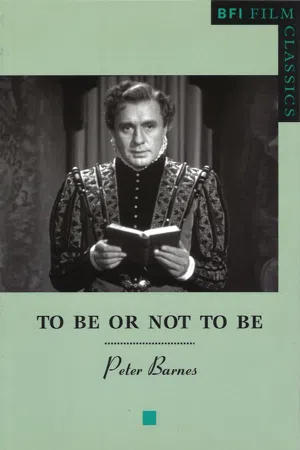
In 'To Be or Not to Be' (1942), Ernest Lubitsch brought his legendary comic touch to the most unpromising situation: life in Nazi-occupied Poland. In this study, Peter Barnes considers what it is to make comedy out of tragedy.
Information
'TO BE OR NOT TO BE'

In 1963 during its '100 Clowns' season, Jack Benny came to the National Film Theatre to talk about To Be or Not to Be.1 He told two stories about the film's director, Ernst Lubitsch.
Lubitsch had previously been a successful German silent film actor. On To Be or Not to Be, as on all his productions, he acted out every part in every scene before it was shot. According to Benny, he was funny but outrageously over the top. Of course, his cast never told him. In fact they were secretly delighted. Like actors everywhere, they all believed they could play their parts better than their director. He was clear and explicit – more often than not, over-explicit – but gave them great confidence by being so bad. Confidence is the one essential ingredient you must have in playing comedy and Lubitsch gave it to every actor he ever worked with.
Benny also recalled playing a scene and seeing Lubitsch, crouched down beside the camera with a handkerchief stuffed in his mouth to stop himself laughing. Comic business and witticisms (many of them his own) which he must have seen or heard dozens of times before, still sent him into fits of laughter. Benny remembered the incident, after over twenty years, as being the most inspiring in his movie career. He had made a number of films but their directors had never cracked as much as a smile before, during or after production. Maybe that was one of the reasons they are so poor.
The time between when the film was shot in late 1941, and released in 1942, was the very worst of times. In 1941, an unstoppable Hitler had smashed the Allies in the Middle East and was overrunning Russia and besieging Moscow; HMS Ark Royal was sunk, Sebastopol fell, Pearl Harbor was bombed and America entered the war, which was going very badly. The Japanese advanced across East Asia, taking Malaya and Singapore, while the Russians were fighting street by street in Leningrad, and thousands were dying daily. In January 1942, Himmler's right hand man, Reihard Heydrich, talked about the extermination of the Jews in the Final Solution and by March Jews were being deported to Auschwitz in Poland. Everything is Poland.
It is important to remember that no-one connected with To Be or Not to Be had the gift of prophecy. No-one knew that the Allies would win. In fact, it looked at this stage as if they might lose. This makes the film, among other things, an act of faith and courage, particularly as Lubitsch was one of Hitler's pet hates as an actor. The Nazis were very show-business-orientated, and Hitler had Lubitsch's face plastered on posters at railway stations as an example of a truly degenerate non-Aryan. There really is such a thing as bad publicity.
To produce a comedy about the Nazis' savage occupation of Poland, at a period when the world was engaged in a lethal struggle with rampant fascism, raises questions that are still relevant. For example, are there taboo subjects that cannot be dealt with comedically? Adorno wrote that you cannot write poetry after Auschwitz. What would he have said about writing comedy?
Actually I have personal knowledge of this dilemma. I wrote a theatrical comedy called Laughter! about the horrors of Auschwitz Concentration Camp. It asks the question, is laughter, even laughter that freezes in mid air, a legitimate reaction to events too terrible to contemplate, or just a convenient way of making sure we make no effort to stop them happening again? Is laughter truly cathartic or just an excuse to let injustice and oppression exist and do nothing?
More questions. Did Lubitsch and his scriptwriter, Edwin Justus Mayer, really know what was going on in Poland in 1941? Could they have only made a film of such pitch-black humour by being ignorant of the facts? Lubitsch himself answered this point in an article he produced for the New Yorker in answer to Bosley Crowther, the paper's dreary, middle-brow film critic, who was wrong on every major film he ever reviewed.
Lubitsch wrote:
I admit that I have not resorted to the methods usually employed in pictures, novels and plays to signify Nazi terror. No actual torture chamber is photographed, no flogging is shown, no close-up of excited Nazis using whips and rolling their eyes in lust. My Nazis are different: they passed that stage long ago. Brutality, floggings and torture have become their daily routine. They talk about it the same way as a salesman referring to the sale of a handbag. [A reference, perhaps, to Lubitsch's previous film in 1940, The Shop around the Corner.] Their humour is built around concentration camps, around the suffering of their victims ...2
Lubitsch obviously knew exactly what was going on in Europe in late 1941. By approaching the Nazis in this way he makes them ridiculously evil, instead of heroically evil.
Most tyrants, in and out of uniform, are banal. The absurd President Amin was a monstrous buffoon, Hitler, a blood-soaked Charlie Chaplin. Franco, Pinochet, Pol Pot, Kissinger, were all smaller and grubbier than legend, with bad teeth and smelly socks. Afterwards we ask how did they get such power and why were they obeyed? The answer is always the same; they got the power because we gave it to them to relieve us of any guilt, and they were obeyed because we wanted to obey them. Monsters are created and exist as convenient scapegoats. Men and women want to do what they do and the monsters provide them with a good excuse. They are blood-stained, sacrificial lambs. Lubitsch wrote to his informal biographer, Herman G. Weinberg in 1947:
Despite being farcical, To Be or Not to Be was a truer picture of Nazism than was shown by most novels, magazine stories and pictures which deal with the same subject. In those, the Germans are pictured as a people who were beleaguered by the Nazi gang and tried to fight the menace through the Underground wherever they could. I never believed in that and I definitely think that this so-called Underground spirit amongst the German people never existed.3
It takes a German or an Austrian to know the truth about their respective nations.
To Be or Not to Be also implies that if bone-headed incompetents like Colonel Ehrhardt (Sig Ruman), who regularly escapes from difficulties into disasters, can rise to be a Colonel in the Gestapo, what does this say about the calibre of the rest of the men below and above him? Ehrhardt is a monster but a recognisable monster. He is no Superman, and certainly has no special talents, except for always getting it wrong. He uses fear and lives in fear, sweating in a job too big for him. He is ourselves, dramatised.
Like Otto Preminger and Marlene Dietrich, Lubitsch was never fooled by the Germans. He knew them too well. Preminger told me a story that some time after the end of World War II, he finally forced himself to return to Berlin. The first morning he was walking outside his hotel, and found he kept passing middle-aged men who seemed to recognise him, and almost gave him an automatic 'Hitler' salute. Later he realised that a number of his wartime films, in which he always played Nazi officers, had been finally released in Germany. The befuddled Germans thought he was an old comrade. Preminger had only been doing a job, as a film actor, but the acting – the faking – had become a kind of reality for some of his audiences. His story confirms one of the central ideas of To Be or Not to Be – that it is impossible to separate real life from acting, especially if the acting is bad enough. In other words, it's all show-business.
Ernst Lubitsch was born on 28 January 1892, in Berlin, the son of a prosperous tailor. Naturally, all of Lubitsch's characters are immaculately dressed, especially the men. Lubitsch earned an apprenticeship with the famous Max Reinhardt Theatre Company, and made his acting début with them in 1911. It is interesting to note how many distinguished Hollywood directors started with Reinhardt. They included the oddball William Dieterle, director of Buñuel's favourite film, The Portrait of Jennie (1948), and the master of stylish American decadence, Douglas Sirk.
From 1914 to 1919, Lubitsch directed and acted in some twenty-seven crude shorts in which he played a greedy shop-boy called Mayer. These shorts are truly terrible; his performance in them is hammy, grating and by today's standards – by any standards – anti-Semitic. There is a complete absence of charm, wit and grace, qualities that were to become the very essence of the mature Lubitsch.
From then on, the only way was up. Lubitsch more or less forsook acting on the screen and confined himself to performing in the rehearsal room. But he always truly loved actors. He made films for them. This is not true of seventy-five per cent of film and theatre directors, who find actors an encumbrance that somehow has to be overlooked or dealt with. Most would prefer hand-puppets, then they could literally claim to do it all.
Lubitsch soon moved into full-time directing, trying everything from expressionist fantasies, romances, farces and comedies, including The Oyster Princess (1919) and I Don't Want to Be a Man [Ich Möchte Kein Mann Sein] (1919). He achieved his biggest success with large-scale, historical epics like One Arabian Night [Sumurun] (1920) and Madame Dubarry (1919).
By the time he left for America in 1923 to direct Mary Pickford in Rosita (1923), he had made fourteen features. He never made another picture outside America. Yet, perversely, he almost never made one set in his new-found land. Instead they were set in Lubitschland, a country of charm and sophistication, much like our own, only better, where the thieves, crooks and swindlers – particularly the thieves, crooks and swindlers – had impeccable manners and clean underwear. Lubitschland is a lost continent now, much like Atlantis, but then it never really existed, except in the generous heart of its creator.
In America, he only made romantic comedies and musicals except for a now lost, Tsarist melodrama The Patriot (1928) with Emil Jannings and the wan, pacifist piece The Man I Killed [Broken Lullaby] (1932). This later film was a flop. It is like watching one of Woody Allen's 'serious' films; worthy but depressing, two hours spent grinding your teeth.
I need hardly add that contemporary critics rather liked The Man I Killed. It was so relentlessly sincere. One of the problems with it, however, is that it could easily have been a comedy. The absurdist plot, whereby a young man, who has killed Lionel Barrymore 's boy, becomes the bereaved man's substitute son, is worthy of one of Lubitsch's intricate farces.
Lubitsch never tried 'serious' again and returned with relief to more frivolous and deeper matters, thereby ensuring he was true to his own greatness and made light of serious subjects like sex and money, love and death.
The director was always surprised that intellectuals treated comedy so dismissively as for...
Table of contents
- Cover
- Title Page
- Contents
- 'To Be or Not to Be'
- Notes
- Credits
- eCopyright
Trusted by 375,005 students
Access to over 1.5 million titles for a fair monthly price.
Study more efficiently using our study tools.
Frequently asked questions
Yes, you can cancel anytime from the Subscription tab in your account settings on the Perlego website. Your subscription will stay active until the end of your current billing period. Learn how to cancel your subscription
No, books cannot be downloaded as external files, such as PDFs, for use outside of Perlego. However, you can download books within the Perlego app for offline reading on mobile or tablet. Learn how to download books offline
Perlego offers two plans: Essential and Complete
- Essential is ideal for learners and professionals who enjoy exploring a wide range of subjects. Access the Essential Library with 800,000+ trusted titles and best-sellers across business, personal growth, and the humanities. Includes unlimited reading time and Standard Read Aloud voice.
- Complete: Perfect for advanced learners and researchers needing full, unrestricted access. Unlock 1.5M+ books across hundreds of subjects, including academic and specialized titles. The Complete Plan also includes advanced features like Premium Read Aloud and Research Assistant.
We are an online textbook subscription service, where you can get access to an entire online library for less than the price of a single book per month. With over 1.5 million books across 990+ topics, we’ve got you covered! Learn about our mission
Look out for the read-aloud symbol on your next book to see if you can listen to it. The read-aloud tool reads text aloud for you, highlighting the text as it is being read. You can pause it, speed it up and slow it down. Learn more about Read Aloud
Yes! You can use the Perlego app on both iOS and Android devices to read anytime, anywhere — even offline. Perfect for commutes or when you’re on the go.
Please note we cannot support devices running on iOS 13 and Android 7 or earlier. Learn more about using the app
Please note we cannot support devices running on iOS 13 and Android 7 or earlier. Learn more about using the app
Yes, you can access To be or Not to be by Peter Barnes in PDF and/or ePUB format, as well as other popular books in Media & Performing Arts & Film & Video. We have over 1.5 million books available in our catalogue for you to explore.