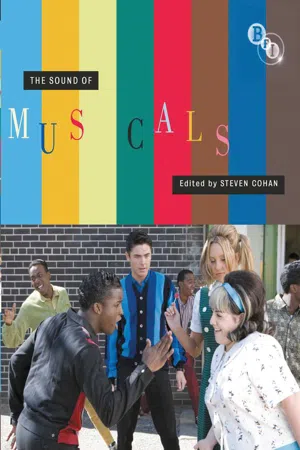
Despite having had its obituary written many times, the movie musical remains a flourishing twenty-first century form, and as this volume demonstrates, one that exists far beyond the confines of Broadway and Hollywood. The Sound of Musicals examines the films, stars, issues and traditions of the genre from the 1930s to the present day. Featuring sixteen original essays by leading international scholars, this illuminating collection addresses the complex history and global variety of the movie musical, and considers the delight and passionate engagement that musicals continue to inspire in audiences around the world.
The contributors address key issues for understanding the movie musical: questions of genre and generic traditions; questions of history, bringing fresh perspectives to a consideration of Classical Hollywood musicals; and the musical beyond Hollywood, looking at alternatives to the Hollywood model from the 'New Hollywood' and American independent cinema to Bollywood and other national musical traditions. Individual chapters consider key musical stars such as Frank Sinatra, Julie Andrews and Barbra Streisand; film-makers including Robert Altman and Christophe Honoré, and classic musicals such as South Pacific (1958) and Hairspray (1988). In his introduction to the volume, Steven Cohan addresses the significance and enduring appeal of this multi-faceted genre, and considers its recent renaissance with movies such as the High School Musical franchise, and the success of the television series Glee.
- 232 pages
- English
- ePUB (mobile friendly)
- Available on iOS & Android
eBook - ePub
The Sound of Musicals
About this book
Information
Rick Altman
This article takes a fresh look at the beginnings of Hollywood musicals. I argue that existing treatments of the musical are so attendant to endings and to synchronic analysis that the beginnings of musicals have been lost in the shuffle. What we discover by transferring our attention away from repeated conclusions and stable structures is altogether surprising, and of more than passing importance for our understanding of the cultural projects at work in the musical.
Assumptions regarding the relative importance of endings, as compared to beginnings, are widespread. From Frank Kermode’s classic The Sense of an Ending to the Conclusion (‘Endgames and the Study of Plot’) of Peter Brooks’s Reading for the Plot, academic critics have made a cottage industry of writing about conclusions. Not unlike the importance of deathbed conversions in certain religious traditions, endings somehow seem more meaningful, more important, more … final than other textual segments. There is a sense that endings have the power to transform all that came before. In terms of textual analysis, the danger lies not so much in the power of an ending to transform a beginning or a middle, but in the ever-present possibility that beginnings and middles will be forgotten or misremembered, hidden as they tend to be in the shadow of the ending. It’s not that endings are unimportant, it’s that the ending orientation of virtually all plot-based analysis enforces a sort of back-formation whereby beginnings and middles are read through endings, thereby robbing them of any potential independent importance they might have.
Musicals offer particularly strong incentives to attend to endings. Virtually every musical ends with a show-stopping number, designed to attract attention. Many musicals substantially expand this strategy, offering not one but a whole series of final numbers. The list includes such varied films as Footlight Parade (Bacon, 1933), The Gang’s All Here (Berkeley, 1943), Thousands Cheer (Sidney, 1943), The Band Wagon (Minnelli, 1953), The Glenn Miller Story (Mann, 1954) and Woodstock (Wadleigh, 1970). It is hardly surprising that illustrations of these and other comparable films often privilege finales. Of the two full-page illustrations that Bruce Babington and Peter William Evans dedicate to their chapter-long exemplary treatment of Easter Parade, one is predictably of the film’s final scene. A similar effect is produced by the freeze-frame two-shots that end so many musicals; because they encapsulate the plot’s conclusion, while providing a convenient image of both male and female stars, final freeze-frames often find their way into printed or video references to musicals. Academic analyses of musical films also regularly stress the film’s plot and the couple’s final clinch. In fact, even the growing group of critics who actively champion alternative approaches to the musical typically begin by recognising the importance of endings for our traditional understanding of the genre.
Critical attention to musical endings is not the only reason why the opening sections of musicals have been so regularly disregarded. An important contributing factor in the neglect of musical beginnings lies in the tendency of recent critics to apply the semiotics-inspired techniques of synchronic analysis to musicals. The more synchronic our analyses, the less access we have to the kind of diachronic concerns that might concentrate attention on the early portions of musicals.
A quick glance in the mirror reminds me that I am in all probability the culprit most responsible for skewing attention toward musical endings. A recent rereading of my book on The American Film Musical convinced me that the analytical strategies presented there, while illuminating certain questions and portions of the text, left others all too much in the shadows. For example, in reading , on ‘The Structure of the American Film Musical’, I noticed a repeated tendency to consider the notion of structure as purely synchronic in nature. Through the use of section headings like ‘Each separate part of the film recapitulates the film’s overall duality’, and ‘The basic sexual duality overlays a secondary dichotomy’, I was able to describe several essential structural features of the musical, but only to the extent that they fit comfortably into my overall dual-focus approach to the form. Recognising the musical’s repeated pairing of opposite-sex stars, dual-focus analysis allowed me to show how the members of the primary heterosexual couple regularly serve as the repository of paired but opposed cultural values, ultimately united through the couple’s eventual mating. For all practical purposes, this pattern sacrifices chronological considerations in favour of spatial pairings. With the exception of the final resolution, usually achieved through marriage of the principals, musicals are seen in this approach as stable and unchanging. While this analytical technique may offer substantial insight into each film’s synchronic system, it virtually forecloses access to diachronic analysis, especially with regard to earlier portions of the film.
My suspicions regarding the potential danger of an approach that closes as many options as it opens were compounded by the memory of a passage from an earlier article in which I made some quite specific claims about the relative importance of beginnings and endings. In response to David Bordwell’s claim that ‘of one hundred randomly sampled Hollywood films, over sixty ended with a display of the united romantic couple … and many more could be said to end happily’, I blithely affirmed – as part of a general claim that Hollywood beginnings are retrofitted to a pre-existing ending, to which the beginnings must appear to lead – that ‘it is safe to assume that, outside of formal similarities, the beginnings of Hollywood films have no such common content’. On what basis I made this claim I have no idea. Instead of contesting the apparent tyranny of endings by careful analysis of beginnings, I simply assumed that there would be nothing to be gained by looking closely at beginnings, of musicals or of any other Hollywood genre.
The kind of synchronic analysis championed by The American Film Musical treats musicals as structured by a simple and thus mnemonically satisfying pattern. Individual films are thus seen through the regular alternation between the heterosexual partners whose union constitutes the text’s conclusion. Because the text’s closure mechanisms are all triggered by processes involving the primary heterosexual couple, other textual aspects tend to be excluded. Analyses of individual texts may well focus on details other than the central romance, but overall assessments of the genre regularly return to the fundamental dual-focus framework constituted by the romantic couple who carry both plot and thematic content. Whatever else may be going on in individual musicals, this approach affirms, the genre as a whole is about heterosexual partnerships.
Without abandoning this basic claim, would it be possible to discover additional things that the musical is ‘about’? In order to do so, it seems evident, we would have to begin by turning our backs on the standard synchronic, ending-oriented approach presented in The American Film Musical. Were we to follow this path, what would we find? MGM’s classic 1951 An American in Paris offers a useful test case. For traditional musical analysis, Vincente Minnelli’s film is quite obviously about the romance between Gene Kelly and Leslie Caron, two dancers who discover each other thanks to the magic that is Paris. But if we were to break the film down into its successive scenes, we would find that only a small portion of the text is specifically dedicated to presentation of the Kelly/Caron romance. A substantial proportion of the film details Kelly’s involvement with an older woman who offers to bankroll his painting. Apparently interested in much more than her younger charge’s artistic skills, Nina Foch is however consistently presented as an inappropriate match for Kelly. Her age, financial situation and scheming personality are a poor match for Kelly’s youth, poverty and all-American naïveté. Paralleling the many scenes devoted to Kelly’s mismatch are a series of episodes in which French chansonnier Georges Guétary is presented as a possible – but equally inappropriate – partner for Leslie Caron. Older by far than Caron, Guétary consistently displays feelings for her that are more paternal than romantic. Much of the film is thus more about ‘wrong’ partners than Kelly and Caron as ‘right’ partners.

In An American in Paris (1951), Gene Kelly dances with one ‘wrong’ partner after another, from men to children and old ladies. This dance with Leslie Caron is one of the few times when the romantic leads actually dance together
A closer look at the film’s song-and-dance routines confirms the sense that the film is just as much about alternatives to a Kelly/Caron romance than it is about the apparently central couple. As Stephen Harvey has pointed out, An American in Paris is ‘the only important musical of the era with an all-male vocal score’. To be sure, Kelly and Caron do engage in a memorable dance sequence on the banks of the Seine. But they never sing together, and – as in many of his films – Kelly does far more dancing with others than with his eventual romantic match. An upbeat version of George and Ira Gershwin’s ‘By Strauss’ offers Kelly an opportunity to waltz with a woman more than twice his age. Later, he involves a group of Paris street urchins less than half his age in a delightful rendition of the Gershwins’ ‘I Got Rhythm’. Soon Kelly will be involved in a still odder pairing. In what might easily seem an unlikely duet, he dances around and on Oscar Levant’s piano, to the tune of ‘Tra La La’. Before long, Kelly will be singing ‘S’Wonderful’ as a duet with Georges Guétary. When An American in Paris is configured as a traditional dual-focus musical, stressing the courtship of a young couple, these parts of the film receive relatively little attention. When we make a point of concentrating on scenes in which the successful couple are absent, however, something quite different appears. By far the majority of the film seems populated by mismatches, by potential couples that are unacceptable for one reason or another. Waltzing grandma: too old. Nina Foch: wrong age, wrong interests. Street urchins: too young. Oscar Levant and Georges Guétary: wrong sex. Even the culminating ballet, which gives Kelly and Caron the opportunity to dance together in what should be a final consecration of their romance, overwhelms couple-oriented considerations with Minnelli’s over-the-top recreation of the Paris art scene in the first half of the twentieth century.
When understood as a traditional musical, using the tools provided by The American Film Musical, An American in Paris is clearly just as much about Kelly and Caron as Gigi is about Louis Jourdan and Caron or Top Hat is about Astaire and Rogers. However, a second look offers a different version of the film. Quantitatively, An American in Paris is apparently more about wrong matches than about the one right match that is usually stressed. Taken individually, each event involving a wrong match seems inconsequential. Taken together, the overall pattern of presenting one potential wrong match after another takes on greater importance. The obvious question that we must ask is this. If we were to apply the same kind of analysis to the genre as a whole, stressing beginnings and diachronic analysis rather than endings and synchronic analysis, what would we find? Would an attempt to consciously avoid synchronic analysis generated by a known and generically stable ending lead to a new understanding of the genre? Or would we simply find ourselves back where we started, with the ‘wrong couple’ syndrome simply serving as yet another way to draw attention to the central couple?
The Astaire/Rogers classic Top Hat (Sandrich, 1935) offers an appropriate starting point for an alternative analysis of the musical, just as attendant to beginnings and wrong matches as to the more obvious pairing of the principals. As a consummate Astaire/Rogers vehicle, Top Hat has understandably always been analysed through the primary couple’s interaction. Typically, my own treatment of Top Hat begin...
Table of contents
- Cover
- Title Page
- Contents
- Acknowledgments
- Notes on Contributors
- Introduction: How Do You Solve a Problem Like the Film Musical?
- Part One: Genre Matters
- Part Two: Histories of the Hollywood Musical
- Part Three: Beyond Classic Hollywood
- Index
- List of Illustrations
- eCopyright
Trusted by 375,005 students
Access to over 1.5 million titles for a fair monthly price.
Study more efficiently using our study tools.
Frequently asked questions
Yes, you can cancel anytime from the Subscription tab in your account settings on the Perlego website. Your subscription will stay active until the end of your current billing period. Learn how to cancel your subscription
No, books cannot be downloaded as external files, such as PDFs, for use outside of Perlego. However, you can download books within the Perlego app for offline reading on mobile or tablet. Learn how to download books offline
Perlego offers two plans: Essential and Complete
- Essential is ideal for learners and professionals who enjoy exploring a wide range of subjects. Access the Essential Library with 800,000+ trusted titles and best-sellers across business, personal growth, and the humanities. Includes unlimited reading time and Standard Read Aloud voice.
- Complete: Perfect for advanced learners and researchers needing full, unrestricted access. Unlock 1.5M+ books across hundreds of subjects, including academic and specialized titles. The Complete Plan also includes advanced features like Premium Read Aloud and Research Assistant.
We are an online textbook subscription service, where you can get access to an entire online library for less than the price of a single book per month. With over 1.5 million books across 990+ topics, we’ve got you covered! Learn about our mission
Look out for the read-aloud symbol on your next book to see if you can listen to it. The read-aloud tool reads text aloud for you, highlighting the text as it is being read. You can pause it, speed it up and slow it down. Learn more about Read Aloud
Yes! You can use the Perlego app on both iOS and Android devices to read anytime, anywhere — even offline. Perfect for commutes or when you’re on the go.
Please note we cannot support devices running on iOS 13 and Android 7 or earlier. Learn more about using the app
Please note we cannot support devices running on iOS 13 and Android 7 or earlier. Learn more about using the app
Yes, you can access The Sound of Musicals by Steven Cohan in PDF and/or ePUB format, as well as other popular books in Media & Performing Arts & Film History & Criticism. We have over 1.5 million books available in our catalogue for you to explore.