- 96 pages
- English
- ePUB (mobile friendly)
- Available on iOS & Android
eBook - ePub
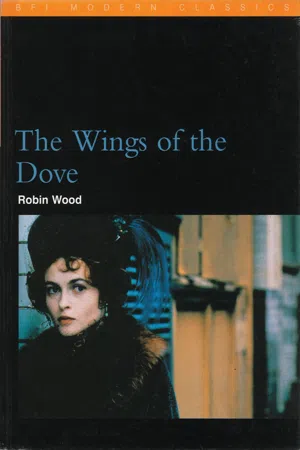
The Wings of the Dove
About this book
Examines the most successful literary adaption of a clutch of 1990s films based on Henry James' The Wings of the Dove (Ian Softley, 1997). The author is interested in the nature of cinema adaptations of classic literature and it is in this context that he has written.
Information
The Wings of the Dove: Henry James in the 1990s
Henry James and the Feminist Melodrama
Lovers of James's fiction may be surprised, and even outraged, by the association of his name with the term 'melodrama', so I had better concede immediately that (except in certain of the early novels and stories, most obviously The American) James is the least 'melodramatic' of writers. The term evokes qualities such as excess, overt emotionalism, exaggeration, 'in-your-face-ness', and James in his mature work is characteristically the subtlest, most reticent, most indirect of writers, leaving – for all the ever-increasing stylistic elaboration – so much to be inferred or intuited, read between the lines. Yet if one reduces the novels to their plots (of course a monstrous reduction) they can be seen to relate in a number of cases to the thematic concerns of what we have come to call the Hollywood 'woman's picture' that finds its most powerful and frequent generic form in melodrama. Novel after novel, tale after tale, reveals itself as centrally preoccupied with the position of women in a patriarchal culture, their oppression and subordination, their manipulation by men, the male drive to control and possess them, the women's resistance and (occasional) transgression of the patriarchal laws. His heroines, even when defeated, reveal in their evolution ever deeper resources of strength.
It could be argued, I think, that melodrama is a form of expression to which the cinema lends itself with particular ease. Literature has its own potentials for excess, but they can hardly compete with the potentials inherent in the huge close-up, jagged (hysterical) editing, violent colour schemes, passionate music. Such potentials (for such is the complexity of cinema) can be used in radically different ways, for the direct expression of emotional extremes as in the melodramas of King Vidor (Duel in the Sun, Ruby Gentry, Beyond the Forest) or ironically as in Sirk (There's Always Tomorrow, Imitation of Life). Or there is the possibility of a deliberate, perverse reversal of stylistic expectations, as in the remarkable anti-melodramatic melodramas of Preminger in the 40s and 50s. What could be more melodramatic in content than the final moments of Angel Face? Yet what could be less melodramatic than Preminger's rigorous (and non-judgmental) refusal of melodramatic effect, with minimal editing and everything in long shot?
It is perhaps their underlying melodramatic potential that has attracted film-makers to James's novels and stories. I shall argue later (and readers may take this as a 'trailer' or, as it is called in North America, a preview) that the particular distinction of The Wings of the Dove lies in its respect for the novel's melodramatic basis combined with the ability to find cinematic equivalents for something of James's subtlety, complexity and ambiguity.
James in the 90s:
Washington Square and The Portrait of a Lady
Is it coincidence that the three recent film adaptations of James novels – Washington Square, The Portrait of a Lady and The Wings of the Dove – are all, essentially, feminist melodramas, and that all three share the same basic premise? In all three a young, innocent American heiress falls prey to the attractions and persuasions of a suitor, in whose sincerity she believes completely but who is really after her money, the narrative reaching its climax and, subsequently, its resolution in response to her discovery of his true motive. They are in fact three of the only four James novels with this premise (the fourth, The Golden Bowl, has been the subject of a recent BBC adaptation). One might suggest, tentatively, that the first great wave of feminism (the suffragette movement) nurtured the novels, at least on an unconscious level (the conscious one being sadly represented by The Bostonians). The second wave, the far more sweeping and comprehensive radical feminism of the 60s and 70s, and the heightened awareness of women's oppression and exploitation that it produced, was a potent influence on the films. Certainly, the implicit feminism of the novels is rendered explicit, especially in the two films directed by women, Washington Square and The Portrait of a Lady.
If the three novels – and The Golden Bowl – are variations on a premise, it must be stressed that, given their shared basis, they could scarcely be more different from one another. Their heroines are quite distinct in personality, degree of intelligence and awareness, and personal situation; the suitors range from the insidiously seductive and hateful Gilbert Osmond of The Portrait of a Lady to the wholly sympathetic Merton Densher of The Wings of the Dove, whose only fault is completely understandable (in the context) human weakness. Of the three, The Portrait of a Lady comes closest to acknowledging an explicit feminist intention, especially in its conclusion, which one might reasonably describe as 'lesbian' in the wider sense made accessible by the women's movement: female bonding, for mutual support against male domination. Henrietta Stackpole (whom it is tempting to read as lesbian in the narrower sense) marries an ineffectual adorer for whom she feels nothing beyond a sort of affectionate contempt solely in order to remain in Europe, and her motivation for remaining in Europe (of which, as a chauvinistic American, she is extremely critical) is solely to be accessible to Isabel. Isabel, in her turn, decides to go back to a wretched and loveless marriage and an intolerable domestic situation solely to attempt to rescue Pansy Osmond from the machinations of her loathsome father. The bonds of commitment among the three women represent the novel's ultimate 'positive', illuminating its otherwise dark conclusion. I find it inexplicable that Jane Campion, despite her clear feminist position, makes nothing of this: Henrietta disappears from the narrative, and Campion withholds any information as to Isabel's final intentions.
Perhaps of all James's novels, Washington Square offers itself most readily for appropriation as feminist melodrama – and, for that matter, for translation into film, being relatively short and compact, lacking the scope, structural complexity, and multiple characters of The Portrait of a Lady. But, while both adaptations translate James into melodrama, they do so in somewhat different ways. Holland unashamedly embraces the 'melodramatic' style, with its directness and excess: even the most extreme instances (the teenage Catherine losing control of her bladder when expected to recite a poem at her father's birthday party – a moment that suggests we are being given a remake of The Exorcist – and Catherine's hysterical pursuit of Morris through the streets during a downpour, culminating in her fall in the mud) are not really out of place within the overall context, however those who demand fidelity may shudder. The Portrait of a Lady (the novel), three times as long, far more elaborate, and far more concerned with its heroine's inner life, the analysis of a consciousness, presents greater challenges for the film-maker, which Campion attempts to meet by simplifying and coarsening the leading characters (though whether she was aware of that is uncertain, as it is a direct consequence of the casting).
It was inevitable that Agnieszka Holland's film would be compared (generally unfavourably) to The Heiress; it seems to me that the comparison usefully illuminates Holland's achievement, highlighting Washington Square's far greater detail, density and complexity. Doubtless its superiority is due in great part to the fact that it was adapted directly from James's novel, where Wyler's much more celebrated film was drawn from an already greatly simplified (and melodramatised) play. Wyler's task was to fill out a somewhat thin and schematic scenario by means of his actors' performances (Ralph Richardson, especially, restoring much of the complexity of James's original). Holland's task was to pare down a short but dense and subtle novel to the scope of a hundred minute film, preserving the density and subtlety as far as possible while using it also as a vehicle for her own preoccupations.
In one respect she actually improves on James, adding a tragic dimension the novel lacks. Dr Sloper's treatment of his daughter is unforgivable (though James makes it entirely understandable), yet he is clearly right about Morris Townsend – Catherine's marriage would be disastrous for her, she would be first exploited then neglected. But by depriving his heroine of even the possibility of happiness James makes her 'case' merely hopeless. The problem is carried over, unresolved and apparently unrecognised, into The Heiress, where Montgomery Clift is allowed or encouraged to play Morris as a two-dimensional, shallow schemer endowed with insidious charm and plausibility. When, at the end of the film, we are suddenly asked to believe that he now wants Catherine's love as well as her money, this comes across as perfunctory and unconvincing, a cheap attempt at a final ironic twist. (In James he returns as he left, except that he is now coarse and unattractive, deprived by failure of his spurious charm.)
Holland seems quite aware of this problem (though her solution may be felt to create new ones): she makes it clear that, as Catherine blossoms, Morris begins to respond. This is not spelt out, but it is very clear in the acting: watch Ben Chaplin during the central, and crucial, confrontation with Albert Finney, and it is impossible to doubt his sincerity. He still, of course, requires Catherine's inheritance, he is not suddenly transformed from a self-serving opportunist into a spellbound Romeo. But his newly-developed feeling for Catherine as a person is evident, and the suggestion is that, given sufficient wealth to satisfy his extravagant ambitions for a future of comfort and idleness, he could have made Catherine happy. While almost any means of escape from her father would be an improvement, neither James's novel nor The Heiress holds out even that much hope. The problem is that this transfers all the opprobrium the reader/viewer is made to feel from Townsend to Dr Sloper, whose inability to see that he is not acting for his daughter's good turns him into a kind of monster.
Equally intelligent – given her feminist commitment – is Holland's transformation (or extension?) of James's ending. The Heiress opted for a melodramatic pessimism: with the (ambiguously) reformed Morris Townsend beating hysterically on her door, Catherine takes her lamp and mounts the stairs to her room – the room where, metaphorically at least, it is implied that she will spend the rest of her life, in solitude and bitterness. James leaves her relatively tranquil – firm, but rational and controlled. Holland, without surrendering to any temptation to a sentimentalist's happy ending, allows her to find a certain modest satisfaction as a kind of one-woman daycare centre for young children. If not exactly fulfilled she is at least content, and the experiences of Catherine's own childhood, a childhood without respect, will permit her to be a beneficent influence.
While Washington Square is clearly the more successful of the two films, The Portrait of a Lady (which has far greater problems of adaptation to overcome) is in some ways the more interesting. Campion's work never lacks distinctness and a certain distinction, the distinction of a film-maker in love with her chosen medium: The Portrait of a Lady is consistently intelligent and sensitive in its use of colour (the images become systematically depleted as the narrative unfolds, from the verdure and sunshine of the opening through the progressively sombre Italian sequences to the barren, snowbound conclusion), widescreen composition and camera placement, and one can derive considerable pleasure from the film by concentrating on the mise-en-scène.
Its basic problem is the one endemic to literary adaptations: its hesitation between 'faithful' and 'free' (one might compare Cuaron's splendid Great Expectations, where the adaptation is so free that, after a while, one ceases to think of Dickens at all). Its most obvious liberties can be easily discounted: mere annoyances that could be cut from the film without the slightest loss to narrative coherence or thematic sense. There are three: the absurd and irrelevant credit sequence in which various young women in modern dress disport themselves or strike poses amid trees, as if auditioning for modelling jobs somewhere between GAP and Ralph Lauren; the fantasy sequence (as jarring in the film as its equivalent would have been in the novel) in which Isabel imagines herself erotically caressed on a bed by Ralph Touchett, Lord Warburton and Casper Goodwood simultaneously (is she trying to choose or wondering whether she could perhaps juggle all three?); and the parodic sequence, presented as an old black-and-white movie in academy ratio, that fills in the period of Isabel's travels while she considers Osmond's proposal and decides that she loves him.
The problem goes deeper: the film, obvious aberrations apart, continuously presents itself as a representation of the novel, yet could not possibly satisfy anyone who loves and admires it. I have already mentioned the casting. Nicole Kidman works very hard and clearly takes her role very seriously (one feels, watching her, that one is studying the mechanics of acting, although there is little about the film one could call Brechtian), but she is many miles short of James's Isabel: beautiful, vibrant, longing fully to experience life in all its complexity, with an intelligence fatally flawed by the innocence that permits her to take Osmond at face value. Who could have undertaken this role successfully? I can think of no one available today; perhaps Jean Simmons or Jennifer Jones when they were in their twenties. Today, perhaps, we should be thankful that at least we were not given Parker Posey (though she would have given Osmond his comeuppance pretty briskly). But James's Isabel captivated three men and was viewed by a fourth as a perfect objet d'art for his collection and self-enhancement. Kidman's Isabel comes across as a somewhat ordinary young woman with no remarkable qualities; the actress's persona (perfectly suited to her role in To Die For) is far too 'knowing' for her to be capable of embodying Isabel's innocence, without which her capitulation to (and misreading of) Osmond cannot be convincing; worst of all, she is not likely to be capable of empathising with the predicament of Pansy Osmond, or of sacrificing her possible future to save her.
Then there is the casting of John Malkovich, who plays Osmond as a transparent sleazeball, whom only a complete idiot could fail to identify instantly as such. This thoroughly undermines James's conception, but it might have been made to work on a lower level: unintelligent, easily duped young woman with money falls for cultured dilettante after her wealth and lives to regret it. This would result...
Table of contents
- Cover Page
- Title Page
- Contents
- Preface: The Problem of Literary Adaptation
- The Wings of the Dove: Henry James in the 1990s
- Credits
- eCopyright
Trusted by 375,005 students
Access to over 1.5 million titles for a fair monthly price.
Study more efficiently using our study tools.
Frequently asked questions
Yes, you can cancel anytime from the Subscription tab in your account settings on the Perlego website. Your subscription will stay active until the end of your current billing period. Learn how to cancel your subscription
No, books cannot be downloaded as external files, such as PDFs, for use outside of Perlego. However, you can download books within the Perlego app for offline reading on mobile or tablet. Learn how to download books offline
Perlego offers two plans: Essential and Complete
- Essential is ideal for learners and professionals who enjoy exploring a wide range of subjects. Access the Essential Library with 800,000+ trusted titles and best-sellers across business, personal growth, and the humanities. Includes unlimited reading time and Standard Read Aloud voice.
- Complete: Perfect for advanced learners and researchers needing full, unrestricted access. Unlock 1.5M+ books across hundreds of subjects, including academic and specialized titles. The Complete Plan also includes advanced features like Premium Read Aloud and Research Assistant.
We are an online textbook subscription service, where you can get access to an entire online library for less than the price of a single book per month. With over 1.5 million books across 990+ topics, we’ve got you covered! Learn about our mission
Look out for the read-aloud symbol on your next book to see if you can listen to it. The read-aloud tool reads text aloud for you, highlighting the text as it is being read. You can pause it, speed it up and slow it down. Learn more about Read Aloud
Yes! You can use the Perlego app on both iOS and Android devices to read anytime, anywhere — even offline. Perfect for commutes or when you’re on the go.
Please note we cannot support devices running on iOS 13 and Android 7 or earlier. Learn more about using the app
Please note we cannot support devices running on iOS 13 and Android 7 or earlier. Learn more about using the app
Yes, you can access The Wings of the Dove by Robin Wood in PDF and/or ePUB format, as well as other popular books in Media & Performing Arts & Film History & Criticism. We have over 1.5 million books available in our catalogue for you to explore.