- 155 pages
- English
- ePUB (mobile friendly)
- Available on iOS & Android
eBook - ePub
Tony Leung Chiu-Wai
About this book
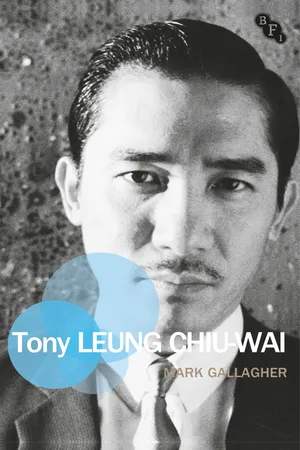
Tony Leung Chiu-Wai investigates the rich, prolific career of an acclaimed leading man of Hong Kong and Chinese film and television: the star of more than 70 films and dozens of television series, and the only Hong Kong actor to earn the Cannes Film Festival's best-actor award. This book addresses the dynamics of media stardom in Hong Kong, mainland China and the East Asian region, including the importance of television series for training and promotion; the phenomenon of regional, transmedia stardom across popular entertainment genres; and cultural and political considerations as performers move among different East Asian production environments. Attentive to Leung's position in both East Asian and global screen cultures, the book addresses relations among acting, global stardom and internationally circulating film genres and acclaimed directors. Overall, this unique study of Leung – who the New York Times calls "one of the world's last true matinee idols" – illuminates challenges and opportunities for Chinese screen actors in local, regional and global cultural and industrial contexts.
Information
1 HOW TO ACT SEXY
Described by the Asian-American-themed magazine Giant Robot as looking 'like sex in a white suit' (Ko 2001: 37), Leung Chiu-Wai has since the early 1980s enjoyed a reputation as a sexually charismatic performer.1 Much of his film work since the late 1980s, as well as some of his work in popular Hong Kong television series across that decade, has drawn on his good looks. And while mostly unknown in the US despite numerous international awards and prestige releases, Leung did earn a memorable notice as one of People magazine's 'Sexiest Men Alive' in 2000 (if as 'Sexiest Newcomer', despite his scores of prior film roles). Internationally distributed films such as Chungking Express, In the Mood for Love, and Lust, Caution, along with many Hong Kong romantic comedies, thrillers and martial-arts films, have capitalised on his physical appeal and his ability to perform as a sexually charismatic man.2 In this chapter, I investigate Leung Chiu-Wai as a regional and global star, focusing on attributes of his acting that convey sex appeal or have been received as sexy. A lead actor in more than two dozen television series in the 1980s and 1990s in his native Hong Kong as well as scores of genre films, Leung has acquired an international reputation based on roles in art-cinema efforts from filmmakers such as Wong Kar-Wai, Ang Lee and Hou Hsiao-Hsien. Leung thus appears a popular star in a regional Asian context but a more rarefied, art-cinema performer internationally. Despite this bifurcated reputation, his sex appeal yields a powerful symbolic currency bankable in local as well as global contexts. Sex appeal also demonstrates Leung's flexibility as an actor. He performs both straight and gay romantic roles, alternately displays gentlemanliness or caddishness in romantic interactions, and plays characters ranging from sexually passive or de facto asexual figures to Lotharios and outright predators. Responses to his possible appeal are similarly flexible, registering in different ways in diverse reception contexts. Through attention to the highly legible yet difficult-to-quantify category of sex appeal, I identify features of Leung's acting and stardom that inform his overall career activity. By addressing a screen star's performance history and long-term creative trajectory, I begin here to account for the complex performative and cultural phenomenon of cinematic sex appeal. Sex appeal is far from the only lens through which to view Leung and his work, but it does correspond substantially to his star reputation and his screen work's reception.
Leung is arguably greater China's most acclaimed contemporary film actor, the recipient not only of the Cannes Film Festival's Best Actor award in 2001 for his lead role in In the Mood for Love, but also a four-time nominee and three-time winner of Best Actor prizes at Taiwan's annual Golden Horse Awards, a three-time winner of the Best Actor prize at the Hong Kong Film Critics Association's annual Golden Bauhinia Awards, and the winner of multiple other Asian and US festival awards. Most remarkably, since 1987 Leung has been nominated fourteen times as best actor or best supporting actor at the annual Hong Kong Film Awards, winning seven times. In 2008, he also won the Hong Kong Society of Cinematographers' annual 'Most Charismatic Actor' award.3 This designation serves as a pivot point for one tool of my analysis, assessing Leung's on-screen charisma, which includes (though is not limited to) sex appeal. Leung has played various types across his more than thirty-five years of screen acting, from sexless, noble warrior or avatar of Zen philosophy to sweet seducer or amoral cad, with occasional detours such as mopey gay expatriate or sadistic revenger. Here, I explore in particular sex scenes and episodes of physical display in a series of Leung's films, some local Hong Kong films and others categorisable as global art-cinema works. Scenes in each offer explicit sites for the articulation of actorly charisma and sex appeal.
To approach sex appeal as a manifestation of charisma, I turn to Leslie O'Dell's model of the 'charismatic chameleon', proposed in her book of the same title. O'Dell argues that successful acting involves the interplay of charismatic and chameleonic properties. For her, charisma involves 'the unleashing of an intensely personal psychic energy' that 'fill[s] ... fictional characters with a compelling spark of individuality' (2010: 4, xiii). Such energy combines with technical skill: 'Actors need to discipline their voices, bodies, and imagination so that they can adapt themselves, like the chameleon, to the fictional character they are portraying and to the world ... in which that character appears' (2010: xiii). She notes further that 'a chameleon actor will demonstrate mastery of the means of expressive communication in voice, face, and body' (2010: 3). O'Dell offers her book in part as a training manual for actors. Leung's own training, in the early 1980s in the TVB television channel's actor-training programme, probably did not conform to O'Dell's approach. Still, the basic 'charismatic chameleon' template encourages us to identify in screen performances both consistent expressions of personal energy and chameleonesque adaptations to the dramatic requirements of given roles. The model thus gives us some purchase on manifestations of sex appeal, which can combine performers' individualised affects with specific character attributes, and which aspects of the cinematic apparatus such as framing and lighting can magnify or downplay. While sex appeal, like physical attractiveness generally, resists empirical analysis, textual evidence and extratextual materials such as industry awards, magazine covers and journalistic and other discourse indicate constructions of Leung as a sexually desirable figure in East Asian as well as wider global contexts.
Lust and its tamer precursors
We can briefly return now to Leung's 'Most Charismatic Actor' award of 2008. The award represents a broad-brush assessment, not least because it has gone to a wide range of Hong Kong and Chinese leading men, men whose characterisations and performance styles lack common currency. Recipients in the past decade include Tony Leung Ka-Fai (in 2006), Aaron Kwok (2007), Donnie Yen (2009), Simon Yam (2010), Huang Xiaoming (2011), Lau Ching-Wan (2012), Nicolas Tse (2013), Louis Koo (2014) and Gordon Lam (2015), each winning the award through appearances in films ranging from historical martial-arts action and contemporary police thrillers to non-action dramas. While the award is not attached to specific films, for Leung Chiu-Wai its source is clear enough: his performance in Lust, Caution, his only 2007 release. 'Charismatic' is a generous or charitable enough term for Leung's acting in Lust, Caution, in which he plays a Shanghai official who collaborates with the occupying Japanese Army during the Second Sino-Japanese War, and whose duties involve exposing Chinese nationalists and consigning them to death. As the film earned notoriety for its reasonably graphic sex scenes, it offers a useful case through which to see how films present him as a sexual being, and on what performance resources he draws in his characterisation of the official, Mr Yee.4
Lust, Caution features five scenes of characters having sex.5 All involve actress Tang Wei's character, Wong Chia Chi, who goes undercover as Mak Tai Tai in a plot to assassinate Yee. Before seducing Yee, Wong must first unburden herself of her virginity and practise having sex, which she does in two scenes of semi-awkward coupling with a comrade-in-arms, Liang Jun Sheng (Ko Yu-Luen, aka Lawrence Ko). In the film's second half, Wong, now known as Mak, has sex three times with Yee. Each of these scenes is about two and a half minutes long, including what passes for foreplay. Yee and Mak's first sexual encounter is a de facto rape, with Yee assaulting Mak by throwing her against a wall, tearing at her underwear, beating her with a belt and binding her hands before rough rear-entry coupling. Both remain mostly clothed for the scene, set in daytime. Leung is silent until the end of the scene, when he tosses her coat to her and leaves the bedroom. His actions are aggressive throughout, with sudden movements and an angry expression on his face. He appears in a range of shot types, though many close-ups show his face turned away from the camera or obscure it behind his or Tang's hair. The scene demonstrates Yee's dominance of Mak, though its last shot is a close-up of her face breaking into a sly smile, as her goal had been to arouse his desire and thus to facilitate his later entrapment.
Yee and Mak's second sex scene also occurs in daytime, though now with both characters naked. Yee does not speak, and Mak is mostly silent, but as they lie curled together near the end of the scene, she bluntly declares, 'give me an apartment', again asserting her command of the situation, this time not just to viewers but to Yee. Leung's gestures and body language soften over the course of the scene. Initially he puts his hand on her throat, appearing to choke her, but his touch becomes less violent and more tender as they continue, and by the end the pair embrace, in what could read as romantic intimacy. (Still, while the scene includes licking and kissing, Yee and Mak do not kiss on the lips.) The scene's lighting approximates daytime interior sunlight, this time with warmer tones than in the first sex scene, the violent rape, which shows rain falling outside to motivate its cold lighting (and which put characters in clothing to match, both in blues shading toward grey). While many shots emphasise a tangle of body parts seen in fragments, Leung's face often appears in close-ups, his expressive eyes on display. While his emotions and mindset remain ambiguous, the scene's final shots of him reveal a look of apparent concern, even regret, on his face. The few scenes of Yee in his work role present him as an understated villain, dispassionately overseeing imprisonments and executions. In the wake of his lusty encounters with Mak, intimate close-ups allow him to register emotions legible as humane, if not as outright sympathetic.

Leung's mature, sculpted body on display in Lust, Caution (2007)
Notably, all three scenes include some rear-entry sex, indicating Yee's aggression, his unromantic temperament and his ostensible degradation of Mak (given rear-entry and anal sex's connotations, valid or not, of male power over women).

Intimate close-ups in Lust, Caution allow Leung a degree of expressivity

Lust, Caution's sex scenes keep Leung's genitals out of view
The conceit also lends the scenes the frisson of sex acts beyond the standard missionary position, and most practically of course, conveniently shields Leung's genitals. The scenes' power dynamics, and the overall narrative situation - assassination plotter seduces traitorous, murderous bureaucrat - challenge any viewer efforts to read the scenes as expressly pleasurable. These conditions also restrict Leung from acting in a charming manner, if not in a charismatic one.
For the third scene, a nighttime setting engenders still warmer lighting, and much of the frame appears in deep shadow throughout. Mak now assumes the dominant role in the unspoken power dynamic, even placing a pillow over Yee's eyes and staring at his holstered gun hanging near the bed. Yee yanks the pillow from his face in a gesture of panic or victimhood, and in his few close-ups he appears a desperate or fearful figure, seemingly anticipating his demise. More than in the previous sex scene, shots and body positions obscure his features, rendering him a servicer of Mak, an anonymous if visually appealing mass of slick, black hair and taut, smooth skin. While both scenes featuring nudity supply fuller views of actress Tang, Leung's lean but muscular frame also receives considerable visual attention. Though bare backs and bottoms may not routinely be understood as performance tools in dramatic cinema, in Lust, Caution they account substantially for Leung's sex appeal, particularly when the film limits views of his face and when his character cannot be played as a genial, charming one.

Naked bodies as performance tools for Tang Wei and Leung in LUST, Caiuion
Let me interrupt the reading of Leung's performance to introduce a further critical context. The recognition of a given screen role as charismatic or sexy depends upon a range of performance signs as well as on viewers' responses to those signs, and their acceptance of, or at least familiarity with, surrounding social protocols. Or, as Cynthia Baron and Sharon Marie Carnicke argue, 'interpretations of filmic gestures are influenced by viewers' personal associations with comparable social gestures and their acquaintance with the gestural conventions of pertinent aesthetic traditions' (2008: 4). Beyond performance, elements of mise-en-scène, lighting and framing, along with sound and editing choices, help determine the presentation and appeal of a given actor's work.
Foregrounding acting in this dynamic system, Baron and Carnicke observe further that 'performance details extend, support, and counterbalance impressions, meaning, and significance created by other filmic choices' (2008: 5). Lest we forget too, other performers contribute as well, as apparent in regular, subjective judgments of paired or ensemble performers' on-screen 'chemistry'. In this regard, I offer a final point from Baron and Carnicke: 'actors adjust the quality and energy of their gestures, voices, and actions to fit their characters' shifting desires and interactions with others' (2008: 44, my emphasis). In total, screen charisma involves individual performance tools, interpersonal dynamics on screen, scene space and cinematographic attributes, and viewers' situation of all these within personal and socially constructed landscapes of meaning.
We might re-read Lust, Caution's sex scenes in terms of this array of criteria, but for a less intense expression of Leung's sexual charisma, we can turn instead to earlier roles that make different demands on him and on viewers. Such roles show Leung delivering charismatic, engaging performances even ...
Table of contents
- Cover
- Title Page
- Contents
- Acknowledgements
- Introduction
- 1 How To Act Sexy
- 2 1980s Hong Kong Television And Early Film Efforts
- 3 Pan-Asian And Global Art-Cinema Stardom
- 4 Tony Leung And Genre Stardom
- 5 The Mainlanding Of Tony Leung Chiu-Wai
- Conclusion
- Notes
- Bibliography
- Filmography
- Index
- eCopyright
Trusted by 375,005 students
Access to over 1.5 million titles for a fair monthly price.
Study more efficiently using our study tools.
Frequently asked questions
Yes, you can cancel anytime from the Subscription tab in your account settings on the Perlego website. Your subscription will stay active until the end of your current billing period. Learn how to cancel your subscription
No, books cannot be downloaded as external files, such as PDFs, for use outside of Perlego. However, you can download books within the Perlego app for offline reading on mobile or tablet. Learn how to download books offline
Perlego offers two plans: Essential and Complete
- Essential is ideal for learners and professionals who enjoy exploring a wide range of subjects. Access the Essential Library with 800,000+ trusted titles and best-sellers across business, personal growth, and the humanities. Includes unlimited reading time and Standard Read Aloud voice.
- Complete: Perfect for advanced learners and researchers needing full, unrestricted access. Unlock 1.5M+ books across hundreds of subjects, including academic and specialized titles. The Complete Plan also includes advanced features like Premium Read Aloud and Research Assistant.
We are an online textbook subscription service, where you can get access to an entire online library for less than the price of a single book per month. With over 1.5 million books across 990+ topics, we’ve got you covered! Learn about our mission
Look out for the read-aloud symbol on your next book to see if you can listen to it. The read-aloud tool reads text aloud for you, highlighting the text as it is being read. You can pause it, speed it up and slow it down. Learn more about Read Aloud
Yes! You can use the Perlego app on both iOS and Android devices to read anytime, anywhere — even offline. Perfect for commutes or when you’re on the go.
Please note we cannot support devices running on iOS 13 and Android 7 or earlier. Learn more about using the app
Please note we cannot support devices running on iOS 13 and Android 7 or earlier. Learn more about using the app
Yes, you can access Tony Leung Chiu-Wai by Mark Gallagher in PDF and/or ePUB format, as well as other popular books in Media & Performing Arts & Film & Video. We have over 1.5 million books available in our catalogue for you to explore.