eBook - ePub
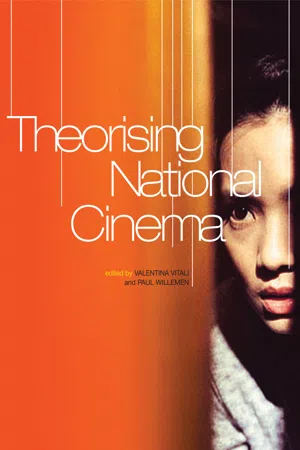
Theorising National Cinema
- 208 pages
- English
- ePUB (mobile friendly)
- Available on iOS & Android
eBook - ePub
Theorising National Cinema
About this book
Why do we think of clusters of films as 'national cinema'? Why has the relationship between the nation and film become so widely and uncritically accepted? 'Theorising National Cinema' is a major contribution to work on national cinema, by many of the leading scholars in the field. It addresses the knotty and complex relationship between cinema and national identity, showing that the nationality of a cinema production company, and the films that its made, have not always been seen as pertinent. The volume begins by reviewing and rethinking the concept of national cinema in an age of globalisation, and it goes on to chart the parallel developments of national film industries and the idea of a nation state in countries as diverse as Japan, South Korea, Russia, France and Italy. The issues of a 'national cinema' for nation states of contested status, with disputed borders or displaced peoples, is discussed in relation to film-making in Taiwan, Ireland and Palestine. The contributors also consider the future of national cinema in an age of trans-national cultural flows, exploring issues of national identity and cinema in Latin America, Asia, the Middle-East, India, Africa and Europe. 'Theorising National Cinema' also includes a valuable bibliography of works on national cinema.
Information
1History, Textuality, Nation
Kracauer, Burch and Some Problems in the Study of National Cinemas1
Philip Rosen
How might one employ recent approaches to filmic textuality in the study of film history? In addressing this question, I will limit myself to the notion of a national cinema as one traditionally central concept in film historiography. My examples of accounts of national cinemas will be Siegfried Kracauer’s From Caligari to Hitler:A Psychological History of the German Film (1947) and Noël Burch’s To the Distant Observer: Form and Meaning in the Japanese Cinema (1979), two histories by theoretically concerned writers.
Most elementally, a national cinema is a large group of films, a body of textuality. This body of textuality is usually given a certain amount of historical specificity by calling it a national cinema. This means that issues of national cinema revolve around an intertextuality to which one attributes a certain historical weight. What would allow a historian to attribute such a weight to the concept of the nation in his or her analytical construction of such large blocs of textuality?
To invoke the concept of intertextuality to describe the construction of a group of films which is thought to have a certain coherence might seem to be a somewhat contrary move. As applied to individual texts, the concept of intertextuality is most rigorously used to break down notions of organicness, unity, coherence, etc. It is well known that for well over a decade, influential kinds of criticism have been seeking gaps, contradictions, inadequacies, failures of individual texts to be self-sufficient. A theory of intertextuality treats those gaps as openings onto other texts, but those gaps can, in opposed or complementary ways, also be treated as openings onto society or history.
Now, one of the fundamental productive emphases in recent textual theory has been on a dialectic between two interpenetrating yet competing aspects of textuality. On the one hand, there is a more or less realised semiotic dispersion of meaning within and among signifiers or discourses. Over and against this textual impulse is a counter-process called containment, repression, etc. A result of this concentration has been to stress the importance of how unifying mechanisms of texts function. If this model were projected onto a national cinema as an intertextual grouping, then the coherence, or unity, of the group would not be an easy one but rather an effort or impulse of the body of textuality under investigation. Nationality as intertextual symptom would then become the object of analysis.
In contemporary theories of textuality which appeal to psychoanalysis, modes of discursive coherence are theorised as operations by which a text posits, addresses, appeals to a spectator. The key link between notions of discursive coherence and the study of a film’s address to the spectator has been the Lacanian concept of the Imaginary Order, which grounds the postulation of an impossible desire for a sense of mastery as a sense of coherence and identity on the part of the spectator. From this perspective, the textual dialectic (semiotic dispersion vs. textual coherence) can be described as a dialectic between a potential dispersion of the ego via the drives versus the knotting of the drives in and as identity. That is, textual address is described as the conversion of perceptual force into an offering of identificatory force (see, for instance, Heath 1981). If this tendency in contemporary textual analysis were applied to an intertextual national grouping, then, the issue of identity – national identity? – might come to the forefront.
The question of coherence, then, becomes significant for issues of national cinema on a theoretical as well as methodological (what permits the historian to group these films together) level. But it does not end here. The discussion of a national cinema assumes not only that there is a principle or principles of coherence among a large number of films; it also involves an assumption that those principles have something to do with the production and/or reception of those films within the legal borders of (or benefiting capital controlled from within) a given nation-state. That is, the intertextual coherence is connected to a sociopolitical and/or socio-cultural coherence implicitly or explicitly assigned to the nation.
I am less concerned here with the old debates over ‘reflection’ than with the constitution of these general coherencies by the historian. Given the above considerations, I suggest that the study of a national cinema would always have to be based on three conceptualisations: (1) not just a conceptualisation of textuality, but one which describes how a large number of superficially differentiated texts can be associated in a regularised, relatively limited intertextuality in order to form a coherence, a ‘national cinema’; (2) a conceptualisation of a nation as a kind of minimally coherent entity which it makes sense to analyse in conjunction with (1); (3) some conceptualisation of what is traditionally called ‘history’ or ‘historiography’. The status of these coherences is of importance; identifying them will always require sensitivity to the countervailing, dispersive forces underlying them.
By now it is easy enough – indeed, often too easy – to agree that in most accounts of national cinemas these conceptualisations are too implicit, unthought and native. Perhaps what we need are not straw men, but rather an understanding of the avenues of historical comprehension open to us. It is therefore in search of methodologically and theoretically productive pressure points that I now turn to Kracauer and Burch.
Kracauer and Burch
The problem Kracauer defines for himself is notorious: he wishes to read psychological predispositions towards Nazism in the post-World War I German cinema. What view of textuality allows him to group together so many films as revelatory in this respect? It is true that Kracauer makes an argument for the special utility of cinema for those seeking such mass dispositions, but it will be more useful here to highlight his methodology for textual analysis. In this, his most significant argument is that generally and compulsively repeated motifs appearing throughout all levels of a nation’s films – from a self consciously ‘artistic’ cinema to the most mass-oriented – are symptoms of a ‘collective mentality’, a shared ‘inner life’. Such motifs consist not only in diegetic objects and actions (such as the fairground/chaotic circle form found in some films; a male protagonist placing his head on the bosom or lap of a female character, etc.), but also in components of form and style (for instance, what we recognise as expressionist mise en scène).
For Kracauer’s project, the pertinent aspects of textuality therefore have less to do with individual films than with the vicissitudes of such motifs, in their similarities and variations, throughout the inter-war period. Thus, for example, the components of the authoritarian necromancer/sleepwalking criminal duality are clearly established by 1919 in The Cabinet of Dr Caligari (R.Wiene), but are found in the Mabuse film and in M (F. Lang, 1931) (where the necromancer is internalised into the still hapless criminal as irrational compulsion). These motifs inform individual film narratives with a historically pregnant intertextuality. In them, Kracauer can trace a great theme at the heart of the inter-war German collective mentality: that of the rejection of the multivalent, undecidable concrete real, and the resulting fascination with an authoritarianism whose alternative is figured as chaos.2

M (Fritz Lang, 1931)
It seems reasonable to argue that the model for Kracuer’s jump from obsessively repeated motifs to a stipulated ‘collective mentality’ is a psychoanalytic one. This is not the same as saying that Kracauer’s reading is rigorously psychoanalytic. But is not Kracauer reading the collection of motifs in their vicissitudes as a psychoanalyst reads displacements, condensations and secondary revisions in order to decode the anxieties and traumas underlying the analysand’s obsessions and hysterical symptoms? In that case, Kracauer’s investigation rests on something like an analogy, or the (loose) projection of an analytic framework designed to deal with individual human beings in terms of collective processes. Now, this is a kind of move which one finds in Freud himself and to which we will return. But here it is enough to notice that the necessary effect of such a move is one of massive unification. A presumably diverse national population is implicitly likened to an individual subjectivity; hence, Karacuer can link his account of the film texts to a nation. In order for this move to be convincing, such national coherence requires some further explanation.
On the surface, the German nation does not seem to have been the most unified sociopolitical entity imaginable during the period with which Kracauer is most concerned. At the beginning there was near-revolutionary discontent and upheaval; at the end, the Nazis took power at a moment when their electoral popularity was actually decreasing (contrary to what one might expect from some of Kracauer’s propositions). Kracauer recognises that he is nevertheless committed to arguing for a certain basic national unity, so he introduces it as an implicit class phenomenon: ‘In pre-Nazi Germany, middle-class penchants penetrated all strata’ from the Left to the upper classes, which explains ‘the nation-wide appeal of the German cinema – a cinema firmly rooted in middle-class mentality’(1947: 8–9).
It is appropriate that this claim occurs in the introduction to his study, for it is not a conclusion but an enabling premise. The existence of a culturally dominant class, or a class dominant in culture, whose social-psychological coherence can be alleged and then lent to the society as a whole, is what underlies the national coherence Kracauer requires for his reading of the films. For example, Kracauer reads the proliferation of expressionist mise en scène in German silent cinema of the early 1920s as a proliferation of signs of ‘soul at work’, that is, as signifying a film’s import as an explicit meditation on difficulties of life as difficulties of interiority rather than of relations to the exterior, undecidably concrete world. He can read this as a sign of the state of mind of millions of Germans, especially in the middle classes, who ‘acted as if under the influence of a terrific shock which upset normal relations between their outer and inner existence’. This was the ‘shock of freedom’ which resulted in a reaction against the liberties suddenly thrust upon Germans after World War I. Once he has assumed the unity of the nation around the middle classes, Kracauer can treat the films as registering a subterranean but general mental impulse to avoid directly dealing with the terrifyingly complex and unpredictable outer world and, led by that dominant class, a retreat to interiority, to reconsider the nature of the self or soul. The film image, which might otherwise seem to be so useful for recording exterior, chancy, concrete reality, is therefore utilised to deal with such spiritual agonies (1947: 58–60).3
As a historian of a national cinema, Kracauer is exemplary in his construction of two coherencies – a bloc of filmic (inter)textuality and the social formation of a specified period. These are related in such a way as to enable Kracauer to investigate the kind of middle-class social-psychological patterns he treats as crucial for the appeal of Hitlerism. Once the neat logic of his enterprise is outlined, however, a number of the traditional objections to Kracauer as historian can be raised. To many readers, it has always seemed that Kracauer’s approach to film history rests on simplistic reflectionist presumptions for the possibility of reading an underlying mentality from the cinema – especially the cinema – of a nation: indeed, Kracauer sometimes states these presumptions as if they had the status of a general law. However, insofar as his project rests on the attribution of a fundamental unity to the nation, it may be that Kracauer’s claims are not so generalisable. In Kracauer’s account there was something peculiar to Germany’s social formation after World War I which permits his reading: the cultural dominance of middle-class social psychology. Against Kracauer’s excessive methodological claims, then, it is also possible to read From Caligari to Hitler as demonstrating that the inter-war period in Germany represents an unusually fertile historical moment for treating film texts as reflecting social-psychological formations in this way. Such a view of his interpretation of German cinema would make his analysis there consistent with Kracauer’s posthumous theory of history, in which he argues that there is such a thing as a specifically historical generalisation, but what makes it specifically historical is its limited range and validity in comparison with generalisations and laws in philosophy and science.4
Another traditional complaint about Kracauer’s history is its ‘teleologism’, the post hoc ergo propter hoc logic by which everything in post-war German film texts seems to lead to the Nazis and Hitler. But to what extent is there any indication that this is a general tenet of historiography for Kracauer? Still keeping in mind Kracauer’s late theory of history, such teleologism might be not a philosophy of history in the sense of universal principle, but rather a registration of the unique cataclysm of Hitlerism in German history. After all, the ultimate purpose for From Caligari to Hitler is not to provide the generally valid basis for any film history or any social readings of films (despite some inconsistent indications in the introduction). Rather Kracauer’s purpose is to outline the mental preconditions which were a necessary condition for the success of National Socialism. To be sure, this means that the pertinent coherences (textual and national) of the period are defined by what followed it. However, the proposition that the rise and defeat of Hitler marks out the parameters of one of the great ruptures in German political and cultural history is certainly a defensible one, and it is hard to see how one might attempt to explain such a historical phenomenon without confronting determinant processes and factors preceding it. If we see Kracauer’s teleologism not as an overarching historiographic principle, but as one possible form of understanding differentiated, local, conjunctural historical phenomena – that is, not as a philosophy of history as such, but as a method not necessarily applicable in any individual case but sometimes useful for organising historical temporality in relation to specific kinds of questions – then we may be in a better position to understand certain kinds of phenomena, despite the well-known dangers of ending up with concepts of an expressive totality, etc.5
Noël Burch’s To the Distant Observer seems to be a very different approach to the study of national cinemas. Of course, Burch, like Kracauer, necessarily must claim a certain broad unity for a large group of films produced in a single nation. However, as one would expect, the textual descriptions of that coherence by Burch, the materialist semiotician, differ in kind from those of Kracauer, the realist social critic. Whereas Kracauer tends to treat Hollywood as an economic force with strong but localised effects on the German film industry, Burch’s claim for the textual distinctiveness of a large body of Japanese films is made in an international cinematic context dominated by the global impact of the Institutional Mode of Representation (IMR). This term of Burch’s (actually developed as such elsewhere, but the concept is clearly at work in the Japanese book) denotes a set of possibilities for, and limitations on, the organisation of images and sounds in narrative feature films. This set is familiar to film theorists and important in semiotic investigations of cinema as ‘the’ classic Hollywood text.6
Thus, plot summary and characterisation, which Kracauer sometimes emphasises, are less important to Burch’s textual descriptions than formal, stylistic and narrative codes which can be defined in relations of similarity and difference to this paradigmatic set. At crucial points in his accounts of major Japanese directors, Bur...
Table of contents
- Cover
- Title Page
- Contents
- Notes on Contributors
- Introduction
- Part I: Theories
- Part II: Histories
- Part III: Crossroads
- Bibliography
- Index
- eCopyright
Trusted by 375,005 students
Access to over 1.5 million titles for a fair monthly price.
Study more efficiently using our study tools.
Frequently asked questions
Yes, you can cancel anytime from the Subscription tab in your account settings on the Perlego website. Your subscription will stay active until the end of your current billing period. Learn how to cancel your subscription
No, books cannot be downloaded as external files, such as PDFs, for use outside of Perlego. However, you can download books within the Perlego app for offline reading on mobile or tablet. Learn how to download books offline
Perlego offers two plans: Essential and Complete
- Essential is ideal for learners and professionals who enjoy exploring a wide range of subjects. Access the Essential Library with 800,000+ trusted titles and best-sellers across business, personal growth, and the humanities. Includes unlimited reading time and Standard Read Aloud voice.
- Complete: Perfect for advanced learners and researchers needing full, unrestricted access. Unlock 1.5M+ books across hundreds of subjects, including academic and specialized titles. The Complete Plan also includes advanced features like Premium Read Aloud and Research Assistant.
We are an online textbook subscription service, where you can get access to an entire online library for less than the price of a single book per month. With over 1.5 million books across 990+ topics, we’ve got you covered! Learn about our mission
Look out for the read-aloud symbol on your next book to see if you can listen to it. The read-aloud tool reads text aloud for you, highlighting the text as it is being read. You can pause it, speed it up and slow it down. Learn more about Read Aloud
Yes! You can use the Perlego app on both iOS and Android devices to read anytime, anywhere — even offline. Perfect for commutes or when you’re on the go.
Please note we cannot support devices running on iOS 13 and Android 7 or earlier. Learn more about using the app
Please note we cannot support devices running on iOS 13 and Android 7 or earlier. Learn more about using the app
Yes, you can access Theorising National Cinema by Valentina Vitali, Paul Willemen, Valentina Vitali,Paul Willemen in PDF and/or ePUB format, as well as other popular books in Media & Performing Arts & Film History & Criticism. We have over 1.5 million books available in our catalogue for you to explore.