- 224 pages
- English
- ePUB (mobile friendly)
- Available on iOS & Android
eBook - ePub
About this book
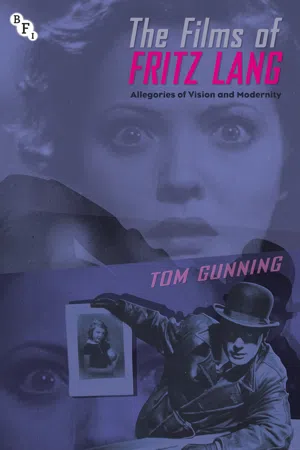
ln this volume Tom Gunning examines the films of Fritz Lang not only as a stylistically coherent body of work, but as an attempt to portray the modern world through cinema. The world of modernity in which systems replace individuals is conveyed by Lang's mastery of cinematic set design, composition and editing. Lang presents not only a decades-long vision of cinematic narrative which can be compared to that of Alfred Hitchcock or Jean Renoir, but a view of modernity that relates strongly to the ideas of Adorno, Brecht, Benjamin and Kracauer. From the sweeping allegorical films of the 20s to the chilly and abstract thrillers of the 50s, Lang's films, Gunning claims, are 'among the most precious records of the twentieth century'. The Films of Fritz Lang immeasurably enriches our understanding of a great artist and, in so doing, reimagines what a film arlist is: an author who fades away even in being recognised and interpreted, an enigmatic figure at the junction of aesthetics, history, biography and theory.
Information
PART I
Reading the Text of Death
Lang’s Silent Allegories:
Der müde Tod (1921)
Die Nibelungen (1924)
Metropolis (1927)
The greater the significance, the greater the subjection to death, because death digs most deeply the jagged line of demarcation between physical nature and significance.
Walter Benjamin, The Origins of German Tragic Drama1
1
The Märchen: Der müde Tod – Death and the maiden
Who Tells the Timely Story of Death?
Watchman, what of the night? Watchman, what of the night?
The watchman said, the morning cometh, and also the night: if ye will inquire, inquire ye: return, come.
Isaiah 21, 11–12
The subjection that the character Fritz Lang feels to the clock outside Minister Goebbels’ window inscribes his place within a system he cannot control. Lang does not describe his dilemma simply in terms of his fear of Goebbels’ power and tyranny. His dramatic agony comes from the possibility that he might not be able to make it in time, get to the bank, get his money, make his train – and from the second-by-second frustration of his intentions. Although the theme of destiny as analysed in Lang’s films by previous commentators (including Lang) most often opposed individual freedom to a metaphysical determinism (‘Man’s fight against the gods’), Lang’s narratives supply a more dynamic model. The question becomes not which is more powerful, an individual’s will or the decree of the gods, but rather who is in control of a system by which events are interrelated and characters’ destinies become interlocked, who can make use of its order and power and who will be crushed by it? Will Lang be able to leave the office and carry out his plans by making the connections the system of train schedules and banking hours allows? Or will Goebbels seem to work in concert with the clock (remember the two interlocking revolving hand gestures Lang made in telling the story) and frustrate Lang’s intentions? I would claim Lang never raises the philosophical issue of pure freedom or pure necessity. Rather, his plots trace the attempts by different characters to control or at least work in concert with a system that operates separately from their desires and according to its own mechanical logic. Lang stages again and again the varying relations characters can have with this system which I term the Destiny-machine.

This struggle with a systematic order often becomes staged as a battle to control the narrative structure of the film itself, as if the attempt of these characters to seize control of the Destiny-machine mimicked the power of the director over the film. Lang at points seems to confuse the clear separation between diegetic story and action and extra-diegetic style, as characters seem to assert control over the visual devices of the film itself, especially its editing. In many ways, Lang’s 1921 film Der müde Tod offers the most elegant convergence between the Destiny-machine and the film’s narrative structure. Lang structures his film not only as a story to be followed, but as an emblematic text which must be read and interpreted, cueing viewers to unravel its enigmas and ask questions about its authorship and intentions. He balances his exposition of the Destiny-machine in this film with another device, equally important to his narrative style: moments of revelation, visionary moments in which characters must read reality in a different manner than they did previously. The revelations offered by these visionary moments also provide the film’s viewer with a deeper insight into the dynamics of the film in the form of visual emblems which the viewer, as well as the character, must interpret. The interplay between the Destiny-machine and such visionary moments forms one of the basic armatures of Lang’s film-making as I will trace it in this book, recurring in various guises and with shifting significances throughout his career.
Although Lang’s earlier films, especially Der Spinnen, set up many of his basic themes, elements of dramaturgy and mise-en-scène, Der müde Tod (‘The Weary Death’, known in France as Les Trois Lumières,‘The Three Lights’ and in England and the US as Destiny) provides the first example of Lang’s completely developed system. As only the third film of Lang’s long collaboration with Thea von Harbou (whom he married about a year after completing the film), it reminds us how much Lang’s cinema was shaped by this collaboration. Der müde Tod remains also one of the most perfectly crafted films of the Weimar cinema, perhaps the most beautiful of the Märchen films based on folk and fairy tales. The subtitle of the film describes it as ‘Ein Deutsches Volkslied in 6 Versen’, the six verses corresponding to the film’s six reels. In the film’s intertitles and‘naive’ characterisation Lang and Harbou invoke the style of a popular tale, with its simplicity of psychology, its materialisation of metaphysical figures (the cloaked figure of ‘weary’ Death himself) and the tale’s aspiration to deliver wisdom about the antinomies of life, the intertwining of love and death. But concealed within its self-conscious invocation of an oral tradition of tale-telling Der müde Tod offers a complex meditation on cinematic narrative.
The story stands as one of scenarist Harbou’s most poetic inventions. A young couple about to wed meet a mysterious figure who joins them at table in a tavern. We learn he arrived in town not long before, bought a plot of land which he proceeded to enclose with a huge wall. Most mysteriously, this wall seems to have no gateway or door, no means of entrance or exit, which baffles and disturbs the burgomasters. The young fiancée leaves the table for a moment and when she returns, finds her lover and the man in the cloak gone. Searching for her lover hopelessly, she is aided by an apothecary seeking mandrakes in the moonlight. At his pharmacy the despairing young woman drinks poison. Immediately she comes to the vast wall of the mysterious figure, in which a door now appears for her. The cloaked figure announces himself to her as Death and asks why she has entered his realm without being summoned. When she explains she is searching for her lover, Death holds out no hope for his return. Taking pity on her, he shows her a vast room filled with candles. Each candle, he explains, is a life, and when it flickers out, the life is lost. Death himself is weary of this role and wishes it could be changed. He therefore offers the maiden a chance to rescue her lover from death.
He shows her three candles (the ‘three lights’ of the French title) and tells her that if she can save these lives from being extinguished, she may have her lover back. The largest section of the film narrates these three tales, each comprising a reel (or ‘verse’, as the original intertitles term them) of the film, set in a different historical and cultural milieu: the caliphate of Baghdad; Renaissance Venice; and a fairy-tale vision of China. In each of the tales the same actress who plays the maiden, Lil Dagover, plays a young woman who is threatened with the loss of her lover. In each tale she strives bravely to preserve him, but in each of them he dies and the candle flame is extinguished. Still wishing to see the young woman defeat the decree of fate, Death offers her another bargain: if she can find a life whose time has not yet come, willing to enter the realm of death early, he will give her her lover in exchange, but she must find this soul before midnight. When we return to the framing story in the pharmacy, no time has passed in the human realm. The apothecary manages to knock the poison from the maiden’s hand. The clock strikes eleven; she has one hour to find a substitute for her lover. Although she searches among the abject, the old and the infirm, everyone responds with the same refrain: ‘Not one day, not one hour, not one breath’ will they give up.
The maiden finds that the infirmary is on fire, trapping an infant on an upper floor. She fights her way to the room and Death appears, arms outstretched to receive the babe from her as the fulfilment of their bargain. Instead, the young woman rushes to the window and lowers the baby to its frantic mother below. Apparently perishing in the fire, the maiden is now reunited with her lover in the realm of death.
The simplicity and symmetry of the tale cannot obscure its powerful meditation on the nature of story-telling. As a tale, we watch this film unfold, aware that it is being told, our attention drawn to its structuring devices and to such extra-diegetic processes as casting and scripting. The film’s division into six single reel ‘verses’ (two reels given to the opening, the first ending with the lover’s disappearance; the next three divided between the three stories, and the last reel given to the final attempt to find a soul) draws the viewer’s attention to the film as a crafted piece of story-telling. Its structure as a series of embedded stories highlights the tale form, as we follow three different stories and the larger framing tale which encompasses them. Likewise, the casting of Lil Dagover as the maiden and Walter Janssen as her lover in a similar role in each tale and the appearance of Bernhard Goetzke (who plays the weary Death in the framing tale as well as the figure who ultimately defeats the lover in each of the embedded tales) draws attention to casting and performance. Lang/Harbou also provide a series of relays between the tales through repetition. The similar narrative structure in each tale of love crushed by tyrants cues the viewer to see them as variants of a single plot, and establishes the film’s sense of fatality through repetition of the same story dynamics and identical endings. Each story moves towards its resolution implacably, like destiny. The end of each story is death, as the appearance of Goetzke signals the closure of each tale, Death becoming a figure of fate because it represents the inevitable ending. Story-telling, therefore, provides a perfect image of the struggle against, and surrender to, death, which is destiny. In Der müde Tod the story serves as a perfect image for the Destiny-machine, the system whose ending is always the same. And that’s why Death is weary.
But who tells the story, who sets the Destiny-machine in motion? The desire to find the figure behind it all motivates the young girl’s search for her lover, for the one who has taken him from her and can return him to her. Her search is initiated by an act of reading. The girl enters the realm of Death impelled by the words she reads from The Song of Solomon in the Bible lying open in the apothecary’s: ‘Set me as seal upon thine heart, as a seal upon thine arm; for love is strong as death’. The text proclaims that her desire stands as an equal opponent to the power of death and this contest between them supplies the ongoing motive force for the story. The seesaw opposition between desire’s restless quest and the weary carrying-out of duty by Death sets the Destiny-machine in motion. If the girl cannot find her lover, she wants to find the one in charge, the apparent master of the story, he who determines its end and therefore could change it. But Harbou/Lang endow this early master narrator with more self-reflection than the hubristic master criminals of their later films. Death knows he is not his own master, and indeed he is weary of playing out the same scenario from time immemorial. If all humans, all characters in this story, are subject to death, to whom is Death subject?
The film makes this the central enigma of its story-telling, one which it refuses to answer unequivocally, but insists on raising. Within the embedded tales, the figure of Death generally acts as the servant of one of the tyrant characters. In the Arabic tale the gardener El Mot follows the orders of the Caliph and buries Zobeide’s lover alive, and in China the Emperor’s archer kills the lover of Tiao-tsien. But the Renaissance tale provides an essential reversal; Death appears here as the Moorish servant of the heroine Fiametta, instructed by her to stab a man with a poisoned dagger. Fiametta has plotted that the Moor’s victim should be her tyrannical betrothed, Girolamo. But because Girolamo has intercepted and exchanged the note Fiametta sent her lover, her plot is derailed. Instead, her lover arrives at the time appointed for the murder, and receives the fatal wound in Girolamo’s place. Death only appears to be someone else’s servant; in truth, he acts to bring the story to its ironic resolution.
But as Death indicates to the maiden, Death itself has no will, no desire to end human lives. He is not his own master. Is Death then the servant of the story-telling process, subject to the narrative as Destiny-machine? This seems to be the film’s logic. When Death indicates he is incapable of returning her lover to the young girl, he explains his impotence by bringing her into the Hall of Flames, and showing her the candles. These inanimate objects would seem to control human destiny and the actions of Death. In each of the tales, the story ends, the lovers die, as the candle burns out. The candle seems to have a causal power, a magical potency that Death, at least as a character, lacks. Further, Lang identifies the power invested in the candle with the devices of the cinema, especially the act of editing. This is evident not only in the last shot of each of the tales which cuts (usually through an overlap-dissolve) to a sputtering candle, but also to the brief sequence in which Lang first demonstrates visually the power of the candle through two key cinematic devices: the overlap-dissolve and parallel editing.
Death leads the maiden over to a candle and surrounds its flame with his delicately cupped hands. Through a trick superimposition, Death seems to lift the flame from the candle, raising it. The flame then dissolves into a naked infant, cradled in Death’s hands. Death looks up from the infant and, as his gaze meets the camera, the infant disappears. Death spreads his now empty hands apart. We cut immediately to a woman collapsed weeping over a cradle, then back to Death and the Hall of Flames. The cinematic figuration of this sequence is worth reading closely as one of the emblems Lang offers in this film which demand to be unpacked. Lang’s delight in cinematic tricks appears throughout this film (with the Chinese tale performing a homage to the trick cinema of Méliès and Pathé of more than a decade earlier). But beyond the delight in both technology and the amazement it creates, this candle sequence shows that cinematic tricks can convey other realities, an essentially German attitude to the possibility of the fantastic in film, first heralded by Georg Lukacs and Paul Wegener in the early 1910s, and put into practice in Wegener’s earlier Märchen films.2 Lang and Harbou continued this tradition, undoubtedly due to its cinematic as well as metaphysical possibilities. Lang employed the overlap-dissolve throughout the 1920s as a means of revealing a deeper reality beneath the surface of things (recall his overlap-dissolve from the lunatic swinging his arms to the clock works which reveal his hallucinatory self-perception). In the first two stories of Der...
Table of contents
- Cover
- Title Page
- Contents
- Dedication
- Preface and Acknowledgments
- Introduction: Standing Outside the Films – Emblems
- Part I: Reading the Text of Death – Lang’s Silent Allegories: Der müde Tod (1921), Die Nibelungen (1924), Metropolis (1927)
- Part II: The Mastery of Crime – Lang’s Urban Thrillers: Dr. Mabuse, the Gambler (1922), Spies (1928), The Testament of Dr. Mabuse (1932)
- Part III: Hinge – M (1931)
- Part IV: Fritz Lang’s America – The Social Trilogy: Fury (1936), You Only Live Once (1937), You and Me (1938)
- Part V: Framing Desire:The Woman in the Window (1944), Scarlet Street (1945), The Secret Beyond the Door (1948), House by the River (1950)
- Part VI: The 50s Exposés and Lang’s Last Testament: The Blue Gardenia (1953), The Big Heat (1953), While the City Sleeps (1955), Beyond a Reasonable Doubt (1956), The Thousand Eyes of Dr. Mabuse (1960)
- Notes
- Bibliography
- Index
- eCopryright
Trusted by 375,005 students
Access to over 1.5 million titles for a fair monthly price.
Study more efficiently using our study tools.
Frequently asked questions
Yes, you can cancel anytime from the Subscription tab in your account settings on the Perlego website. Your subscription will stay active until the end of your current billing period. Learn how to cancel your subscription
No, books cannot be downloaded as external files, such as PDFs, for use outside of Perlego. However, you can download books within the Perlego app for offline reading on mobile or tablet. Learn how to download books offline
Perlego offers two plans: Essential and Complete
- Essential is ideal for learners and professionals who enjoy exploring a wide range of subjects. Access the Essential Library with 800,000+ trusted titles and best-sellers across business, personal growth, and the humanities. Includes unlimited reading time and Standard Read Aloud voice.
- Complete: Perfect for advanced learners and researchers needing full, unrestricted access. Unlock 1.5M+ books across hundreds of subjects, including academic and specialized titles. The Complete Plan also includes advanced features like Premium Read Aloud and Research Assistant.
We are an online textbook subscription service, where you can get access to an entire online library for less than the price of a single book per month. With over 1.5 million books across 990+ topics, we’ve got you covered! Learn about our mission
Look out for the read-aloud symbol on your next book to see if you can listen to it. The read-aloud tool reads text aloud for you, highlighting the text as it is being read. You can pause it, speed it up and slow it down. Learn more about Read Aloud
Yes! You can use the Perlego app on both iOS and Android devices to read anytime, anywhere — even offline. Perfect for commutes or when you’re on the go.
Please note we cannot support devices running on iOS 13 and Android 7 or earlier. Learn more about using the app
Please note we cannot support devices running on iOS 13 and Android 7 or earlier. Learn more about using the app
Yes, you can access The Films of Fritz Lang by Tom Gunning in PDF and/or ePUB format, as well as other popular books in Media & Performing Arts & Film History & Criticism. We have over 1.5 million books available in our catalogue for you to explore.