"That photo; that wasn't who Baylee was. She wasn't 'the baby in the fireman's arms'. She was my child."
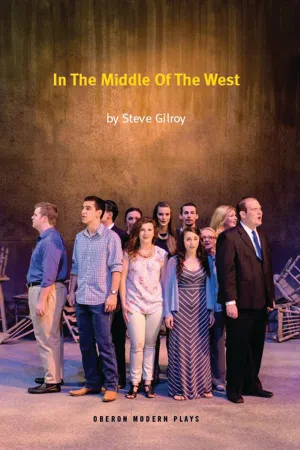
In Oklahoma City on the morning of April 19th 1995, Timothy McVeigh detonated a truck bomb outside the Alfred P Murrah Federal building, killing one hundred and sixty-eight people. Through interviews, In the Middle of the West gathers revealing and surprising first-hand accounts from those most intimately involved.
Tragic, compelling and funny, the play (for up to over twenty performers), weaves together the dramatic and powerful stories of people whose lives were forever changed by what remains America's most destructive domestic terror attack.
In the Middle of the West is also about Oklahoma, a frontier state whose people are characterized by their independence and determination. What is the lasting legacy for those caught up in this tragic event? How does its impact still resonate for Oklahoma City – a city in the middle of Mid-America?
"They're self-reliant and they feel like the government is getting too big? At some point they may say; 'We have to defend ourselves . . . from our own government.'."
- 72 pages
- English
- ePUB (mobile friendly)
- Available on iOS & Android
eBook - ePub
In the Middle of the West
About this book
Information
The play is largely constructed from interviews conducted in Oklahoma City, USA, London, England and Newcastle upon Tyne during 2015 and 2016.
Notes:
When performing it’s useful to consider the nature of “everyday” speech. The ellipses, the patterns, the “ums” and “uhs” and the pace. In general conversation people often speak much quicker than one would imagine so it’s important where appropriate to play the text with pace and energy.
Words in square brackets [ ] are not spoken, but are for clarification of meaning.
A stroke (/) indicates the point of interruption by the following speaker or character. A character’s line placed within the text of another indicates that the latter continues uninterrupted. For example:
CLAIRE: I think you got there sooner. (ANDREW: Yeah.) I got there the next day. (ANDREW: I got–) And you had a lot of delays, getting there, it was trouble it was really difficult I remember, I think you called from the plane or something?
“slides” refer to the projection of the text described. This could be a conventional projection onto a screen or a wall, or it could just be cardboard signs. The point in most cases is to identify the person/s. Not all projected slides are referred to in the text, but assume there is one per character. The slides should dissolve in. And then out.
In the original production a minimal set comprised a number of chairs which is equal to the number of actors in the cast. The chairs are wooden, old, and a little battered. They are not of uniform design.
In the original production most of the songs were accompanied by a simple guitar but included vocal harmony arrangements.
The play was originally performed with 11 performers in Oklahoma City and 17 performers in the UK. For smaller casts, performers can play multiple parts.
The characters Timothy McVeigh and Donald Trump were not represented in the original Oklahoma City University production.
SCENE 1
Blackout.
Lights up. The stage is bathed in warm light, some birds are singing. The Company are onstage.
CHARACTER A: Something about a bright early morning in Oklahoma / City.
CHARACTER B: The sky is so clear.
CHARACTER A: Yes. So blue, quite an intense …
CHARACTER B: The air is still.
Beat.
CHARACTER A: This isn’t typical.
CHARACTER B: (Agrees.) No.
CHARACTER A: Not for / April.
CHARACTER B: Not for / April.
CHARACTER A: (Agrees.) No. (Short pause.) It’s a vibrant sky.
CHARACTER B: But still.
CHARACTER A: Unusual.
CHARACTER B: Oklahoma skies are always busy …
CHARACTER A: Weather here is always busy.
CHARACTER A: Such a pretty / morning.
CHARACTER A: Just after Easter.
CHARACTER A: So still.
CHARACTER A: Blue.
Pause.
SCENE 2
The loud “clunk” of a large power switch to “off”. The stage changes to cold steel. The Company look out to the audience. Pause. All are still and then together, the cast take a sharp intake of breath – a gasp – for air. Beat.
The loud sounds of the bombing aftermath; sirens, helicopters, etc. What follows are the edited actual words spoken by witnesses of the bombing from the documentary “Terror Hits Home” 1995. Vocally the actors replicate the voices of their characters, but with volume and energy. Some use megaphones. The stage is transformed into the chaotic aftermath of a bombing. A physically frenetic scene. The actors randomly echo/repeat each other’s lines and this becomes more pronounced with repeated echoed voices.
CHARACTER 1: The side of the federal Building has been blown / off
CHARACTER 2: A tremendous blast came in through the windows, blew us out of our chairs and onto the / floors.
CHARACTER 3: I thank the Lord that I wasn’t sitting at my desk at that time, because that portion of the building, that portion of the building has / gone.
CHARACTER 4: They are bringing people out who that just covered in blood ehm, ambulance crews have been arriving for the last ten minutes and they’re going into / the building.
CHARACTER 5: We’ve got a lot of children hurt over here at the / YMCA!
CHARACTER 6: The devastation at the Alfred P Murrah building appears to be / almost uh, total.
CHARACTER 7: I don’t know what happened, just a / blast.
CHARACTER 8: I was falling and then I hit and I was dazed for a minute and I realized it had to be an / explosion or something.
CHARACTER 9: The large church at the corner of fourth and Harvey all the stained glass windows have been blown out … it is chaos / down here.
CHARACTER 10: At the federal building there’s a children’s centre … we need to get some fire officials / up there as soon as possible
At the Creche.
CHARACTER 11: (To a little girl.) Can you tell me your name? Can you tell me / your name?
CHARACTER 12: Is there someone there?
AREN: My daughter’s one and she’s in there.
CHARACTER 13: You went to the / nursery?
CHARACTER 7: Well we were pullin’. We’ve pulled five little kids out and a couple of / ladies
CHARACTER 14: All we can do is just be of as much assistance as we can to those who are injured and try to get them some medical / care.
CHARACTER 6: You’re doing a great job. We, all of us, in Oklahoma City thank you for what you’ve done today … The devastation in downtown Oklahoma City,/ it’s incredible.
CHARACTER 15: Let’s / move out!!
The stage starts to empty.
JENIFER: Right be careful, let’s just warn them now Cynthia that this is raw tape that we shot at the hospital which we have not censored in any way and you may see some graphic / stuff.
CHARACTER 17: It’s just astonishing to me that er an evil human being would do this to children and other innocent people, especially here in the Middle of mid / America.
CHARACTER 6: This is something that happens somewhere else, this is something that happens in places like … Beirut. Places far, far away with strange sounding names. It’s not something that’s supposed to happen in places like Oklahoma City. It’s not something that’s supposed to happen (Beat.) at home.
SCENE 3
A member of the Company sings, “By the Time I get to Phoenix” by Glenn Campbell which eventually cross-fades to the recording by Glen Campbell playing on the jukebox of a typical diner.
A diner.
Lights fade up. SAM GONZALES sits in a booth facing the audience with a cup of coffee. A voice recorder sits on the table and opposite SAM. His interviewer is not on stage but signified by an empty chair. She is a young woman. Music fades down. SAM addresses the interviewer.
SAM: We had a Mayor’s Prayer Breakfast at the Convention center. We had about twelve hundred people there, big event. (Slide: Sam Gonzales, seventy-nine years – former Chief of Police.) uhh I sat at the table with the Fire Chief and the City Manager. (Referring to diary.) Started about … ya know? Nobody’s seen this … nobody’s read it but me. I kept a diary during the bombing every day. So I can tell you exactly … the time I left. I think at 8:45 …
WAITRESS refills SAM’s coffee.
SAM: Thanks
WAITRESS: (Friendly.) You’re very welcome. (Exits.)
GARY enters other side of the stage. He never acknowledges the other characters. He addresses the audience directly.
GARY: After the Breakfast we were heading back in my car, (Slide: Gary Marrs-former Fire Chief.) headed back to city hall and the explosion occurred while (Enter RON who also doesn’t acknowledge the other characters but addresses the audience directly.) we were in the car downtown and of course I immediately drove over to the / scene.
RON enters and also does not acknowledge the other characters and addresses the audience directly.
RON: So I had gone to my business office which is uh just South of Baptist Hospital. (Slide: Ron Norick, former Mayor.) A five-story building and that building just shook like an earthquake.
SAM: Well, I like most people, when I got there I didn’t think it was a bombing. As I approached it, I thought it was gonna be some kind of natural gas explosion … And when I drove up to the scene and saw the / crater …
GARY: Uhm, Gonzalez the police chief told me that he thought he recognized the crater / in front of the building …
SAM: Huge crater out front, of the street, then being a police officer, I knew what it was. It was a car bomb, a truck bomb, some kind of bomb.
RON: It was still smoking y’know, lotta smoke and all that and they said it was a bomb and “What, what d’y’mean a bomb?” … why I’m thinkin’ it’s either airplanes crashed, gas lines blown up, or fuel truck something like that but not a-not a / bomb.
SAM: You know the first, first couple of hours are chaos. I, I, I, don’t care whether it’s here, or New York City. (Pause.) There were still a lot of bodies … laying out in open view. Uh, there was a lot of people in the building screaming for help and there was a lot of people, just, just people, not trained people, just / people.
WAITRESS: Not to bother you again Chief, it was in April of 1995?
SAM: It was.
WAITRESS: What day?
SAM: Nineteenth.
WAITRESS: (With pace.) Well that’s what I thought, I was just saying to Jenny it was the 19th, well she’s too young to remember anyways, but I told her “You know who that is? Well that’s Sam Gonalez, ‘Oklahoma City Chief of Police’, that man’s a hero” (SAM: Oh no … ) (To the girl interviewer.) Sorry for interrupting your meeting darlin’. (WAITRESS goes to leave and then turns.) Well I might leave you alone now … but I might not, okay?
SAM: (Laughing.) That’s alright, I don’t mind at all. (WAITRESS exits.)
RON: It was eh, it was traumatic, because we lost One hundred and sixty-eight people nineteen kids and it took … It was three weeks before we recovered the last two bodies and I was with the families when we recovered the last two
SAM: Oh, I connected with my granddaughter. She was born on March third. My therapy at night was to go home and hug her. I’d rock her in an old rocking chair. That’s, probably what I remember most about what uhh helpe...
Table of contents
- Front Cover
- Title Page
- Copyright Page
- Contents
- Characters
- Act I
- Act II
Trusted by 375,005 students
Access to over 1.5 million titles for a fair monthly price.
Study more efficiently using our study tools.
Frequently asked questions
Yes, you can cancel anytime from the Subscription tab in your account settings on the Perlego website. Your subscription will stay active until the end of your current billing period. Learn how to cancel your subscription
No, books cannot be downloaded as external files, such as PDFs, for use outside of Perlego. However, you can download books within the Perlego app for offline reading on mobile or tablet. Learn how to download books offline
Perlego offers two plans: Essential and Complete
- Essential is ideal for learners and professionals who enjoy exploring a wide range of subjects. Access the Essential Library with 800,000+ trusted titles and best-sellers across business, personal growth, and the humanities. Includes unlimited reading time and Standard Read Aloud voice.
- Complete: Perfect for advanced learners and researchers needing full, unrestricted access. Unlock 1.5M+ books across hundreds of subjects, including academic and specialized titles. The Complete Plan also includes advanced features like Premium Read Aloud and Research Assistant.
We are an online textbook subscription service, where you can get access to an entire online library for less than the price of a single book per month. With over 1.5 million books across 990+ topics, we’ve got you covered! Learn about our mission
Look out for the read-aloud symbol on your next book to see if you can listen to it. The read-aloud tool reads text aloud for you, highlighting the text as it is being read. You can pause it, speed it up and slow it down. Learn more about Read Aloud
Yes! You can use the Perlego app on both iOS and Android devices to read anytime, anywhere — even offline. Perfect for commutes or when you’re on the go.
Please note we cannot support devices running on iOS 13 and Android 7 or earlier. Learn more about using the app
Please note we cannot support devices running on iOS 13 and Android 7 or earlier. Learn more about using the app
Yes, you can access In the Middle of the West by Steve Gilroy in PDF and/or ePUB format, as well as other popular books in Literature & American Drama. We have over 1.5 million books available in our catalogue for you to explore.