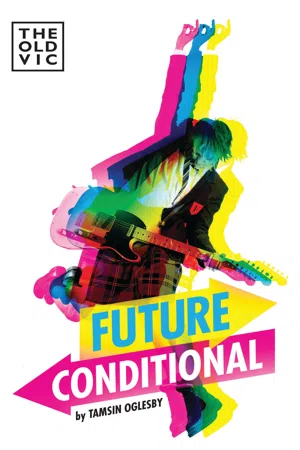
Future Conditional tackles the nightmare of British schooling through a myriad of characters including parents, teachers, and Alia, a prodigiously clever fourteen-year-old Afghan refugee and the newest member of Britain's Education Research Board. Alia has a radical solution for Britain's schools that could restore our place in the world education league. But is the system ready to take lessons from a schoolgirl…?
- 104 pages
- English
- ePUB (mobile friendly)
- Available on iOS & Android
eBook - ePub
Future Conditional
About this book
Information
ACT TWO
SCENE ONE
Boardroom. The members take their seats. ALIA stands next to MEG. OLIVER and MEG go to sit in the central chair at the same time.
OLIVER: Oh.
MEG: Sorry darling, did you want to sit here?
OLIVER: No no, it’s fine.
MEG: I don’t mind. /Go on, go ahead.
OLIVER: No, it’s okay, it’s just I was sitting there last time.
MEG: You want to sit down, sit down.
OLIVER: Doesn’t matter, honestly.
MEG: Oliver. Sit down.
OLIVER: Thank you.
OLIVER sits. MEG waits until everyone’s seated.
MEG: Okay. Let me introduce our newest member of the Commission to everyone. This is Alia. She’s sixteen. She’s at school in East London at the moment, having experienced a few different schools along the way. And I’m very grateful that she’s found time between her studies to join our research group and to contribute to our strategic planning over these last few meetings.
ALIA: Thank you. It is an honour.
MEG: I don’t know whether you want to say a word or two about how you came to be here before we start, Alia?
ALIA: Yes. I would like to say something about your country and your education. And why I am here. Four years I have been in England and I have known only kindness. When I first arrive, I first arrived in this country with no family, no friends, no suitcase, just a little plastic bag with my personal effects. The first person I met was the immigration officer. He talked to me gently, carefully, with respect. This was not so in Turkey and Vienna, on my way here. Then I met Joe, he is a social worker.
He’s a funny man, bit of a joker. I like him very much. Then I met my foster mother and I found it hard to believe, I wondered how a human being could be capable of welcoming a stranger like this. I could hardly speak English, but they took me into their home, Ellie and Sam, they shared their house, their lives, everything with me, they treated me as like they’d known me for ever. Ellie is a shop assistant, Sam works for the gas. Their kindness, it has transformed me. I was a fearful person who thought I was nothing. I am a person now, full of hope, may be human after all. And then there was Mr Crane. He is also a teacher. He is a great teacher. He was at my school in Hastings. Then I had to move. I am with a new family, new school, all good. I love teachers. They have saved my life. I owe everything to the teachers, to your education, the kindness of your people, your country. Which now I like to call my country. I want to repay it if I can.
She sits. General approval.
MEG: Alia, thank you very much.
ROB: What kind of school do you go to now, Alia?
ALIA: Is called ‘satisfactory’. But for me it is very good.
MEG: Wickham school. Leytonstone. Mixed comprehensive.
OLIVER: And how do you feel about your school?
ALIA: Lucky.
OLIVER: That’s good.
ALIA: How do you feel about your school?
OLIVER: My school?
ALIA: When you went to school, yes. How do you feel about the school you went to?
OLIVER: No, no I went to public school.
ALIA: Yes?
OLIVER: So obviously I was lucky too, but, well, you know.
ANNA: He went to Eton.
ALIA: It was not very good?
Laughter.
OLIVER: No, no, it was very good but you see public school – you know about public school, right?
ALIA: I have heard what it is but I don’t understand. Why it is called public school for starters. When it is clear you have to pay.
OLIVER: Because, okay, because when they were first set up they were, unlike church-affiliated schools, open to anyone.
BILL: Who could pay.
OLIVER: Anyone who could pay, yes. Then what happened is government funded schools came along and they were not just open to the public, but compulsory, you see. But since the term ‘public’ was already taken by the fee-paying system they called them ‘state’ schools. So the state system became the public system but couldn’t call itself public because the public system had already nabbed the name and never got round to changing it.
BILL: For fear of losing its charitable status.
ALIA: This is what I like about your language. One word means two contradictory things. Is how you avoid fundamentalism.
Beat.
OLIVER: Yes.
ALIA: And your teachers. Were they good?
OLIVER: Most of them, yep. Generally very good. My Divinity master was excellent.
ALIA: Master?
OLIVER: Teacher.
ALIA: What is the difference?
ROB: About twenty thousand a year.
Laughter.
ALIA: Teachers should be paid well, I think. Like doctors, lawyers. They save lives. No?
MEG: I was a teacher once so yes.
ALIA: And the children who go to these public schools, they are rich?
OLIVER: No. No, not really.
ANNA: Oh come on.
OLIVER: They’re reasonably well off. But it’s not about money.
ALIA: What is it about?
OLIVER: It’s about, well, it’s about the ethos. Public school tries to address the whole person. It’s a milieu ...
Table of contents
- Cover
- Half-title Page
- Title Page
- Copyright
- Dedication
- Contents
- Characters
- Producation Team
- Act One
- Act Two
- By the same Author
Trusted by 375,005 students
Access to over 1.5 million titles for a fair monthly price.
Study more efficiently using our study tools.
Frequently asked questions
Yes, you can cancel anytime from the Subscription tab in your account settings on the Perlego website. Your subscription will stay active until the end of your current billing period. Learn how to cancel your subscription
No, books cannot be downloaded as external files, such as PDFs, for use outside of Perlego. However, you can download books within the Perlego app for offline reading on mobile or tablet. Learn how to download books offline
Perlego offers two plans: Essential and Complete
- Essential is ideal for learners and professionals who enjoy exploring a wide range of subjects. Access the Essential Library with 800,000+ trusted titles and best-sellers across business, personal growth, and the humanities. Includes unlimited reading time and Standard Read Aloud voice.
- Complete: Perfect for advanced learners and researchers needing full, unrestricted access. Unlock 1.5M+ books across hundreds of subjects, including academic and specialized titles. The Complete Plan also includes advanced features like Premium Read Aloud and Research Assistant.
We are an online textbook subscription service, where you can get access to an entire online library for less than the price of a single book per month. With over 1.5 million books across 990+ topics, we’ve got you covered! Learn about our mission
Look out for the read-aloud symbol on your next book to see if you can listen to it. The read-aloud tool reads text aloud for you, highlighting the text as it is being read. You can pause it, speed it up and slow it down. Learn more about Read Aloud
Yes! You can use the Perlego app on both iOS and Android devices to read anytime, anywhere — even offline. Perfect for commutes or when you’re on the go.
Please note we cannot support devices running on iOS 13 and Android 7 or earlier. Learn more about using the app
Please note we cannot support devices running on iOS 13 and Android 7 or earlier. Learn more about using the app
Yes, you can access Future Conditional by Tamsin Oglesby in PDF and/or ePUB format, as well as other popular books in Literature & British Drama. We have over 1.5 million books available in our catalogue for you to explore.