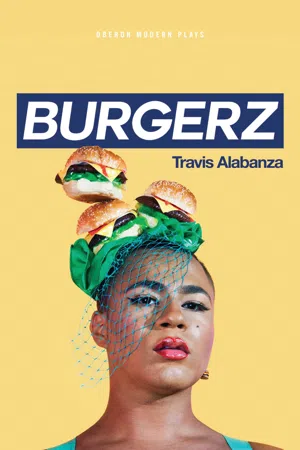
Hurled words. Thrown objects. Dodged burgers.
A burger was thrown at Travis Alabanza on Waterloo Bridge in 2016. From this experience they have created a poetic, passionate performance piece based around the 'burger': the texture, and taste of being trans.
Their experiences include verbal abuse, ostracisation and being thrown out of a Top Shop changing room. The piece also explores the black trans experience.
eBook - ePub
Burgerz
About this book
Information
A warehouse with a giant box centre stage. The doors of the box open to reveal TRAVIS wearing overalls and boots.
A burger was thrown at me in broad daylight in April 2016 on Waterloo Bridge whilst someone yelled the word tranny. I think over one hundred people saw and I know no one did anything.
Pause.
If I become obsessed with how the burger works, how it flies, how it smells and how it lands then maybe I will have some agency over it. Maybe I will feel like I was once in control.
Imagine that burger now. Imagine it in front of you. The most typical burger you can see. The emoji. The archetype. The original. The real burger.
Pause.
The burger bun. A piece of dough.
A piece of dough is just a piece of dough until you figure out it is supposed to be part of a burger, to make the bun. Then, there are many things you must do to it to make it right. Make it work. Turning flour and yeast to whole things, heating things, changing things. Altered to circles through knives and cuts. Kneaded and poked, stretched out and pinched, moulding and ploughing the dough, prodding it into shape to eventually be the bun, that will eventually hold the burger.
The burger bun must be round. Top heavy, bottom light, one bigger than the other. Always one bigger than the other, big holding small in place. Top to bottom. We are not aiming for equal.
Imagine that burger now. Imagine it in front of you. The most typical burger you see. The emoji.
The archetype. The original. Real burger.
The burger bun.
Once made, cut into half, burger in mind, always burger in mind, bread cut, cursed for not being quite right. A patty placed in. We imagined beef, do not pretend you did not. Or moreover that it would be weird if I placed chicken in there now. Sure, we accept a veggie pattie, or even aubergine in some high-end food places in East London served in old car parks – but do not lie that you imagined that first. You saw the patty. Real burger equals real patty equals real beef equals real…burger. Placed inside.
Pause.
This is where people believe the burger has some freedom. We’ve got the bun, the beef, the patty – and now, we finally have a choice. That the burger becomes your liberal playground, toppings are where you can make you… You! The burger that liberals want. Now it’s your turn to jazz it up, place whatever on top, go wild, it’s your burger, it’s your life! But let’s not pretend we didn’t all have ideas for how this burger should look. Expectations. Lettuce, green. Tomatoes, sliced, I guess red. Cheese, thin. Mayo over the top. Onions, maybe. Some other garnish. Sure, some freedom – but we did know what to expect. We had this burger planned, and imagined. All I see now is the dough that is the burger bun, attached at the waist to the patty, to the salad, to the expectations. And if I change too much about how this burger was imagined, it will be ridiculed. Sent back to the kitchen.
Pause.
‘HOT DOG OR BURGER?’
‘HOT DOG OR BURGER, LOVE?’
‘HOT DOG…OR BURGER, LOVE?’
‘HOT DOG OR BURGER, LOVE?’
‘HOT DOG…OR BURGER, LOVE?’
I can’t remember what I chose or I don’t want to mention it, partly because I’m not sure it was a choice.
‘You often have to choose between burgers and hot dogs in life, Travis – it would be odd to have both.’
‘But Mum, last time I saw a burger stall was at that tacky Christmas fair with you, they sold hot dogs and burgers there, and you didn’t find it odd.’
‘Yeah, you’re right. But they were sold in separate containers. Clearly labelled.’
Pieces of the same dough could be made into a bun for a burger or a bun for a hot dog, but once it’s made into another it’s very hard to change back. People would still know it was always a hot dog bun first.
People might only see buns as something to hold burgers, that is until they hear about hot dogs, and then there is this whole other world where you had hot dogs as your priority, your archetype, your emoji – and figuring out about hot dogs meant that you looked at burgers completely differently. My mum never really cooked or made hot dogs in the house, so all we ever knew was how to choose burgers, but if I grew up with my dad then I’d pick hot dogs every time, without question. Then twenty years or so down the line I’d be making some show called HOT DOGZ with a Z.
Pause.
It’s ridiculous that we place two things next to each other and expect ourselves to be able to make a choice, or to lie and tell ourselves it is a choice when there are two things placed next to each other. As if something containing only two could ever be a choice. That is not a choice. That is rather jumping to which death you think may be less painful.
HOT DOG OR BURGER?
Die quietly or die loudly? Splitting things up into two arbitrary categories has never worked ever since the beginning of time.
And you went there with your fucking utensils, your fucking cutlery, your fucking recipe books with no fucking seasoning and decided that we all had to choose between a fucking burger and a fucking hot dog, but it wasn’t a choice, because you looked at me, and you said in one minute this person is a fucking person that eats burgers. As if I couldn’t be that and more, as if I couldn’t catch my breath, for a minute.
As if burgers isn’t something that happens violently after it, as if burgers isn’t violence in it...
Table of contents
- Front Cover
- FOREWORD
- Half-Title Page
- Title Page
- Copyright Page
- Dedication
- Contents
- Chapter 1
Trusted by 375,005 students
Access to over 1.5 million titles for a fair monthly price.
Study more efficiently using our study tools.
Frequently asked questions
Yes, you can cancel anytime from the Subscription tab in your account settings on the Perlego website. Your subscription will stay active until the end of your current billing period. Learn how to cancel your subscription
No, books cannot be downloaded as external files, such as PDFs, for use outside of Perlego. However, you can download books within the Perlego app for offline reading on mobile or tablet. Learn how to download books offline
Perlego offers two plans: Essential and Complete
- Essential is ideal for learners and professionals who enjoy exploring a wide range of subjects. Access the Essential Library with 800,000+ trusted titles and best-sellers across business, personal growth, and the humanities. Includes unlimited reading time and Standard Read Aloud voice.
- Complete: Perfect for advanced learners and researchers needing full, unrestricted access. Unlock 1.5M+ books across hundreds of subjects, including academic and specialized titles. The Complete Plan also includes advanced features like Premium Read Aloud and Research Assistant.
We are an online textbook subscription service, where you can get access to an entire online library for less than the price of a single book per month. With over 1.5 million books across 990+ topics, we’ve got you covered! Learn about our mission
Look out for the read-aloud symbol on your next book to see if you can listen to it. The read-aloud tool reads text aloud for you, highlighting the text as it is being read. You can pause it, speed it up and slow it down. Learn more about Read Aloud
Yes! You can use the Perlego app on both iOS and Android devices to read anytime, anywhere — even offline. Perfect for commutes or when you’re on the go.
Please note we cannot support devices running on iOS 13 and Android 7 or earlier. Learn more about using the app
Please note we cannot support devices running on iOS 13 and Android 7 or earlier. Learn more about using the app
Yes, you can access Burgerz by Travis Alabanza in PDF and/or ePUB format, as well as other popular books in Social Sciences & British Drama. We have over 1.5 million books available in our catalogue for you to explore.