Celebrating the 70th anniversary of the founding of the NHS, award-winning comedian and activist Mark Thomas takes a look at our NHS, what state it's in, where it's going, and what we need to do to keep it.
To create this show Mark Thomas conducted a series of public interviews with academics and practitioners, he spent a month in residency at the Imperial Healthcare Trust, and he spoke to a retired doctor about what could go wrong with his own health over the coming years.
The result is this funny, raw and angry show about a service created, in its founder's words "in place of fear", which is now threatened by lack of funding. Through the interviews and hospital scenes recreated in the show, we see a service held together by dedicated staff, crippled by government policy which has created an internal market and indebted by PFI contracts from which private companies have made millions.
This informative show toured venues throughout the UK in 2018, and is a strong wake-up call for those who want to see the NHS survive.
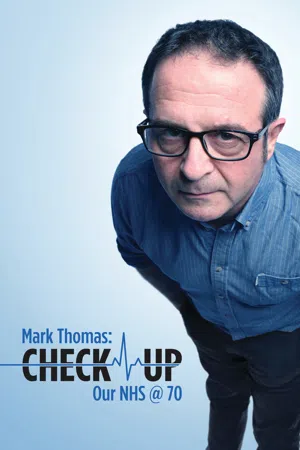
- 80 pages
- English
- ePUB (mobile friendly)
- Available on iOS & Android
eBook - ePub
Check Up: Our NHS at 70
About this book
Information
Onstage a four-panel hospital screen stage left and a plastic chair in front of it. Downstage right a hospital trolley on wheels. A projection screen at the back of the stage.
Footage of the entrance to Lisson Grove Health Centre, with a caption saying ‘The view from the rehearsal room,’ is played on a screen whilst audience are seated.
Screen changes and Pathé fanfare & newsreel plays:
‘A HEALTHIER BRITAIN
It’s coming.
It’s on the way.
Look out for it’
V/O: This leaflet is coming through your letterbox one day soon or maybe you’ve already had your copy. Read it carefully. It tells you what the new National Health Service is.’
Lights go down and intro fanfare replays. Lights go up and MARK enters.
My mum remembers seeing that, she remembers the creation of the NHS, she says,
‘Your nan was thrilled.’
My grandmother came from North Seaton, the North East, from a mining family. All her stories were about bullies and physical calamity.
She told me how they lived in a row of miners’ houses owned by the mining company and she remembered when the company installed electricity, so the miners’ families had electric lights for the first time but the company didn’t give them any switches. The company kept the switch. And 4.30pm in the winter they switch on the lights in every house, 9.30pm time for bed and all the lights go out.
She told me that when there was an accident at pit an alarm was sounded and the families would stand in the street by their front doors, and the medical cart would come down the street bearing the injured and/or dead, about how they were terrified that the cart would stop at their door, because then it was your relatives in there. And she said how she felt enormous relief when it passed mixed with intense guilt that she had wished misfortune on the people further down the street.
Her family used to save a penny a week in a cup on the shelf for the doctor and if a child was ill there was a discussion about whether they should call the doctor and spend the money or save it until someone else was worse.
The NHS was founded in 1948 on three principles, it should be free, comprehensive – everything is covered – and universal – for everyone.
Health Minister Nye Bevan, the father of the NHS, said the NHS was created, ‘In Place of Fear.’
‘In Place of Fear.’
And in its first two years of existence between 1948 and 1950 it prescribed – well guess how many pairs of glasses the NHS prescribed for free in its first two years?
Seventeen million pairs of glasses.
Seventeen million people who could read and see properly. And my grandmother was one of them.
For seventy years the NHS has not just fought illness but fear.
Like 45,000,000 others I was born under the NHS. I was born in St Thomas’s hospital on the south bank of the Thames opposite Parliament. I was literally born screaming at politicians. And here I am today…
I was born to a nurse, my mum was a midwife, she trained in Glasgow in the Gorbals in 1957. She told me stories of delivering babies in tenements and there was no crib or cot so she would wrap the baby in swaddling and put it in drawer. Health and wealth have always been entwined.
Everyone says the NHS needs more money, you can’t turn on Question Time without someone declaring they would be happy to pay a 1p in the pound tax increase IF the money was ring-fenced for the NHS – by the end of the show I hope to prove that argument wrong.
Everyone says it needs more money, even our Prime Minister agrees and is increasing funding to the NHS as a birthday present, a present! Only the Tories can spend our tax money and call it a present.
Everyone I spoke to in the NHS said this money is not enough and will barely get the service back to where it was ten years ago, let alone improve it.
Nearly everyone I spoke to talked of how this year, the celebratory year, has been the most difficult, people working in mental health spoke of the service buckling under the pressure and they point to the fact only four in ten people with a mental illness get any kind of treatment on the NHS. Four in ten. If that was cancer there would be uproar … And for two weeks this year the NHS was in special measures.
My family worked in the NHS. I was born in the NHS and it is very possible that I will die in the NHS and I want to know what state it is going to be in when I need it most.
To do this I do three things:
I conduct a series of public interviews with academics and practitioners to see where the NHS is now and where it could be.
I spend a month in residency at the Imperial College Healthcare Trust which has four NHS hospitals in West London, shadowing consultants, doctors and nurses.
And finally I talk to a doctor to assess what could go wrong for me over the coming years. What will drive me into the arms of the NHS.
The results are this show,
CHECK-UP: Our NHS @ 70.
***
Doctor Ron is a retired GP from Tower Hamlets in London and I spend an afternoon with him to ask what could go wrong with me.
MARK (AS RON): ‘Everything. Anything. You’re fifty-five now Mark. The only things you don’t have to worry about are milk teeth and the menopause. Other than that everything is coming at you. Now when you die you want to go quick. You don’t want to linger, don’t hang about, you don’t want to end up in hospital, nasty places, people die there. An accident. Run over by a car. Nice and quick. A bus would be more certain. Or a mirror on the side of the bus. Back of the head. Bang. Wouldn’t even see it coming. Out. You’re a cyclist. And I bet you don’t stop at red lights. Boom! Travis Perkins scaffold lorry. Over.’
MARK walks to trolley, gets soap from dispenser attached to trolley and cleans hands.
Armed with that cheery thought I head for my second day at St Mary’s, Paddington. I am scheduled to be there from 5pm to 6.30pm to tour Major Trauma. There are four major trauma centres in London, if you get shot stabbed, have serious head injuries, are in a car crash or involved in a terrorist attack, one of these is where you go. The man I am shadowing is Dr Asif Rahman, he is from Fife and to any Scots in the audience I apologise in advance for the accent.
MARK (AS RAHMAN): ‘Right, you need to understand the colour of the scrubs. Senior consultants wear purple scrubs. This is Jane, she’s in purple, senior consultant for A & E tonight, Jane is ex-army. We like ex-army. So Senior Consultant – purple, doctors – green, nurses – blue, senior nurses – dark blue and just for clarity some doctors – blue. I’m in charge of Resus tonight.’
Resus is an extension to A&E. The area is quite small, six bays, three each side, divided by concertinaed paper curtains. At one end is a nurses’ station with some computers and a TV screen with a live CCTV feed onto the ambulance bay.
MARK (AS RAHMAN): ‘When a patient comes in my job is to organise the team, assign a doctor who leads the team, what people we need, what equipment and call on the expertise of surgeons and consultants in the hospital who we might need.’
‘It seems pretty quiet…’
‘Do not use the ‘Q’ word. You used the ‘Q’ word!...
Table of contents
- Front Cover
- Half-Title Page
- Title Page
- Copyright Page
- Contents
- Acknowledgements
- Introduction, by Mark Thomas
- Preface, by Nicolas Kent
- Creative Team
- In Pictures
- Check-up: Our Nhs @ 70
Trusted by 375,005 students
Access to over 1.5 million titles for a fair monthly price.
Study more efficiently using our study tools.
Frequently asked questions
Yes, you can cancel anytime from the Subscription tab in your account settings on the Perlego website. Your subscription will stay active until the end of your current billing period. Learn how to cancel your subscription
No, books cannot be downloaded as external files, such as PDFs, for use outside of Perlego. However, you can download books within the Perlego app for offline reading on mobile or tablet. Learn how to download books offline
Perlego offers two plans: Essential and Complete
- Essential is ideal for learners and professionals who enjoy exploring a wide range of subjects. Access the Essential Library with 800,000+ trusted titles and best-sellers across business, personal growth, and the humanities. Includes unlimited reading time and Standard Read Aloud voice.
- Complete: Perfect for advanced learners and researchers needing full, unrestricted access. Unlock 1.5M+ books across hundreds of subjects, including academic and specialized titles. The Complete Plan also includes advanced features like Premium Read Aloud and Research Assistant.
We are an online textbook subscription service, where you can get access to an entire online library for less than the price of a single book per month. With over 1.5 million books across 990+ topics, we’ve got you covered! Learn about our mission
Look out for the read-aloud symbol on your next book to see if you can listen to it. The read-aloud tool reads text aloud for you, highlighting the text as it is being read. You can pause it, speed it up and slow it down. Learn more about Read Aloud
Yes! You can use the Perlego app on both iOS and Android devices to read anytime, anywhere — even offline. Perfect for commutes or when you’re on the go.
Please note we cannot support devices running on iOS 13 and Android 7 or earlier. Learn more about using the app
Please note we cannot support devices running on iOS 13 and Android 7 or earlier. Learn more about using the app
Yes, you can access Check Up: Our NHS at 70 by Mark Thomas in PDF and/or ePUB format, as well as other popular books in Politics & International Relations & British Drama. We have over 1.5 million books available in our catalogue for you to explore.