"I spent more than half my life, when I ought to have been enjoying myself, arguing and planning and running around like a maniac, all to sell a lot of things to people I didn't know, so that I could buy a lot of things that I didn't have time to use. Sheer lunacy. And it took nothing less than an atom bomb to blow me out of it."
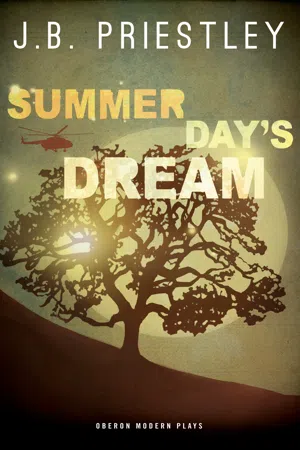
Following a devastating nuclear war which has seen Britain bombed back into the pre-industrial past, Stephen Dawlish and his family live a quiet rural life. Until their quiet, agrarian existence is disrupted by the appearance of three representatives of the New World Order – an American, a Russian and an Indian – who have devastating plans that will end their new peaceful way of life forever...
- 96 pages
- English
- ePUB (mobile friendly)
- Available on iOS & Android
eBook - ePub
Summer Day's Dream
About this book
Information
ACT ONE
SCENE 1
The entrance hall of Larks Lea, an old country house on the South Downs. Early afternoon around Midsummer, 1975.
The house was originally a stately early eighteenth century mansion. Everything is clean and well-kept in the place, but its original grandeur has obviously gone for ever, and it has an air of cheerful ruin. Sections of the wood panelling are missing, revealing the bricks underneath, and it is clear that the entrance hall is now used as an all-purpose room and has a farmhouse look about it. The front entrance, with large double doors with a decorative fanlight over them, are in an alcove up right centre. When the doors are open the remains of a stone balustrade can be seen, and a glimpse is had of a lush, overgrown, neglected garden in high summer. There are windows in the right and left sides of the alcove. There is a large window right also overlooking part of the garden. A once fine, broad shallow staircase, now sadly dilapidated, leads from up left to the first floor. There is tall narrow window in the back wall where the staircase turns at a small landing. A door down left leads to the kitchen and the rest of the ground floor of the house. The stairs are uncarpeted and two mats, one by the doors up centre, and one centre, only partially cover the stone-flagged floor. There are no curtains to the windows. The furniture is nondescript. A large sofa, with a drop end, stands under the window right. A circular, rough wood table stands centre, with an upright chair above it and kitchen-type elbow chairs right and left of it. A small wood stool stands underneath the table. A small plain refectory table with a wood bench right of it, stands against the wall left. Small stools at each end of the refectory table complete the furniture. Left of the doors up centre there are two or three hooks on the wall on which a raincoat is hanging. Other coats and a fishing basket hang on some hooks left of the staircase window. Shot-guns and other odds and ends generally found about a farmhouse, occupy various corners. An old coat hangs over the bannister rail, and a pair of gum-boots stand at the foot of the stairs. There are no pictures. Shaded electric pendants hang right centre and left centre, but at night the actual source of light, which is soft and mellow, falls in localised areas from two hessian shaded lights, one over the foot of the stairs, and the other over the table centre. They are controlled from switches on the left wall of the alcove up centre.
When the curtain rises, it is a bright, hot summer day. The doors up centre are wide open. STEPHEN DAWLISH, who is very old, but still a tremendous character, is asleep in the chair right of the table centre. He is snoring gently and peacefully. He is dressed in very old patched tweeds. All the English characters are dressed very simply and rather shabbily, though the young people have a good deal of colour in their clothes. All of them look very healthy, as if they spent most of their time out of doors. After some moments – for the scene should be very slow in opening, to suit the mood of the time – FRED VOLES enters up centre. He is a man of about sixty, a slow, dependable rural type. He carries a trug basket full of potatoes. He moves above the table centre, sees STEPHEN is asleep, laughs gently but does not disturb him. He then moves quietly to the table left, puts the basket on it, sits on the bench left, takes an old pipe, a pouch of tobacco and some matches from his pocket, and fills and lights the pipe. STEPHEN slowly wakes up and sniffs carefully at FRED’s smoke.
STEPHEN: Fred?
FRED: Yes, Mr Dawlish?
STEPHEN: (Sniffing; almost accusingly.) There’s some real tobacco in that pipe.
FRED: There is. But I’ve still mixed it with some coltsfoot – about half and half. (He rises and moves to left of STEPHEN.) Try some? (He hands his pouch to STEPHEN.)
STEPHEN: (Taking the pouch.) Thank you, Fred. (He takes a pipe from his pocket and begins to fill it.) Where did the tobacco come from?
FRED: Frank Waterhouse. His lad, the one who’s at sea, brought him some, and when we sold them two heifers to him the other day, Frank gave me about a pound.
(STEPHEN returns the pouch to FRED, and lights his pipe.)
Some’s for you, of course, Mr Dawlish, if you want it.
STEPHEN: Certainly I want it, Fred. All you can spare. (His pipe is going now, and he tastes it.) Not bad. Not bad at all.
FRED: ’Tisn’t, is it? I’ll bring yours up tonight. You’ve got some coltsfoot to mix in with it, eh?
STEPHEN: Plenty. (He sighs with satisfaction and smokes comfortably.) I was dreaming, Fred. Sixty years back. Nineteen-fifteen – first World War. About the time you were born.
FRED: (Sitting in the chair above the table centre.) That’s right. Nineteen-fifteen. I’m sixty this year.
STEPHEN: (Slowly.) I was in the trenches again – near Neuve Chapelle – splashing about in gum-boots in a foot or two of water. (He pauses.) I could see the rotting sandbags, as plain as I can see you – after sixty years. By thunder, Fred, I’ve been through something in my time – and it’s all here somewhere, even the sandbags. I’m a miracle, Fred, and nothing less.
FRED: Right, Mr Dawlish. And maybe we all are.
STEPHEN: Certainly. Only I’m more of one.
(FRED laughs.)
Is the hay in?
FRED: Finished this noon. I came to tell you. But I’ve had to send the big cart up to Longbarrow Down.
STEPHEN: Why? You’re not lending it to Joe Watson again, are you?
FRED: No. Joe doesn’t need it this year.
STEPHEN: Then why send it up to Longbarrow Down?
FRED: Joe sent his boy down with a message that them three foreigners up there have had an accident with their helicopter or whatever it is – and they look like being stuck here for a day or two. So Christopher and Miss Rosalie said these foreigners had better come and stay with you.
STEPHEN: (Grumbling humorously.) Oh, they did, did they?
FRED: It’ll be all right, won’t it, Mr Dawlish?
STEPHEN: I don’t know, Fred. I’ve arrived now at an age when I’ve stopped knowing – or really caring – whether things are all right. But I don’t mind them coming here.
FRED: (Grinning.) That’s a good job, because they’re on their way here now.
(MARGARET DAWLISH enters down left. She is a tall striking-looking woman in her forties. She has obviously been cooking, but nevertheless retains an impressive air of dignity. She has a rather slow, deep voice, and a strange, searching look. She carries two pillows.)
MARGARET: (Moving to the foot of the stairs.) Good afternoon, Fred.
FRED: (Rising.) Afternoon, Mrs Dawlish. (He moves left.)
STEPHEN: The big cart’s on its way here with three foreigners who’ve been asked to stay here.
MARGARET: Well, I think we ought to have them. The dark one – Indian or something – has hurt himself.
STEPHEN: What’s this, Margaret? More witchcraft?
MARGARET: Not this time. Gladys Watson brought me some eggs in exchange for some butter, and she told me. One of the three is a woman – a Russian.
STEPHEN: (Grumbling humorously.) Worse and worse.
MARGARET: (Moving above the table, centre.) We can manage for a day or two. (She places the pillows on the chair above the table, centre.) And it’ll be a nice change for you, Father.
STEPHEN: I don’t want a nice change. I don’t want any more changes, nice or otherwise. I’ve seen too many. Where are we going to put them?
MARGARET: I’ve worked that out nicely. Christopher’s still sleeping outside, so one of them can have his room. Rosalie can share with me…
STEPHEN: Yes, yes, my dear. You’ve worked it out…
MARGARET: As for meals – I’m baking that lovely piece of ham – and a big rabbit pie – and then there’s plenty of…
STEPHEN: (Interrupting.) All right, M...
Table of contents
- Cover
- Half-title Page
- Title Page
- Copyright
- Author’s Preface
- Characters
- Contents
- Act One
- Act Two
Trusted by 375,005 students
Access to over 1.5 million titles for a fair monthly price.
Study more efficiently using our study tools.
Frequently asked questions
Yes, you can cancel anytime from the Subscription tab in your account settings on the Perlego website. Your subscription will stay active until the end of your current billing period. Learn how to cancel your subscription
No, books cannot be downloaded as external files, such as PDFs, for use outside of Perlego. However, you can download books within the Perlego app for offline reading on mobile or tablet. Learn how to download books offline
Perlego offers two plans: Essential and Complete
- Essential is ideal for learners and professionals who enjoy exploring a wide range of subjects. Access the Essential Library with 800,000+ trusted titles and best-sellers across business, personal growth, and the humanities. Includes unlimited reading time and Standard Read Aloud voice.
- Complete: Perfect for advanced learners and researchers needing full, unrestricted access. Unlock 1.5M+ books across hundreds of subjects, including academic and specialized titles. The Complete Plan also includes advanced features like Premium Read Aloud and Research Assistant.
We are an online textbook subscription service, where you can get access to an entire online library for less than the price of a single book per month. With over 1.5 million books across 990+ topics, we’ve got you covered! Learn about our mission
Look out for the read-aloud symbol on your next book to see if you can listen to it. The read-aloud tool reads text aloud for you, highlighting the text as it is being read. You can pause it, speed it up and slow it down. Learn more about Read Aloud
Yes! You can use the Perlego app on both iOS and Android devices to read anytime, anywhere — even offline. Perfect for commutes or when you’re on the go.
Please note we cannot support devices running on iOS 13 and Android 7 or earlier. Learn more about using the app
Please note we cannot support devices running on iOS 13 and Android 7 or earlier. Learn more about using the app
Yes, you can access Summer Day's Dream by J. B. Priestley in PDF and/or ePUB format, as well as other popular books in Literature & British Drama. We have over 1.5 million books available in our catalogue for you to explore.