The Sikhs have been a people in transition. Unwanted displacements, willing movements and a changing world have led them through demographic, occupational and experiential shifts. While this has led to the evolution of new facets within the community, it has also evoked mixed responses from outside.
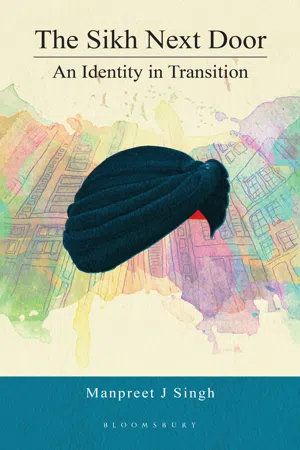
As new generations of Sikhs engage with the world through sensibilities defined by their contemporary contexts, they find themselves constructed in images dissonant with their lived realities. The Sikh Next Door: An Identity in Transition traces these changes while also making an incisive analysis of old stereotypes-some heroic, some menacing and some farcical.
It simultaneously brings into focus the real people behind these images, their varying social stances and their collective commitment to a common religious identity.
The work attempts to reframe the Sikhs, bending a few existing narratives and offering an impetus for a more nuanced understanding of the community.
- 244 pages
- English
- ePUB (mobile friendly)
- Available on iOS & Android
eBook - ePub
About this book
Trusted by 375,005 students
Access to over 1.5 million titles for a fair monthly price.
Study more efficiently using our study tools.
Information
Topic
Teologia e religioneSubtopic
Religioni asiatiche1
Nudged Out of the Narrative: The Trader/Professional Sikh
Community identities are deceptive in their display of homogeneity for they are multitudinous assimilations, holding subgroup schemas and stratification statuses. This is true of the Sikh community too and derives from the fact that Sikhism emerged out of a fluid social order. The religion attracted followers from diverse backgrounds and occupations that sometimes included people with conflicting interests and attitudes. This resulted in divergent strands within the community with different trajectories and cultural focuses. Two such strands, with fundamentally different worldviews, are the trader/professionals and the agriculturists. The former represents the mercantile and service class. The latter, apart from being the face of the Sikh agricultural community, also represents its martial identity. Bound by a common faith but fundamentally different from each other, the two groups have often presented confusing and contradictory stances in behaviour, attitude and priorities. Through historical and political twists, as the numerically stronger agriculturists have gained advantage, the narrative centred around Sikhs as an agricultural community has overshadowed the story of the trader/professional class. This has been exacerbated by the tragic displacements and losses of the latter during Partition and its aftermath. A growing marginalisation within the community as well as national narratives has also resulted in their distinct identity being subsumed within the dominant community identity. This, in turn, has led to a tendency to measure them by false normatives creating misleading attributions with crucial implications ranging from the banal to the serious. The undocumented history of these experiences holds within itself more than just material losses. It carries within it a story of an identity compromised, of a position repeatedly thwarted and also a resilience, which has seen them through it all.
A reconstruction of this history vis-à-vis the contemporary positioning of the Sikh trading community is important for many reasons. Apart from allowing an understanding of their distinct group schema, it helps trace the sequence of events that led to their once-dominant position within the community being compromised. Shifts in power paradigms can become ‘explanatory devices and justification of social relationships’ (Howard 2000). These contexts, therefore, also help analyse subsequent evaluations created around their difference from those who replaced them in the hierarchy. It shows how, while on one hand it constructed them as anomalies within the highly masculinised community identity, on the other hand, outside that identity, it also made them susceptible to being identified with the views not necessarily their own. Theirs thus became an identity doubly challenged within the community and the nation. An understanding of these backgrounds helps re-situate them within a frame of reference allowing greater cognisance of their identity. It also provides better understanding of the behavioural stances and attitudinal patterns of the group.
The trading community among the Sikhs is identified, among others, with two important subgroups called the Khatris and the Aroras. Among these, it is the Khatris who assume a greater significance because of their once-powerful position within the evolving Sikh identity, which gradually shifted to the Jats or the agriculturists. An understanding of the dynamics this involved and how it impacted future perceptions of the community, requires contextualisation within the past. Both the traders and agriculturists were integral parts of Punjabi society before they came into the Sikh fold. Historically, the Khatris had been concentrated in the central and western parts of Punjab. Their observance of upper-caste social codes and better financial position gave them a privileged place in the social hierarchy. Broadly speaking, they were categorised into four main subsections called the Bahris, Bunjahis, Sarins and Khokhran. Within these were various zats which were endogamous groups. Within the zats were gots or exogamous groups with lineages tracing common descent through male progeny. The Khatris distinguished themselves from other mercantile castes like the Aroras. They spread to areas of Pothowar, Gujranwala, Rawalpindi, Lahore etc. of present-day Pakistan, and beyond that to Hazara and the Western Hill states. Some of them were also located in places like Baluchistan, Iran, Afghanistan because of business opportunities and due to their appointments by the ruling powers. Some among them also served in non-combative civil and petty administrative positions. Their occupations, caste and cultural patterns distinguished them from the agriculturists in the central and eastern parts of Punjab whose identities were rooted in the land. These agriculturists, mainly Jats, were closely bound to the demographics they evolved through, and the areas and villages they belonged to. Demarcations based on common descent were more important to them than caste (Malhotra 2002: 30). A hardworking and physically robust people, they resisted authority, could make good allies and bad enemies. Within the larger Punjabi social order, however, the Jats were placed at the lower rungs of the caste hierarchy due to their agricultural background and the socio-cultural patterns prevalent therein (P. Singh 2010).
Khatri Pre-dominance in the Early Phase of Sikh Evolution
In the 15th century, people from different occupations had started following Guru Nanak, the founder of Sikhism. Nanak himself came from a Hindu Khatri family from Talwandi near Lahore. His father Mehta Kalo was the patwari (the official land record keeper) of his village. As Nanak grew up, his inclination for the spiritual manifested in a negation of the upper-caste social codes followed by his family. Nanak’s understanding of spirituality was personal and did not concede any importance to dogma and ritual. Rather, he propagated its outer manifestation in the form of a righteous engagement with social existence. This righteousness involved egalitarianism and compassion while dispensing with superstitions and ritualism. In a way, Guru Nanak’s teachings offered a middle path between asceticism and worldly life, which could still lead to spiritual fulfilment. His practical philosophy attracted followers from all walks of life and caste hierarchies. For the Khatris, it provided a way to spiritual connection, more fulfilling than mere ritualism, while carrying on with the business of life. For the Jats, who seem to have been drawn to spiritual groups that condemned rigid caste hierarchies, it provided a sense of dignity. Just as some among them had been drawn in large numbers to Sufi shrines like those of Baba Farid, others were now drawn to the new Sikh faith.
Guruship in Sikh faith did not necessarily pass from father to son, at least in the early phases. However, it did continue being passed on to members of different gots of the Khatri group. While Guru Nanak belonged to the Bedi got, Guru Angad, the second in line, came from the Trehan got, Guru Amar Das, the third guru, belonged to the Bhalla got. All the gurus who followed came from the Sodhi got. This led to an increase in Khatri influence among the gradually evolving religion. The process of the entry of the rural people had already begun during the period of Guru Nanak and continued with the successive gurus. As the son of a land-owning patwari, Guru Nanak’s association with the peasantry was not new. In the later years of his life, he chose to settle down in Kartarpur, a village largely populated by the cultivators. This was the first step towards bridging the gap between the urban culture of the Khatris and the rural lives of the agriculturists (P. Singh 2010). While in due course, an increasing number of followers of Sikhism began to come from the rural background, the leadership role remained in Khatri hands. The primacy of the Khatris is reflected in the fact that all Sikh gurus were Khatris. Moreover, in the early stages of Sikh formation, all leading members came from among the Khatris while the agriculturists existed at a less significant level of membership (McLeod 2000: 60).
The fourth guru, Guru Ramdas, conceived the idea of digging a tank in village Tung in the Majha region of Punjab hoping that people from all professions would settle around it. This came to be called Ramdaspur and would emerge later as the holy city of Amritsar. The fifth guru, Guru Arjan Dev, got a centre of worship built in the centre of this tank and called it the Harmandar. In 1604, he had the Adi Granth installed in it making it the most important Sikh spiritual centre. While the Khatri dominance in the guru ghar continued, Guru Arjan Dev’s focus on the well-being of the agriculturists of the area reflects the growing connection of the Sikh gurus with the rural population. Among the many measures he took, one was the excavation of a well with six Persian wheels (chheharta), an irrigation technology for which the Mughals had extracted a huge revenue from the Jats. This had caused discontent and uprisings against the Mughal officials. Such measures brought many more from the proud and loyal Jat class into the Sikh fold, a shift already causing unease among the Mughals. Akbar, in fact, sought cordial diplomatic relations with Guru Arjan Dev as an indirect means of controlling these otherwise turbulent people.
The rising Sikh influence was in itself a cause of concern for the Mughal emperors. The growing presence of the belligerent and not-easily-cowed-down Jats within its fold was an added reason for apprehension. Guru Arjan Dev’s blessings to Khusrau, the rebellious son of Jehangir, became the last straw. In a rapid escalation of tension, Guru Arjan Dev was captured by the Mughal forces, tortured and killed in Lahore. To consolidate power against Mughal hostility in 1634, Guru Hargobind, the next guru, decided to shift base from Amritsar to Kiratpur, a village in the Shivalik Hills, which separated the plains of Punjab from the Himalayas and was on the fringe of the Mughal empire. Guru Tegh Bahadur, the ninth guru, shifted base from Kiratpur to nearby Anandpur. Constant skirmishes with the combined forces of the Hill Rajas and the Mughal forces required military upkeep. From the time of Guru Hargobind to the time of the last living guru, Guru Gobind Singh, the gurus took upon themselves the mantle of political as well as spiritual leadership. Defending the right to their faith became as important as practising it.
The Rising Jat Influence within the Sikh Fold
As the gurus aggregated power, they also required men, money and weapons to establish armies. This made way for the rise of the Jats to a more prominent position within the Sikh fold. Most of them were khud kasht or self-cultivating farmers. Some, who had ventured into ploughing uncultivated tracts along the rivers in Punjab, settled down permanently in those areas, aggregating clout. They eventually got rights to collect taxes from the people who came later. As their economic influence increased, they also aspired for upward social mobility. One means to such aspirations, worldwide, has been affiliation with socio-religious groups which have an already established standing (Dhavan 2014: 51). The Sikh gurus came from upper castes but negated the distinctions made by caste hierarchies, which made Sikhism a favourable option. Moreover, as a fiercely independent people, they were frequently in cudgels with Mughal authority. Aligning themselves with the increasingly militarised Sikh sect gave them a better standing and made them a part of an organised group gearing to fight Mughal authority. They started contributing lavishly to the Sikh gurus by way of cash, arms, horses and military manpower. Letters of the gurus testify that in due course they became critically important in the Punjab Hills (Dhavan 2014). By the 17th century, a substantial proportion of the panth’s membership was already Jat, and as a group, they were steadily gaining greater influence (McLeod 2000: 61).
As the 18th century began, Guru Gobind Singh, then Guru Gobind Rai, the last of the living Sikh gurus, found his position in Punjab reaching a crisis. Repeated attacks by Rajput rulers ruling other hill areas of Punjab, along with the existent threat from the Mughals, made his position vulnerable. Adding to his troubles was the reluctance of the influential Khatri members to pay attention to these disturbances (61). Having traditionally worked for the Mughal kings, they did not wish to be seen as standing against them. This was a challenge to the guru’s authority. Added to it was the misuse of their clout deriving from some of their traditional roles. The Khatris till then had also wielded considerable power as the links between the guru and his followers. As per the practice started by the fourth guru, Sikh followers in places other than the one where the guru resided followed the directives of the masands appointed by the gurus. The masands, generally from the Khatri class, collected the offerings made by the faithful and sent it to the gurus for the upkeep of the Sikh administrative, military and religious establishments. There were, however, increasing instances of the masands creating power centres in this role. In cognisance of the undue power aggregated by the Khatris and their dwindling allegiance in the fight against the Mughals, Guru Gobind Singh abolished the masand system and did away with their authority as mediators. Instead, he ordered a direct connect with his followers. In 1699, he created the Khalsa fold. Those who partook initiation into the fold were given a new identity, which dismissed all previous power hierarchies. It recognised no caste or class differences, only allegiance to the teachings of the gurus and a zeal to fight oppression under the leadership of the guru. Some accounts indicate that a section among the Khatris was even wary of adopting the Khalsa identity, for fear of being othered within their existing Khatri kinship networks in which caste identity and the practices it entailed remained crucial. While the ending of the caste hierarchies was a setback to their traditionally superior status, their dithering over adopting a clear position in the new power paradigm adversely impacted their place within the community as well.
Meanwhile, the Jats gained further influence when in 1705, the joint forces of the Mughals, Rajput and Hill Rajas tried to destabilise Guru Gobind Singh. He shifted his seat from Anandpur and moved to a region of Punjab called Malwa. Here, he made important contacts with Jat groups, and they joined the Khalsa in huge numbers (Dhavan 2014: 50). This gradually shifted the character of the Sikh following, particularly those directly involved in fighting for the Sikh faith and position. There remained Khatri leaders within the fighting force but their numbers were far exceeded by the Jats. McLeod feels that from here on, powerful Jat influences in some measure influenced the changing character and philosophy of the developing panth (2000: 61). Many critics have questioned McLeod’s presumption, pointing out that it was the guru’s decision to militarise the Sikh order rather than the influence of the Jats, which further militarised the Sikh faith. In a way, it was the logical progression of Guru Nanak’s emphasis on the necessity of combining spiritual righteousness with social life that now emerged as the same righteousness merging with political life. In either case, it brought the more aggressive component of the community to the forefront. The Jat temperament was better suited to the emerging focus of the Sikh faith. It is to be remembered, however, that despite the growing influence of the Jats within the military culture of Guru Gobind Singh’s time, the other prominent sections of the Sikh panth continued to survive in the non-militarised social and spiritual spheres (2000: 63).
The Rise of the Sikh Kingdom, Divided Areas of Influence
After the death of Guru Gobind Singh in 1708, the Sikhs were led by Banda Bahadur for a short while. He was arrested by the Mughals a few years later and the armies of the Khalsa—now leaderless and divided into groups—were involved in constant infighting and skirmishes even though they acknowledged a common Khalsa identity. This period also coincided with repeated attacks by Afghans under Ahmad Shah Abdali, who also desecrated the Golden Temple in Amritsar. The need to fight a common enemy led to the organisation of Sikh misls or units with independent leaders and defined territories. A majority of these misls were led by Jat leaders. Once the Afghans withdrew, the leaders of the misls started fighting among themselves in a bid to gain ascendancy within the Khalsa fold. Many of them established independent states. The 18th century thus proved to be a phase of survival and struggle for them. Eventually, Ranjit Singh—the Jat Sikh leader of the powerful Sukerchakia misl—consolidated power by bringing many other misls under his leadership. He expanded his kingdom and went on to occupy Lahore to become the most powerful Sikh ruler. This gave further impetus to Jat ascendancy among the Sikh fold.
While the pride in the formation of the Sikh kingdom was common to the entire community, there were subterraneous apprehensions. The shift in the power paradigm was apparent and was causing apprehensions. It is reflected in voices from the era, even though not specifically in response to a particular event. For instance, Waris Shah, the well-known poet from Punjab, wrote of a social order falling apart. He refers to men of menial birth and peasants flourishing, the Jats taking over as the masters and creating new modes of government while the nobles were reduced to a pitiable situation (Malhotra 2002: 21).
As a ruling class, martial identity became more significant for the Sikhs. Although there were Khatris, Muslims as well as French in Ranjit Singh’s army, the dominant warrior identity was Jat. The fact that the reigning king belonged to the same group, probably further bolstered the status of the group despite Ranjit Singh’s democratic practices. Paintings of the time portray Sikh soldiers and generals as spectacular and awe-inspiring. The Jats were eulogised for their bravery, which in turn translated to pride in that warrior identity. By virtue of their association with the martial aspect of Sikh life, they were also more closely identified with the exclusive Khalsa identity bestowed by Guru Gobind Singh. Jat Sikh boys were reared with a great emphasis on physical fitness, specifically with a view to their recruitment as soldiers. The rise in self-esteem among the Jats was accentuated by recognition and compensation by the ruling power.
While the Jats gathered both political and military power, prominent Khatris were still accorded special status, particularly in the spiritual spheres. They continued to be credited for spreading the words of the gurus within Punjab and outside, of aggregating their teachings in written forms, of creating literary works about Sikh traditions and of providing direction to the Sikhs following the death of the last guru. Some among them were elites in the late 18th and 19th centuries. This was particularly true of those who belonged to the guru lineages. Harjot Oberoi points out that the Sodhis of Anandpur controlled most of the shrines in the area, performed ritual duties and were venerated by the Sikh masses. They lived grandly through the vast revenue-free land grants from the Lahore state and the other Sikh kingdoms like those of Patiala and Faridkot. Exercising considerable clout were also the Sodhis of Harsahai in Ferozepur and the Sodhis of Kartarpur, both in possession of relics and parts of the writings of the gurus. They too had huge followings.
The Bedis, as direct descendants of the founder of the faith, had a special position in the eyes of the ruling classes. Sikh chiefs and jagirdars acknowledged their superior spiritual status and granted them revenue-free lands and important positions. Many times, they were called upon to settle disputes among the Jat chieftains. Sahib Singh Bedi, a descendant of Guru Nanak’s family, held so much clout that he not only accompanied Ranjit Singh on military expeditions but also influenced his decisions in crucial ways. After he seized Lahore from other Sikh chiefs, the ceremony for his assumption of the title of Maharaja of Punjab in 1801 was performed by Sahib Singh Bedi. This was considered important for bestowing religious sanction on the new ruler. Sahib Singh Bedi and others of the line were so powerful because of the combination of ritual authority and economic resources invested in them, that they could be placed at the apex of the Sikh panth (Oberoi 1994: 111–115). They also wielded considerable influence among the Jat peasantry in the capacity of babas and bhais. The illiterate Jat pe...
Table of contents
- Cover
- Half Title
- Title Page
- Copyright
- Contents
- Preface
- Acknowledgements
- Introduction
- 1. Nudged Out of the Narrative: The Trader/Professional Sikh
- 2. Evolving Urban Profiles: From the Village to the City
- 3. They Are Not Like Us: Sikhs in Other Cultural Settings
- 4. Finding New Anchors: Sikh Identity in Foreign Lands
- 5. Process of Becoming: The Sikh Woman
- 6. Images and Stereotypes: Exploring the Impetus
- Conclusion
- Glossary
- Bibliography
- Index
- About the Author
Frequently asked questions
Yes, you can cancel anytime from the Subscription tab in your account settings on the Perlego website. Your subscription will stay active until the end of your current billing period. Learn how to cancel your subscription
No, books cannot be downloaded as external files, such as PDFs, for use outside of Perlego. However, you can download books within the Perlego app for offline reading on mobile or tablet. Learn how to download books offline
Perlego offers two plans: Essential and Complete
- Essential is ideal for learners and professionals who enjoy exploring a wide range of subjects. Access the Essential Library with 800,000+ trusted titles and best-sellers across business, personal growth, and the humanities. Includes unlimited reading time and Standard Read Aloud voice.
- Complete: Perfect for advanced learners and researchers needing full, unrestricted access. Unlock 1.5M+ books across hundreds of subjects, including academic and specialized titles. The Complete Plan also includes advanced features like Premium Read Aloud and Research Assistant.
We are an online textbook subscription service, where you can get access to an entire online library for less than the price of a single book per month. With over 1.5 million books across 990+ topics, we’ve got you covered! Learn about our mission
Look out for the read-aloud symbol on your next book to see if you can listen to it. The read-aloud tool reads text aloud for you, highlighting the text as it is being read. You can pause it, speed it up and slow it down. Learn more about Read Aloud
Yes! You can use the Perlego app on both iOS and Android devices to read anytime, anywhere — even offline. Perfect for commutes or when you’re on the go.
Please note we cannot support devices running on iOS 13 and Android 7 or earlier. Learn more about using the app
Please note we cannot support devices running on iOS 13 and Android 7 or earlier. Learn more about using the app
Yes, you can access The Sikh Next Door by Manpreet J Singh in PDF and/or ePUB format, as well as other popular books in Teologia e religione & Religioni asiatiche. We have over 1.5 million books available in our catalogue for you to explore.