The Big Sleep: Marlowe and Vivian practising kissing; General Sternwood shivering in a hothouse full of orchids; a screenplay, co-written by Faulkner, famously mysterious and difficult to solve. Released in 1946, Howard Hawks' adaptation of Raymond Chandler reunited Bogart and Bacall and gave them two of their most famous roles. The mercurial but ever-manipulative Hawks dredged humour and happiness out of film noir. 'Give him a story about more murders than anyone can keep up with, or explain,' David Thomson writes in his compelling study of the film, 'and somehow he made a paradise.'
When it was first shown to a military audience The Big Sleep was coldly received. So, as Thomson reveals, Hawks shot extra scenes, 'fun' scenes, to replace one in which the film's murders had been explained, and in so doing left the plot unresolved. Thomson argues that, if this was accidental, it also signalled a change in the nature of Hollywood cinema: 'The Big Sleep inaugurates a post-modern, camp, satirical view of movies being about other movies that extends to the New Wave and Pulp Fiction.'
- 104 pages
- English
- ePUB (mobile friendly)
- Available on iOS & Android
eBook - ePub
The Big Sleep
About this book
Information
‘The Big Sleep’
For decades now, since a Saturday in 1961 when I saw it three times in a row, coming out of one screening at the National Film Theatre’s original Hawks season and joining the queue for the next (as if the movie were a ride on a sensational fairground entertainment), I’ve regarded Howard Hawks’ The Big Sleep as my favourite film. Or, if not quite that, then the most entertaining, the most rich, confident and comfortable. It’s a picture you want to curl up in, like Bogart and Bacall in their tiny car, just looking at each other and practising kissing, while music and fate build up outside like a thunderstorm. It has always seemed to me, somehow, the happiest of films, so relaxed and yet so controlled: seeing it offers the chance of a rapture like that of being in love.
And I can hardly separate my good spirits from the steady spectacle – at full or three-quarters length – of the drably dressed Bogart carrying all before him: standing up to the heat of General Sternwood’s greenhouse; rallying at the net with Bacall; pushing Joe Brody in a circle until the creep cracks; plugging Canino; kissing Mrs Rutledge; and just generally looking so damn good and being so wry that you feel better about everything. It’s a dark world, and nearly every composition offers the shape of claustrophobia, if you want to feel gloomy. But Bogart handles himself and the space as deftly as Joe DiMaggio running left field. The space is like his shadow, or familiar.
Now here I am, years later, having volunteered to write something useful about the film, and for another great celebration of Hawks. Will there be new kids who have never seen it before, and be as delighted as I was? I hope so. But, still, as I try to be useful, I have to notice how odd this happiness is, and how disguised a form it takes. Maybe that’s the first hint of Hawks’ unique perversity or indirectness. Ask him to make a film about happiness and he’d have gone fishing, or got drunk. But give him a story about more murders than anyone can keep up with, or explain, and somehow he made a paradise. Maybe he needed a cover, some way of seeming tough, cool and superior, if he was ever going to do happiness.
After all, in lots of ways The Big Sleep looks and feels like Fritz Lang, a man whose ‘happy’ scenes are about as encouraging as sweet breath in someone preparing to torture you. It is an interior film, without sunlight, fresh air or real nature. Though its compositions are not as intense, not as filled with convergent psychic toothache as Lang’s, still they are formal, orderly, enclosing and dictated by the specially designed sets. That any Hawks film feels more open or optimistic than any Lang picture isn’t merely in their different attitudes to composition. It’s more that Hawks is always looking at people, their gestures, their antics, their personality, with an eternally sad respect and fondness; whereas Lang sees shapes, against which the human figures are on the rack and pressured. Hawks’ approach was so anecdotal and so ready for surprise – but still he composed his shots like a man who shared Lang’s basic notion that there was no escaping fate. After all, The Big Sleep looks and sometimes feels like a film noir, which – clearly – is a mistaken or much less than adequate labelling of the movie.
Nevertheless, if you step back from the pleasure or the happiness, or whatever you elect to call it, you have to begin to see the ways in which Hawks has denied himself things that Raymond Chandler, say, appreciated. There is not one moment in the movie of The Big Sleep when proceedings get out into the potent open air of Southern California or when the film sees the kind of thing Chandler noticed in his first sentence in 1939, the way in which ‘It was about eleven o’clock in the morning, mid October, with the sun not shining and a look of hard wet rain in the clearness of the foothills.’
It does rain in the movie, but this is the rain laid down on studio streets by sprinkler systems, the puddles placed like beauty spots, the lights arranged so that rain looks like the night’s negligee. Indeed, there are studious efforts to play fair by nature in the movie. When Marlowe goes bookstore hunting, there is an appealing air of some Los Angeles street, and yet it has no sky, no real threat of wildness, and so Marlowe strolls and drolls around, as elegant as Astaire. And when he goes up to Geiger’s house in the hills, there is a charming masquerade of hilliness, with a garden, inclines, trees and damp night air. So much care has been taken to avoid just going out and finding some pretty, sinister nook in those Hollywood hills that could be Laverne Terrace, Geiger’s place, and the kind of address you have to check out carefully to make sure it never existed in L.A. Looked at closely, the elaborate, craftsmanly exterior set is every bit as arranged as what Marlowe finds inside the Laverne Terrace cottage. And then later, much later, when Marlowe goes down to Realito – which, if you think about it, is a name to tease detectives and scholars – we get a lovely atmosphere of road, mist and a wayside garage. But it’s all a set, a moody gesture towards the little town Chandler dreamed up in orange grove country:
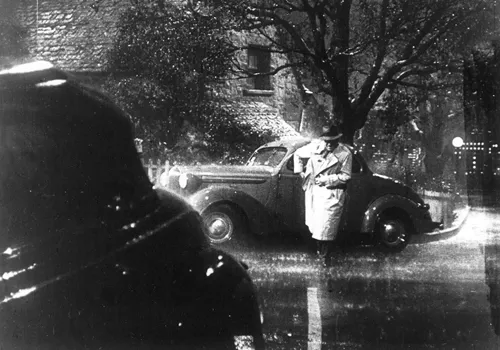
‘It does rain in the movie, but this is rain laid down on studio streets by sprinkler systems’
The groves thinned out and dropped away to the south and the road climbed and it was cold and to the north the black foothills crouched closer and sent a bitter wind whipping down their flanks. Then faintly out of the dark two yellow vapor lights glowed high up in the air and a neon sign between them said: ‘Welcome to Realito.’
Chandler had mixed feelings about L.A. and Southern California, even if nowadays he is used as a spokesman for nostalgia’s golden age. After all, it was reading Chandler as much as anything that reminded a real Angeleno, Robert Towne, of the places, the airs and fragrances of his childhood, so that in Chinatown and that film’s mid-to-late 1930s (before Marlowe’s October morning) Jake Gittes has a nose and an eye for landscape and the faint, metallic tang of what might be water (or iniquity). Gittes is a good deal of a cynic: he feels more modern than Marlowe, even though he predates him. Gittes is far readier than Marlowe to compromise, to be pushed around by fate. But he has sounder roots than Marlowe: he has a palpable history and failures already; he falls in love and he is stirred by the sheer wicked wonder of how Los Angeles has been contrived out of the desert. He might wince a little at Robert Towne’s romanticism, but he has been coloured by it:
And if at five in the afternoon you happened to find yourself down by Union Station during a Santa Ana, you could feel the warm dry itch across your skin, look down the tracks to the mountains and sky and the pastels of lavender, salmon, and blue the color of painting from old tile-topped motels long since blown to rubble – you could still see the city [Carey] McWilliams and Chandler wrote about and I remembered in those last moments before sunset.
That’s Towne in an essay on how he came to write Chinatown, and it’s testament to a legacy from Chandler that has affected screenwriters, writers in the age of movies, and many Los Angelenos. This is the notion that the place, its weather, its light and its nearness to earthquake, fire and landslide are all begging metaphors for a city that has always enjoyed hovering between real and realito. The city has changed, and not much for the better: so much of the old Spanish flavour has gone, the air has become more toxic, and that pleasant hovering is now more evidently unstable, or crazy. But Angeleno detectives relate to the place, and what it means. Gittes gazes into pools of water. The Marlowe of Altman’s The Long Goodbye appreciates the beach at Malibu. And even in 1996’s far more modest Mulholland Falls, the four fedora’d L.A.P.D. men – the partners – marvel at the huge, abrupt, shockingly beautiful crater in Nevada where the government is experimenting with vaporizing cities. In L.A., you see, there has always been a brief, hallucinatory interval between the air and the light and the solid things.
After all, in Chandler’s The Big Sleep, when Marlowe’s had his round with General Sternwood and then another with Vivian Regan, not to mention the early routine with Carmen and Norris, he takes stock and places the Sternwood mansion (3765 Alta Brea Crescent – precise as a clue, but off the maps) in space and history:
I stood on the step breathing my cigarette smoke and looking down a succession of terraces with flowerbeds and trimmed trees to the high iron fence with gilt spears that hemmed in the estate. A winding driveway dropped down between retaining walls to the open iron gates. Beyond the fence the hill sloped for several miles. On this lower level faint and far off I could just barely see some of the old wooden derricks of the oilfield from which the Sternwoods had made their money. Most of the field was public park now, cleaned up and donated to the city by General Sternwood. But a little of it was still producing in groups of wells pumping five or six barrels a day. The Sternwoods, having moved up the hill, could no longer smell the stale sump water or the oil, but they could still look out of their front windows and see what had made them rich. If they wanted to. I didn’t suppose they would want to.
So much of Chandler’s shy, bitter morality rests in those two afterthought sentences. They let us know that Chandler feels we’re on a fault zone here, that many successful Angelenos need to learn a way of overlooking their own past and back story. Whereas Hawks’ Marlowe is never anywhere near shy, uncertain or ethically perturbed. He takes a certain amount of wickedness for granted – his favoured line in dry, deadpan jokes relies on that great force of human frailty. He has no plan for eradicating it, and no fear that it could corrupt him. So Hawks never lets his Marlowe have moments of reflection (or that intimate voice-over), where he looks down from the hills and feels the measure of the past. This Marlowe, after all, is flawless, superb and utterly self-sufficient, save for one thing. He wants someone to talk to, the way a comic needs a straight man (or woman). It’s rather like Walter in His Girl Friday, who hardly notices murder, death sentences or human beings in his rapt search for a scoop, but who is getting edgier and as sharp as a hunter wondering if he might lose Hildy, might even end up alone – and silent.
So Hawks’ Philip Marlowe doesn’t really come to the Sternwood mansion to earn his $25 a day, plus expenses, or to hold back the remorseless pressure of crime and malignancy in L.A. He wants a little fun, and some good talk. He’s ready to let life be empty or absurd, so long as it’s not boring. The routine of existence, the plainness, the ordinariness – these things are to be eclipsed by comic routines, lines, scenes, and indelible meetings. Hawks did meetings as if his life depended on it – and so it did, I think, because if there hadn’t always been meetings and new doors ready to open he’d have had to get into something more profound and terrifying. Like the real squalor of the Sternwood sisters, the creeping entropy of L.A. and the disaster of lives like that of Harry Jones.
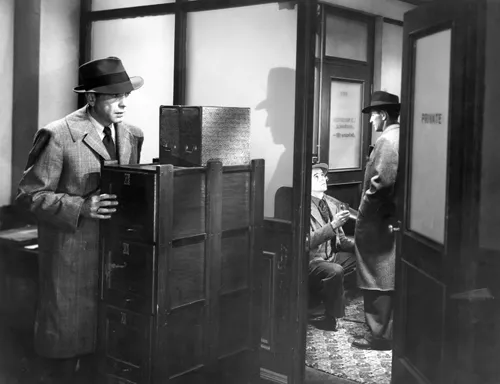
Marlowe overhears the last words of Harry Jones (‘one of the greatest things in the book and the movie’)
Harry (Elisha Cook) is one of the greatest things in the book and the movie, and it’s interesting to consider how far he is someone who isn’t quite tall, insolent, eloquent or magnificent enough to b...
Table of contents
- Cover
- Series
- Dedication
- Title
- Contents
- Acknowledgments
- ‘The Big Sleep’
- Notes
- Credits
- Bibliography
- Copyright
Trusted by 375,005 students
Access to over 1.5 million titles for a fair monthly price.
Study more efficiently using our study tools.
Frequently asked questions
Yes, you can cancel anytime from the Subscription tab in your account settings on the Perlego website. Your subscription will stay active until the end of your current billing period. Learn how to cancel your subscription
No, books cannot be downloaded as external files, such as PDFs, for use outside of Perlego. However, you can download books within the Perlego app for offline reading on mobile or tablet. Learn how to download books offline
Perlego offers two plans: Essential and Complete
- Essential is ideal for learners and professionals who enjoy exploring a wide range of subjects. Access the Essential Library with 800,000+ trusted titles and best-sellers across business, personal growth, and the humanities. Includes unlimited reading time and Standard Read Aloud voice.
- Complete: Perfect for advanced learners and researchers needing full, unrestricted access. Unlock 1.5M+ books across hundreds of subjects, including academic and specialized titles. The Complete Plan also includes advanced features like Premium Read Aloud and Research Assistant.
We are an online textbook subscription service, where you can get access to an entire online library for less than the price of a single book per month. With over 1.5 million books across 990+ topics, we’ve got you covered! Learn about our mission
Look out for the read-aloud symbol on your next book to see if you can listen to it. The read-aloud tool reads text aloud for you, highlighting the text as it is being read. You can pause it, speed it up and slow it down. Learn more about Read Aloud
Yes! You can use the Perlego app on both iOS and Android devices to read anytime, anywhere — even offline. Perfect for commutes or when you’re on the go.
Please note we cannot support devices running on iOS 13 and Android 7 or earlier. Learn more about using the app
Please note we cannot support devices running on iOS 13 and Android 7 or earlier. Learn more about using the app
Yes, you can access The Big Sleep by David Thomson in PDF and/or ePUB format, as well as other popular books in Media & Performing Arts & Film History & Criticism. We have over 1.5 million books available in our catalogue for you to explore.