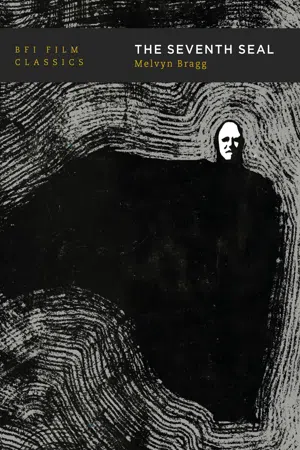
The Seventh Seal is probably Bergman's best-known work and the film that most clearly bears the director's unmistakeable signature.
The opening scene sets the tone: a stony beach under a leaden sky, the knight alone with his thoughts, then the approach of black-clad Death, whom the knight invites to play a game of chess. Bergman's medieval allegory of faith and doubt is dark with the horrors of witch-burnings and the plague. But it is also shot through with bright flashes of peace and joy, symbolised in the milk and wild strawberries offered to the knight by an innocent family of actors.
In his compelling appreciation, Melvyn Bragg describes his own first encounter as a student with this extraordinary film, and how it revealed to him another cinema, quite different from the Hollywood he had grown up with. He recounts too his later meeting with Bergman himself, and how the marks of the director's powerful personality are everywhere in this troubling and inspiring masterpiece.
- 104 pages
- English
- ePUB (mobile friendly)
- Available on iOS & Android
eBook - ePub
The Seventh Seal
About this book
Information
1 Art and Religion
Regardless of my own beliefs and my own doubts, which are unimportant in this connection, it is my opinion that art lost its basic creative drive the moment it was separated from worship. It severed an umbilical cord and now lives its own sterile life, generating and degenerating itself. In former days the artist remained unknown and his work was to the glory of God. He lived and died without being more or less important than other artisans; ‘eternal values’, ‘immortality’ and ‘masterpiece’ were terms not applicable in his case. The ability to create was a gift. In such a world flourished invulnerable assurance and natural humility.1
Bergman wrote this in the introduction to the script of The Seventh Seal. The interest lies not only in the statement itself but also in his decision to place it as a signpost to what is his most widely known and arguably most influential film. Is he claiming something for the film, is he reclaiming his own past or is he declaring a truth which he wishes to be universally acknowledged?
For there is a catch, in the paragraph which immediately follows:
Today the individual has become the highest form and the greatest bane of artistic creation. The smallest wound or pain of the ego is examined under a microscope as if it were of eternal importance. The artist considers his isolation, his subjectivity, his individualism almost holy. Thus we finally gather in one large pen, where we stand and bleat about our loneliness without listening to each other and without realising that we are smothering each other to death. The individualists stare into each other’s eyes and yet deny the existence of each other. We walk in circles, so limited by our own anxieties that we can no longer distinguish between true and false.2
Just as the opening paragraph can be seen to apply to The Seventh Seal and other films Bergman made in the 50s, so the second paragraph could be said to apply to Persona and Scenes from a Marriage and other films he made in the 60s and 70s. Like many other great artists, Bergman can face both ways. As some of his films redefined the force of religious art, the power of the sacramental, the resonance of a moral-aesthetic imperative, so others appear to cast out all of that and, with no less skill and with no less art, stand for the bleak and alienated individual of twentieth-century modernism.
Yet the undertow of religious essentiality in art persists in his introductory remarks. Having described the legend of Chartres – burnt down and reconstructed by thousands of builders and craftsmen, none with a name, so that ‘no one knows to this day who built the Cathedral of Chartres3
– he concludes with what reads like a profound credo:
Thus if I am asked what I would like the general purpose of my films to be, I would reply that I want to be one of the artists in the cathedral on the great plain. I want to make a dragon’s head, an angel, a devil – or perhaps a saint – out of stone. It does not matter which; it is the sense of satisfaction that counts. Regardless of whether I believe or not, whether I am a Christian or not, I would play my part in the collective building of the cathedral.4
There is more than a suggestion there that art is religion whether we believe or not. That in the end it will last only as long as it aspires to or fits into some collective cathedral which alone is the lasting temple of art. It is noteworthy that Bergman wants to make something out of ‘stone’. Obviously a metaphor, but just as obviously he wants to be associated with what appears to be the most lasting of materials – forgetting, for the moment, Ozymandias. The cathedral can be seen as the sum of all the great art – all art, in Bergman’s view – strained through a religious vision or even an unconscious intention. It can also be seen as the collective endeavour which film-making is and which is so much a part of his enjoyment and commitment to it. And the cathedral, where congregations gather to see the great illuminated stories in glass, to watch the ritual performances on the stage of the altar, to follow, through the calendar, the great epic of Christianity with its heroes, its villains, its disputes and digressions, its strange character parts, its compelling story-line, can be seen as the cinema of the pre-celluloid era.
Even though he himself has contributed vividly to the cinema of alienation, the cinema of the dispossessed individual, the post-Christian, fallen world of the second half of this century, we must take his seriousness about the connection between art and religion for what it is: the governing test of a film-maker whose intelligence and curiosity have inspired some of the finest films ever made. Bergman, in my opinion, is one of the dozen or so master film-makers of the century; and one of the marks of his genius, when he is at his best, is the intensity of what can only be called a vision of life. This can be almost unbearably bleak, though redeemed by stoicism in Winter Light; eroticism in Summer with Monika; womanism and tenderness in Cries and Whispers; or religion, in a line which takes him back to his beloved Chartres, in The Seventh Seal. His thesis would be challenged by many who would produce pagan, heathen, secular, atheistic, even irreligious artists, and whole centuries of artistic achievement which only by the loosest connection could be said to qualify and pass the Bergman test. Yet for him it was, and is, a profound and informing truth. And if ever it needed an exemplar, The Seventh Seal is first in line.
Bergman’s statement here reminds me of a cri de coeur I once heard from a Welsh painter and poet-novelist, David Jones. He was being interviewed on television – a unique appearance which took us into the one-roomed studio-bedroom he lived in at Harrow on the Hill, a suburb on the northern rim of London. He was a Catholic; according to T. S. Eliot among others, an artist of greatness – and an innocent whose life was largely confined to this one amazingly cluttered room in a small hotel. The interview concerned his views, explained with great circumspection in the essay ‘Art and Sacrament’.5
Pushed on the critical point, that of the essential, as he saw it, link between man the maker and man the moral being, he cried out, ‘If there isn’t a connection, then it’s all balls!’ By then he had utterly forgotten the camera: it was the cry of someone on the razor-edge of doubt and perhaps even shouting in that dark to reassure or to recharge himself. Whatever it was, it had to be claimed. Bergman too from what, superficially, could seem a religious background greatly different from David Jones’s Catholicism feels impelled to claim it. ‘It is my opinion that art lost its basic creative drive the moment it was separated from worship.’6
We must take him at his word and see The Seventh Seal from the outset as Bergman’s attempt to keep that link: the link between creation and worship and the link between the mid-twentieth century, the Middle Ages, the New Testament and much deeper into the past.
Yet even when we look at the artefacts from ancient Mexico, Egypt, Assyria or Aboriginal Australia and so many antique civilizations, let alone the variety of work left by the Greeks, we are struck both by the religious and the secular nature of the works. Those clearly designed to fit in with the governing theology, bow to the belief of the tribe, conform to worship, and those made by ‘man/woman the maker’ for the sake of the thing itself, for the hell of it as opposed to the Heaven of it. Even in Chartres there are carvings which show the carver showing his own skill, taking a little of the glory to himself as well as offering so much to his God. Even in that which is ostensibly devoted to the imperative of worship, there is always space made by the individual, the artist, the mischief-maker perhaps, the side of Bergman which gives him the skills to be the worshipper through cinema and in cinema that he aimed to be.
Of course, many questions are begged even in one of his apparently simple sentences – what is a ‘basic creative drive’? When and how was it separated from worship and what was the more precise quality of the worship? Nor is art itself a small and easily understood, casually accepted factor in this question. But we can go along with the idea without, I think, misrepresenting or misunderstanding it. Moreover, in The Seventh Seal itself, Bergman gives us directions and instances throughout.
Lindsay Anderson, the British film director who did the commentary for Thames Television’s two-hour study of Bergman, said that in The Seventh Seal, ‘Bergman influenced a whole generation of film-makers and film-goers.’7
I would suggest that this influence spreads now beyond the one generation. As television recycles old movies and art-houses reach out for cheap and cult re-runs, the Bergman oeuvre grows in importance both as an example of what one man could achieve on what were very often small, even meagre, resources and as a number of films which take on territory few dare enter with any confidence. There is a Bergman world. It is a landscape lit by the finely modulated greys of Northern European light; it has intensity and intelligence in equal measure; it can be charming and comic and erotic and playful, but this is a place where the shadow is as important as the living figure and the inwardness of life is as demanding as anything that happens in the world outside. It is a cultivated world, a thinking world, above all perhaps a world trying to answer the questions which cannot be answered. For many, the clearest statement of all Bergman’s preoccupations is expressed with the simplicity of genius in The Seventh Seal.
2 On First Meeting Ingmar Bergman
It can seem a long way from Wigton and ‘the pictures’ in the 1940s to Oxford and Bergman at the end of the 50s. The small Cumbrian town in which I grew up was in much closer touch with the age of the gas-lit theatre than with the century of the moving image. In fact, small as it was, it welcomed a repertory company each year which came for a few months, lodged in the town and put on plays in the upstairs room of the Parish Rooms, Mondays to Sa...
Table of contents
- Cover
- Series
- Dedication
- Title
- Contents
- Acknowledgments
- 1 Art and Religion
- 2 On First Meeting Ingmar Bergman
- 3 The Play’s the Thing
- 4 Sealed in Childhood
- 5 The Making of the Film
- 6 A Film by Ingmar Bergman
- Notes
- Credits
- Copyright
Trusted by 375,005 students
Access to over 1.5 million titles for a fair monthly price.
Study more efficiently using our study tools.
Frequently asked questions
Yes, you can cancel anytime from the Subscription tab in your account settings on the Perlego website. Your subscription will stay active until the end of your current billing period. Learn how to cancel your subscription
No, books cannot be downloaded as external files, such as PDFs, for use outside of Perlego. However, you can download books within the Perlego app for offline reading on mobile or tablet. Learn how to download books offline
Perlego offers two plans: Essential and Complete
- Essential is ideal for learners and professionals who enjoy exploring a wide range of subjects. Access the Essential Library with 800,000+ trusted titles and best-sellers across business, personal growth, and the humanities. Includes unlimited reading time and Standard Read Aloud voice.
- Complete: Perfect for advanced learners and researchers needing full, unrestricted access. Unlock 1.5M+ books across hundreds of subjects, including academic and specialized titles. The Complete Plan also includes advanced features like Premium Read Aloud and Research Assistant.
We are an online textbook subscription service, where you can get access to an entire online library for less than the price of a single book per month. With over 1.5 million books across 990+ topics, we’ve got you covered! Learn about our mission
Look out for the read-aloud symbol on your next book to see if you can listen to it. The read-aloud tool reads text aloud for you, highlighting the text as it is being read. You can pause it, speed it up and slow it down. Learn more about Read Aloud
Yes! You can use the Perlego app on both iOS and Android devices to read anytime, anywhere — even offline. Perfect for commutes or when you’re on the go.
Please note we cannot support devices running on iOS 13 and Android 7 or earlier. Learn more about using the app
Please note we cannot support devices running on iOS 13 and Android 7 or earlier. Learn more about using the app
Yes, you can access The Seventh Seal by Melvyn Bragg in PDF and/or ePUB format, as well as other popular books in Medien & darstellende Kunst & Filmgeschichte & Filmkritik. We have over 1.5 million books available in our catalogue for you to explore.