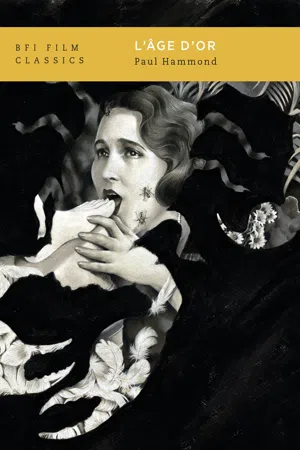
One of the greatest collaborations of cinema history, L'Âge d'Or(1930) united the geniuses of Luis Buñuel and Salvador Dali in the making of a Surrealist masterpiece - a uniquely savage blend of visual poetry and social criticism. The film was banned and vilified for many years in many countries, becoming justly legendary for its subversive eroticism and its furious dissection of 'civilised' values.
In a remarkable, intuitive reading of L'Âge d'Or, Paul Hammond interweaves a detailed account of the extraordinary circumstances of its production with a dazzling interpretation of its aesthetic and political nuances. At once authoritative and polemical, this is a study entirely in tune with its subject, a fitting celebration of a major landmark in world cinema.
eBook - ePub
L'Âge d'or
About this book
Information
The first prismatic articulation
Posters had gone up around the pueblo: ‘Scorpions wanted! Top prices paid!’ An hour later the fisherfolk of Cadaqués were congregating in the Hotel Miramar, horny hands wrapped around heaving jamjars. That night, 4 April 1930, Luis Buñuel bedded down with fifty of the beasts.
The director, his assistants Jacques Brunius and Claude Heymann, cameraman Albert Duverger and a clutch of actors were on the Costa Brava for five days of location shooting. The ‘grandiose geological delirium’ of nearby Cap de Creus would be L’Âge d’or’s opening backdrop.1 Dalí country, of course. But where was co-scenarist Salvador?
On the run. The Christmas before, Salvador Dalí Senior, incensed by newspaper reports of his offspring’s Surrealist shenanigans in Paris – particularly a picture called ‘Sometimes I Spit For Pleasure on My Mother’s Portrait’ – had banished him from Figueres. Dalí Junior lit out, but by March he was back, looking to buy a fisherman’s cottage in Port Lligat, just up the coast from Cadaqués. And from Mum and Dad: the family had a holiday home there. Getting wind of this, the father asked Buñuel to be the go-between: tell my son if he disturbs my peace in Cadaqués I’ll stick the Guardia Civil on him. Señor Dalí, a notary, was looked up to in the village, could queer Buñuel’s pitch. Appeasement was in order if the location work was to proceed smoothly.
Kept until her death in Ana María Dalí’s biscuit tin, Menjant garotes (Eating Sea Urchins), as the family called the ‘vanity movie’ Buñuel made that April, is one to add to the filmography. Although it bit into his tight schedule, Buñuel planned the five-minute short with care, having Duverger shoot it on 35mm. The Lumière-style narrative of paterfamilias and spouse strolling through their terraced garden is filmed from eleven different angles. Edited, I’d say, in camera, the movie ends on the cannibal grin of Dalí père as he gobbles a testicular urchin.
Menjant garotes grew out of bloody-minded territorialism and so was not without bearing on what came after. L’Âge d’or would begin with an entomological essay on the instinctual behaviour of the scorpion, how it is driven by a primordial will to power. And to self-destruction: was it true that, as an Aragonese folk myth had it, a scorpion encircled by fire stings itself to death?
In the script the scorpion sequence segued into the next, the bandits.2 The camera would dolly back from an arachnid inching up an escarpment until the creature was lost to sight. Another angle of the same baked landscape revealed, in medium shot, a bandit clinging to a rock. A match-cut, then, to make the equation: bandit = scorpion.
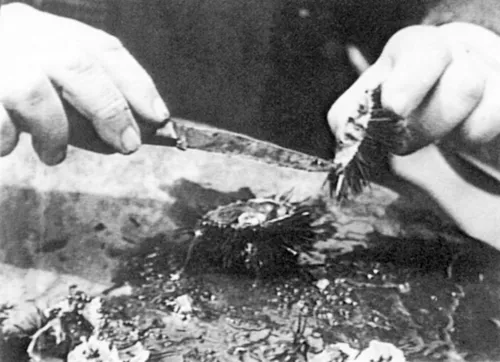
Dalì père serves up a sea urchin in Menjant garotes, Buñuel’s vanity movie of April 1930 (Filmoteca de Catalunya)
What with the time spent on Menjant garotes and the rain that fell on Cap de Creus, L’Âge d’or was soon behind schedule. Either the scorpion sequence wasn’t shot, or if it was the creatures were no Rin-Tin-Tins and the footage was unusable. A replacement was needed, and Brunius was dispatched to an agency specializing in pedagogical films, the Compagnie Universelle Cinématographique, to look for it. He came up with Le Scorpion languedocien, a popular science documentary made by the Eclair Company in 1912 as part of their ‘Scientia’ series. The seventy-five ‘Scientia’ shorts directed by J. Javault and André Bayard between 1912 and 1914 were aimed at schoolkids and focused, in the main, on zoology.
Buñuel had already decided to abrade the look of L’Âge d’or by incorporating film shot by other hands. In their functionalist writings on cinema from 1927 to 1929 he and Dalí repeatedly praised scientific documentaries, Fox newsreels and Taylorised Tinseltown productions for their ‘anti-artistic’ qualities. (Napoléon, Metropolis, Le Ballet mécanique were ‘artistic’ and, as such, excoriated.) The dilapidated condition of the found print, the way its stuttery framing sometimes fails to keep the asocial scorpions in shot, acts as a foil to Duverger’s photogenic camerawork and Buñuel’s deft cutting. Getting his state-of-the-art sound film off to a bad start appealed to the director’s provocative sense of humour and love of mystification.
The documentary peaks with a rat in a vivarium succumbing to a scorpion’s sting, a shot which scuppered the scripted cut matching beast and bandit. The sequence acts instead like a ‘prologue’, analogous to the eye-slicing scene in Un Chien andalou. Although less powerful than that blinding, it’s still an effing affront to the viewer. A snare Andalusian.
The prologue tells us that the scorpion’s tail ‘is formed of a series of five prismatic articulations’, and that it ‘ends in a sixth vesicular joint, the poison sac’. Since L’Âge d’or is also divisible into six discrete parts I’ve taken my chapter headings from the scorpion intertitles.
On 18 November 1929 the Vicomte de Noailles commissioned Buñuel to make a short of around the same length as Un Chien – seventeen minutes – but with sound. At this point Buñuel and Dalí, thinking no further than a remake, again centred their scenario on the tragicomic romancing of a man and a maid. Later, as people like Brunius and Heymann put in their oar, the film grew segmentally from a short into a feature. By February 1930 it was forty-five minutes long and twice the budget. Buñuel now anxiously deferred to his patron-producer, offering to trim things back to the original twenty minutes, but Noailles okayed the longer version. During the March to May shooting further ‘gags’ were improvised, taking the movie to an hour. Again, the director offered to cut the new material should Noailles say the word. Since nothing was deleted, the ad hoc work that emerged is as much heterogeneous collage as homogeneous montage. Even well-disposed critics of the time like Jean-Paul Dreyfus – who had a bit part in it – observed that L’Âge d’or lacked the formal unity of Un Chien. But then, wasn’t this Buñuel’s goal, to make a film so ragged it couldn’t pass, like its predecessor, for being ‘well made’?
This collage approach was consonant with the Surrealist intuition that film could replicate the ‘dream-work’, disguise and derange meaning through a rebus rhetoric of displacement; condensation; accepted contradiction; dislocated time, space and causality. Mise en scène and cutting were the elements Buñuel used to ‘irrationalize’ – ‘oneirise’ – Hollywood melodrama. Take the scene in Un Chien where a character begins a fall inside a room and ends it in a meadow. Time ‘matches’, is synchronic; space ‘jumps’, is diachronic. Buñuel got the idea from looking at Méliès or the Bosetti-Durand school of primitive comedy, I’d wager. Then there’s his paradoxical use of the intertitle. ‘Sixteen years before’, we might read, and in the ensuing shot the actors and the décor haven’t changed. Here space is synchronic, time diachronic. I believe Buñuel took this from Keaton. At the end of The Paleface (1922) Buster is in a clinch with his girl. Then comes the intertitle ‘Two years later’. In the next shot same Buster, same girl, same kiss. With sound to play with, Buñuel took the idea further. In L’Âge d’or mismatches still happen between the ‘articulations’, through the use of mendacious intertittles; ‘matching jump-cuts’; colliding aesthetics and textures. But they also occur within them, by the making of deliberate mistakes in visual or verbal continuity and in having the image perturbed by incongruous sound and word.
As well as functioning oneirically, L’Âge d’or is a fine example of Shklovskian ‘retardation’: the ironical, here permanent, postponement of a climax through the interpolation of incongruous formal and dramatic material. Confound you! Once, though, we’ve got over the disorientation of a first viewing and look again (and again) we find that the deconstructive tendency is countered by the way recurring details and running jokes hold the film together.
Whether these correspondences were always planned is irrelevant; it’s enough that they exist in the eye of the beholder. I’ll often submit to my own délire d’interpretation in the pages ahead, but right now I’m thinking of the prologue and the ‘epilogue’: those gruesome scalps of women nailed to a cross amid swirling snow. Brutal death is common to both. Heat counterpoints cold. I see a congruence between the scuttling scorpions in the first shot, long tails stretched out like pokers, limbs bunched at right angles to their abdomens, and the configuration of the Christian cross in the last. ‘The scorpion is a type of arachnid widespread in the hot regions of the ancient world,’ an intertitle tells us. And what if one of those ancient hot regions was Judaea, c. AD30?
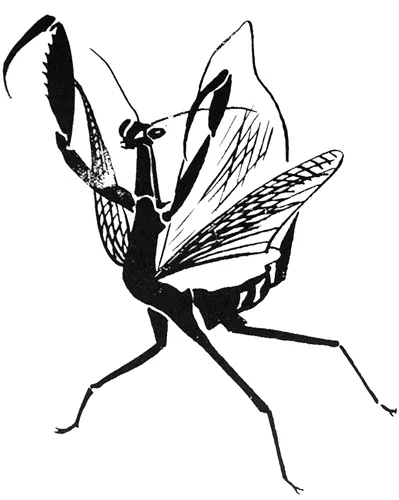
Female trouble: Ernst’s praying mantis, cribbed from a photo in Fabre’s Souvenirs entomologiques, commissioned by Breton in 1924 and printed in the Studio 28 programme
Arachnids are phantasmatically linked to femellitude in the male imagination. Witness the Pauline father, St Jerome: ‘Woman is the gate of the devil, the road of evil, the sting of the scorpion.’ And the Freudian father, Karl Abraham, opining that another arachnid, the spider, represents the feared phallic mother.
We know from the rich lore of the Buñuel family that Luis had a dread of spiders. Nor are scorpions that cuddly. Conchita Buñuel has recounted how their infant sister Margarita, taking the glossy black segments of a scorpion’s tail for the beads of a rosary in the garden one day, narrowly missed the fate of the rat in the vivarium.
The intertitles are not Buñuel’s work; they came with Le Scorpion languedocien. (The lettering was redrawn, of course.) Furthermore, they’re verbatim quotations from Jean-Henri Fabre. Immensely popular during the 1910s, especially among children, Fabre’s ten-volume Souvenirs entomologiques (1898–1907) were the methodological model for the ‘Scientia’ series. Buñuel, too, was a Fabre enthusiast, having read him as an entomology student in Madrid, and he may have had the insect man in mind when he planned the scorpion sequence. Perhaps this Fabrean analogy had already struck home: ‘Two scorpions are often found beneath the same stone, one devouring the other. Is this a case of banditry between equals?’3 That the Éclair intertitles were straight Fabre doubtless impressed Buñuel as a splendid instance of hasard objectif.
Subtitled ‘Studies on the Instinct and Manners of Insects’, the enthused writings of this outsider scientist – whom Dalí likened to the visionary architect, ‘Postman’ Cheval – were greatly admired by the Surrealists. Although a deist, the entomologist’s austere and terrifying depiction of the dialectic of Eros and Thanatos in nature bears comparison to Sade’s atheistic psychopathia sexualis. Fabre was especially intrigued by insect courtship. Considering the passivity of the male Golden Gardener beetle towards post-coital evisceration by his mate, he wrote:
This tolerance reminds one of the scorpion of Languedoc, which on the termination of the hymeneal rites allows the female to devour him without attempting to employ his weapon, the venomous dagger which would form a formidable defence; it reminds us also of the male of the Praying Mantis, which still embraces the female though reduced to a headless trunk, while the latter devours him by small mouthfuls, with no rebellion or defence on his part. 4
Although Fabre is nowhere mentioned by name his ideas form the latent content of the film, lending it coherence at the analogical level. L’Âge d’or will image the ‘hymeneal rites’ of a bungling heterosexual couple. The theme of libidinal frustration is even fleetingly announced in the objet trouvé. We see a shot of two scorpions, tails entwined in erotic embrace. Suddenly a third arachnid charges through them, sundering the blissful dancers.
The second prismatic articulation
Having rejigged the scorpion sequence Buñuel bridged the unforeseen ellipsis between it and the bandits with a perfunctory intertitle: ‘Some hours afterwards.’ (Another windfall; it comes from Le Scorpio...
Table of contents
- Cover
- Series
- Dedication
- Title
- Contents
- Acknowledgments
- The first prismatic articulation
- Notes
- Credits
- Bibliography
- Copyright
Trusted by 375,005 students
Access to over 1.5 million titles for a fair monthly price.
Study more efficiently using our study tools.
Frequently asked questions
Yes, you can cancel anytime from the Subscription tab in your account settings on the Perlego website. Your subscription will stay active until the end of your current billing period. Learn how to cancel your subscription
No, books cannot be downloaded as external files, such as PDFs, for use outside of Perlego. However, you can download books within the Perlego app for offline reading on mobile or tablet. Learn how to download books offline
Perlego offers two plans: Essential and Complete
- Essential is ideal for learners and professionals who enjoy exploring a wide range of subjects. Access the Essential Library with 800,000+ trusted titles and best-sellers across business, personal growth, and the humanities. Includes unlimited reading time and Standard Read Aloud voice.
- Complete: Perfect for advanced learners and researchers needing full, unrestricted access. Unlock 1.5M+ books across hundreds of subjects, including academic and specialized titles. The Complete Plan also includes advanced features like Premium Read Aloud and Research Assistant.
We are an online textbook subscription service, where you can get access to an entire online library for less than the price of a single book per month. With over 1.5 million books across 990+ topics, we’ve got you covered! Learn about our mission
Look out for the read-aloud symbol on your next book to see if you can listen to it. The read-aloud tool reads text aloud for you, highlighting the text as it is being read. You can pause it, speed it up and slow it down. Learn more about Read Aloud
Yes! You can use the Perlego app on both iOS and Android devices to read anytime, anywhere — even offline. Perfect for commutes or when you’re on the go.
Please note we cannot support devices running on iOS 13 and Android 7 or earlier. Learn more about using the app
Please note we cannot support devices running on iOS 13 and Android 7 or earlier. Learn more about using the app
Yes, you can access L'Âge d'or by Paul Hammond in PDF and/or ePUB format, as well as other popular books in Media & Performing Arts & Film & Video. We have over 1.5 million books available in our catalogue for you to explore.