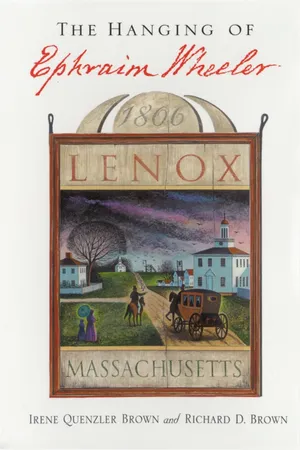
In 1806 an anxious crowd of thousands descended upon Lenox, Massachusetts, for the public hanging of Ephraim Wheeler, condemned for the rape of his thirteen-year-old daughter, Betsy. Not all witnesses believed justice had triumphed. The death penalty had become controversial; no one had been executed for rape in Massachusetts in more than a quarter century. Wheeler maintained his innocence. Over one hundred local citizens petitioned for his pardon--including, most remarkably, Betsy and her mother.
Impoverished, illiterate, a failed farmer who married into a mixed-race family and clashed routinely with his wife, Wheeler existed on the margins of society. Using the trial report to reconstruct the tragic crime and drawing on Wheeler's jailhouse autobiography to unravel his troubled family history, Irene Quenzler Brown and Richard D. Brown illuminate a rarely seen slice of early America. They imaginatively and sensitively explore issues of family violence, poverty, gender, race and class, religion, and capital punishment, revealing similarities between death penalty politics in America today and two hundred years ago.
Beautifully crafted, engagingly written, this unforgettable story probes deeply held beliefs about morality and about the nature of justice.
eBook - ePub
The Hanging of Ephraim Wheeler
A Story of Rape, Incest, and Justice in Early America
- 388 pages
- English
- ePUB (mobile friendly)
- Available on iOS & Android
eBook - ePub
The Hanging of Ephraim Wheeler
A Story of Rape, Incest, and Justice in Early America
About this book
Information
CHAPTER ONE
This county may be regarded as composed of a very intelligent and moral, and relatively considered, religious population. The literary and pious institutions and customs of our fathers have sent down a blessed influence, which has reached until the present time, notwithstanding the evil moral tendency of the Revolutionary war and Shays insurrection, the party politics that have sometimes raged, and other unhappy events. Our scattered settlements and general employments are favorable to good morals. The repeated revivals, affecting many of the influential men & families, and very many of the substantial yeomanry, have had a mighty and most beneficial effect upon the whole community.
[David Dudley Field and Chester Dewey],
A History of the County of Berkshire, Massachusetts … (1829)
Dramas of good and evil, of crime and punishment can be enacted anytime, anywhere; but each one is shaped by its own time and place. The story of Ephraim Wheeler, his wife Hannah, and their children belongs to Massachusetts’ westernmost county of Berkshire in the decades after the American Revolution. The roughly thirty thousand people of this hilly region of farms and forests were struggling toward prosperity as they cleared and cultivated a landscape that had been largely Indian country prior to American independence. Indian warriors killed a handful of Berkshire settlers and carried several more into captivity less than twenty years before the battles of Lexington and Concord. Only the British victories over the French and the Indians in 1759 and 1760 enabled English families to settle the central and northern parts of the county.
The settlement drive accelerated after 1761, when the Massachusetts legislature formally organized Berkshire County, a twenty-milewide strip that ran between Massachusetts’ southern and northern borders. Lying more than a four-day horseback ride (120 miles) west of Boston, but only a single day’s ride from Hudson and Albany, New York, the new county was bounded to the east by the 1,500- to 2,500- foot Green Mountain barrier that it shared with Hampshire County, and to the west by the 2,000- to 3,000-foot Taconic Mountains that spread into New York. Lacking any great, fertile and navigable river valley such as the Connecticut to the east or the Hudson to the west, Berkshire did boast the narrow but productive Housatonic valley, which meandered through the central and southern portions of the county on its way to Connecticut and Long Island Sound. To the north, the smaller Hoosic River, a tributary of the Hudson, ran north and west.1
At the beginning of the 1760s, except for the few settlements in the south that lay along the Housatonic River, the region was heavily forested. Because Berkshire possessed good (though often shallow) soils, moderate rainfall (36 inches annually), and a growing season (about 150 days) long enough to support deciduous trees as well as conifers, a great variety of plant and animal life flourished in its hills and valleys, swamps and hollows, ponds and streams. During the first half of the eighteenth century the forest had sustained hundreds of Indians, people who chose to clear only small patches of land. They had, however, embraced European trade goods and so had exterminated the beaver for the sake of their pelts. Now their English successors would attack bear, wolves, and rattlesnakes for safety’s sake, and deer and turkeys for meat, hunting so avidly that within a generation or so—certainly by 1800—large game and rattlesnakes would become a rarity. But in 1760 these animals, as well as foxes, wildcats, woodchucks, raccoons, and skunks, thrived wherever they found suitable habitat. Rodents, large and small—from porcupines, rabbits, and squirrels to weasels, muskrats, and minks—were also abundant. Field rats and mice foraged mostly in the meadows created by the natural filling in of old beaver ponds.2
Life also thrived in Berkshire’s chilly waters. Downstream waterfalls blocked the entry of migratory fish such as salmon and shad into the region, but there were perch and trout, bullhead (catfish), dace and suckers, sunfish, eels, and shiners. These, together with crawfish, freshwater clams, and several kinds of turtles, snakes, frogs, and salamanders, fed the mammals and birds that hunted them.
Beneath the forest canopy and around Berkshire’s meadows, swamps, ponds, and rivers several dozen kinds of birds passed at least part of their year. In 1760 wild turkeys were still numerous, and eagles occasionally scoured the region’s waters, where loons and gulls, black ducks, and Canada geese sometimes nested. In daylight when hawks hunted, blue jays and crows called out warnings. At night, when searching for prey, owls screeched and hooted to each other through the darkness, their calls both territorial and triumphant. In the springtime the woods hummed with the songs of thrushes and wrens, mockingbirds and phoebes. Near dusk, as the calls of other birds died away, the rhythmic song of whippoorwills and the hammering of woodpeckers stood out. As years passed and meadows and pasturelands multiplied, so also did blackbirds and robins, doves and woodcocks, martins and swallows, as well as an abundance of flies, grasshoppers, butterflies, and moths, and the magical fireflies of early summer.
To the farmers who cleared Berkshire valleys and hillsides the forest was not the sylvan paradise that later generations envisioned. For them it was a rough wilderness, an obstacle to their prosperity. When they looked at the great oaks, chestnuts, sugar maples, ash and beech trees, white and yellow pine, and spruce trees that grew 70 to 100 feet into the air, they saw timber, firewood, and fencing. Most of the other trees—aspens, poplars, hornbeam, black alder, elms, cherries, balsam firs, hemlocks, and hackmatacks—were simply obstacles to be destroyed in order for the settlers to raise crops and livestock.
No one in the 1760s or later expected Berkshire to be a land of milk and honey, where farmers would grow fat; so much of the land was sloping, and the growing season was too short. But because southern New England was filling up, its farmland becoming scarce and expensive, Berkshire seemed attractive. The closest Berkshire ever came to a land rush was in the 1760s and 1770s, when the legislature incorporated twenty towns. Thereafter, not new arrivals but the children of the settlers—mostly English, with small numbers of Scots, Irish, and Hudson River Dutch—accounted for most of Berkshire’s growth.
By the eighteenth century, Berkshire’s Indian population was much diminished. In the 1730s Massachusetts clergymen, with English support, created a mission that brought nearly all the Indians to villages in Stockbridge. Here the Reverends John Sergeant, Jonathan Edwards, and Stephen West converted several hundred native people to Christianity. But as white settlers multiplied after the Revolution, the Native Americans fell prey to alcohol and debt. To halt their further decline, groups of Indian families moved out of Berkshire County to settle on a large tract in New York, a gift of the Oneida people that they named New Stockbridge.3 During the same decade, as the Indians departed, scores of newly free African Americans came into Berkshire, augmenting the handful of ex-slaves once owned by county gentlefolk. Berkshire’s white Yankee residents were not especially welcoming to black or mixed-race people, but those who worked hard and behaved decently could be accepted on their own merits. Indeed, sixty miles to the north, at Rutland, Vermont, the Congregational church was even willing to install a mulatto, Lemuel Haynes, as its clergyman in 1788.4 No such recognition was accorded to any people of color in Berkshire, but by the time of the first United States census in 1790 over 300 blacks had settled in the county. Among this group was a family of seven headed by Ichabod Odel. His daughter Hannah would later marry Ephraim Wheeler, a white Yankee who had arrived in the region in the 1780s.5
By 1790 the inhabitants of Berkshire’s twenty-four towns had reached the 30,000 level, and their number would continue to grow modestly to a peak of 36,000 in 1810. Then, in the decade that followed, repeated cold seasons, soil depletion, and erosion on hill farmlands led to bad harvests and a slight population decline, as young men and some farm families sought more and better land in New York and Ohio. Hereafter Berkshire’s growth would no longer depend on the multiplication of traditional Yankee farmsteads that produced most of their own food, fuel, and clothing, but on commerce, manufacturing, extractive industries such as timber and quarrying, and farms that specialized in sheep or dairying.6
Around 1800, however, the county seemed prosperous. The European warfare that had begun in the early 1790s and would continue until the defeat of Napoleon in 1815 brought high prices for farm products; so, in a region where more than nine out of ten families depended on the land, times were good. Never before had the people of Berkshire enjoyed such protection from physical danger, privation, and want. But the blessings of peace and prosperity did not bring tranquility to everyday life. Though nearly all were Yankee Protestants with southern New England roots, Berkshire people argued vigorously over matters of this world and the next.
That they did so verbally and legally—in the courts, at town and parish meetings, in the press, and at the ballot box—contrasted with the turbulent, dangerous past that many adults remembered. During the independence movement and Berkshire’s subsequent protest against independent Massachusetts’ “unconstitutional” government in the Revolution, the Reverend Thomas Allen of Pittsfield had led hundreds of Berkshiremen to seize control of the county, arguing that they were empowered by “natural law” to run their own affairs.7 Similarly, but on a much broader scale, during the farmers’ Shays’ Rebellion of 1786–1787 some in Berkshire County had resorted to extralegal measures, including military action.
In the southern part of the county, in skirmishes at West Stockbridge and Sheffield, hundreds of pro- and antigovernment Berkshiremen had fired on each other, wounding three dozen men, five fatally. In the West Stockbridge action Theodore Sedgwick, then the Speaker of the Massachusetts House and later a Federalist congressman (and one of Wheeler’s judges), exposed himself to rebel gunfire before talking scores of the insurgents, some of whom he knew personally, into laying down their arms. In the neighborhood of Sheffield and Stockbridge, Berkshire’s two oldest towns—both were incorporated in the 1730s—the conflict between gentlemen creditors and mortgaged farmers was often personal. Soon after Sedgwick’s victorious West Stockbridge confrontation, a group of rebels retaliated by raiding his home while the master was away in Boston. They seized Sedgwick’s two apprentice law clerks and stole his clothing, his linens, and a horse.8 These lawbreakers escaped punishment. However, John Bly and Charles Rose, two Shaysites who went on a rampage of violent burglaries after the rebellion had ended, were captured, tried, and executed at Lenox in 1787.9
When the uprising collapsed in the spring of 1787 the state recoiled from bloody political reprisals. The leaders of the rebellion were tried for treason, convicted, and sentenced to hang; but when John Hancock was swept into the governorship in May 1787 his mandate was moderation. So although he let the prisoners mount the scaffold as a mark of state authority, when they stood at the brink of execution he pardoned them. This gesture of reconciliation was intended to ease the enmities surrounding the conflict.10
Despite these attempts at peacemaking, however, alienation from the state government and its court system remained widespread. One Berkshire-bred recent Yale graduate, Barnabas Bidwell, reported that “the majority” in Berkshire were “disaffected to Governmental measures.” Whereas the few “Gentlemen of learning and the liberal professions, especially the Clergy, are universally for Government,” Bidwell observed that “Debtors are generally on the other side; and this class comprehends more than half the people.” He disdainfully concluded that “Rhode Island Emigrants and almost all of the denomination of Baptists; men of warm passions and but little reason; men of fickle minds, fond of every new scheme and proud of an enterprising spirit—such have generally engaged in the Insurrection.” In addition the rebellion had gained strength from the “ignorant, uninformed, but well-meaning common people, who hearing such a dreadful outcry against Government” naively embraced the cause. Now that the rebellion was finished, Bidwell found that “almost all, with whom I have conversed, acknowledge that they took a wrong method to get redress, by resorting to arms and stopping Courts.” Now they realized they could have achieved reforms “by instructing their [state] Representatives or changing them” at the annual election.11 Against this backdrop, with anarchy and bloodshed so immediate in local memory, the rule of law was no mere abstraction, especially among property owners, men who voted and served on juries. Experience had taught them that social order was an achievement attained by blending consent with coercion.
By 1800 social conflict in Berkshire was more orderly, but still intense. The state and national contests between Federalists and Jeffersonians divided the county elite. Though Sedgwick and Bidwell had been on the same side during Shays’ Rebellion, now Sedgwick led the Federalists in Congress as Speaker of the House and Bidwell, who would win the same seat for the Jeffersonians five years later, represented Berkshire in the state senate as a Republican. Like their learned and wealthy neighbors, farmers too displayed divided loyalties. The fact that local, legislative, and gubernatorial elections took place every spring made party competition virtually continuous, and for some it was deadly serious.
Berkshire, moreover, was especially contentious because neither the Federalist party of Washington, Adams, and Hamilton nor the Republicans of Jefferson and Madison could wholly dominate. Countywide, Republicans generally achieved only narrow majorities, and in particular communities competition was so intense that party leaders like Sedgwick counted every last vote and, on occasion, brought residents who were away on business back to town on horseback so as to secure their votes.12 In one election Jeffersonians complained that Federalists “brought out their last man,” including “four negro votes.”13 Because Berkshire was among the state’s more agrarian and less commercial and cosmopolitan regions, it was unlikely to warm to the Federalist agenda of a strong, procommerce central government. In addition, Republican arguments in favor of separation of church and state were popular in a county where the officially preferred Congregationalists faced challenges from dissenting Baptists and Methodists. And although Episcopalians, Quakers, and Shakers, as well as unchurched residents, differed with each other in religion, the issue of religious establishment often brought them to support the Republicans at the polls.
The two centers of Berkshire’s political geography in 1800—Stockbridge with 1,260 people, and Pittsfield with 2,260 inhabitants—lay along the Housatonic River near the middle of the county. At the older town of Stockbridge, Heman Willard, a twenty-five-year-old native, published the ardently Federalist weekly paper, The Western Star. At Pittsfield, Phinehas Allen, the twenty-four-year-old native and nephew of activist parson Thomas Allen, published The Pittsfield Sun, or Republican Monitor, a resolutely Jeffersonian weekly. With each paper circulating to some 500 subscribers, roughly one household in six took either the Star or the Sun. In addition, one or the other, rarely both, were kept in most public houses, taverns where like-minded men routinely gathered to talk and carry on their personal and public business.14
Both papers looked almost the same; both followed the journalistic conventions typical of the American press of the period. Beneath their boldface titles, the first page displayed four columns of small print that usually included commentary in the form of an essay or letter signed with a pseudonym. In addition, the papers carried official news from Washington, Boston, and foreign capitals that might cover the second page or even part of a third. The third page, which presented news from around the United States, also ran a...
Table of contents
- Cover
- Title Page
- Copyright Page
- Contents
- List of Illustrations
- Map: The Wheelers’ and Odels’Massachusetts, ca. 1800
- Introduction: The Ride to the Gallows
- 1 The Setting
- 2 The Trial
- 3 The Daughter
- 4 The Wife and Mother
- 5 The Condemned Man
- 6. The Final Judgment
- 7. The Execution
- Aftermath: People and Memory
- Notes
- Acknowledgments
- Index
Trusted by 375,005 students
Access to over 1.5 million titles for a fair monthly price.
Study more efficiently using our study tools.
Frequently asked questions
Yes, you can cancel anytime from the Subscription tab in your account settings on the Perlego website. Your subscription will stay active until the end of your current billing period. Learn how to cancel your subscription
No, books cannot be downloaded as external files, such as PDFs, for use outside of Perlego. However, you can download books within the Perlego app for offline reading on mobile or tablet. Learn how to download books offline
We are an online textbook subscription service, where you can get access to an entire online library for less than the price of a single book per month. With over 1.5 million books across 990+ topics, we’ve got you covered! Learn about our mission
Look out for the read-aloud symbol on your next book to see if you can listen to it. The read-aloud tool reads text aloud for you, highlighting the text as it is being read. You can pause it, speed it up and slow it down. Learn more about Read Aloud
Yes! You can use the Perlego app on both iOS and Android devices to read anytime, anywhere — even offline. Perfect for commutes or when you’re on the go.
Please note we cannot support devices running on iOS 13 and Android 7 or earlier. Learn more about using the app
Please note we cannot support devices running on iOS 13 and Android 7 or earlier. Learn more about using the app
Yes, you can access The Hanging of Ephraim Wheeler by Irene Quenzler Brown,Richard D. Brown in PDF and/or ePUB format, as well as other popular books in History & North American History. We have over 1.5 million books available in our catalogue for you to explore.