The little-known story of the sophisticated and vibrant Arabic book culture that flourished during the Middle Ages.
During the thirteenth century, Europe's largest library owned fewer than 2,000 volumes. Libraries in the Arab world at the time had exponentially larger collections. Five libraries in Baghdad alone held between 200,000 and 1,000,000 books each, including multiple copies of standard works so that their many patrons could enjoy simultaneous access.
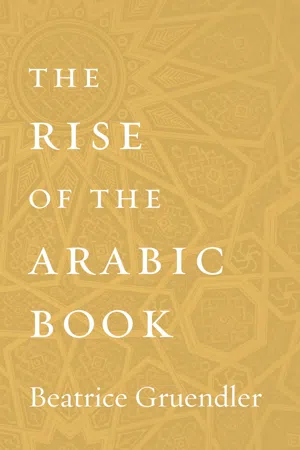
How did the Arabic codex become so popular during the Middle Ages, even as the well-established form languished in Europe? Beatrice Gruendler's The Rise of the Arabic Book answers this question through in-depth stories of bookmakers and book collectors, stationers and librarians, scholars and poets of the ninth century.
The history of the book has been written with an outsize focus on Europe. The role books played in shaping the great literary cultures of the world beyond the West has been less known—until now. An internationally renowned expert in classical Arabic literature, Gruendler corrects this oversight and takes us into the rich literary milieu of early Arabic letters.
- 262 pages
- English
- ePUB (mobile friendly)
- Available on iOS & Android
eBook - ePub
The Rise of the Arabic Book
About this book
Information
CHAPTER ONE
SCHOLARS
A clash over the book as a new medium occurred between two major philologists at the end of the eighth century, al-Aṣmaʿī and Abū ʿUbayda.1 Together with Abū Zayd al-Anṣārī (d. 830) they formed the triumvirate (al-thalāth) of the Basran school of grammarians. The rocky relationship of the first two, recounted in this chapter, encapsulates phenomena that recurred throughout their generation.
DRAMATIS PERSONAE
ʿAbdalmalik b. Qurayb, known as al-Aṣmaʿī (d. 828), commanded several talents that made him an ideal performer of his knowledge.2 He expressed himself in flawless ʿarabiyya. This was no one’s native language, but rather the literary tongue of pre-Islamic times (sixth century C.E.), newly codified by scholars of his kind. To speak it required learning and presence of mind. Even scholars occasionally slipped up, and the grammarian al-Farrāʾ describes it as an acquired skill: “For Bedouins inflection is natural, but for settled people erring [in inflection] is natural. When I learn [something by heart], I do not err, but when I then speak naturally again, I err.”3 With “inflection” he referred to the fact that the colloquials spoken in the Arab cities at his time differed from the ʿarabiyya most noticeably in lacking the grammatical endings of words. Inflection was referred to as iʿrāb (literally “making [something] Arabic”), and it had been protected and preserved in the classical poetry by its quantitative meter.4 These case and mood endings were not written in the Arabic script and had to be added by the speaker. Therefore, their correct realization formed the initial subject of most early Arabic grammars: “The first thing that became deficient in the speech of the Arabs and required study was inflection, because error [laḥn] appeared in the speech of converts and arabized people from the time of the Prophet.”5
Al-Aṣmaʿī was gifted with a prodigious memory. Good memory was not uncommon, and people’s minds were well trained, but even in his time, al-Aṣmaʿī’s abilities stood out. One could learn to recall things by memory simply by listening, as did al-Farrāʾ, who rather than writing things down had his teachers repeat them, as his classmates observed. He would later dictate his books, without notes, instead of writing them.6 But al-Aṣmaʿī’s retention must have been near-photographic and astounded even his contemporaries, and it applied to any kind of text, even administrative documents. Once in a court session that included the presiding secretary’s answering to submitted petitions, al-Aṣmaʿī was provoked to prove his skill. He proceeded to recite the texts of the petitions and the verdicts upon them one by one (they were nearly fifty) in their original order, which even the treasurer, who had been handed them for follow-up, had forgotten.7 Nearly finished, al-Aṣmaʿī stopped only because someone warned him that he was tempting fate.8
Al-Aṣmaʿī used his gift to memorize classical poetry. What we now term “classical” meant either pre-Islamic or early Islamic verse composed until the end of the Umayyad period in 750, which constituted the raw data for the disciplines of grammar, lexicography, genealogy, and history. There are quibbles about which exact poet was considered the last worthy to supply linguistic proof in the form of verses (shawāhid, literally “witnesses”). The poetry of al-Aṣmaʿī’s own Abbasid era was no longer considered linguistically pure enough for this purpose. He in turn devoted particular attention to the thorny and lexically intricate rajaz poetry, a half-verse type composed in the rajaz meter, and claimed to know by heart 16,000 poems, some of which ran between 100 and 200 verses.9
His feats of recitation made his colleagues despair. A younger philologist from the rival Kufan school, Ibn al-Aʿrābī (d. 839 or 844), reports: “I once witnessed al-Aṣmaʿī reciting circa 200 verses, not a single one of them we knew.”10 The legendary Kufan transmitter Khalaf al-Aḥmar (d. 796) lost a competition with al-Aṣmaʿī and conceded: “Only a madman confronts you in lexicon.”11 Even those native doyens of poetry, the Bedouins, marveled at this “city-dwelling expert of Arabs’ speech.”12 He once eavesdropped on a Bedouin poetess mourning over the tomb of her sweetheart, and he recited the entire lamentation back to her, upon which she asked him: “Are you perhaps al-Asmaʿī, whose news has reached us?”13
He excelled not only in the extent but also in the quickness of his memory. On any given subject, he cited on demand verses and accounts, even placing them in historical context. Such appositeness was an asset in the literary gatherings that caliphs and viziers hosted, where typically verses were requested on any theme of the ongoing conversation, or on the setting’s context, such as the cold weather or a distant fire in the night. The host would open the floor with the question “Has anyone composed poetry about this?” and those present were expected to respond. Another way to solicit verses was by giving a model and inquiring about earlier or different renditions of the motif it contained. One such case is a session of the Barmakid vizier Jaʿfar b. Yaḥyā (d. 803), in which someone cited a couplet on a lover’s desire to delay the sunset to hold off the departure of his beloved:
Is it not amazing that our neighborsreadied tears [ghurūb] for the time of sunset [ghurūb]?If I had power over the sunI would forbid the sun to set [var.: the sun would take long to set].14
Al-Aṣmaʿī was jokingly invited to give prece...
Table of contents
- Cover
- Title Page
- Copyright
- Dedication
- Contents
- Introduction
- 1. Scholars
- 2. Poets
- 3. Stationers
- 4. Book Owners and Readers
- Conclusion
- Abbreviations
- Notes
- Bibliography
- Acknowledgments
- Contents in Detail, Figures, and Lists
- Index of Names and Works
- Index of Subjects and Terms
Trusted by 375,005 students
Access to over 1.5 million titles for a fair monthly price.
Study more efficiently using our study tools.
Frequently asked questions
Yes, you can cancel anytime from the Subscription tab in your account settings on the Perlego website. Your subscription will stay active until the end of your current billing period. Learn how to cancel your subscription
No, books cannot be downloaded as external files, such as PDFs, for use outside of Perlego. However, you can download books within the Perlego app for offline reading on mobile or tablet. Learn how to download books offline
Perlego offers two plans: Essential and Complete
- Essential is ideal for learners and professionals who enjoy exploring a wide range of subjects. Access the Essential Library with 800,000+ trusted titles and best-sellers across business, personal growth, and the humanities. Includes unlimited reading time and Standard Read Aloud voice.
- Complete: Perfect for advanced learners and researchers needing full, unrestricted access. Unlock 1.5M+ books across hundreds of subjects, including academic and specialized titles. The Complete Plan also includes advanced features like Premium Read Aloud and Research Assistant.
We are an online textbook subscription service, where you can get access to an entire online library for less than the price of a single book per month. With over 1.5 million books across 990+ topics, we’ve got you covered! Learn about our mission
Look out for the read-aloud symbol on your next book to see if you can listen to it. The read-aloud tool reads text aloud for you, highlighting the text as it is being read. You can pause it, speed it up and slow it down. Learn more about Read Aloud
Yes! You can use the Perlego app on both iOS and Android devices to read anytime, anywhere — even offline. Perfect for commutes or when you’re on the go.
Please note we cannot support devices running on iOS 13 and Android 7 or earlier. Learn more about using the app
Please note we cannot support devices running on iOS 13 and Android 7 or earlier. Learn more about using the app
Yes, you can access The Rise of the Arabic Book by Beatrice Gruendler in PDF and/or ePUB format, as well as other popular books in Literature & Middle Eastern History. We have over 1.5 million books available in our catalogue for you to explore.