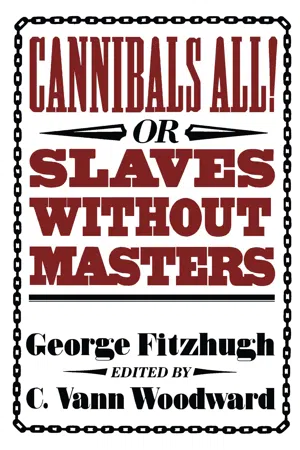
Cannibals All! got more attention in William Lloyd Garrison's Liberator than any other book in the history of that abolitionist journal. And Lincoln is said to have been more angered by George Fitzhugh than by any other pro-slavery writer, yet he unconsciously paraphrased Cannibals All! in his House Divided speech.
Fitzhugh was provocative because of his stinging attack on free society, laissez-faire economy, and wage slavery, along with their philosophical underpinnings. He used socialist doctrine to defend slavery and drew upon the same evidence Marx used in his indictment of capitalism. Socialism, he held, was only "the new fashionable name for slavery," though slavery was far more humane and responsible, "the best and most common form of socialism."
His most effective testimony was furnished by the abolitionists themselves. He combed the diatribes of their friends, the reformers, transcendentalists, and utopians, against the social evils of the North. "Why all this," he asked, "except that free society is a failure?"
The trouble all started, according to Fitzhugh, with John Locke, "a presumptuous charlatan," and with the heresies of the Enlightenment. In the great Lockean consensus that makes up American thought from Benjamin Franklin to Franklin Roosevelt, Fitzhugh therefore stands out as a lone dissenter who makes the conventional polarities between Jefferson and Hamilton, or Hoover and Roosevelt, seem insignificant. Beside him Taylor, Randolph, and Calhoun blend inconspicuously into the American consensus, all being apostles of John Locke in some degree. An intellectual tradition that suffers from uniformity—even if it is virtuous, liberal conformity—could stand a bit of contrast, and George Fitzhugh can supply more of it than any other American thinker.
eBook - ePub
Cannibals All! Or, Slaves without Masters
- 265 pages
- English
- ePUB (mobile friendly)
- Available on iOS & Android
eBook - ePub
Cannibals All! Or, Slaves without Masters
About this book
Information
GEORGE FITZHUGH, SUI GENERIS
If social theories regularly shared the fate of the social systems in which they were born, the history of thought would be a thin and impoverished thing of purely contemporary dimensions. The theories of George Fitzhugh came very near suffering the fate that befell the social order and institutions he defended. It was not merely that he was the spokesman of a cause that was overwhelmed in military disaster and an order that was leveled by revolutionary action. Nor was it simply that he was the outspoken champion of the discredited, despised, and abolished institution of Negro slavery. More important than the fall of the old order in explaining the eclipse of Fitzhugh was the sensational, if temporary, triumph of the system he opposed, a triumph that followed hard upon the collapse of the order he championed.
The fact was that the very aspects of “free society” that Fitzhugh most fiercely attacked, the aspects he repeatedly prophesied would spell the doom and downfall of that system, were the features that flourished most exuberantly in the decades following Appomattox. These features were an economy of laissez faire capitalism, an ethic of social Darwinism, and a rationalistic individualism of a highly competitive and atomized sort. Even part of his beloved South joined in the pursuit of these heresies.
It is little wonder that one writer could ask, “But who in America would be reading Fitzhugh in twenty years?” The question was intended to be rhetorical and the answer was, of course, “Nobody.” In the America of the post-Civil War period, admittedly, it is impossible to imagine a more completely irrelevant and thoroughly neglected thinker than George Fitzhugh.
The lapse of a century, however, has altered the perspective from which earlier generations assessed the significance of Fitzhugh’s thought. The triumph of a highly individualistic society no longer seems as permanent in this country as it once did; nor does the disappearance of all forms of slavery before the advance of progress seem inevitable in the rest of the world. The current of history has changed again. Millions of the world’s population are seeking security, abandoning freedom, and finding masters. It is not the sort of socialism that Fitzhugh advocated, nor the slavery he defended, but another type of system that he feared which is fulfilling his prophesies. Even in those societies where socialism is abhorred, mass production, mass organization, and mass culture render his insights more meaningful than they ever were in the old order of individualism.
It was Fitzhugh’s constant complaint that his contemporary opponents rejected his theory out of hand without evaluation or understanding. He would have been more crushed by the total neglect of posterity, even in the South, until quite recently. For an intellectual tradition that stands in desperate need of contrast and suffers from uniformity – albeit virtuous liberal uniformity – this oversight is unfortunate. Granting his wicked excesses and sly European importations, Fitzhugh could at least furnish contrast. The distance between Fitzhugh and Jefferson renders the conventional polarities between Jefferson and Hamilton, Jackson and Clay, or Hoover and Roosevelt – all liberals under the skin – insignificant indeed. When compared with Fitzhugh, even John Taylor of Caroline, John Randolph of Roanoke, and John C. Calhoun blend inconspicuously into the great American consensus, since they were all apostles in some degree of John Locke.
With such a wealth of sterling and illustrious examples of the Lockean liberal consensus, from Benjamin Franklin to Abraham Lincoln and on down, surely a small niche could be found in our national Pantheon for one minor worthy who deviated all down the line. For Fitzhugh frankly preferred Sir Robert Filmer and most of his works to John Locke and all his. He saw retrogression in what others hailed as progress, embraced moral pessimism in place of optimism, trusted intuition in preference to reason, always preferred inequality to equality, aristocracy to democracy, and almost anything – including slavery and socialism – to laissez faire capitalism. Whatever his shortcomings, George Fitzhugh could never, never be accused of advocating the middle way. Granting all his doctrine to be quite un-American, one might still ask that Fitzhugh’s thought be re-examined, if only for the sharp relief in which it throws the habitual lineaments of the American mind.
Louis Hartz, who applauds America’s rejection of Fitzhugh, has deplored the prevailing indifference to what he calls “The Reactionary Enlightenment” of the Southern conservatives. “For this was the great imaginative moment in American political thought,” he writes, “the moment when America almost got out of itself, as it were, and looked with some objectivity on the liberal formula it has known since birth.” While in his opinion the movement ran to fantasy, extravagance, and false identifications, he calls it “one of the great and creative episodes in the history of American thought,” and its protagonists “the only Western conservatives America has ever had.”1
Hartz is quite justified in placing Fitzhugh near the center and in the forefront of the Reactionary Enlightenment. He goes further to pronounce him “a ruthless and iconoclastic reasoner,” “the most logical reactionary in the South,” and to attribute to him “a touch of the Hobbesian lucidity of mind.” He is on more doubtful ground when he pronounces the Virginian a “more impressive thinker” than the great Carolinian, John C. Calhoun, but he qualifies his praise with numerous charges of inconsistency, irresponsibility, and even insincerity. In commenting upon the South’s shift from the liberal doctrine of the Revolution to ante bellum conservatism, Hartz writes: “Fitzhugh substituted for the social blindness of Jefferson a hopeless exaggeration of the truth. The South exchanged a superficial thinker for a mad genius.”2 I would not agree fully with either the praise or the indictment implied, but would cordially endorse the demand for serious attention to a neglected and provocative thinker.
It would be misleading, however, to leave the impression that George Fitzhugh was typical of the Southern thinkers of his period or representative of the pro-slavery thought or of agrarian thought. Fitzhugh was not typical of anything. Fitzhugh was an individual – sui generis. There is scarcely a tag or a generalization or a cliché normally associated with the Old South that would fit him without qualification. Fitzhugh’s dissent usually arose out of his devotion to logic rather than out of sheer love of the perverse, but evidence warrants a suspicion that he took a mischievous delight in his perversity and his ability to shock. He once wrote teasingly to his friend George Frederick Holmes, referring to his Sociology for the South, “It sells the better because it is odd, eccentric, extravagant, and disorderly.”3 He was always a great one for kicking over the traces, denying the obvious, and taking a stand on his own.
For one thing, Fitzhugh was decidedly not an agrarian, for in his opinion “the wit of man can devise no means so effectual to impoverish a country as exclusive agriculture.” Manufacturing and commerce were the road to wealth. “Farming is the recreation of great men, the proper pursuit of dull men.”4 As for that sacred Southern dogma of free trade, it was a snare and a delusion, another fraud perpetrated by the Manchester heresy, to be avoided at all costs.5 Those who dismiss Fitzhugh and his friends as bemused romantics enamored of feudalism will have to reckon with the Virginian’s praise of Cervantes, who “ridded the world of the useless rubbish of the Middle Ages, by the ridicule so successfully attached to it.”6 And those who identify the pro-slavery argument with a poisonous racism will have to take into account Fitzhugh’s rejection of it. He deplored “the hatred of race” and anything that “cuts off the negro from human brotherhood,” “because it is at war with scripture, which teaches that the whole human race descended from a common parentage; and, secondly, because it encourages and encites brutal masters to treat negroes, not as weak, ignorant and dependent brethren, but as wicked beasts, without the pale of humanity.”7
Apart from his ideas, Fitzhugh had traits of personality and character that discourage classifying him with any type. In many ways he was the antithesis of the fierce-eyed, grimfaced polemicist who stares out from the picture galleries of the 1850’s, whether in the wing for Southern fire-eaters or the wing for abolitionists. Fanaticism is not compatible with a temperament that selects Falstaff and Sancho Panza as favorite characters of fiction. He made much of his remote family connection with the prominent abolitionist leaders Gerrit Smith and James G. Birney, and his acquaintance with other abolitionists. He sought them out, cultivated them. “We have an inveterate and perverse penchant of finding out good qualities in bad fellows,” he wrote. “Robespierre and Milton’s Satan are our particular friends.”8 There was none of the suspicious recluse in him. “We admire them all, and have had kindly intercourse and correspondence with some of them,” he said of the abolitionists. He referred often to his debate with Wendell Phillips and to the “generous reception and treatment we received, especially from leading abolitionists, when we went north to personate Satan by defending Slavery.”9 Even after the war, when his world was in ruins, his home part of a battlefield, and his enemies were plotting more mischief, he could write in the old vein: “Love is a pleasanter passion than hate, and we have been hating so intensely for the last six years, that we are now looking about for something to love. … We are resolved to hate no one, and to quarrel with no one. No, not even with Thad. Stevens and his men.”10 If candor and magnanimity could disarm hostile critics, Fitzhugh was well endowed.
George Fitzhugh was born in Prince William County, Virginia, on the Northern Neck between the Potomac and the Rappahannock Rivers on November 4, 1806. He sprang from a numerous family that included men of large landed property and prominence in the history of Virginia. He was descended from William Fitzhugh, “a fair classical scholar, a learned, able, and industrious lawyer, a high tory, high Churchman,” who came to the colony in 1671 as land agent for Lord Fairfax. George Fitzhugh’s father, a doctor and small planter, did not prosper, and the paternal estate passed out of family hands shortly after his death in 1829. That year, however, the son improved his lot somewhat by marrying Mary Brockenbrough of Port Royal, Caroline County, and promptly moving into his wife’s home. This was described later by an unsympathetic neighbor as a “rickety old mansion, situated on the fag-end of a once noble estate.”11
Like the mansion, the village of Port Royal had seen better days, but it was prettily seated on the banks of the Rappahannock, and Fitzhugh became devoted to the village and its few citizens. Its most distinguished citizen, the great Jeffersonian intellectual, John Taylor of Caroline, had died five years before young Fitzhugh moved to Port Royal. It is not known whether Fitzhugh ever met Taylor, but he did have several of the famous agrarian’s books in his library and their influence may be detected in his own works. He acquired sever...
Table of contents
- Cover
- Title
- Copyright
- Contents
- “George Fitzhugh, Sui Generis”
- Cannibals All! or Slaves without Masters
- Dedication
- Preface
- Introduction
- I. The Universal Trade
- II. Labor, Skill, and Capital
- III. Subject Continued — Exploitation of Skill
- IV. International Exploitation
- V. False Philosophy of the Age
- VI. Free Trade, Fashion, and Centralization
- VII. The World is Too Little Governed
- VIII. Liberty and Slavery
- IX. Paley on Exploitation
- X. Our Best Witnesses and Masters in the Art of War
- XI. Decay of English Liberty, and Growth of English Poor Laws
- XII. The French Laborers and the French Revolution
- XIII. The Reformation — The Right of Private Judgment
- XIV. The Nomadic Beggars and Pauper Banditti of England
- XV. Rural Life of England
- XVI. The Distressed Needle-Women and Hood’s “Song of the Shirt”
- XVII. The Edinburgh Review on Southern Slavery
- XVIII. The London Globe on West India Emancipation
- XIX. Protection and Charity to the Weak
- XX. The Family
- XXI. Negro Slavery
- XXII. The Strength of Weakness
- XXIII. Money
- XXIV. Gerrit Smith on Land Reform, and William Lloyd Garrison on No-Government
- XXV. In What Anti-Slavery Ends
- XXVI. Christian Morality Impracticable in Free Society — But the Natural Morality of Slave Society
- XXVII. Slavery — Its Effects on the Free
- XXVIII. Private Property Destroys Liberty and Equality
- XXIX. The National Era an Excellent Witness
- XXX. The Philosophy of the Isms — Showing Why They Abound at the North, and Are Unknown at the South
- XXXI. Deficiency of Food in Free Society
- XXXII. Man Has Property in Man
- XXXIII. The Coup de Grâce to Abolition
- XXXIV. National Wealth, Individual Wealth, Luxury, and Economy
- XXXV. Government a Thing of Force, Not of Consent
- XXXVI. Warning to the North
- XXXVII. Addendum
- Index
Trusted by 375,005 students
Access to over 1.5 million titles for a fair monthly price.
Study more efficiently using our study tools.
Frequently asked questions
Yes, you can cancel anytime from the Subscription tab in your account settings on the Perlego website. Your subscription will stay active until the end of your current billing period. Learn how to cancel your subscription
No, books cannot be downloaded as external files, such as PDFs, for use outside of Perlego. However, you can download books within the Perlego app for offline reading on mobile or tablet. Learn how to download books offline
Perlego offers two plans: Essential and Complete
- Essential is ideal for learners and professionals who enjoy exploring a wide range of subjects. Access the Essential Library with 800,000+ trusted titles and best-sellers across business, personal growth, and the humanities. Includes unlimited reading time and Standard Read Aloud voice.
- Complete: Perfect for advanced learners and researchers needing full, unrestricted access. Unlock 1.5M+ books across hundreds of subjects, including academic and specialized titles. The Complete Plan also includes advanced features like Premium Read Aloud and Research Assistant.
We are an online textbook subscription service, where you can get access to an entire online library for less than the price of a single book per month. With over 1.5 million books across 990+ topics, we’ve got you covered! Learn about our mission
Look out for the read-aloud symbol on your next book to see if you can listen to it. The read-aloud tool reads text aloud for you, highlighting the text as it is being read. You can pause it, speed it up and slow it down. Learn more about Read Aloud
Yes! You can use the Perlego app on both iOS and Android devices to read anytime, anywhere — even offline. Perfect for commutes or when you’re on the go.
Please note we cannot support devices running on iOS 13 and Android 7 or earlier. Learn more about using the app
Please note we cannot support devices running on iOS 13 and Android 7 or earlier. Learn more about using the app
Yes, you can access Cannibals All! Or, Slaves without Masters by George Fitzhugh,George FITZHUGH, C. Vann Woodward in PDF and/or ePUB format, as well as other popular books in History & North American History. We have over 1.5 million books available in our catalogue for you to explore.