On January 30, 1933, hearing about the celebrations for Hitler's assumption of power, Erich Ebermayer remarked bitterly in his diary, "We are the losers, definitely the losers." Learning of the Nuremberg Laws in 1935, which made Jews non-citizens, he raged, "hate is sown a million-fold." Yet in March 1938, he wept for joy at the Anschluss with Austria: "Not to want it just because it has been achieved by Hitler would be folly."
In a masterful work, Peter Fritzsche deciphers the puzzle of Nazism's ideological grip. Its basic appeal lay in the Volksgemeinschaft—a "people's community" that appealed to Germans to be part of a great project to redress the wrongs of the Versailles treaty, make the country strong and vital, and rid the body politic of unhealthy elements. The goal was to create a new national and racial self-consciousness among Germans. For Germany to live, others—especially Jews—had to die. Diaries and letters reveal Germans' fears, desires, and reservations, while showing how Nazi concepts saturated everyday life. Fritzsche examines the efforts of Germans to adjust to new racial identities, to believe in the necessity of war, to accept the dynamic of unconditional destruction—in short, to become Nazis.
Powerful and provocative, Life and Death in the Third Reich is a chilling portrait of how ideology takes hold.
- 368 pages
- English
- ePUB (mobile friendly)
- Available on iOS & Android
eBook - ePub
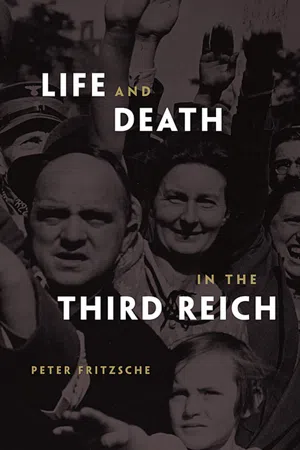
Life and Death in the Third Reich
About this book
Information
Topic
HistoriaSubtopic
Historia alemana1

Reviving the Nation
“Heil Hitler!”
In September 1938, as the Sudeten crisis was heating up over Hitler’s demand to annex the German-speaking territories of Czechoslovakia, Victor and Eva Klemperer took a drive from Dresden to Leipzig. Along the way, they took a break at a truck stop: “huge vehicles outside … huge portions inside.” They walked inside just as the radio began to broadcast speeches from the Nazi party rally in Nuremberg: “Introductory march, roars of triumph, then Göring’s speech, about the tremendous rise, affluence, peace and workers’ good fortune in Germany … But the most interesting thing about it all,” Klemperer noted, “was the behavior of the customers, who all came and went, greeting and taking their leave with ‘Heil Hitler.’ But no one was listening. I could barely understand the broadcast because a couple of people were playing cards, striking the table with loud thumps, talking very loudly. It was quieter at other tables. One man was writing a postcard, one was writing in his order book, one was reading the newspaper. And landlady and waitress were talking to each other or to the card players. Truly: Not one of a dozen people paid attention to the radio for even a single second, it could just as well have been transmitting silence or a foxtrot from Leipzig.” “The behavior of the customers”—this is the fundamental topic Klemperer was trying to figure out as he observed daily life. He was constantly on the lookout for what he called “vox populi” to provide him clues about popular support for Hitler and the Nazis, but the voices were never definitive. “What is real, what is happening?” Klemperer wondered about the Third Reich.1
Scholars have been asking the same question ever since. With the publication in 1995 of the diaries of Victor Klemperer, historians possess one of the most detailed firsthand accounts of life in Nazi Germany, and yet, like Klemperer, they are not sure how to read the evidence. What is more telling: the unselfconscious “Heil Hitler” greeting of the truckers or their disregard of the radio broadcast? Klemperer introduced the new sights and sounds of the Third Reich, but was not sure whether the rituals really had changed the attitudes of Germans. The scene at the truck stop perfectly captures two sides of the debate about National Socialism. On the one hand, historians stress the degree to which non-Jewish Germans accepted Nazism as the normal condition of everyday life and even celebrated the new order. On the other hand, they point to evidence that Germans simply went about their business, taking care to intersect as little as possible with the Nazi party apparatus.
It is worth examining more closely everyday interactions and how they changed in the years after Hitler’s seizure of power. A few months after January 1933, there was hardly a single person who had not on occasion raised the right arm and exclaimed “Heil Hitler!” Most people did so several times every day. Berlin’s “Guten Tag,” Hamburg’s “Moin,” and Bavaria’s “Grüss Gott” could still be heard, but “Heil Hitler!” worked itself so closely into the vocabularies of citizens that the final end to Nazism in 1945 was often remembered as the moment when “we never have to say Heil Hitler again!” As early as July 1933, civil servants were required to use the greeting in official communication. Schoolteachers “heil hitlered” their students at the beginning of class, conductors on the Deutsche Reichsbahn “heil hitlered” travelers when checking tickets, and post office clerks “heil hitlered” customers buying postage stamps. Klemperer himself was astonished to see “employees constantly raising their arms to one another” as he walked through the buildings of his university in the summer of 1933. Erika Mann, daughter of the novelist Thomas Mann, estimated that children saluted “Heil Hitler!” 50 or maybe 150 times a day, in any event “immeasurably more often than the old neutral greetings.” But what did it mean to call out “Heil Hitler!”? What does the greeting, the raised arm, the casual reference to “the Führer” say about the relationship between Germans and Nazis in the Third Reich? How Nazi were Germans, really?2
That the Hitler greeting was compulsory for civil servants confirms the dictatorial power of the regime. After the war, many Germans testified that they felt coerced or bullied into saying “Heil Hitler!” Especially in the early months of the new regime, Nazi loyalists were quick to demand that citizens use the greeting in public. In the summer of 1933, visitors to the tourist destination of Weimar would have seen signs in stores, restaurants, and hotels bearing the “encouraging command: ‘Germans Greet Each Other with Heil Hitler!’” In October 1933 the “German greeting” was made mandatory in the Leipzig theater where Erich Ebermayer worked. “Who cannot go along?” he confided to his diary; for this opponent of the Nazis, “Heil Hitler!” “is now my greeting at work.” As more Germans said “Heil Hitler!” to one another, it became harder not to respond in kind. This dynamic makes it difficult to know whether huge numbers of people were really converts or merely conformists. It is also clear that many Germans did not go along at all. Individuals recalled abruptly crossing the street to avoid the greeting or remembered downgrading public shows of loyalty with “inaudible mumbles and feeble hand gestures.” Visitors to the heavily Catholic regions of southern Germany or to Social Democratic and Communist neighborhoods would have heard “Heil Hitler!” less frequently. Jehovah’s Witnesses refused outright to use the greeting. “Do you already know the new greeting?” someone asked a few months after Hitler had come to power: “forefinger in front of your lips.”3
Yet for all the people who felt pressure to conform, there were others who applied pressure and insisted on the greeting. With “Heil Hitler!” Nazi party members attempted to recompose the body of Germans; the arc of the right hand raised at an angle in front of the body drastically expanded the physical claim of National Socialists to public space. The assertive gesture was accompanied by an unambiguous political declaration. Unlike “Guten Tag,” which sought to reconcile neighbors without further ado, the hortatory “Heil Hitler!” constituted an assertive attempt to create and enforce political unity. “Heil Hitler!” expressed the desire of many Germans to belong to the national community and to participate in national renewal. They undoubtedly included the male and female nurses whom a friend of the Klemperers watched in April 1933 as they sat “around the loudspeaker” in the hospital lounge. “When the Horst Wessel Song is sung (every evening and at other times too), they stand up and raise their arms in the Nazi greeting.”4
“Heil Hitler!” could also be used to make a claim for social recognition because it replaced more deferential greetings in everyday life. When the mailman greeted neighbors with an ostentatious “Heil Hitler!” he put them on notice that he was a Volksgenosse, or people’s comrade, and their equal. In similar fashion, the boss who stood at the doorway of the factory canteen welcoming with a “Heil Hitler!” workers who had previously been excluded was not wiping away social differences, but he was acknowledging the new entitlements enjoyed by his employees. Even in the private space of the home, friends and relatives greeted each other with “Heil Hitler!,” indicating the extent to which loyalists wanted to recognize the place of Hitler’s national revolution in their own personal lives. With the aggressive upward, outward movement of the arm, “Heil Hitler!” occupied new social and political space and made it available to the Nazi movement. It enabled citizens to try on new political and racial identities, to demonstrate support for the “national revolution,” and to exclude Jews from daily social interactions. To put the words “Heil Hitler!” only in the mouths of fanatics is to miss how Germans more and less willingly adjusted themselves to the unitary ideal of the people’s community.
Since it was Hitler who was hailed, the greeting poses the question of the role of the German Führer in creating political consensus. Loyalty to Hitler strengthened the regime in critical ways, but it also set limits to what party activists could achieve, since support for Hitler did not necessarily imply support for Nazi policies. In other words, “Heil Hitler!” might well have covered up differences among Germans and covered for those who were not sympathetic to the Nazis. But precisely those people who considered “Heil Hitler!” nothing more than an ordinary greeting of the day or used it to disguise their own misgivings made it more commonplace. They thereby enhanced the sense of acclamation. To an outsider, it looked as though everyone was turning into a Nazi, a view that stepped up pressure to conform. Yet insiders were never sure whether support for the regime was genuine or halfhearted; the border between true believers and mere opportunists was not clear. For Jews, however, the distinction between apparent and real Nazis did not make much difference, since they, unlike other Germans, could not join in for the sake of appearance. Not able to “pass,” they stood out all the more plainly in the Third Reich.
There is plenty of evidence to suggest that after the initial period of revolutionary mobilization waned, fewer people greeted each other with “Heil Hitler!” In Berlin, in particular, visitors in the mid-1930s expressed surprise that they did not hear the “German greeting” more often. In Munich, “they’ve completely stopped saying ‘Heil Hitler,’” claimed CBS radio correspondent William Shirer in 1940.5 Whether this shift indicated a weakening of support for the Nazis or simply the return to more relaxed conventions is not certain. In the third month of Germany’s war with the Soviet Union, in September 1941, Klemperer reported that in Dresden “Good morning” or “Good afternoon” was said to be increasing. To see for himself, he set out to count “how many people in the shops say ‘Heil Hitler’ and how many ‘Good afternoon.’” The results: “At Zscheischler’s bakery five women said ‘Good afternoon,’ two said ‘Heil Hitler’”; but at Ölsner’s grocery store “they all said ‘Heil Hitler.’” “Whom do I see, to whom do I listen?” Klemperer continued to wonder. As Germany’s defeat became more certain, however, the balance undoubtedly shifted in favor of “Good afternoon.” In February 1944 Franz Göll, an employee in a Berlin print shop, confided: “you seldom hear the greeting ‘Heil Hitler’ any more,” or “you make a joke out of it” by saying “Heilt Hitler”—“heal Hitler” rather than “hail Hitler.” To say it “at home” was “actually frowned upon,” he continued, a reminder, of course, that Göll’s friends and relatives had once upon a time greeted one another with “Heil Hitler!”6
“Heil Hitler!” illustrates both the coerced and self-assertive aspects of the national revolution in January 1933. It raises questions about the illusory nature of acclamation: since once everyone said “Heil Hitler!” the greeting no longer reliably indicated support for the regime. But much of the power of Nazism rested on the appearance of unanimity, which overwhelmed nonbelievers and prompted them to scrutinize their own reservations. Each raised arm undermined a little bit the ambiguous relations among neighbors and built up a little more the new racial collective of National Socialism. Did that mean that sympathies for Nazism had diminished when more people once again called out “Good afternoon” on a Berlin street? Like Klemperer, historians are still counting the “Heil Hitlers” outside Zscheischler’s bakery in Dresden and are still figuring out what it meant when customers said “Good afternoon” instead.
How Far Did Germans Support the Nazis?
A few years before the Klemperers drove up to the truck stop in Saxony, a young American sociologist from Columbia University arrived in Berlin by train. Late in June 1934, Theodore Abel settled in his boardinghouse, went for a walk around bustling Potsdamer Platz, and had a drink in the huge entertainment emporium Haus Vaterland, with its selection of ethnically themed restaurants. Abel himself was busy counting “Heil Hitlers,” a greeting that he found was used “only in official places,” while “Guten Morgen” and “Auf Wiedersehen” prevailed in “everyday contacts.”7 The reason he had come to Berlin was to launch a mammoth research project on the Nazis. His project had an interesting twist. Unlike most sociologists, who would sample the group they wanted to study and analyze it according to age, generation, and social class in order to explain political behavior by social origin, Abel wanted to ask party members directly why they had become Nazis. His was the case study method pioneered by the Chicago School of Sociology. To proceed, he devised the idea of having “old fighters,” those who had joined the party in the 1920s, write their autobiographies, and for this he needed the help of the Nazi party.
At first the Propaganda Ministry, which is where Abel had his contacts, was suspicious. As he put it in his diary, they “feared that I would not do justice to the imponderables and the declaration of faith and only use the factual material.” But Abel gave them assurances that “it was in order to get at the imponderables that I conceived the idea of the life-histories.” In other words, Abel wanted to explore the Nazi phenomenon by way of individual testimonies rather than reduce it to general statistics. The party subsequently ran a contest and collected hundreds of autobiographical statements for Abel to use. His 1938 book, Why Hitler Came to Power, was the fruit of his investigation and featured six extensive autobiographies at the end. The research stands as one of the most successful attempts to assess the political motivations of the Nazis. In his conclusions, Abel acknowledged the importance of social and economic factors, but he emphasized ideology: the role of the war experience, the shock of defeat, and the determination to rejuvenate the political structures of Germany. There were not sixty million ways to Nazism.8
I want to adapt Abel’s method and introduce three life stories, based on diaries and letters, to show in greater detail how “Heil Hitler!” and “Good afternoon” combined with each other in the Third Reich. The lives of the Gebenslebens in Braunschweig in northern Germany, the Dürkefäldens in the nearby town of Peine, and Erich Ebermayer in Leipzig reveal ways in which Germans pulled away from and pushed toward the Nazis in the years after the seizure of power. Victor Klemperer’s extraordinary diary surmised how his non-Jewish neighbors might have contemplated the Nazis. At first, he assumed that the regime relied on both fear and opportunism; later, without completely abandoning his earlier position, Klemperer considered more fundamental ideological and cultural affinities. He suggested that the Third Reich made “Aryans” feel at home—unter uns, “just us,” was the phrase he used. The letters and diaries presented here offer opportunities to evaluate Klemperer’s ideas and to analyze how Germans in the 1930s discussed themselves, their relations with Jews, and the future of the Third Reich.
Elisabeth Gebensleben, a lively forty-nine-year-old and the wife of Braunschweig’s deputy mayor, was an ardent Nazi supporter. Gebensleben and her children had cheered the “national opposition” to the Weimar Republic for over a decade. Like millions of other Germans, she and her husband had switched their allegiance from the monarchist German National People’s Party to the National Socialists in 1930. She described herself as the sort of person who turned “first to politics, then the features” when picking up the newspaper. Her letters brimmed with political observations, and those to her daughter, Irmgard, or Immo, who had married and moved to Holland, are especially detailed. Elisabeth attempted to evoke something of the excitement of 30 January 1933: “Monday morning,” the Gebenslebens’ maid “suddenly called out: ‘lots of Hitler flags are being hung outside’”; Frieda could see them from the window of her room. “Well then your Dad came in with the extra edition. His face was one big smile, and I smiled as well.” As the news sank in, “a couple of tears rolled out”: “finally, finally,” after years of “struggle,” “the goal has been reached.” For Elisabeth, the historical moment was especially poignant because a “simple man, who fought in the trenches, is sitting where Bismarck had once sat.” She believed that Hitler offered Germany social and political reconciliation.9
For a combative nationalist such as Elisabeth, 30 January was the culmination of years of political work. It was the repudiation of the treasonous revolution of 1918 in the name of the patriotic unity of 1914. Nonetheless, Elisabeth worried about the “battles that will now come” and even wondered whether Hitler had arrived on the scene “too late” to beat the Communists. As it was, presidential decrees gave Hitler’s new government unprecedented police powers, especially after the Reichstag Fire on the night of 27 February 1933; across Germany, police and Nazi stormtroopers arrested Social Democratic and Communist activists and shut down their newspapers and trade union offices. “The ruthless intervention of the nationalist government might appear strange to some,” Elisabeth commented after the 5 March elections, in which the Nazi coalition emerged victorious, “but first we have to systematically clean up.” More to the point, the “Communists have to disappear, and Marxists too,” an afterthought referring to the Social Democrats, the only force in Germany loyal to the republican constitution. Suspicious of Communists who “suddenly want to become National Socialists,” she refused to welcome former opponents into the “people’s community” until they served “a three-year probationary period in the concentration camps.” Given this terror, it is no wonder that the “Revolution from the Right” showed “more order and discipline” than the “Revolution from the Left” had in November 1918.10
As the Nazis became stronger, political divisions were less obviously visible, so that the unity of the nation, though rinsed in terror, appeared to come into view. The big celebrations of the spring of 1933—the Day of Potsdam, which on 21 March choreographed the alliance between Hitler and Hindenburg on the occasion of the inaugural session of the new Reichstag; Hitler’s birthday on 20 April; and finally May Day, newly recognized as an official holiday to honor workers and symbolize their integration into the ...
Table of contents
- Cover
- Title
- Copyright
- Contents
- Preface
- Introduction
- 1 Reviving the Nation
- 2 Racial Grooming
- 3 Empire of Destruction
- 4 Intimate Knowledge
- Notes
- Index
Trusted by 375,005 students
Access to over 1.5 million titles for a fair monthly price.
Study more efficiently using our study tools.
Frequently asked questions
Yes, you can cancel anytime from the Subscription tab in your account settings on the Perlego website. Your subscription will stay active until the end of your current billing period. Learn how to cancel your subscription
No, books cannot be downloaded as external files, such as PDFs, for use outside of Perlego. However, you can download books within the Perlego app for offline reading on mobile or tablet. Learn how to download books offline
We are an online textbook subscription service, where you can get access to an entire online library for less than the price of a single book per month. With over 1.5 million books across 990+ topics, we’ve got you covered! Learn about our mission
Look out for the read-aloud symbol on your next book to see if you can listen to it. The read-aloud tool reads text aloud for you, highlighting the text as it is being read. You can pause it, speed it up and slow it down. Learn more about Read Aloud
Yes! You can use the Perlego app on both iOS and Android devices to read anytime, anywhere — even offline. Perfect for commutes or when you’re on the go.
Please note we cannot support devices running on iOS 13 and Android 7 or earlier. Learn more about using the app
Please note we cannot support devices running on iOS 13 and Android 7 or earlier. Learn more about using the app
Yes, you can access Life and Death in the Third Reich by Peter Fritzsche in PDF and/or ePUB format, as well as other popular books in Historia & Historia alemana. We have over 1.5 million books available in our catalogue for you to explore.