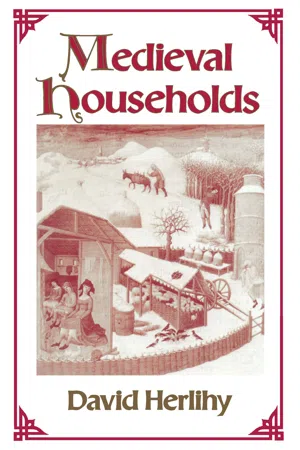
How should the medieval family be characterized? Who formed the household and what were the ties of kinship, law, and affection that bound the members together? David Herlihy explores these questions from ancient Greece to the households of fifteenth-century Tuscany, to provide a broad new interpretation of family life. In a series of bold hypotheses, he presents his ideas about the emergence of a distinctive medieval household and its transformation over a thousand years.
Ancient societies lacked the concept of the family as a moral unit and displayed an extraordinary variety of living arrangements, from the huge palaces of the rich to the hovels of the slaves. Not until the seventh and eighth centuries did families take on a more standard form as a result of the congruence of material circumstances, ideological pressures, and the force of cultural norms. By the eleventh century, families had acquired a characteristic kinship organization first visible among elites and then spreading to other classes. From an indifferent network of descent through either male or female lines evolved the new concept of patrilineage, or descent and inheritance through the male line. For the first time a clear set of emotional ties linked family members.
It is the author's singular contribution to show how, as they evolved from their heritages of either barbarian society or classical antiquity, medieval households developed commensurable forms, distinctive ties of kindred, and a tighter moral and emotional unity to produce the family as we know it. Herlihy's range of sources is prodigious: ancient Roman and Greek authors, Aquinas, Augustine, archives of monasteries, sermons of saints, civil and canon law, inquisitorial records, civil registers, charters, censuses and surveys, wills, marriage certificates, birth records, and more. This well-written book will be the starting point for all future studies of medieval domestic life.
- 227 pages
- English
- ePUB (mobile friendly)
- Available on iOS & Android
eBook - ePub
Medieval Households
About this book
Information
Publisher
Harvard University PressYear
1985Print ISBN
9780674563766
9780674563759
eBook ISBN
9780674254374
1 | THE HOUSEHOLD IN LATE CLASSICAL ANTIQUITYCivitatem salvam esse sine matrimoniorum frequentia non posse. The state cannot be secure without numerous marriages. —Aulius Gelius, Atticae Noctes, 1.66 |
THE STUDY of the medieval household requires an initial backward glance into the two parent societies of the Middle Ages: the classical Roman empire, and the peoples, whom the Romans called barbarians, settled to the north of the imperial frontiers. In this chapter we look at the domestic institutions of imperial Rome. The conventional date for the fall of the empire in the West is 476, but we must carry our survey a little farther, into the sixth century. One reason is that much of what we know of ancient households derives from the laws and commentaries which emperor Justinian (527–65) brought together and preserved in the Corpus Iuris Civilis.1 In spite of its late redaction, the Corpus is the single most important source for the legal institutions of the ancient Roman empire. Then too, in things touching on the family, the sixth century seems to make a sharper break with the past than did the political collapse of the western empire, in the fifth century.
CONCEPTS OF FAMILY AND HOUSEHOLD
Historians who investigate ancient families immediately confront a perplexing question. What is the family—the primary descent group (parents and children)—called in the ancient languages?
Meanings
There are no terms, in either classical Greek or Latin, precisely corresponding to our own word “family.”2 In ancient Greek the most likely synonym is genea. The root meaning of genea is “generation,” and it variously designates offspring, lineage, or a generation of time. But it seems never to have meant “family” in the modern sense. The modern Greek word for family (oikogeneia) sweeps away ambiguity by appending the word for house (oikos) to the term for generation. It thus neatly expresses the two chief aspects in the modern notion of family: primary relationship of the members through marriage and blood, and coresidency.
The lack of a precise equivalent for the modern word “family” in classical Greek is the more surprising as the ancients wrote extensively about households, meaning coresidential units of some sort.3 The art and science of household management constituted “economics,” and this was the exact counterpart to “politics,” the science of city government. In their ruminations on social organization, the Greek thinkers used the word “household” (oikos) in two different but related ways. The educator and philosopher Xenophon wrote, about 386 B.C., probably the oldest and certainly the most influential discourse on “economics.” He equated the household with its property, that is, with the material possessions of the household head: “The household looks to us to be the totality of possessions.”4 But others, including Aristotle, preferred to view the household as all those persons subject to the authority of its chief—slaves and servants as well as spouse and blood relations.5
In classical Latin, the word familia carries equivalent meanings. It designates everything and everybody under the authority (patria potestas) of the household head. Familia in classical usage is often synonymous with patrimony. “His family, that is, his patrimony,” writes the jurist Gaius.6 Familia could also mean persons only, specifically those persons subject to the authority of the paterfamilias, the household chief, usually the father. This was the more common usage in classical Latin. Thus, the jurist Ulpian, in the second century A.D., defines “family” as those persons who by nature (that is, natural offsprings) or by law (wife, adopted children, slaves) are subject to the patria potestas.7 This definition still recognizes no distinction between the primary descent group and servants and slaves. But it does retain a crucial distinction between the father and the family, the ruler and the ruled, even though by Ulpian’s day the patria potestas had considerably weakened. Ulpian also offers a secondary definition of familia: slaves only.8 But then he has no term to identify the residual members of the household, the husband, wife, and offspring. Isidore of Seville, who died in 636 and gave to the Middle Ages its favorite encyclopedia, the “Etymologies”, states that familia derives from femur, and means in the strict sense “offspring.”9
These usages yield a startling conclusion: the classical understanding of the word familia excluded from its membership its chief, the paterfamilias. He was not subject to his own authority, as Ulpian requires. Nor was he his own offspring, in Isidore’s etymology. Then too, this understanding of the family was not applicable beyond the narrow range of the free and wealthy classes. The ancients, in sum, lacked a clear sense of the primary descent group as a distinct moral unit, and lacked too a concept of family or household that could be applied across all social levels.
From late antiquity into the Middle Ages, the most common meaning of familia continued to be the property or the dependents (sometimes only the servants) of the household head.10 But in late Latin usage, probably under the influence of interpretations given to the Greek genea, familia assumed connotations of blood descent. It frequently appears with this meaning in Christian Latin writings. For example, around the year 200, Tertullian, the first major Christian writer to express himself in Latin, observed that “the Jewish people … were divided into tribes and peoples and families and houses.”11 Familia here means kindred or descent group. The “Itala,” the oldest Latin translation of the Scriptures, uses familia as a rendering of the Greek patria, a word with the primary meaning of “lineage.”12 There is no implication in either the Christian or the pagan writings that this familia represented a coresidential unit, with its own moral identity.
If familia in ancient usage did not have the primary meaning of coresidential descent group, were there other terms in the classical vocabulary which expressed this sense? In Greek, oikos, which is a root of “economy,” was, like the Latin domus, the house itself and all who dwelt within it, slaves and retainers as well as parents and children. The Roman household was a religious community, charged with maintaining the cult of the household gods, the lares and penates. These words were often used metaphorically to signify home or hearth. When Tacitus wished to say that the Germans did not herd their slaves into gangs, he observed that each slave had his own “seat” (sedem) and penates.13 But these terms do not describe household units comparable across society. Another Latin word for hearth was focus. It meant the physical hearth, or, in late Latin, the fire within it, as in modern Italian, fuoco. Occasionally, it was used to connote all the households within the community, as in the rallying cry, pro aris et focis, “for altars and hearths.” But it was rarely used as a metaphor for households, and it never represents a coresidential domestic unit common to all, or even one found at many social levels.14
The ancients failed to identify and to name the coresidential, primary descent group, the family in the modern meaning of the term. This is one indication that the ancient households varied widely across society and the homes of the rich had little in common with those of the poor. After all, the familia of the Roman aristocrats typically included scores, even hundreds of members.15 These big establishments were fundamentally different from the hovels of the humble, and the secretive cohabitations of slaves.
Census Units
The conclusion that ancient households lacked uniformity across social levels gains support from the practices of census takers in ancient Mediterranean societies. This cradle of civilization nourished a long tradition of such surveys. The Bible itself records some nine censuses, made or attempted, of the Israelites.16 According to the Book of Numbers, God instructed Moses and Aaron “to take the sum of all the congregation of the children of Israel by their families and houses, and the names of everyone, as many as are of the male sex, from twenty years old and upwards, of all the men of Israel fit for war …”17 In all these Biblical surveys, the able-bodied warrior and the taxpayer, not the household or hearth, were the targets. And the word “family” used in regard to them means not so much the coresidential unit as the lineage, set within the tribe, set within the kin, and only vaguely differentiated from them.
The Romans were the great census takers in the ancient Mediterranean world. Every five years, special officers, the censors, were required to register citizens capable of bearing arms or liable to pay taxes; they also prepared an inventory of their possessions. We have fragmentary results of their scrutinies dating from 225 B.C., and the censors continued their efforts into the imperial period, apparently until the reign of Vespasian (A.D 69–79).18 As the empire expanded, the government took similar censuses of the newly acquired provinces and used them as the basis of tax assessments. But neither in counting its subjects nor in assessing their wealth did Rome make clear use of household units. In the period of the late empire (conventionally reckoned to last from 285 to 476), the imperial government developed an elaborate, and for historians still opaque, method of tax assessment, known as the capitatio-iugatio.19 Capitatio involved a count of heads, presumably able-bodied workers; iugatio was an estimate of land area and its productivity; and in ways that are less than clear, animals too were factored into the assessment. The methods were so intricate as to cause wonder; why did not the Roman assessors simply prepare lists of hearths, and assign an assessment to each, in anticipation of the manner of medieval surveyors? The answer seems to be that domestic units were still too disparate. No common net could catch them all.
Only in one area of Roman institutions and life do households appear as equivalent units in a social array: the laying out of colonies. Since the early republic, the Roman government had rewarded veteran soldiers with grants of land. Grouped into colonies, the veterans worked their farms primarily with the aid of their families; they could have owned few or no slaves.20 These farms were units of production as well as of residence, and this made them particularly suitable for surveys. In the late empire, as the problem of deserted fields mounted, the emperors took to settling barbarian contingents upon the land, again on the basis of families and family tenures. The emperor Aurelian (d. 277), for example, settled familias captivas on mountainous and wooded lands from Tuscany to the Maritime Alps; they were enjoined to plant the land in vineyards, to augment the wine supply for Rome.21
The appearance of commensurable household units thus seems intimately related to the extension of family-based, peasant agriculture. Perhaps this close association with peasant agriculture also explains why the ancient censors utilized hearths so rarely in their work. The unit could not be easily used to assess large, slave-run estates (or...
Table of contents
- Cover
- Title
- Copyright
- Contents
- 1. The Household in Late Classical Antiquity
- 2. The Household in Late Barbarian Antiquity
- 3. The Emergence of the Early Medieval Household
- 4. The Transformations of the Central and Late Middle Ages
- 5. Domestic Roles and Family Sentiments in the Later Middle Ages
- 6. The Household System in the Late Middle Ages
- Conclusion
- References
- Notes
- Index
Trusted by 375,005 students
Access to over 1.5 million titles for a fair monthly price.
Study more efficiently using our study tools.
Frequently asked questions
Yes, you can cancel anytime from the Subscription tab in your account settings on the Perlego website. Your subscription will stay active until the end of your current billing period. Learn how to cancel your subscription
No, books cannot be downloaded as external files, such as PDFs, for use outside of Perlego. However, you can download books within the Perlego app for offline reading on mobile or tablet. Learn how to download books offline
Perlego offers two plans: Essential and Complete
- Essential is ideal for learners and professionals who enjoy exploring a wide range of subjects. Access the Essential Library with 800,000+ trusted titles and best-sellers across business, personal growth, and the humanities. Includes unlimited reading time and Standard Read Aloud voice.
- Complete: Perfect for advanced learners and researchers needing full, unrestricted access. Unlock 1.5M+ books across hundreds of subjects, including academic and specialized titles. The Complete Plan also includes advanced features like Premium Read Aloud and Research Assistant.
We are an online textbook subscription service, where you can get access to an entire online library for less than the price of a single book per month. With over 1.5 million books across 990+ topics, we’ve got you covered! Learn about our mission
Look out for the read-aloud symbol on your next book to see if you can listen to it. The read-aloud tool reads text aloud for you, highlighting the text as it is being read. You can pause it, speed it up and slow it down. Learn more about Read Aloud
Yes! You can use the Perlego app on both iOS and Android devices to read anytime, anywhere — even offline. Perfect for commutes or when you’re on the go.
Please note we cannot support devices running on iOS 13 and Android 7 or earlier. Learn more about using the app
Please note we cannot support devices running on iOS 13 and Android 7 or earlier. Learn more about using the app
Yes, you can access Medieval Households by David Herlihy,David HERLIHY in PDF and/or ePUB format, as well as other popular books in History & European History. We have over 1.5 million books available in our catalogue for you to explore.