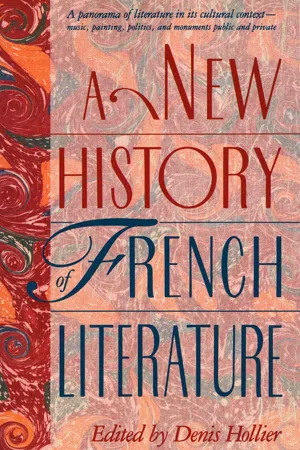
Designed for the general reader, this splendid introduction to French literature from 842 A.D.—the date of the earliest surviving document in any Romance language—to the present decade is the most compact and imaginative single-volume guide available in English to the French literary tradition. In fact, no comparable work exists in either language. It is not the customary inventory of authors and titles but rather a collection of wide-angled views of historical and cultural phenomena. It sets before us writers, public figures, criminals, saints, and monarchs, as well as religious, cultural, and social revolutions. It gives us books, paintings, public monuments, even TV shows.
Written by 164 American and European specialists, the essays are introduced by date and arranged in chronological order, but here ends the book's resemblance to the usual history of literature. Each date is followed by a headline evoking an event that indicates the chronological point of departure. Usually the event is literary—the publication of an original work, a journal, a translation, the first performance of a play, the death of an author—but some events are literary only in terms of their repercussions and resonances. Essays devoted to a genre exist alongside essays devoted to one book, institutions are presented side by side with literary movements, and large surveys appear next to detailed discussions of specific landmarks.
No article is limited to the "life and works" of a single author. Proust, for example, appears through various lenses: fleetingly, in 1701, apropos of Antoine Galland's translation of The Thousand and One Nights; in 1898, in connection with the Dreyfus Affair; in 1905, on the occasion of the law on the separation of church and state; in 1911, in relation to Gide and their different treatments of homosexuality; and at his death in 1922.
Without attempting to cover every author, work, and cultural development since the Serments de Strasbourg in 842, this history succeeds in being both informative and critical about the more than 1,000 years it describes. The contributors offer us a chance to appreciate not only French culture but also the major critical positions in literary studies today. A New History of French Literature will be essential reading for all engaged in the study of French culture and for all who are interested in it. It is an authoritative, lively, and readable volume.
- 1,158 pages
- English
- ePUB (mobile friendly)
- Available on iOS & Android
eBook - ePub
A New History of French Literature
About this book
Information
Publisher
Harvard University PressYear
1998Print ISBN
9780674615663
9780674615656
eBook ISBN
9780674254619

Works whose authorship is known are given under the authors’ names. Anonymous works and periodicals are listed by title.
’Abd-al-Qadir, 698–699
Abélard, Peter (Pierre Abélard), 45, 51; letters of Héloïse and, 95, 482–483
Abrabanel, Judah Leon (Leon Hebreo), 214; Dialoghi d’amore, 175
Abraham, Nicolas, 801–802
Abraham ibn Ezra, The Beginning of Wisdom, 4
Absolutism. See Monarchy, and absolutism
Absurd, the, 468, 469, 855, 913, 975; and absurdists, 608; theater of, 1006–1101
L’abusé en cour, 128
Académie de Sedan, 380
Académie Française (Institut de France, 1795–1816), 267–273, 273–274, 282, 294, 307, 308, 315, 354, 358, 364, 375–379, 392, 394, 418, 419, 433, 597, 617, 638, 641, 690, 828, 829, 880, 995, 1030, 1055, 1056, 1060; Dictionnaire de l’Académie Française, 178, 270–272, 299, 373, 375–376, 423, 449; Les sentiments de l’Académie sur Le Cid, 270–272, 274
Academies, 272, 318, 386, 597; imperial, 625; provincial, 294, 319; Revolutionary, 625. See also individual names; Salons, literary
Academy of Architecture, 268
Academy of Berlin, 11
Academy of Châlons-sur-Marne, 561
Academy of Dance, 268
Academy of Inscriptions and Letters (Little Academy), 170, 268, 272, 315, 819; Médailles sur les principaux événements du règne de Louis le Grand, 347
Academy of Moral and Political Sciences, 687, 690, 691
Academy of Munich, 11
Academy of Music, 268, 336
Academy of Painting and Sculpture, 268, 314, 406, 477, 508, 625
Academy of Poetry and Music, 245, 254, 267
Academy of Sciences, 268, 386, 558; Description et perfection des arts et métiers, 449
Academy of the Poem in Set Rhymes (formerly Academy of Wit and Gallantry), 294
Academy of Vienna, 11
Acarie, Barbe Jeanne Avrillot (Marie de l’lncarnation), 255...
Table of contents
- Cover
- Title
- Copyright
- Contents
- Introduction
- On Writing Literary History
- 778: Entering the Date
- 842: The Birth of Medieval Studies
- 1050?: Saints’ Lives
- 1095: The Epic
- 1123?: Manuscripts
- 1127: The Old Provençal Lyric
- 1152: The Romances of Antiquity
- 1165: Erec et Enide
- 1175: Fables and Parodies
- 1180?: Marie de France
- 1181?: The Grail
- 1202: Old French Prose Historiography
- 1209?: Arthurian Romance in Prose
- 1210: The Fabliaux
- 1214, 27 July: Literature and History
- 1215, November: The Impact of Christian Doctrine
- 1225?: Generic Hybrids
- 1267: Medieval Rhetoric
- 1277, 7 March: Jean de Meun’s Le roman de la rose
- 1300?: Medieval Vernacular Drama
- 1342?: Lyricism in the Age of Allegory
- 1401, St. Valentine’s Day: Trials of Eros
- 1456: “I the Scholar François Villon”
- 1460?: Farces, Morality Plays, and Soties
- 1493: The Rhétoriqueurs
- 1512: Writing without Reserve
- 1517: Humanist Models
- 1526, July: Life-Saving Stories
- 1527: Margaret of Navarre
- 1528: Manners and Mannerisms at Court
- 1532: Rabelais and Textual Architecture
- 1534, Fall: Literary Banquets
- 1534, 17–18 October: Evangelism
- 1536: Emblems
- 1536, Summer: The Sonnet
- 1538, 6 March: Dialogue
- 1539: The Birth of French Lexicography
- 1541, July: Translation as Literature
- 1541, September: Calvin the Writer
- 1542: The Neoplatonic Debate
- 1544: The Architecture of Poetic Sequences
- 1549: A New Intellectual Elite
- 1550: Inspiration and Poetic Glory
- 1552: Renaissance Comedy
- 1553, March: The Origin of French Tragedy
- 1553, June: Antiquities and Antiquaries
- 1555, July: Petrarchism with a Difference
- 1555, 13 September: Books in Print
- 1562: Scientific Poetry
- 1563, 18 August: Anti-Dictator
- 1566: History and Vernacular Humanism
- 1572, 24 August: Poetry and Action
- 1573: From Mannerism to Baroque
- 1578: Antarctic France
- 1581: The Spectacle of Power
- 1595: Montaigne and His Readers
- 1609: Devout Humanism
- 1619: Pastoral Fiction
- 1627: The Age of the Technician
- 1634, 13 March: The Académie Française
- 1637: Toward French Classical Tragedy
- 1640: Problems in Logic and Rhetoric
- 1647: The Subject of Modern Discourse
- 1648, 26–28 August: The Sound of the Fury
- 1651: Cultural Life outside Paris
- 1654: The Salons and “Preciosity”
- 1657: Figures of Social and Semiotic Dissent
- 1660: Autocritical Dramaturgy
- 1661: From Roi Soleil to Louis le Grand
- 1664: Jansenist Tragedy
- 1668: Moralists
- 1673, 17 February: The Comic at Its Limits
- 1674: On the Sublime, Infinity, Je Ne Sais Quoi
- 1677: Historiography in the Age of Absolutism
- 1678: The Emergence of the Novel
- 1680, 21 October: The Comédie-Française
- 1685: Religious Controversies
- 1687: The Ancients and the Moderns
- 1689: Pedagogy
- 1694: Linguistic Absolutism
- 1697: Marginal Writing
- 1699: Racine and the French New Criticism
- 1700: Classics in the Making
- 1704: Sunset Years
- 1707?: Fêtes Galantes
- 1721: Others
- 1725: The Politics of Epistolary Art
- 1727: Portrait of the Philosopher as a Tramp
- 1734: Intricacies of Literary Production
- 1735: The Gender of the Memoir-Novel
- 1750: Beauty in Context
- 1751: Ordering Knowledge
- 1754?: Origins
- 1754: From Natural Philosophy to Scientific Discourse
- 1759, January: On Cultivating One’s Garden
- 1759, 23 April: Clearing the Stage
- 1759, August–September: Salons
- 1761, February: The Novel and Gender Difference
- 1761, December: What Was Enlightenment?
- 1762: Writing the Political
- 1769: Reason
- 1770: Kisses, en Taille Douce
- 1771: Diderot at the Crossroads of Speech
- 1772: Utopias
- 1774, 19 April: A War at the Opera
- 1782, March: Words and “the Thing”
- 1782, May: Autobiographical Acts
- 1784, 27 April: Pre-Revolution (a Comedy)
- 1787: Designing Women
- 1788: Civil Rights and the Wrongs of Women
- 1789: Seventeen Eighty-nine
- 1791, 13 January: Language under Revolutionary Pressure
- 1791, Summer: Pleasure, Perversion, Danger
- 1794, 8 June: Twilight of the Gods
- 1794, 25 July: Unfinished Work
- 1799, 10 October: The Ideologists
- 1800: The Melodramatic Imagination
- 1802, 14 April: Gothic Revival
- 1808, 17 March: Discipline and Melancholy
- 1814, 4 June: Restoration Freedom and Repression
- 1816, 8 May: Women’s Voices in Literature and Art
- 1820: The Lady in the Lake
- 1823: Romantic Historiography
- 1827, February: The Invention of the Renaissance
- 1827, December: Drama
- 1830, 27–29 July: An Oedipal Crisis
- 1833: The Scandal of Realism
- 1834: Romanticism and Social Vision
- 1835: Dialogues with the Muse
- 1836, 25 October: Egypt in Paris
- 1837: Fantastic Tales
- 1839: Body Bildung and Textual Liberation
- 1840: Discourses on Misery
- 1843, 9 June: Publishing Novels
- 1847, 23 December: Orientalism, Colonialism
- 1848: Class Struggles in France
- 1851, 2 December: Literature Deterritorialized
- 1852, 2 December: Bonapartism
- 1853: French Poe
- 1857: Two Trials
- 1859, 23 July: Poète Maudite
- 1859, 7 December: Exile from Within, Exile from Without
- 1866: The Dream of Stone
- 1869: Tics
- 1871, 15 May: Commune Culture
- 1873: Exit and Save
- 1874: Haute Couture and Haute Culture
- 1876: Idealism
- 1877: Nature, Society, and the Discourse of Class
- 1880: Prostitution in the Novel
- 1884: Decadence
- 1885, February: The Music of the Future
- 1885, June: The Liberation of Verse
- 1886: The Phantom’s Voice
- 1889: Commemoration and the Revolution
- 1892: Writing and the Dance
- 1895: Literature in the Classroom
- 1898: The Dreyfus Affair
- 1905, 9 December: On Schools, Churches, and Museums
- 1911: From Exoticism to Homosexuality
- 1913: Lyrical Ideograms
- 1914–1918: Visions of Death and Dissolution
- 1920: Bourgeois Sin
- 1922, 18 November: Death and Literary Authority
- 1924: From Text to Performance
- 1925, November: Mise en Abyme
- 1925, December: “I Cannot Abide Stupidity”
- 1928, 3 May: Amnesias
- 1929: “Odor di Femina” [Sic]
- 1931, March: Sadology
- 1931, June: Plenty of Nothing
- 1933, February: Negrophilia
- 1933, November: Americans in Paris
- 1933, December: “Terrorists Ask No Questions”
- 1934, 6 February: Birthrate and Death Wish
- 1935, 6 May: Staging the Plague
- 1937, March: The Avant-Garde Embraces Science
- 1937, 12 July: Committed Painting
- 1939: Surrealism and Négritude in Martinique
- 1940–1944: The Honor of Poets
- 1941: How Is Literature Possible?
- 1942: The Problem of Belief
- 1945, 6 February: Literature and Collaboration
- 1945, 15 October: Rebellion or Revolution?
- 1946, July: Samuel Beckett Emerges as a French Writer
- 1949: An Intellectual Woman in Postwar France
- 1953: The Nouveau Roman
- 1954, January: On Certain Tendencies of the French Cinema
- 1959, 9 January: The Ministry of Fate
- 1959, 28 October: The Theater of the Absurd
- 1960: As Is
- 1962, November: The School of Independence
- 1966: The Place of Poetry, the Poetry of Place
- 1968, February: Francophonie and Independence
- 1968, May: “Actions, No! Words, Yes!”
- 1973: French Lib
- 1975: “French Feminism”
- 1976, 15 November: Hubert Aquin and Quebec Literature
- 1985, 27 September: Friday Night Books
- 1989: How Can One Be French?
- Chronology
- Map of Modern France
- Acknowledgments
- Contributors
- Index
Trusted by 375,005 students
Access to over 1.5 million titles for a fair monthly price.
Study more efficiently using our study tools.
Frequently asked questions
Yes, you can cancel anytime from the Subscription tab in your account settings on the Perlego website. Your subscription will stay active until the end of your current billing period. Learn how to cancel your subscription
No, books cannot be downloaded as external files, such as PDFs, for use outside of Perlego. However, you can download books within the Perlego app for offline reading on mobile or tablet. Learn how to download books offline
Perlego offers two plans: Essential and Complete
- Essential is ideal for learners and professionals who enjoy exploring a wide range of subjects. Access the Essential Library with 800,000+ trusted titles and best-sellers across business, personal growth, and the humanities. Includes unlimited reading time and Standard Read Aloud voice.
- Complete: Perfect for advanced learners and researchers needing full, unrestricted access. Unlock 1.5M+ books across hundreds of subjects, including academic and specialized titles. The Complete Plan also includes advanced features like Premium Read Aloud and Research Assistant.
We are an online textbook subscription service, where you can get access to an entire online library for less than the price of a single book per month. With over 1.5 million books across 990+ topics, we’ve got you covered! Learn about our mission
Look out for the read-aloud symbol on your next book to see if you can listen to it. The read-aloud tool reads text aloud for you, highlighting the text as it is being read. You can pause it, speed it up and slow it down. Learn more about Read Aloud
Yes! You can use the Perlego app on both iOS and Android devices to read anytime, anywhere — even offline. Perfect for commutes or when you’re on the go.
Please note we cannot support devices running on iOS 13 and Android 7 or earlier. Learn more about using the app
Please note we cannot support devices running on iOS 13 and Android 7 or earlier. Learn more about using the app
Yes, you can access A New History of French Literature by Denis Hollier in PDF and/or ePUB format, as well as other popular books in Literature & French History. We have over 1.5 million books available in our catalogue for you to explore.