eBook - ePub
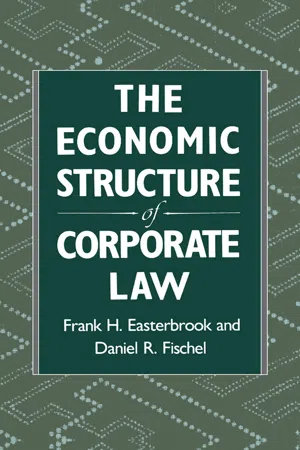
The Economic Structure of Corporate Law
- 366 pages
- English
- ePUB (mobile friendly)
- Available on iOS & Android
eBook - ePub
The Economic Structure of Corporate Law
About this book
The authors argue that the rules and practices of corporate law mimic contractual provisions that parties would reach if they bargained about every contingency at zero cost and flawlessly enforced their agreements. But bargaining and enforcement are costly, and corporate law provides the rules and an enforcement mechanism that govern relations among those who commit their capital to such ventures. The authors work out the reasons for supposing that this is the exclusive function of corporate law and the implications of this perspective.
Information
Publisher
Harvard University PressYear
1996Print ISBN
9780674235397
9780674235380
eBook ISBN
9780674253834
1

The Corporate Contract
For a long time public and academic discussion of corporations has started from the premise that managers have “control” and use this to exploit investors, customers, or both. The usual prescription is some form of intervention by the government. This may mean prescription of the firm’s output, wages, and prices. It may be regulation of the securities markets. It may take the form of corporate law, which establishes minimum voting rules and restricts how managers can treat the firm and the investors.
The argument is simple. In most substantial corporations—firms with investment instruments that are freely traded, which we call “public corporations”—each investor has a small stake compared with the size of the venture. The investor is therefore “powerless.” The managers, by contrast, know how the business is running and can conceal from investors information about the firm and their own activities. Armed with private knowledge and able to keep investors in the dark, the managers can divert income to themselves, stealing and mismanaging at the same time. Diversion and sloth may not be obvious, but they exist. Even when they do not, the potential for misconduct remains. Only some form of regulation can protect investors. And the limit on regulation is to be found not in principles of free contracting—for the corporate charter is at best a contract of adhesion by which the managers call all the shots—but in a concern that regulation not go “too far.” Thus in the debate about whether public corporations should be permitted to issue nonvoting stock, most people assume that nonvoting stock is bad because it insulates the managers further from investors’ control, and the only question is whether an outright ban (as opposed to severe regulation) would restrict “too much” the ability of firms to raise capital.
Although the language of regulation is everywhere, corporate law has developed along a different path. The corporate code in almost every state is an “enabling” statute. An enabling statute allows managers and investors to write their own tickets, to establish systems of governance without substantive scrutiny from a regulator. The handiwork of managers is final in all but exceptional or trivial instances. Courts apply the “business judgment rule,” a hands-off approach that judges would not dream of applying to the decisions of administrative agencies. Yet administrative officials do not stand to profit from their decisions—and therefore, one might think, are not subject to the pressures that cause managers’ goals to diverge from those of investors. So courts ride herd on disinterested administrators while leaving self-interested managers alone. What can be going on?
Consider the domain of managers’ choice. The founders and managers of a firm choose whether to organize as a corporation, trust, partnership, mutual, or cooperative (a form of ownership by customers). They choose what the firm will make or do and whether it will operate for profit, not for profit, or hold a middle ground, pursuing profit but not to the exclusion of some other objective (as publishers of newspapers do). They choose whether to allow the public to invest or whether, instead, the firm will be closely held. They choose what kinds of claims (debt, equity, warrants) to issue, in what ratios, for what price, with what entitlements: not only the right to receive payments (how often, in what amounts) but also whether these investments allow their holders to vote—and if to vote, how many votes, and on what subjects. They choose where to incorporate (states have different legal rules). They choose how the firm will be organized (as a pyramidal hierarchy or a loose, multidivisional collective), whether central leadership will be strong or weak, and whether the firm will grow (internally or by merger) or shrink (by selling existing assets or spinning off divisions). Investors select the members of the board of directors, who may be “inside” (part of the management team) or “outside” (often associated with investors, suppliers, or customers), and the board decides who exercises which powers on the firm’s behalf. As a practical matter boards are self-perpetuating until investors become dissatisfied and a majority decides to redo everything to a new taste. With trivial exceptions all business decisions—including the managers’ pay, bonuses, stock options, pensions, and perquisites—are taken by or under the supervision of this board, with no substantial inquiry by anyone else. Anyone who asks a court to inquire will be brushed off with a reference to the business judgment rule.
Some things are off-limits. States almost uniformly forbid perpetual directorships (persons who cannot be displaced by holders of a majority of the voting power). They set quorum rules (on critical decisions, a third of the board and sometimes half of the investors must participate) and require “major” transactions to be presented to the board (occasionally shareholders too) rather than stand approved by managers or a committee. States also forbid the sale of votes divorced from the investment interest and the accumulation of votes in a corporate treasury (that is, boards cannot perpetuate themselves by voting “treasury shares” or by cross-holding shares of related corporations). They require managers to serve equity investors’ interests loyally. Federal law requires firms to reveal certain things when they issue securities, and public firms must make annual disclosures.
Determined investors and managers can get ’round many of these rules, but the mechanisms for doing so are sidelights. Any theory of corporate law must account for the mandatory as well as the enabling features, and must account for the pattern of regulation—one that leaves managers effectively free to set their own salaries yet forbids them to delegate certain questions to subcommittees, that gives shareholders no entitlement to dividends or distributions of any kind but specifies a quorum of one-third of the board for certain decisions. We attend to that task throughout this book. For now it is enough to know that what is open to free choice is far more important to the daily operation of the firm, and to investors’ welfare, than what the law prescribes. Restraints on contracts are common (for example, occupational safety laws limit the risks employees may agree to accept), but few of these concern corporate organization.
Why does corporate law allow managers to set the terms under which they will administer corporate assets? Why do courts grant more discretion to self-interested managers than to disinterested regulators? Why do investors entrust such stupendous sums to managers whose acts are essentially unconstrained by legal rules? We offer answers to these questions, explanations of the economic structure of corporate law.
The Dynamic Shaping of the Corporate Form
The view you take of corporations and corporate law is apt to depend on your assumptions about how investors, employees, and other players come to be associated in a venture. You are likely to be driven to a regulatory view of corporations if you assume that corporations are born with a complement of managers, employees, and investors, in which managers have complete control of the corporation and investors are powerless. But corporations do not arise by spontaneous generation. Managers assume their roles with knowledge of the consequences. Investors part with their money willingly, putting dollars in equities instead of bonds or banks or land or gold because they believe the returns of equities more attractive. Managers obtain their positions after much trouble and toil, competing against others who wanted them. All interested persons participate. Firms begin small and grow. They must attract customers and investors by promising and delivering what those people value. Corporations that do not do so will not survive. When people observe that firms are very large in relation to single investors, they observe the product of success in satisfying investors and customers.
How is it that managers came to control such resources? It is no secret that scattered shareholders cannot control managers directly. If the investors know that the managers have lots of discretion, why did they fork over their money in the first place? If managers promise to return but a pittance, the investors will not put up very much capital. Investors simply pay less for the paper the firms issue. There is therefore a limit on managers’ efforts to enrich themselves at investors’ expense. Managers may do their best to take advantage of their investors, but they find that the dynamics of the market drive them to act as if they had investors’ interests at heart. It is almost as if there were an invisible hand.
The corporation and its securities are products in financial markets to as great an extent as the sewing machines or other things the firm makes. Just as the founders of a firm have incentives to make the kinds of sewing machines people want to buy, they have incentives to create the kind of firm, governance structure, and securities the customers in capital markets want. The founders of the firm will find it profitable to establish the governance structure that is most beneficial to investors, net of the costs of maintaining the structure. People who seek resources to control will have to deliver more returns to investors. Those who promise the highest returns—and make the promises binding, hence believable—will obtain the largest investments.
The first question facing entrepreneurs is what promises to make, and the second is how to induce investors to believe them. Empty promises are worthless promises. Answering the first question depends on finding ways to reduce the effects of divergent interests; answering the second depends on finding legal and automatic enforcement devices. The more automatic the enforcement, the more investors will believe the promises.
What promises will the entrepreneurs make in order to induce investors to hand over more money? No set of promises is right for all firms at all times. No one thinks that the governance structure used for a neighborhood restaurant will work well for Exxon or Hydro Quebec. The best structure cannot be derived from theory; it must be developed by experience. We should be skeptical of claims that any one structure—or even a class of structures—is best. But we can see the sorts of promises that are likely to emerge in the competition for investments.
Some promises entail submitting to scrutiny in advance of action. Outside directors watch inside ones; inside directors watch other managers; the managers hire detectives to watch the employees or set up cross-check systems so that employees possess little ability to act independently. At other times, though, prior monitoring may be too costly in relation to its benefits, and the most desirable methods of control will rest on deterrence, on letting people act as they wish but penalizing mistakes and misdeeds. Fiduciary obligations and litigation are forms of subsequent settling-up included among these kinds of devices. Still other methods operate automatically. Managers enjoy hefty salaries and perquisites of office; the threat of losing these induces managers to act in investors’ interest.
Managers in the United States must select the place of incorporation. The fifty states offer different menus of devices (from voting by shareholders to fiduciary rules to derivative litigation) for the protection of investors. The managers who pick the state of incorporation that is most desirable from the perspective of investors will attract the most money. The states that select the best combination of rules will attract the most corporate investment (and therefore increase their tax collections). So states compete to offer—and managers to use—beneficial sets of legal rules. These include not only rules about governance structures but also fiduciary rules and prohibitions of fraud.
Managers decide when to go public. Less experienced entrepreneurs start with venture capital, which comes with extensive strings. The venture capitalists control the operation of the firm with some care. Only after the managerial team and structure has matured will the firm issue public securities. Although the entrepreneurs commonly keep majority control on the initial public sale, they remain bound by contracts with venture capitalists that tie continuation of control to continuation of success. Eventually the entrepreneurs sell working control, and venture capitalists withdraw. The firm has become public in fact as well as in name.
Entrepreneurs make promises in the articles of incorporation and the securities they issue when they go public. The debt investors receive exceptionally detailed promises in indentures. These promises concern the riskiness of the firm’s operations, the extent to which earnings may be paid out, and the domain of managerial discretion. These promises benefit equity investors as well as debt investors. The equity investors usually receive votes rather than explicit promises. Votes make it possible for the investors to replace the managers. (Those who believe that managers have unchecked control should ask themselves why the organizers of a firm issue equity claims that enable the investors to replace the managers.) The managers also promise, explicitly or otherwise, to abide by the standards of “fair dealing” embedded in the fiduciary rules of corporate law. Sometimes they make additional promises as well.
To sum up: self-interested entrepreneurs and managers, just like other investors, are driven to find the devices most likely to maximize net profits. If they do not, they pay for their mistakes because they receive lower prices for corporate paper. Any one firm may deviate from the optimal measures. Over tens of years and thousands of firms, though, tendencies emerge. The firms and managers that make the choices investors prefer will prosper relative to others. Because the choices do not impose costs on strangers to the contracts, what is optimal for the firms and investors is optimal for society. We can learn a great deal just by observing which devices are widely used and which are not.
It is important to distinguish between isolated transactions and governance structures. There are high costs of operating capital and managerial markets, just as there are high costs of other methods of dealing with the divergence of interest. It is inevitable that a substantial amount of undesirable slack or self-dealing will occur. The question is whether these costs can be cut by mechanisms that are not themselves more costly. Investors, like all of us in our daily lives, accept some unwelcome conduct because the costs of the remedy are even greater. We also use deterrence (say, the threat of punishment for fraud) rather than other forms of legal control when deterrence is the least costly method of handling a problem, which it generally is. The expensive legal system is not cranked up unless there is evidence of wrongdoing; if the anticipated penalty (the sanction multiplied by the probability of its application) is selected well, there will not be much wrongdoing, and the costs of the system will be correspondingly small. A regulatory system (one entailing scrutiny and approval in advance in each case) ensures that the costs of control will be high; they will be incurred even if the risk is small.
Markets that let particular episodes of wrongdoing slide by, or legal systems that use deterrence rather than regulatory supervision to handle the costs of management, are likely to be effective in making judgments about optimal governance structures. Governance structures are open and notorious, unlike the conduct they seek to control. Costs of knowing about a firm’s governance are low. Firms and teams of managers can compete with each other over the decades to design governance structures and to build in penalties for malfeasance. There is no substantial impediment to the operation of the competitive process at the level of structure. The pressures that operate in the long run are exactly the forces that shape structure. Contractual promises and fiduciary rules arise as a result of these considerations.
Before tackling particular topics such as limited liability and takeovers, however, it is useful to step back and ask whether corporation-as-contract is a satisfying way of looking at things even in theory. No one portrays the relation between trustee and beneficiary as one of arm’s-length contracting, and legal rules impose many restrictions that the trustee cannot avoid. Why think about corporations differently?
Markets, Firms, and Corporations
“Markets” are economic interactions among people dealing as strangers and seeking personal advantage. The extended conflict among selfish people produces prices that allocate resources to their best uses. This is an old story, and Adam Smith’s The Wealth of Nations (1776) remains the best exposition. A series of short-term dealings in a market may be more useful for trading than for producing goods, however. The firm—an aggregation of people banded together for a longer period—permits greater use of specialization. People can organize as teams with the functions of each member identified, so that each member’s specialization makes the team as a whole more productive than it would otherwise be.
Teams could be assembled every day, the way stevedore contractors hire longshore workers. The construction industry assembles teams by the project. More often, however, the value of a long-term relation among team members predominates, and to the extent it does recognizable firms grow. Yet as the size of a firm grows, there must be more and more transactions among members. A manufacturer of cars that makes its own paint must decide how much paint to use, and of what quality. Does it make sense to make the paint job a little less durable? This depends on the value of the paint the firm uses—and on whether someone else could provide the paint for less.
An integrated firm has difficulty assessing the value of the paint it makes for itself. It must take expensive steps to give the paint a value (called a “transfer price”), which at best duplicates information that markets produce and at worst may be quite inaccurate, leading the firm to make inefficient decisions. Managers may specify transfer prices that lead firms to produce paint they should have bought, or to use too much or too little paint in their products. Transacting for paint in markets has risks (will the seller deliver on time? will the quality be good?) that are costly to deal with. Letters of credit, the courts, organized exchanges and credit bureaus, and other institutions are among the costs of markets. The firm grows until the costs of organizing production internally exceed the costs of organizing through market transactions.
One cost of cooperative production inside the firm is the divergence of interest among the participants. It is sometimes useful to think of the atoms dealing in markets as individual people who reap the gains and bear the expenses of their own decisions. The organization of production in teams is not so simple. The firm may hire labor by the hour (“hourly employees”) or the year (“salaried employees”); either arrangement hires a segment of time but not a specified effort. It is difficult to induce the employee to devote his best effort to the firm’s fortunes. Why should he? His pay is the same no matter his performance. Although it may be possible to penalize sluggards by reducing their wages or firing them (a process sometimes called “ex post settling-up”), it is costly to monitor effort—and who monitors the monitors’ efforts? On top of that, it is often very difficult to determine the quality of the work performed. A team of designers may put together an excellent airplane (the Lockheed L-1011 comes to mind) that fails in the market either for reasons beyond their control or because it was “too good” and so too costly. A system of monitoring that asked only whether the employees’ work was profitable for the firm would lead to inaccurate rewards when there are risks beyond the control of the employees or knowledge beyond the reach of the monitors. Unless someone knows the quality of each person’s work in relation to the demand, settling-up must be imperfect. Given that accounts may be settled well after the work has been performed, the time value of money sometimes will...
Table of contents
- Cover
- Title
- Copyright
- Contents
- 1. The Corporate Contract
- 2. Limited Liability
- 3. Voting
- 4. The Fiduciary Principle, the Business Judgment Rule, and the Derivative Suit
- 5. Corporate Control Transactions
- 6. The Appraisal Remedy
- 7. Tender Offers
- 8. The Incorporation Debate and State Antitakeover Statutes
- 9. Close Corporations
- 10. Trading on Inside Information
- 11. Mandatory Disclosure
- 12. Optimal Damages
- Acknowledgments
- Case Index
- Author Index
- General Index
Trusted by 375,005 students
Access to over 1.5 million titles for a fair monthly price.
Study more efficiently using our study tools.
Frequently asked questions
Yes, you can cancel anytime from the Subscription tab in your account settings on the Perlego website. Your subscription will stay active until the end of your current billing period. Learn how to cancel your subscription
No, books cannot be downloaded as external files, such as PDFs, for use outside of Perlego. However, you can download books within the Perlego app for offline reading on mobile or tablet. Learn how to download books offline
Perlego offers two plans: Essential and Complete
- Essential is ideal for learners and professionals who enjoy exploring a wide range of subjects. Access the Essential Library with 800,000+ trusted titles and best-sellers across business, personal growth, and the humanities. Includes unlimited reading time and Standard Read Aloud voice.
- Complete: Perfect for advanced learners and researchers needing full, unrestricted access. Unlock 1.5M+ books across hundreds of subjects, including academic and specialized titles. The Complete Plan also includes advanced features like Premium Read Aloud and Research Assistant.
We are an online textbook subscription service, where you can get access to an entire online library for less than the price of a single book per month. With over 1.5 million books across 990+ topics, we’ve got you covered! Learn about our mission
Look out for the read-aloud symbol on your next book to see if you can listen to it. The read-aloud tool reads text aloud for you, highlighting the text as it is being read. You can pause it, speed it up and slow it down. Learn more about Read Aloud
Yes! You can use the Perlego app on both iOS and Android devices to read anytime, anywhere — even offline. Perfect for commutes or when you’re on the go.
Please note we cannot support devices running on iOS 13 and Android 7 or earlier. Learn more about using the app
Please note we cannot support devices running on iOS 13 and Android 7 or earlier. Learn more about using the app
Yes, you can access The Economic Structure of Corporate Law by Frank H. Easterbrook,Daniel R. Fischel,Frank; Daniel R. Easterbrook; Fischel in PDF and/or ePUB format, as well as other popular books in Law & Law Theory & Practice. We have over 1.5 million books available in our catalogue for you to explore.