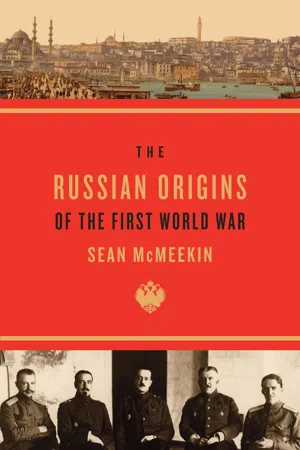
The catastrophe of the First World War, and the destruction, revolution, and enduring hostilities it wrought, make the issue of its origins a perennial puzzle. Since World War II, Germany has been viewed as the primary culprit. Now, in a major reinterpretation of the conflict, Sean McMeekin rejects the standard notions of the war's beginning as either a Germano-Austrian preemptive strike or a "tragedy of miscalculation." Instead, he proposes that the key to the outbreak of violence lies in St. Petersburg.
It was Russian statesmen who unleashed the war through conscious policy decisions based on imperial ambitions in the Near East. Unlike their civilian counterparts in Berlin, who would have preferred to localize the Austro-Serbian conflict, Russian leaders desired a more general war so long as British participation was assured. The war of 1914 was launched at a propitious moment for harnessing the might of Britain and France to neutralize the German threat to Russia's goal: partitioning the Ottoman Empire to ensure control of the Straits between the Black Sea and the Mediterranean.
Nearly a century has passed since the guns fell silent on the western front. But in the lands of the former Ottoman Empire, World War I smolders still. Sunnis and Shiites, Arabs and Jews, and other regional antagonists continue fighting over the last scraps of the Ottoman inheritance. As we seek to make sense of these conflicts, McMeekin's powerful exposé of Russia's aims in the First World War will illuminate our understanding of the twentieth century.
- 324 pages
- English
- ePUB (mobile friendly)
- Available on iOS & Android
eBook - ePub
The Russian Origins of the First World War
About this book
Information
CHAPTER ONE
The Strategic Imperative in 1914
Everywhere you feel the fear of something threatening; something dangerous and repulsive is imminent, a consciousness of an approaching catastrophe. All feel it, including those who are preparing it.
—F. A. Rodichev, May 19141
The road to Constantinople runs through Warsaw.
—E.N.Trubetskoi2
The shortest and safest operational route to Constantinople runs through Vienna ... and Berlin.
—Quartermaster-General Yuri Danilov3
IF THERE IS a dominant cliché in current thinking about the outbreak of World War I, it is German fear of the “Russian steamroller.” Chancellor Theobald von Bethmann Hollweg’s anxiety about the growth of Russian power is amply confirmed in both his correspondence and in the Riezler diaries, in which he is overheard muttering, “Russia grows and grows. She lies on us like a nightmare.” From the raw data, it is easy to see why policymakers in Berlin felt time was not on their side: Russia’s population had grown by forty million since just 1900, and was approaching 200 million to Germany’s sixty-five. By the time the Great Program was complete in 1917–1918, Russia’s peacetime army (already Europe’s largest in 1914, at 1.42 million) would number 2.2 million soldiers, or roughly triple the size of Germany’s.4 Russia’s economy, although still only fifth-largest in the world (behind Britain, France, Germany, and the United States) was growing at a “developing economy” rate of nearly 10 percent annually, rather like China’s is today. Measured in output of coal, iron, and steel, Russia was already fourth (having passed France) and inching up inexorably to first rank. Just looking at a map was enough to induce terror in Russia’s neighbors: according to a famous calculation the Romanov Empire had grown by fifty-five square miles a day—20,000 a year —since 1683, primarily west, south, and southeast. It was not hard to extrapolate forward a geopolitical map on which Russian territory included half of China, Afghanistan, northern Persia, Anatolia, Constantinople and the Straits, Austrian Galicia, and Eastern Prussia.
Like all clichés, this one rests on a kernel of truth. Russia’s population, economy, and her military strength were increasing in size each year. Bethmann Hollweg, an intelligent and well-traveled man, was not paranoid: he had visited Russia himself in July 1912 and witnessed her growing industrial might firsthand. In an era when military budgets were—even in autocratic Russia—subject to parliamentary and public scrutiny, it was easy to compare the strengths of European armies. The size of the Imperial Russian Army in 1914 and its basic mobilization timetable was no secret, although whether or not Russia really could mobilize as fast as her generals claimed was an open question.5 Nor were the implications of the Great Program enacted in 1913 secret: by 1917, Russia would theoretically be able to mobilize roughly one hundred divisions for battle within eighteen days of mobilization, only “three days behind Germany in overall readiness.”6 In strictly military terms, one can see why German military planners concluded Russia would be easier to beat in 1914 than three or four years later.
International relations, however, are not conducted in a vacuum. As Russian policymakers knew perhaps better than their western European counterparts, what matters in geopolitics is not the absolute growth in one country’s demographic, economic, or military power, but its relative growth compared to other powers.7 And here the Russian steamroller cliché begins losing plausibility. There was just one European power that had prodigiously increased in strength vis-à-vis all its rivals in the previous half-century, and it was certainly not Imperial Russia, which had lost two major conflicts (the Crimean War of 1853–1856, and the Russo-Japanese War of 1904–1905) and won a conspicuously hollow victory in a third (the Russo-Turkish War of 1877–1878, in which Petersburg’s gains were largely nullified by Bismarck and Disraeli at the Congress of Berlin). Had not the Franco-Prussian War of 1870–1871 heralded a new geopolitical era, with Germany decisively passing France as the greatest military power in Europe—a development that led the Russian General Staff to convene an unprecedented “strategic conference” in 1873 designed to produce a plan for preserving the Romanov Empire against the German threat?8 Were not the German use of railways and the near-universal literacy in the ranks of the Prussian army both revolutionary developments in military effectiveness—developments that had not only embarrassed France but made Imperial Russia (with her paltry rail network and a literacy rate of 30 percent as late as 1913) look positively outdated? Had not the German economy exploded in size since the 1880s, surpassing even Britain’s, to trail only continent-sized America? Did not German heavy industry dwarf that of her eastern rival, with—despite the latter’s three-to-one edge in population—her production of coal still nearly ten times that of Russia, and her annual output of coal and pig iron four times as great?9 Were not the Germans now world leaders in everything from pharmaceuticals to automotive technology to—perhaps more significantly—evermore destructive explosives and ever-more accurate (and longer range, and larger caliber) artillery? The words Krupp and Skoda alone were enough to terrify infantrymen who might have to face Germans. Fear of the growth of Russian power? Judging by the outcome of the war on the eastern front between 1914 and 1917, the growth of German power would seem to have been the more plausible nightmare.

The “growth of German power” was no less visible on the diplomatic playing field, at least as perceived in Petersburg. Bethmann Hollweg and his diplomats may have felt that they had been dealt a series of defeats at the hands of France and England (most recently following the Agadir incident of 1911, when, as the chancellor lamented, in return for acquiescing in French domination of Morocco, the Germans had received “an immense number of square miles of tropical marshes” in the middle of Africa).10 But these should have been balanced out by clear German victories over Petersburg, such as the Russian climb-down over Austria’s 1908 annexation of Bosnia (enforced by an unsubtle German threat in March 1909), and more recently the Liman von Sanders affair of winter 1913–1914. Liman von Sanders, a German officer appointed to command the Turkish army corps defending the Straits, had ultimately been allowed to stay on (at an elevated rank which rendered Liman “overqualified” to command a single Turkish army corps) despite a passionate protest from the Russians. The Russians, for their part, felt they had suffered through a series of diplomatic debacles since the humiliating military defeat in the Russo-Japanese War—the Bosnian annexation, the Balkan wars (from which Russia herself had gained nothing tangible, despite the gains of nominal proxies like Serbia), and the Liman affair—but with no compensating victories to cushion the defeats.
Of course, diplomatic gains and losses could be a matter of interpretation. In a seeming paradox, many politicians in both Berlin and Petersburg felt that they had lost in the Liman affair, for example, while Russia and Austria-Hungary were almost equally frustrated over the muddled outcome of the Balkan wars. To some extent, the perception that one was losing ground was chronic in the classical era of great power diplomacy, when crises were usually evaluated in zero-sum terms. Diplomats everywhere were supremely sensitive to the slightest slip in their country’s status, which might imply a victory for rival diplomats (even if these rivals believed themselves to have lost).
The sense of losing ground, however, was felt more by some powers than by others. France and Britain both ruled over fairly stable, far-flung colonial empires acquired gradually over several centuries, to which the only real neighboring rivals (aside from each other) tended to be decaying imperial has-beens like Spain and Portugal, or lesser powers such as Belgium. Neither Paris nor London had a real strategic interest in the Balkans, scene of the most serious diplomatic crises of the past half-decade. The Eastern Question—the struggle to manage the collapse of the Ottoman Empire, which all powers expected to be imminent—was for neither France nor England terribly urgent. London had long since wrested control of Ottoman Egypt and the Suez Canal, which together formed the linchpin of British global communications. In June 1914, Britain signed an agreement with the Porte that divided the Arabian Peninsula into Ottoman and British spheres of influence, with the latter including the entire southern coastal area between Aden and Qatar. London had little further interest in Asiatic Turkey besides the quiet economic penetration of Mesopotamia and southern Arabia. Some French imperialists, it is true, did look on Syria and Lebanon with greedy eyes, but Parisian capital was already so dominant in the Ottoman Empire that the absorption of the Levant into the French sphere of influence seemed to be only a matter of time. In terms of imperial prestige and the basic state of the game, Britain and France were essentially “status quo” powers in 1914, with their imperial appetites largely sated.
Berlin and Petersburg, by contrast, were both heavily invested in the Eastern Question and knee deep in the Balkans (even if, in the case of Germany and the Balkans, mostly at second remove via Austria-Hungary). Neither the Germans nor the Russians were anywhere near satisfied in terms of imperial appetite, nor feeling particularly secure in their current positions. The ambitions of pan-Germanists—largely shared by Bethmann Hollweg, the General Staff, and the Wilhelmstrasse—to dominate “Mitteleuropa” and “Mittelafrika,” along with Asiatic Turkey, are well known.11 Much less well known are the goals of Russian imperialists of the time, but they were, in their way, just as ambitious. Since the Russo-Japanese War, Petersburg had made surprising gains in the Far East, with Japanese recognition of Russian supremacy in northern Manchuria in 1912, China reluctantly granting autonomy to Mongolia under strong Russian pressure the same year, and the British consenting to Russian administrative oversight in Harbin in 1914. London also agreed to cede to Petersburg a “zone of influence” north of the Hindu Kush in Afghanistan.12 Meanwhile, Russia’s imperial penetration of northern Persia was rapidly creating a fait accompli on the ground: Russian settlers and syndicates had already acquired title to three-quarters of the arable land in “Persian Azerbaijan,” thanks to judges installed by Russian diplomats already behaving as imperial pro-consuls.13 The Armenian reform campaign of 1913–1914, which alarmed both the Porte and Berlin, was a scarcely disguised Trojan horse for the expansion of Russian influence in Turkish Anatolia. Finally, Russian plans for seizing Constantinople and the Straits were well advanced and universally supported by policymakers by 1914, even if the Black Sea fleet was not yet strong enough to carry them out.
Just as German and Russian ambitions were roughly matched in terms of scale, so, too, were the fears of policymakers on each side that these ambitions would be sundered by a coalition of hostile powers. Kaiser Wilhelm II, Bethmann Hollweg, and the German generals famously, and by no means unjustifiably, complained of “encirclement,” the sense of feeling ringed in by hostile powers (England, France, and Russia). Less well known, although just as significant, was the fear of encirclement felt in Petersburg. If anything, the Russians had a better case than the Germans to complain of Einkreisung: the Romanov Empire’s long and ragged borders butted up against no less than five powers, either actively hostile (Germany, Austria-Hungary, Ottoman Turkey), recently hostile (Japan), or certain to be hostile if she ever got her act together (China). This was not even to count the Raj—British India had, of course, been Russia’s principal strategic antagonist ever since the Napoleonic Wars, and, if Delhi instead of London were driving British policy, would have remained hostile still. Even while negotiations were underway in spring 1914 to forge a closer strategic relationship between London and Petersburg, flare-ups of the old antagonism continued, especially in Persia, where the cynical Accord of 1907 had never really been taken to heart among British and Russian officials on the ground. As the July crisis deepened, French diplomats were terrified that Russia’s ongoing land grab in northern Persia would ruin the fragile accord between London and Petersburg just when Paris needed it the most.14
It is only when we sense the fragility of Russia’s strategic position in 1914 that we can begin to make sense of her behavior during the July crisis. As Lord Durham, an unusually level-headed British ambassador to Petersburg, had once observed at the height of Great Game tensions, “the power of Russia has been greatly exaggerated. There is not one element of strength which is not directly counterbalanced by a corresponding ... weakness.”15 Durham’s was and remained a minority opinion among British policymakers, who tended to overestimate Russia’s strengths both when they were anxious for India’s defense and when they were hoping to unleash her “Slavic hordes” against Germany.a The very size and extent of the Romanov Empire meant that her borders were well-nigh impossible to defend. Russia’s seemingly inexorable imperial expansion into Central Asia in the 1860s and 1870s, which led Russophobes in London to believe that some grand design was afoot targeting India, had in fact been propelled largely by the self-perpetuating strategic problem of border insecurity. “Every time a tribe was pacified,” as one military analyst observed, “Russia was exposed to attack from the peoples who lived on the other side of the frontier cordon.”16
Russia’s more recent imperial expansion into eastern Turkey and northern Persia had reproduced the same strategic conundrum, as new enemies appeared on the frontier to replace those already incorporated inside the borders of the empire. The years before 1914 saw one crisis after another erupt on Russia’s southern borderlands, with an ever-changing array of antagonists: now Kurdish depredations against Armenians and other Russia-friendly Christians, now Ottoman raids across the frontier of “Russian Persia” in pursuit of pro-Russian Kurdish tribesmen, now unrest among Russia’s own Caucasian Muslims, part...
Table of contents
- Cover
- Title
- Copyright
- Contents
- Maps
- Abbreviations
- Author’s Note
- Introduction: History from the Deep Freeze
- 1. The Strategic Imperative in 1914
- 2. It Takes Two to Tango: The July Crisis
- 3. Russia’s War: The Opening Round
- 4. Turkey’s Turn
- 5. The Russians and Gallipoli
- 6. Russia and the Armenians
- 7. The Russians in Persia
- 8. Partitioning the Ottoman Empire
- 9. 1917: The Tsarist Empire at Its Zenith
- Conclusion: The October Revolution and Historical Amnesia
- Notes
- Bibliography
- Acknowledgments
- Index
Trusted by 375,005 students
Access to over 1.5 million titles for a fair monthly price.
Study more efficiently using our study tools.
Frequently asked questions
Yes, you can cancel anytime from the Subscription tab in your account settings on the Perlego website. Your subscription will stay active until the end of your current billing period. Learn how to cancel your subscription
No, books cannot be downloaded as external files, such as PDFs, for use outside of Perlego. However, you can download books within the Perlego app for offline reading on mobile or tablet. Learn how to download books offline
Perlego offers two plans: Essential and Complete
- Essential is ideal for learners and professionals who enjoy exploring a wide range of subjects. Access the Essential Library with 800,000+ trusted titles and best-sellers across business, personal growth, and the humanities. Includes unlimited reading time and Standard Read Aloud voice.
- Complete: Perfect for advanced learners and researchers needing full, unrestricted access. Unlock 1.5M+ books across hundreds of subjects, including academic and specialized titles. The Complete Plan also includes advanced features like Premium Read Aloud and Research Assistant.
We are an online textbook subscription service, where you can get access to an entire online library for less than the price of a single book per month. With over 1.5 million books across 990+ topics, we’ve got you covered! Learn about our mission
Look out for the read-aloud symbol on your next book to see if you can listen to it. The read-aloud tool reads text aloud for you, highlighting the text as it is being read. You can pause it, speed it up and slow it down. Learn more about Read Aloud
Yes! You can use the Perlego app on both iOS and Android devices to read anytime, anywhere — even offline. Perfect for commutes or when you’re on the go.
Please note we cannot support devices running on iOS 13 and Android 7 or earlier. Learn more about using the app
Please note we cannot support devices running on iOS 13 and Android 7 or earlier. Learn more about using the app
Yes, you can access The Russian Origins of the First World War by Sean McMeekin in PDF and/or ePUB format, as well as other popular books in History & Russian History. We have over 1.5 million books available in our catalogue for you to explore.