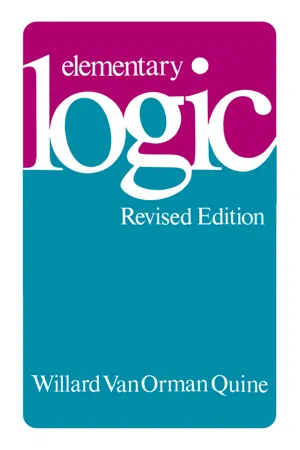
Much revised since its first appearance in 1941, Willard Van Orman Quine's Elementary Logic, despite its brevity, is notable for its scope and rigor. It provides a single strand of simple techniques for the central business of modern logic. Basic formal concepts are explained, the paraphrasing of words into symbols is treated at some length, and a testing procedure is given for truth-function logic along with a complete proof procedure for the logic of quantifiers.
Fully one third of this revised edition is new, and presents a nearly complete turnover in crucial techniques of testing and proving, some change of notation, and some updating of terminology. The study is intended primarily as a convenient encapsulation of minimum essentials, but concludes by giving brief glimpses of further matters.
- 129 pages
- English
- ePUB (mobile friendly)
- Available on iOS & Android
eBook - ePub
About this book
Information
Topic
PhilosophySubtopic
Logic in Philosophy§ 1. Introduction
THE SCOPE of the term ‘logic’ has varied widely from writer to writer through the centuries. But these varying scopes seem all to enclose a common part: the logic which is commonly described, vaguely, as the science of necessary inference. There is a growing tendency to limit the term ‘logic’ to this field; and it is in conformity with this tendency that the term is used in the present book.
A somewhat less vague characterization of the field is as follows. Certain basic locutions, to begin with, including ‘if’, ‘then’, ‘and’, ‘or’, ‘not’, ‘unless’, ‘some’, ‘all’, ‘every’, ‘any’, ‘it’, etc., may be called logical. They appear in statements on any and every subject. The pattern according to which the other more special ingredients of a statement are knit together by these basic locutions may be called the logical structure of the statement. For example, the statements:
(1) Every microbe is an animal or a vegetable,
(2) Every Genevan is a Calvinist or a Catholic,
have the same logical structure. Now logic studies the bearing of logical structure upon truth and falsehood.
A statement is logically true if it is true by virtue solely of its logical structure; i.e., if all other statements having that same structure are, regardless of their subject matter, likewise true. A simple example is:
Every microbe is either an animal or not an animal.
Two statements are logically equivalent if they agree in point of truth or falsehood by virtue solely of their logical structure; i.e., if no uniform revision of the extralogical ingredients of the statements is capable of making one of the statements true and one false. The statement:
If something is neither animal nor vegetable, it is not a microbe, for example, is logically equivalent to (1). One statement logically implies another if from the truth of the one we can infer the truth of the other by virtue solely of the logical structure of the two statements. The statement:
Every Genevan is a Calvinist,
thus, logically implies (2).
Logical truth, equivalence, and implication are not always as readily detected as they are in the case of the above examples. Even at the level of simplicity of these examples error may occasionally arise. We might be tempted, for example, to regard (1) as logically implying:
(3) Some animals are microbes,
whereas this idea can be seen to be wrong by changing ‘microbe’ to ‘azalea’ and observing that (1) remains true while (3) becomes false. Perhaps the reader was prevented by ordinary good sense from falling into this simple error; but he may be assured nevertheless that there are more and more complicated cases, without end, where logical truth and equivalence and implication are hidden from all men save those who have special techniques at their disposal. Logic is concerned with developing such techniques.
A partial development of logic, in this sense of the term, stems from Aristotle and has been known traditionally as ‘formal logic’. But the past century brought radical revisions of concepts and extensions of method; and in this way the confined and stereotyped formal logic of tradition has come to be succeeded by a vigorous new science of logic, far surpassing the old in scope and subtlety. The traditional formal logic is not repudiated, not refuted, but its work is done more efficiently by the new logic as an incidental part of a larger work.
Logic, in its modern form, may conveniently be treated as falling into three parts. In the theory of truth functions, first, we study just those logical structures which emerge in the construction of compound statements from simple statements by means of the particles ‘and’, ‘or’, ‘not’, ‘unless’, ‘if … then’, etc. In the theory of quantification, next, we study more complex structures, wherein the aforementioned particles are mingled with generalizing particles such as ‘all’, ‘any’, ‘some’, ‘none’. In the theory of membership, finally, we turn to certain special structures involved in discourse about universals, or abstract objects. This trichotomy afforded the basic plan of my larger work Mathematical Logic.
But there is equal justice in an alternative classification, whereby logic proper is taken as comprising just the first two of those three parts, while the theory of membership is placed outside logic and regarded as the basic extralogical branch of mathematics.1 Whether we construe ‘logic’ in the tripartite way or in this narrower bipartite way is a question merely of how far we choose to extend the catalogue of ‘logical locutions’ alluded to earlier. According to the wider version, logic comes to include mathematics;2 according to the narrower version, a boundary survives between logic and mathematics at a place which fits pretty well with traditional usages.
The scope of the present book, in any case, is substantially those first two parts—truth functions and quantification. This bipartite province may be called ‘elementary logic’ or simply ‘logic’ at the reader’s discretion. Far narrower than logic in the tripartite sense of Mathematical Logic, it stops short of all topics of a distinctly mathematical flavor; it adheres to matters which no one would hesitate to classify as logical. Still it far outruns the traditional formal logic.
The matters here treated are subject not only to the described dichotomy between statement composition and quantification, but also to a second dichotomy of another sort which runs across the first. For, antecedent to the task of investigating isolated logical structures in their relation to truth and falsehood, logic has also the task of isolating those structures. This is a task of analyzing ordinary statements, making implicit ingredients explicit, and reducing the wholes to systematically manipulable form. It is the interpretative task, as opposed to the calculative. The intersection of these two dichotomies divides the book into four chapters.
1 Cf. § 48; also Mathematical Logic, pp. 127-28. For this point of view I am indebted to Prof. Alfred Tarski.
2 Cf. Mathematical Logic, pp. 5, 126, 237-79.
I • STATEMENT COMPOSITION
§ 2. Truth Values
STATEMENTS ARE sentences, but not all sentences are statements. Statements comprise just those sentences which are true and those which are false. These two properties of statements, truth and falsity, are called truth values; thus the truth value of a statement is said to be truth or falsity according as the statement is true or false.
The sentences ‘What time is it?’, ‘Shut the door’, ‘Oh, that I were young again!’ etc., being neither true nor false, are not counted as statements. Only declarative sentences are statements. But closer examination reveals that by no means all declarative sentences are statements. The declarative sentence ‘I am ill’ is intrinsically neither true nor false; it may simultaneously be uttered as true by one person and as false by another. Similarly the sentence ‘He is ill’ is intrinsically neither true nor false, for the reference of ‘he’ varies with the context; in one context ‘He is ill’ might properly be uttered as true, and in another as false. Indeed, the sentence ‘Jones is ill’ presents the same difficulty; for in the absence of context it is not clear whether ‘Jones’ refers to Henry Jones of Lee St., Tulsa, or John J. Jones of Wenham, Mass. The sentence ‘It is drafty here’ may be simultaneously true for one speaker and false for a neighboring speaker; and ‘Tibet is remote’ is true in Boston and false in Darjeeling. The sentence ‘Spinach is good’, if uttered in the sense ‘I like spinach’ rather than ‘Spinach is vitaminous’, is true for a few speakers and false for the rest.
The words ‘I’, ‘he’, ‘Jones’, ‘here’, ‘remote’, and ‘good’ have the effect, in these examples, of allowing the truth value of a sentence to vary with the speaker or scene or context. Words which have this effect must be supplanted by unambiguous words or phrases before we can accept a declarative sentence as a statement. It is only under such revision that a sentence may, as a single sentence in its own right, be said to have a truth value.
Such adjustments suffice to prevent a statement from being simultaneously true in one mouth or context and false in another. Even after such adjustments have been made, however, the truth value of a statement would still seem frequently to vary with time. The sentence:
(1) Henry Jones of Lee St., Tulsa, is ill
is true at one time and false at another, concomitantly with Jones’s variations in health. Again The Nazis annexed Bohemia’ was false before 1939 and is now true, whereas ‘The Nazis will annex Bohemia’ was true before 1939 and is now false—unless that annexation is destined to be undone and repeated.
But logical analysis is facilitated by requiring rather that each statement be true once and for all or false once and for all, independently of time. This can be effected by rendering verbs tenseless and then resorting to explicit chronological descriptions when need arises for distinctions of time. The sentence ‘The Nazis will annex Bohemia’, uttered as true on May 9, 1936, corresponds to the statement ‘The Nazis annex [tenseless] Bohemia after May 9, 1936’; and this statement is true once and for all regardless of date of utterance. The shorter statement ‘The Nazis annex Bohemia’, construed tenselessly, affirms merely that there is at least one date, past, present, or future, on which such annexation takes place; and this statement again is true once and for all. The sentence (1) above, uttered as a tensed sentence on July 28, 1940, corresponds to the statement ‘Henry Jones of Lee St., Tulsa, is [tenseless] ill on July 28, 1940’; on the other hand, the statement (1), construed tenselessly, might be accounted true once and for all on the grounds that Jones has had or will have at least one illness in his life.
Whereas these refinements are important as a theoretical basis of analysis, it will be convenient in the practical construction of examples to use as statements such sentences as ‘Jones is ill’, or even ‘You will hear from me’. But we are to imagine, always, that each such sentence is expanded into one or another appropriate full statement. The methods of technical analysis will be fashioned in conformity with the understanding that a statement is a sentence which is uniformly true or uniformly false independently of context, speaker, and time and place of utterance.
By means of the connectives ‘and’, ‘or’, ‘if … then’, ‘neither … nor’, etc. we combine simple statements to form compound statements; and the truth value of the compound statement depends in one way or another upon the truth values of the components. The compound statement:
(2) Jones is ill and Smith is away,
for example, is true just in case both of the component statements ‘Jones is ill’ and ‘Smith is away’ are true. The compound:
(3) Neither is Jones ill nor is Smith away
is true just in case neither of the components is true. The compound:
(4) Jones is ill or Smith is away
is true just in case the one component or the other is true. There may also be various sorts of interdependence between the truth value of one compound and the truth value of another compound; it is obvious, for example, that the compounds (2) and (3) will not both be true, nor will (3) and (4).
By successive application of these...
Table of contents
- Cover
- Title
- Copyright
- Preface, 1980
- Preface to the Revised Edition
- Preface to the 1941 Edition
- Contents
- 1. Introduction
- I • Statement Composition
- II • Truth-Functional Transformations
- III • Quantification
- IV • Quantificational Inference
- Index
Trusted by 375,005 students
Access to over 1.5 million titles for a fair monthly price.
Study more efficiently using our study tools.
Frequently asked questions
Yes, you can cancel anytime from the Subscription tab in your account settings on the Perlego website. Your subscription will stay active until the end of your current billing period. Learn how to cancel your subscription
No, books cannot be downloaded as external files, such as PDFs, for use outside of Perlego. However, you can download books within the Perlego app for offline reading on mobile or tablet. Learn how to download books offline
Perlego offers two plans: Essential and Complete
- Essential is ideal for learners and professionals who enjoy exploring a wide range of subjects. Access the Essential Library with 800,000+ trusted titles and best-sellers across business, personal growth, and the humanities. Includes unlimited reading time and Standard Read Aloud voice.
- Complete: Perfect for advanced learners and researchers needing full, unrestricted access. Unlock 1.5M+ books across hundreds of subjects, including academic and specialized titles. The Complete Plan also includes advanced features like Premium Read Aloud and Research Assistant.
We are an online textbook subscription service, where you can get access to an entire online library for less than the price of a single book per month. With over 1.5 million books across 990+ topics, we’ve got you covered! Learn about our mission
Look out for the read-aloud symbol on your next book to see if you can listen to it. The read-aloud tool reads text aloud for you, highlighting the text as it is being read. You can pause it, speed it up and slow it down. Learn more about Read Aloud
Yes! You can use the Perlego app on both iOS and Android devices to read anytime, anywhere — even offline. Perfect for commutes or when you’re on the go.
Please note we cannot support devices running on iOS 13 and Android 7 or earlier. Learn more about using the app
Please note we cannot support devices running on iOS 13 and Android 7 or earlier. Learn more about using the app
Yes, you can access Elementary Logic by Willard Van Orman Quine,W. V. Quine in PDF and/or ePUB format, as well as other popular books in Philosophy & Logic in Philosophy. We have over 1.5 million books available in our catalogue for you to explore.