eBook - ePub
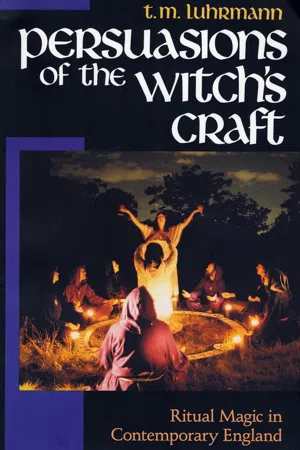
Persuasions of the Witch’s Craft
Ritual Magic in Contemporary England
- 382 pages
- English
- ePUB (mobile friendly)
- Available on iOS & Android
eBook - ePub
Persuasions of the Witch’s Craft
Ritual Magic in Contemporary England
About this book
To find out why reasonable people are drawn to the seemingly bizarre practices of magic and witchcraft, Tanya Luhrmann immersed herself in the secret lives of Londoners who call themselves magicians. She came to know them as friends and equals and was initiated into various covens and magical groups. She explains the process through which once-skeptical individuals—educated, middle-class people, frequently of high intelligence—become committed to the ideas behind witchcraft and find magical ritual so compellingly persuasive. This intriguing book draws some disturbing conclusions about the ambivalence of belief within modern urban society.
Information
Publisher
Harvard University PressYear
1991Print ISBN
9780674663244
9780674663237
eBook ISBN
9780674255500
PART I
Speaking with a different rhythm: magicians in the modern world
1
What makes magic reasonable?
WILLIAM has been witch, kabbalistic initiate and solitary magician. He was born into a prosperous English family between the two World Wars. He was an only child. His father died soon after he was born, and as a young boy he was raised by his mother and aunt. He remembers that it was a strict but loving household. Rather shy by nature, he seems to have led a conventional and retiring life, first in private schools and then at Cambridge. He graduated with a classics degree, and took a comfortable job in the Foreign Office in London.
In the sixties, when new therapies, values and lifestyles appeared like apples in the market, William came across a popular psychological technique for controlling one’s dreams and decided to experiment. For a while he went to sleep each night determined to ‘visit’, while dreaming, a friend he knew in a distant town. He always failed. One night, in the twilight between sleep and awareness, he heard a voice saying ‘sacrifice to Zeus’. He decided that this was a voice of guidance, possibly the voice of God, and that if he followed the instructions his dream experiments might work.
So William set off for Silbury Hill, to sacrifice to Zeus at dawn. Silbury Hill is an ancient mound near one of Britain’s most impressive stone circles. It is a drive of several hours from London. He arrived before dawn and clambered to the top of the grassy hill. To his pleasure, he lit the fire with the first match. He then sacrificed a steak. The Athenian divines traditionally were given meat. His classical education helped him with the invocation. When he got back to London he broke his fast – apart from the charred beef heart he had also sacrificed and eaten on the hill – and went to sleep, and dreamt that a sword was being forged for him with a blade the colours of the rainbow. The next night, he dreamt easily of visiting his friend. It was his first step into magic.
‘These people wholly worship the devil, and often times have conference with him, which appeareth unto them in most ugly and monstrous shape.’1 Something like an anthropology emerged in Hakluyt’s sixteenth-century collection of voyagers’ tales, rich with anecdotes of the spice and silk trade, of explorations of the torrid Americas and the frozen Russian wastelands, of poison-darting Native American Indians and guru-worshipping Indians. Savages fascinated early modern Europe, as counterpoint to an encrusted civilization. Lafitau and Rousseau were among many who saw in ‘natural man’ the way to understand and criticize themselves. Anthropology was fully born only later, in the colonial heyday of a society which needed to assimilate different cultures while maintaining its own hegemony.2 As a discipline it has progressed through many phases: grand theories of speculative evolution, attacks upon the complacency of biological determinism, sweeping attempts to understand the nature of Mind. In all these phases, anthropologists have focused on the distant and more primitive, and claimed that through their very exoticism, the near and apparently more complex might be better understood.
The world has changed for anthropology. The primitive societies are slowly vanishing, and the foreign governments have become more wary of inquisitive intruders. Ever more anthropologists are turning inward to study their own society. But they have tended to focus on the immediate problems of urban life: ethnicity, acculturation, religious revitalization. Few have continued to ask traditional anthropological questions, to look for the exotic and learn from it about the familiar. This study looks at ordinary middle-class English people who become immersed in a netherworld of magic and ritual, and asks a classic anthropological question: why do they practise magic when, according to observers, the magic doesn’t work?
In England several thousand people – possibly far more – practise magic as a serious activity, and as members of organized groups.3 They are not conjurors, hired to produce rabbits at children’s birthday parties. Their magic involves a ritual practice based upon ideas about strange forces and the powers of the mind. These are people who don long robes and perform rituals in which they invoke old gods to alter their present reality. They read tarot cards and cast astrological charts and may feel more holy on Beltane than on Good Friday. It would be incorrect to think of them as ‘only playing’ at their magic, or as joining their groups for the same social reasons that lead many people into Freemasonry. Many of them take this magic as both a religion and a pragmatic result-producing practice, and some of them have practised it regularly, in organized groups, for over a quarter of a century.
In the United States the number of participants is impressive. Adler’s reliable report of paganism in the United States – not quite the same thing as magic, but close4 – suggests that there may be 80,000 self-identified pagans or members of Wicca [modern witchcraft] in America.5 Starhawk’s Spiral Dance (1979), a manual for witches we shall encounter frequently in these pages, sold 50,000 copies between 1979 and 1985.6 1985 saw at least fifty major American festivals with a pagan focus, attended by hundreds or thousands of people. Some 40,000 people have taken part of a correspondence course offered by an organization called the Church and School of Wiccan.7 There are hundreds and hundreds of groups, stores, journals, and events.
To return to England, the focus of this book, these numbers scarcely indicate the wider popular sympathy. There, interest in the occult has ballooned during the last two decades. The largest mail order occult store, The Sorcerer’s Apprentice, has over 25,000 customers who have placed at least two orders with them over the last thirteen years. Many of these regular customers buy once a month; most, the proprietor said, buy at least once a year. The store turns over between 800 and 1000 items each week – books, magical robes, incenses – and employs ten people full time.8 Their catalogues advertise crystal balls and talismans the way other catalogues offer exercycles.
CANDLEMAGIC STARTER KIT: Code P132. Basic outfit introduces you to traditional candlemagic property. 12 × 8″ asstd. candles; candle-oil; 4 candleholders; tapers and book. Have all you need to get to grips with potent form of magic. 19 items! Book shows how to work a variety of candlemagic rituals.
WAX IMAGE DOLLS: Code P63. Cure sickness, capture love, heal and hate with image dolls. Made from traditional formulae incorporating natural wax, herbs. By making an image you can work magic on that person perpetually. 6″ male or female dolls supplied ready to be personalized. Doll prepared with all accumulators, herbs, essences, ready to go. Natural wax colour. Some shamans keep shelffuls of dolls to control all their acquaintances.9
Mysteries, the largest shop for occult items in London, also caters to the wider range of alternative, self-development, spiritualist interests. They opened in 1982; trade doubled every six months for several years, and they have expanded to three times their original quarters. They see two to three hundred customers a day.10 The Aquarian Press, a popular printing press committed to publishing magical material, some of it quite arcane,11 has so far published 10,000 copies of a beginner’s book on magic: Marian Green’s Magic for the Aquarian Age. The 1987 Quest List of Esoteric Sources cites some forty British suppliers of occult goods, and about a hundred British ‘esoteric’ magazines, journals and newsletters: for example, The Pictish Shaman, The Moonstone, The Cauldron. One of these magazines, Prediction, has a circulation of 32,000 and is sold by major newsagents. ‘By the quantitative indices of books published and organizations founded, there can be little doubt that public interest in the occult has grown rapidly since the mid-sixties.’12
The groups I am discussing are only part of the multifarious occult. Modern magic is a mixture of many different activities and ideas: paganism, astrology, mysticism, the range of alternative therapies, even kabbalism – a Jewish mysticism grafted onto Christian magical practice in the Renaissance. People practise as individuals or as members of groups which come and go in a fluctuating population, although some groups have stayed intact for decades. The groups are astonishingly diverse. But there is a working definition of the practices, or at least the ones I saw. Practitioners think of themselves as, or as inspired by, the witches, wizards, druids, kabbalists, shamans, of mostly European lore, and they perform rituals and create ritual groups in which they invoke ancient deities with symbols taken from Sir James Frazer, Thomas Bulfinch, E. Wallis Budge and Jessie Weston. They identify with the mystical religions of Eleusis, Orphism, Mithraism, even of Richard Rolle and Julian of Norwich. And they have two marked characteristics. First, they tolerate a surprising spiritual diversity. Central to the ethos is the notion that any path to a religion is a path to a spiritual reality, and whatever symbols and images one chooses are valid. Groups and their practices are creative, syncretic, their rites often an amalgam of Egyptian headress, Celtic invocation and Greek imagery. The only dogma, they say, is that there is no dogma, and feminist witches, kabbalistic Christians and neo-Nordic shamans socialize well together. Second, they practise what they call magic. They often describe themselves as magicians, perform what they call magical rites, and talk as if they expected those rites to have effects. Not all people involved in these groups would use the term ‘magic’ to explain their activities. I use the term as a convenient shorthand, because they all practice what most of them call magic, even if they do not immediately think of themselves as ‘magicians’ but as kabbalists, witches and the like.
While I am interested in the reasons behind the current ‘revival’ of witchcraft, or the explanation of why some people, rather than others, have become involved in practice, an even more interesting question concerns the process that allows people to accept outlandish, apparently irrational beliefs. ‘Belief’ is a difficult term, and I shall try to avoid it until the final chapters. But the question is how people come to make certain assertions and to act as if they were true. Magicians are ordinary, well-educated, usually middle-class people. They are not psychotically deluded, and they are not driven to practise by socio-economic desperation. By some process, when they get involved with magic – whatever the reasons that sparked their interest – they learn to find it eminently sensible. They learn to accept its core concept: that mind affects matter, and that in special circumstances, like ritual, the trained imagination can alter the physical world. Many non-magicians find that theory fatuous or false. But the Janus face of the outsider’s bafflement and the insider’s nonchalance is not unique to magic. Modern magicians are interesting because they are a flamboyant example of a very common process: that when people get involved in an activity they develop ways of interpreting which make that activity meaningful even though it may seem foolish to the uninvolved.
Understanding how someone comes to find magic persuasive is, roughly, the same problem as understanding how someone can become a priest in a community of unbelievers. More generally, it is the problem of describing what happens as an undergraduate turns into a lawyer: the way she alters her perceptions, interpretations and ideas as she grows older. The youth has one set of habits for interpreting events, and these habits may evolve into a quite different set for the adult. In many cases, the later set is less common to outsiders. An atheist may not understand what a college friend is talking about after he becomes a priest. A literary critic learns to be sensitive to ways of conceptualizing the written word that the historian may find meaningless. The real issue is not that magicians become comfortable practising an irrational activity, but that when someone becomes a specialist, he finds his practice progressively more persuasive through the very process of interpreting and making sense of his involvement; this changing understanding may become progressively more opaque to outsiders. Magic makes the issues particularly clear because magical practice is hard to confirm empirically and is socially unsupported, and so the challenges to finding it persuasive, one might think, are particularly strong.
Magicians raise another question. They maintain their jobs as civil servants, businessmen and computer analysts. If anything, they become more effective at their jobs. Yet they rarely suggest that their clients use magic in their transactions, and they rarely confuse the magical circle with, for example, a foreign policy affair. All people move between different parts of their lives with ease – anthropologist and father, politician and grandmother, executive and socialite. Social theorists have ways of referring to the phenomenon that one acts like a mother when mothering and like a banker while banking: we talk about different discourses, frames of reference, social roles, and the like. There seem to be distinctive ways of talking, acting and – one suspects – thinking in different situations. But how this happens and what it involves is still unclear. Magic presents this problem in particularly sharp outline because the contrast between the role of wizard and computer scientist seems so extreme.
Why do people find magic persuasive? This, the main theme of the book, has been a central problem in social anthropology since the earliest days of the discipline. It arose because magical rituals seem to be intended to do things which, observers say, they cannot possibly achieve. How do practitioners continue to practise in the face of constant failure? They perform rituals which seem to be about producing an effect, to the anthropologist the rituals cannot possibly produce that effect, and yet the indigenous natives perform the rituals generation after generation. Explaining this puzzle has been the major task of the anthropology of religion, for at the bottom of the puzzle, at its inmost core, lies the issue of how people believe in a god whose existence cannot be proven to an unbeliever’s satisfaction.13
There have been two major approaches to this problem in the anthropological literature on primitive societies, and though there have been efforts to overturn them, their assumptions still underlie much anthropological thought. Either, it is said, the ritualists are making claims by their rituals, and the claims happen to be false and one’s task is to explain the perpetuation of the falsehood, or the ritualists are not making claims at all, and one’s task is to explain what it is that they are doing.14 That is, either they really b...
Table of contents
- Cover
- Title
- Copyright
- Contents
- Acknowledgements
- Part I Speaking with a different rhythm: magicians in the modern world
- Part II Listening to the Goddess: new ways to pay attention to the world
- Part III Summoning the powers: the experience of involvement
- Part IV Justifying to the sceptics
- Part V Belief and action
- Bibliography
- Index
Trusted by 375,005 students
Access to over 1.5 million titles for a fair monthly price.
Study more efficiently using our study tools.
Frequently asked questions
Yes, you can cancel anytime from the Subscription tab in your account settings on the Perlego website. Your subscription will stay active until the end of your current billing period. Learn how to cancel your subscription
No, books cannot be downloaded as external files, such as PDFs, for use outside of Perlego. However, you can download books within the Perlego app for offline reading on mobile or tablet. Learn how to download books offline
Perlego offers two plans: Essential and Complete
- Essential is ideal for learners and professionals who enjoy exploring a wide range of subjects. Access the Essential Library with 800,000+ trusted titles and best-sellers across business, personal growth, and the humanities. Includes unlimited reading time and Standard Read Aloud voice.
- Complete: Perfect for advanced learners and researchers needing full, unrestricted access. Unlock 1.5M+ books across hundreds of subjects, including academic and specialized titles. The Complete Plan also includes advanced features like Premium Read Aloud and Research Assistant.
We are an online textbook subscription service, where you can get access to an entire online library for less than the price of a single book per month. With over 1.5 million books across 990+ topics, we’ve got you covered! Learn about our mission
Look out for the read-aloud symbol on your next book to see if you can listen to it. The read-aloud tool reads text aloud for you, highlighting the text as it is being read. You can pause it, speed it up and slow it down. Learn more about Read Aloud
Yes! You can use the Perlego app on both iOS and Android devices to read anytime, anywhere — even offline. Perfect for commutes or when you’re on the go.
Please note we cannot support devices running on iOS 13 and Android 7 or earlier. Learn more about using the app
Please note we cannot support devices running on iOS 13 and Android 7 or earlier. Learn more about using the app
Yes, you can access Persuasions of the Witch’s Craft by T. M. Luhrmann,Tanya Marie Luhrmann in PDF and/or ePUB format, as well as other popular books in Social Sciences & Sociology. We have over 1.5 million books available in our catalogue for you to explore.