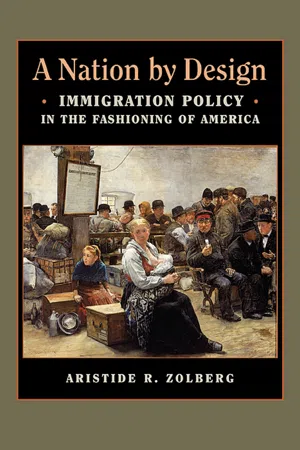
According to the national mythology, the United States has long opened its doors to people from across the globe, providing a port in a storm and opportunity for any who seek it. Yet the history of immigration to the United States is far different. Even before the xenophobic reaction against European and Asian immigrants in the late nineteenth century, social and economic interest groups worked to manipulate immigration policy to serve their needs. In A Nation by Design, Aristide Zolberg explores American immigration policy from the colonial period to the present, discussing how it has been used as a tool of nation building.
A Nation by Design argues that the engineering of immigration policy has been prevalent since early American history. However, it has gone largely unnoticed since it took place primarily on the local and state levels, owing to constitutional limits on federal power during the slavery era. Zolberg profiles the vacillating currents of opinion on immigration throughout American history, examining separately the roles played by business interests, labor unions, ethnic lobbies, and nativist ideologues in shaping policy. He then examines how three different types of migration--legal migration, illegal migration to fill low-wage jobs, and asylum-seeking--are shaping contemporary arguments over immigration to the United States.
A Nation by Design is a thorough, authoritative account of American immigration history and the political and social factors that brought it about. With rich detail and impeccable scholarship, Zolberg's book shows how America has struggled to shape the immigration process to construct the kind of population it desires.
- 658 pages
- English
- ePUB (mobile friendly)
- Available on iOS & Android
eBook - ePub
About this book
Information
Publisher
Harvard University PressYear
2008Print ISBN
9780674030749
9780674022188
eBook ISBN
9780674257641
1
Themes and Perspectives
A nation of immigrants, to be sure, but not just any immigrants. From the moment they managed their own affairs, well before political independence, Americans were determined to select who might join them, and they have remained so ever since. Immigration policy, broadly conceived in this book to encompass not only entry but also related processes that affect the nation’s composition, thus emerged from the outset as a major instrument of nation-building, equivalent in the fashioning of the United States to the amalgamation of diverse regions in the making of the United Kingdom, France, or Spain. Although as historical constructs all nations in some sense make themselves, the very nature of the immigration process provided the Americans with unusual latitude in doing so, and hence theirs may properly be termed “a nation by design.”1
In the Old World, the people came with the territory: the construction of “France” is the history of the royal state’s territorial expansion from the Paris region and of the concurrent transformation of the successively incorporated populations into français; in the same vein, in their aspiration to forge Britons out of the pieces being assembled by way of dynastic manipulations, the rulers of the United Kingdom had little choice but to work with the English, Welsh, Scots, and Irish.2 In contrast, from the very outset, by way of its state and federal governments, the self-constituted American nation not only set conditions for political membership, but also decided quite literally who would inhabit its land. Long before what is conventionally regarded as the beginning of national immigration policy, the Americans undertook to violently eliminate most of the original dwellers, imported a mass of African workers whom they excluded from their nation altogether, actively recruited Europeans they considered suitable for settlement, intervened in the international arena to secure freedom of exit on their behalf, elaborated devices to deter those judged undesirable, and even attempted to engineer the self-removal of liberated slaves, deemed inherently unqualified for membership. Immigration policy not only emerged as a major instrument of American nation-building, but also fostered the notion that the nation could be designed, stimulating the elevation of that belief into an article of national faith.
The American experience of nation-building is exceptional not only in comparison with the Old World prefabs, but also in relation to the other overseas nations of European origin where, throughout their formative years, immigration remained largely governed by the imperial governments or, in the case of the precociously independent South American states, was for a protracted period hardly governed at all.3 As against this, American grievances regarding British immigration and naturalization policy were voiced for several decades before 1776, and their inclusion in the Declaration of Independence, which forms the core of Chapter 2, provides clear evidence of the founders’ understanding that immigration was bound to play a key role in the building of the American nation. Duly noted in accounts of the founding, but as a side issue, the Declaration’s grievances regarding immigration and naturalization belong in the foreground because these matters were regarded by both British imperial authorities and the American leaders as key processes that shaped basic features of the colonies’ existence: the size of their population, its composition, and the rules for membership in the body politic. Rather than isolated skirmishes, the confrontations over these issues were vital episodes in the larger war over sovereignty, and amounted to an epochal struggle over the structure or design of American society. In short, the American colonies amounted to a congeries of disparate population fragments that had come into being largely as intentional and unintentional by-products of migration policies tailored to the pursuit of imperial objectives; to turn these elements into a unified society, and one that would provide the social underpinnings of a republic, was an immensely ambitious task, which required among other things a fundamental modification of ongoing immigration policies and related practices.
My account thus challenges the widely held notion that until the late nineteenth century, the United States maintained a laissez-faire stance in the sphere of immigration. As will be elaborated in Chapter 6, the conventional narrative was largely shaped by the protracted confrontation over immigration that spanned the first two-thirds of the twentieth century. This gave rise to a full-blown Historikerstreit, in which contending historians justified their respective positions by situating the founders on a continuum ranging from “openness” or “generosity” to “restrictionism.” Marcus Lee Hansen’s classic interpretation, elaborated before his death in 1938 and subsequently edited by Arthur M. Schlesinger Sr., prudently but deliberately comes down somewhere in the middle: “So the United States began its career with no encouragement to immigrants except that offered by its opportunities, and with no barriers except those confronting native and foreigner alike.”4 Echoed in the influential synthetic overview published in 1960 by Maldwyn Jones, this interpretation of the policy baseline as benevolently neutral, but marred by occasional eruptions of “nativism,” has become canonic, and nativism itself has become a distinct object of study.5 With regard to the first century, its adoption was facilitated by the near-absence of federal legislation on the explicit subject of immigration. While historians have accepted this as a given, from a perspective informed by theories of state—and nation—formation, this absence constitutes a puzzle: given the evident concern of the founders with the subject, why was so little legislation enacted?
A reexamination of the record with this in mind reveals that the absence of federal legislation does not reflect a lack of interest in regulating entry, but was attributable to the overriding of immigration policy by what was then the central issue of national politics, the matter of states’ rights in relation to slavery. In effect, immigration policy could only be dealt with at the state level. Indeed, a considerable amount of regulation was enacted by port-of-entry states, amounting in toto to a national immigration policy; however, much of this was in turn invalidated by the courts on the grounds that it exceeded state authority. Although Gerald Neuman has reconstructed the record of state action, he has done so from an exclusively juridical perspective and has not paid much attention to the actors who challenged the states’ actions and their motivations.6 Such an inquiry in fact provides considerable insight into the political dynamics underlying immigration policy at a crucial turning point, half a century after independence, when the United States truly became a nation of immigrants.
The American “design” became more explicit as the founders sought to regulate immigration and naturalization so as to foster the transformation of a loose aggregate of political entities, some formed along the “family farm” path, others more properly colonial and stratified along racial lines, into a politically integrated white republic. As elaborated in Chapter 3, emerging as the key theorists in this field, Tench Coxe, Thomas Jefferson, Alexander Hamilton, and James Madison engaged in elaborate explorations of the relationship between population, land, and labor to determine what immigration policy would best serve broader goals of nation-building and economic development. On the political side, in his famous debate with Edmund Burke, Tom Paine set forth a radically innovative “civic” model of the nation as an alternative to the “ethnic” body politic, and this in turn provided the theoretical foundations for the country’s first naturalization law. My analysis engages a collegial debate with Rogers Smith; although he rightly emphasizes the egregious shortcomings of American citizenship with regard to race, he gets so carried away by his critique that he fails to give proper weight to the innovative character of what was done. From a contemporaneous international perspective, the more striking fact is the law’s inclusiveness, indicated by the absence of religious or national origin qualifications.7 This constituted an obvious invitation to non-British nationals and, on the religious side, to Roman Catholics and Jews.
The concerns expressed at the moment of political emancipation adumbrate a lasting feature of the fledgling new republic, rooted in its peculiar colonial origins: although regulation of the movement of persons across a state’s borders and access of aliens to citizenship by way of naturalization were recognized by contemporaneous legal and political thinkers as established practices, in the United States they achieved unprecedented practical and theoretical prominence because foreign immigration—as against mere transfers within the empire—made a much greater contribution to its population than had ever occurred in any European nation, or than any political philosopher envisioned might take place in a constituted community. Paradoxically, while the location of the United States on the western side of the Atlantic somewhat insulated its political development from European ideological currents and the effects of international tensions, thereby lending it a peculiarly insular character, the prominence of international migration rendered it unusually cosmopolitan, and promoted its role as an advocate of freedom of exit (Chapter 4).8
Nevertheless, observing the United States half a century after independence, Alexis de Tocqueville saw it as a fully formed “Anglo-American” society, and at this time Americans hardly thought themselves “a nation of immigrants.” Despite the prevailing immigrationism, annual arrivals amounted to only one-fourth of 1 percent of the white population and contributed less than one-tenth of its spectacular demographic expansion (nearly 3 percent a year!). Chapter 3 demonstrates that this was not happenstance and that, in effect, the largely ignored federal Passenger Act of 1819, together with state regulations governing ports of entry, created a rudimentary system of “remote control,” whereby the United States sought to select immigrants by projecting its boundaries into the source countries.9
However, in a thoroughly pessimistic footnote inserted on the eve of publication of Democracy in America in 1835, Tocqueville observed that the situation he reported on so optimistically had begun to change, and that the country’s two large port-of-entry cities, Philadelphia and New York, were being invaded by a “dangerous” population of poor blacks and poor Europeans who “bring to the United States our greatest vices, and lack any of the interests which might offset their influence.” As demonstrated in Chapter 5, this reflected his Whig friends’ sense that the United States faced an unprecedented “immigration crisis” occasioned by an abrupt and considerable rise of arrivals from Europe, of whom an increasing proportion were perceived as significantly different from the established population, in that they were not “British” but largely Irish and German, as well as Roman Catholic to boot. Induced by the continuing expansion of the “great transformation,” this human wave propelled immigration to the top of the political agenda, lining up the new capitalists eager to maximize their labor supply against defenders of the traditional boundaries of American society, whom historians subsequently labeled “nativists,” and urban wage workers, who perceived immigrants as a threat to their living and an obstacle to the organization of a labor movement. The immigration crisis reached all the way to the U.S. Supreme Court, whose rulings in turn shaped the strategies of both camps and thereby determined the course of policy. The confrontation over immigration eventually interacted with the crisis over slavery to destroy the “second party system” and bring on the Civil War.
Ultimately, the “nativists” lost out to the capitalists, and consequently Tocqueville’s nightmarish footnote moved into the text, transforming the established “Anglo-American” nation into a unique “nation of immigrants.” This outcome inaugurated the protracted hegemony of economically driven policy, further elaborated during and after the Civil War, and expanded to encompass the recently opened West Coast. The vast increase and growing heterogeneity of the immigrants, now including Chinese, once again precipitated a crisis (Chapter 6). In keeping with the general trend of American political development during this period, within a single decade the ambiguous and administratively awkward jurisdictional equilibrium between levels of government in the sphere of immigration decisively shifted toward the national, as measures favored by most states but barred from enactment by the pre–Civil War Supreme Court now became national policy. The availability of a large and ethnically variegated labor force, with a substantial component of “birds of passage” on both coasts, imparted a distinctively segmented structure to the American industrial labor market and largely provides the answer to Werner Sombart’s notorious question, “Why is there no Socialism in the United States?”
Nativism Reconsidered
Our understanding of the onset of federal regulation after the Civil War is largely shaped by the late John Higham’s Strangers in the Land, which has deservedly achieved classic status and remains, after half a century, the most distinguished work on the subject.10 Focusing on the period 1880–1925, Higham constructed a narrative in which the United States moved from openness to steadily growing restriction, culminating in the imposition of the national origin quotas and wholesale Asian exclusion. However, in his preface to a later edition, Higham himself reflected that “I would … if I were writing today, take more account of aspects of the immigration restriction movement that can not be sufficiently explained in terms of nativism.” In his postscript to a revised second edition, he suggested that the “nation-building” framework I had adumbrated in preliminary articles would be particularly helpful.11 His generous encouragement convinced me to undertake the present work, despite my long-term professional involvement in quite different fields.
Tacitly underlying Higham’s conceptualization of nativism is the “frustration-aggression” syndrome derived from psychoanalytic theory by way of Theodore Adorno’s The Authoritarian Personality and Gordon W. Allport’s Prejudice.12 Highly influential among American intellectuals in the 1950s, this syndrome also inspired Richard Hofstadter’s analysis Anti-intellectualism in American Life, “conceived in response to the political and intellectual conditions of the 1950’s,” notably McCarthyism.13 Underlying Higham’s history of immigration policy is the idea that Americans, frustrated by the disruptions that accompanied industrialization and urbanization, projected their anger upon strangers. Translated into pressure on decision makers to restrict immigration, this collective disposition was alleviated only when the international situation provided alternative outlets in the form of external aggression, notably the Spanish-American War and World War I; but these were temporary alleviations, and afterward immigrants became once again the main target.
The basic problem with this approach is that there is no way of independently charting the level of frustration of a society except by using aggressive behavior—that which is to be explained—as the indicator, nor can the level of aggressivity be independently established with respect to particular groups and at different times. The result is such inherent covariance between cause and effect as to suggest we are in the presence of a tautology. Whose frustrations, when, and how deep? While suggestive overall, a psychopathology-inspired approach is inadequate because it cannot account for particular policy outcomes at specific times. Why immigrant strangers rather than other objects? If “nativism” and the restrictions to which it gave rise were rooted in a projection of insecurity in the face of change, how come when insecurity reached a new high in the post–World War II period, it produced McCarthyism instead, while immigration policy was in fact liberalized?
Whereas “nativism” is credible as an expression of frustration, what sort of stance would be “normal”? Given the historical baseline preceding the advent of restriction, it tacitly appears to be open immigration. But surely it is unrealistic to expect the United States to maintain its previous stance in light of the global transformations of the period, which vastly enlarged the worldwide pool of potential immigrants. The moment that constitutes Higham’s starting point marked what is being increasingly recognized as the onset of globalization, when a number of factors changed more or less simultaneously to vastly enlarge the migratory flow, drastically altering the situation the United States faced. To begin with, Europe’s demographic transformation spread to the Continent’s least developed regions, the railroad revolutionized inland transportation, while the advent of iron steamships, whose carrying capacity was nearly tenfold that of sailing vessels and which reduced the Atlantic crossing from approximately one month to one week, transfigured overseas travel. Simultaneously, Asia and Africa were incorporat...
Table of contents
- Cover
- Title
- Copyright
- Contents
- Acknowledgments
- 1 Themes and Perspectives
- 2 From Empire to Republic
- 3 An Acquisitive Upstart
- 4 The American System
- 5 Tocqueville’s Footnote
- 6 Seward’s Other Follies
- 7 “An Intelligent and Effective Restriction”
- 8 A Nation Like the Others
- 9 The Ambiguities of Reform
- 10 The Elusive Quest for Coherence
- 11 Why the Gates Were Not Shut
- Conclusion: National Design in a Globalizing World
- Appendix: Immigration Graphs
- Abbreviations
- Notes
- Index
Trusted by 375,005 students
Access to over 1.5 million titles for a fair monthly price.
Study more efficiently using our study tools.
Frequently asked questions
Yes, you can cancel anytime from the Subscription tab in your account settings on the Perlego website. Your subscription will stay active until the end of your current billing period. Learn how to cancel your subscription
No, books cannot be downloaded as external files, such as PDFs, for use outside of Perlego. However, you can download books within the Perlego app for offline reading on mobile or tablet. Learn how to download books offline
Perlego offers two plans: Essential and Complete
- Essential is ideal for learners and professionals who enjoy exploring a wide range of subjects. Access the Essential Library with 800,000+ trusted titles and best-sellers across business, personal growth, and the humanities. Includes unlimited reading time and Standard Read Aloud voice.
- Complete: Perfect for advanced learners and researchers needing full, unrestricted access. Unlock 1.5M+ books across hundreds of subjects, including academic and specialized titles. The Complete Plan also includes advanced features like Premium Read Aloud and Research Assistant.
We are an online textbook subscription service, where you can get access to an entire online library for less than the price of a single book per month. With over 1.5 million books across 990+ topics, we’ve got you covered! Learn about our mission
Look out for the read-aloud symbol on your next book to see if you can listen to it. The read-aloud tool reads text aloud for you, highlighting the text as it is being read. You can pause it, speed it up and slow it down. Learn more about Read Aloud
Yes! You can use the Perlego app on both iOS and Android devices to read anytime, anywhere — even offline. Perfect for commutes or when you’re on the go.
Please note we cannot support devices running on iOS 13 and Android 7 or earlier. Learn more about using the app
Please note we cannot support devices running on iOS 13 and Android 7 or earlier. Learn more about using the app
Yes, you can access A Nation by Design by Aristide R. Zolberg in PDF and/or ePUB format, as well as other popular books in Social Sciences & North American History. We have over 1.5 million books available in our catalogue for you to explore.