This timely book on structural adhesives joints showcases all the pertinent topics and will be of immense value to scientists and engineers in many industries.
Most structures are comprised of a number of individual parts or components which have to be connected to form a system with integral load transmission path. The structural adhesive bonding represents one of the most enabling technologies to fabricate most complex structural configurations involving advanced materials (e.g. composites) for load-bearing applications. Quite recently there has been a lot of activity in harnessing nanotechnology (use of nanomaterials) in ameliorating the existing or devising better performing structural adhesives.
The 10 chapters by subject matter experts look at the following issues:
Surface preparation for structural adhesive joints (SAJ)
Use of nanoparticles in enhancing performance of SAJ
Optimization of SAJ
Durability aspects of SAJ
Debonding of SAJ
Fracture mechanics of SAJ
Failure analysis of SAJ
Damage behavior in functionally graded SAJ
Impact, shock and vibration characteristics of composites for SAJ
1 Surface Preparation for Structural Adhesive Joints
Anushka Purabgola1, Shivani Rastogi1, Gaurav Sharma1 and Balasubramanian Kandasubramanian2*
1 Nanomaterials Characterization Lab, Center for Converging Technologies, University of Rajasthan, JLN Marg, Jaipur, Rajasthan, India
2 Nano Surface Texturing Lab, Department of Metallurgical and Materials Engineering, Defence Institute of Advanced Technology (DU), Girinagar, Pune, Maharashtra, India
Abstract
Advanced structures require materials that can provide high tensile strength, modulus, along with good load bearing capacity. Several structural adhesives provide good strength to joints made of different materials. The applications of structural adhesives range from domestic appliances to ships and aircraft along with medical and dental fields. However, an efficient adhesion of the structural adhesives to adherends requires various surface treatment methods to be performed prior to the application of adhesives. These modification methods alter the surface free energy and impart distinct polar groups (-OH, -C=O) on the adherend which act as new receptive sites for adhesion. These surface treatment methods are basically divided into degreasing methods, mechanical abrasion methods (e.g., grit blasting), chemical modification methods (acid-etching, anodization, etc.), and physical treatment methods (corona treatment, flame treatment, plasma treatment, etc.). This chapter describes various surface preparation methods for the efficient application of structural adhesives along with theories of adhesion, surface treatment evaluation tests, applications, and future scope of structural adhesives.
Keywords: Tensile strength, surface treatment, degreasing, chemical modifications, physical treatment
1.1 Introduction
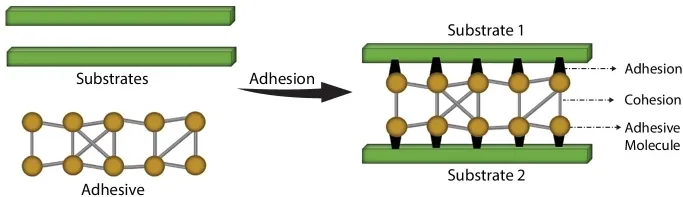
Structural adhesives can be considered as high strength glues, used to hold two substrate surfaces with load-bearing permanent bonds [1]. The structural adhesives offer high modulus, high strength, and flexible bonds to produce lightweight materials [2] capable of maintaining structural integrity even under high stress. This cost-effective method of fabricating stress-bearing materials also provides the advantage of protection against corrosion [3]. The structural adhesives help in maintaining structural integrity of the materials by their ability of transmitting structural stress across the interface when subjected to high loads. The bonding of substrate surfaces using structural adhesives may result due to van der Waals forces, electrostatic attraction, or chemical bonding arising between the surfaces and adhesives (Figure 1.1).
The structural adhesives are generally in liquid form during application between the surfaces, giving wettability to the surfaces followed by curing, thus resulting in rigid, high molecular weight and crosslinked attachment between adhesive and adherend. The structural adhesives are used in aircraft, ships, medical/dental, automotive, domestic appliances, electronics, and construction applications because they provide excellent load-bearing capability [4, 5]. The most widely used structural adhesives include silicones, epoxies, acrylics, urethanes, etc. [5]. The substrates that can be joined using structural adhesives include metals, composites, rubber, plastics, biomaterials (wood and honeycomb panels), etc. [6]. The binding and fabrication of materials using structural adhesives depends on a variety of factors including selection of suitable adhesive, surface preparation of adherend, quality control, proper joining design, etc. Out of all these requirements, surface preparation of the materials to be joined is an important aspect in the field of adhesive bonding. The surface preparation of materials prior to the application of structural adhesives is preferred because of the following reasons [6]:
Figure 1.1 Interaction between adhesive and substrates.
To ensure the formation of strong layer on the surface;
To provide the maximum substrate surface for optimum molecular interaction between the adhesive and adherend;
To ensure achievement of significant joint strength for better stress transmittance across the interface;
To create specific voids/cavities/microstructures or to alter the chemical structure of surface in order to alter the surface free energy for proper adhesive bonding.
The basic surface preparation methods employed prior to the application of structural adhesive include degreasing, mechanical abrasion, and chemical treatments. The degreasing of joint surfaces works by removing the traces of oil and grease contaminants and providing clean and contaminant-free surface to be joined. The degreasing of the joint surfaces can be done via multiple ways such as vapor degreasing, ultrasonic degreasing, and immersion/ spray/solvent wipe degreasing. Another surface preparation method with the advantages of simplicity and ease of performance is the mechanical abrasion. Mechanical abrasion methods (like grit blasting) remove most of the surface deposits (metal deposits such as tarnish, rust and mill scale) and provide joint materials with rough surfaces in order to enable the formation of strong bonds. The mechanical abrasion method is always followed by degreasing to remove the loose materials produced on the abraded material. The chemical treatment or electrolytic pretreatment is another surface preparation method which results in the joint surfaces with optimum strength, reproducibility and resistant to damage. Chemical treatment methods like acid etching work by altering the chemical morphology and composition of the joint surfaces which results in the elevation of the surface free energy, a favorable condition for the formation of high-strength bonds. Chemical treatment of joint surfaces also raises the probability of chemical bonds (van der Waals, covalent, hydrogen, polar, etc.) formation at the substrate – adhesive interface. The alternative surface preparation methods to the chemical treatment provide the same surface modifications but produce less harmful waste materials are corona, plasma and flame treatment methods. These surface treatment methods are always preferred and performed prior to the app...
Table of contents
Cover
Table of Contents
Title Page
Copyright Page
Preface
Part 1: GENERAL TOPICS
Part 2: ANALYSIS AND TESTING
Index
Also of Interest
End User License Agreement
Trusted by 375,005 students
Access to over 1.5 million titles for a fair monthly price.
Study more efficiently using our study tools.
Frequently asked questions
Yes, you can cancel anytime from the Subscription tab in your account settings on the Perlego website. Your subscription will stay active until the end of your current billing period. Learn how to cancel your subscription
No, books cannot be downloaded as external files, such as PDFs, for use outside of Perlego. However, you can download books within the Perlego app for offline reading on mobile or tablet. Learn how to download books offline
Perlego offers two plans: Essential and Complete
Essential is ideal for learners and professionals who enjoy exploring a wide range of subjects. Access the Essential Library with 800,000+ trusted titles and best-sellers across business, personal growth, and the humanities. Includes unlimited reading time and Standard Read Aloud voice.
Complete: Perfect for advanced learners and researchers needing full, unrestricted access. Unlock 1.5M+ books across hundreds of subjects, including academic and specialized titles. The Complete Plan also includes advanced features like Premium Read Aloud and Research Assistant.
Both plans are available with monthly, semester, or annual billing cycles.
We are an online textbook subscription service, where you can get access to an entire online library for less than the price of a single book per month. With over 1.5 million books across 990+ topics, we’ve got you covered! Learn about our mission
Look out for the read-aloud symbol on your next book to see if you can listen to it. The read-aloud tool reads text aloud for you, highlighting the text as it is being read. You can pause it, speed it up and slow it down. Learn more about Read Aloud
Yes! You can use the Perlego app on both iOS and Android devices to read anytime, anywhere — even offline. Perfect for commutes or when you’re on the go. Please note we cannot support devices running on iOS 13 and Android 7 or earlier. Learn more about using the app
Yes, you can access Structural Adhesive Joints by K. L. Mittal, S. K. Panigrahi, K. L. Mittal,S. K. Panigrahi in PDF and/or ePUB format, as well as other popular books in Technology & Engineering & Materials Science. We have over 1.5 million books available in our catalogue for you to explore.