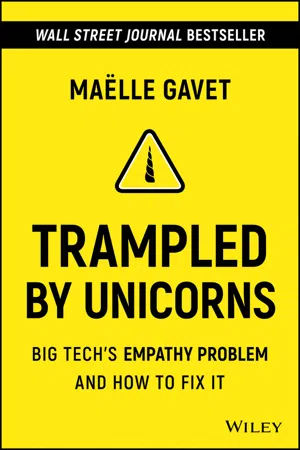
An insider's revealing and in-depth examination of Big Tech's failure to keep its foundational promises and the steps the industry can take to course-correct in order to make a positive impact on the world.
Trampled by Unicorns: Big Tech's Empathy Problem and How to Fix It explores how technology has progressed humanity's most noble pursuits, while also grappling with the origins of the industry's destructive empathy deficit and the practical measures Big Tech can take to self-regulate and make it right again. Author Maëlle Gavet examines the tendency for many of Big Tech's stars to stray from their user-first ideals and make products that actually profoundly damage their customers and ultimately society.
Offering an account of the world of tech startups in the United States and Europe—from Amazon, Google, and Facebook to Twitter, Airbnb, and Uber (to name a few)—Trampled by Unicorns argues that the causes and consequences of Big Tech's failures originate from four main sources: the Valley's cultural insularity, the hyper-growth business model, the sector's stunning lack of diversity, and a dangerous self-sustaining ecosystem. However, the book is not just an account of how an industry came off the rails, but also a passionate call to action on how to get it back on track.
Gavet, a leading technology executive and former CEO of Ozon, an executive vice president at Priceline Group, and chief operating officer of Compass, formulates a clear call to action for industry leaders, board members, employees, and consumers/users to drive the change necessary to create better, more sustainable businesses—and the steps Western governments are likely to take should tech leaders fail to do so. Steps that include reformed tax codes, reclassification of platforms as information companies, new labor laws, and algorithmic transparency and oversight.
Trampled by Unicorns' exploration of the promise and dangers of technology is perfect for anyone with an interest in entrepreneurship, tech, and global commerce, and a hope of technology's all-empowering prospect. An illuminating book full of insights, Trampled by Unicorns describes a realistic path forward, even as it uncovers and explains the errors of the past. As Gavet puts it, "we don't need less tech, we need more empathetic tech." And how that crucial distinction can be achieved by the tech companies themselves, driving change as governments actively pave the road ahead.
When I first began working for OZON, I fell instantly in love. What drew me was the ability for us to make seemingly minor changes that had tremendous real-world impact. Here we were, in the vastness of Russia, building a business that would soon deliver books to millions of people, some in places with hardly a road to speak of. We could make it possible, in these places at the ends of the Earth, for people to choose among hundreds of thousands of books. And, eventually, the same service would deliver equipment for their homes, toys for their children, parts for their cars—all shipped straight to their door.
This astonishing aspect of the work was what I found so exciting: what we did within the digital realm could so quickly alter the possibilities of the physical one. At massive scale and incredible speed. That is what I fell in love with. The benefits felt boundless. In many ways, they still do.
TECH AS DRIVER OF ECONOMIC AND SOCIAL PROGRESS
If we look more specifically at some of the key indicators of economic and social progress (GDP, poverty, life expectancy, literacy), the positive impact of digital technologies is evident across the board.
While there are debates on how to measure the impact of the digital economy on GDP due to the amount of free digital products created by the industry and the lack of clear definition of what the “digital economy” covers exactly, the OECD1 assessed that in 2015 the information and communication technology sector accounted for 4.5 percent of total value added in OECD countries. Access to broadband internet is as clear a booster of economic development as anything. The World Bank estimates that an increase in fixed broadband penetration of 10 percentage points results in a 1.35 percent increase in per capita GDP for developing countries and a 1.19 percent increase for developed countries.2
Digital innovation is improving the standards of living of millions of people thanks to greater efficiency and lower costs across industries, starting with agriculture and transportation. From better irrigation and pesticide and fertilizer use to more efficient agricultural supply chain management, there are countless examples around the world of technology improving the life of people. Mobile supercomputers in our pockets connect us with people virtually anywhere on the planet, play our music, and look up any fact. Smart homes, powered by personal digital assistants that learn our preferences as we use them, offer enhanced security monitoring, automated climate control, and shopping with a few voice commands. Augmented and virtual reality is available in our living rooms, offering new frontiers for entertainment and education. Plant-based meat is now served at fast-food restaurants. Drones and mini-cameras have revolutionized videography. And look at how 3D printers throughout the world helped manufacture the necessary parts for ventilators, as well as face masks and nasal swabs, to fight the COVID-19 pandemic.3
Technology is also helping to improve health and increase life expectancy. Living beyond 100 is likely going to become the norm for most children in the developed world before the end of this century. The British Office for National Statistics estimates that in 2043 in the UK, 20.8 percent of newborn boys and 26.1 percent of newborn girls are expected to live to at least 100 years of age.4 Thanks to technology we will have a longer life and also a healthier one, with fewer diseases and side effects associated with old age. From Alzheimer's and Parkinson's to cancer, tech is making progress toward a future where they all might be curable.
Similar lines of research into faster cures via better drug delivery are seeing astonishing breakthroughs thanks to artificial intelligence. In February 2020, a team of researchers announced their AI program had invented a drug molecule that had gained approval for use in human trials—a first for machine learning. Typically, drug development takes about five years, often longer, before it gets to human trials. The AI developed drug took just 12 months.5
COVID-19 social distancing requirements have boosted telemedicine services into everyday use, but long before the pandemic these services were complementing local health services in remote, rural communities. Data sharing and comprehensive meta-analyses have sped up the flow of information between health systems and hospitals, and mobile software applications are allowing both healthcare professionals and patients to check in and monitor situations constantly and remotely.
In one of the most heartwarming examples I have come across, a nonprofit called Living Goods provides digital tools and information via mobile phone for parents and community health workers in impoverished areas that have little access to doctors. “Thanks to technology, you can turn an ordinary person into someone who can diagnose and in most cases deliver a treatment that directly reduces child mortality,” said CEO Nicola Crosta of Impact46, a social impact accelerator. After three years, the nonprofit demonstrated a 27 percent reduction in under-five mortality in Uganda. Infant and neonatal—under 1 month—mortality was also significantly reduced by 33 and 27 percent, respectively.6
The access that an increasing number of us have to seemingly infinite information is unlike anything to have happened before in human history. Massive Open Online Courses (MOOCs) reached 110 million people in 2019, with more than 13,500 courses available. And those numbers don't even include China, the largest nation with more people online than any other.7 Tusome, a literacy platform in Kenya adopted by the Kenyan government, has benefited over 6.5 million children nationwide,8 throughout 23,000 government-run primary schools as well as 1,500 private schools. It has increased literacy, as well as deepened and widened the impact of good teachers and teaching methods.9 MindSpark, a program focused on STEM learning in India, improved students' performance in math by 38 percent in just five months. The program costs merely $2 a year per student when scaled up to more than 1,000 schools.10
And of course, technology has revolutionized the workplace, in ways too numerous to count. From software that puts data analysis on steroids to robots that make and package products, dramatic efficiencies have made businesses more competitive and profitable.
FIGURE 1.1 Impact of tech innovation on daily life.
Finally, digital technologies will also likely be what will help us with the next big challenge humanity is facing: the degradation of our environment and climate change. Solar and wind energy now produce electricity more cheaply than coal. The entire field of Climate Informatics, which is continuously deepening our understanding of the long-term and short-term impacts of climate change, could not exist without AI and the tools necessary to capture and analyze increasingly complex sets of climatic data.
These are remarkable accomplishments, worthy of praise and admiration. And tech companies receive both from us, overwhelmingly. A survey conducted by The Verge at the end of 2019 found that the vast majority of users—around 90 percent—view brands like Amazon and Google favorably, while around 70 percent of users believe that they remain a positive influence on society.11 I know exactly how they all feel, because I still swoon over much of tech, too.
HIDDEN EFFECTS
So why is this book mainly focused on the problems tech is creating for humanity? For starters, because tech is now so deeply ingrained in everyday life, many of its more insidious effects also occur in the background, like some kind of white noise that is easy to ignore. Yet tech companies' influence over everything from the nature of work, to our privacy, to the contours of our cities, to the underlying fairness of our economies and the health of our democracies, is massive, and growing more so by the minute. As explained by William Davidow, author of The Autonomous Revolution, the technologies of the future (AI, robotics, Internet of Things) “not only make society more efficient and productive; they transform its structure.”12
Moreover, I don't accept the oft-heard tropes of tech that these problems are necessary trade-offs to get us the many benefits technology brings us. In most cases, they are not. Or that these trade-offs are not worth public scrutiny due to their inevitability or their complexity. Or tha...
Table of contents
Cover
Table of Contents
Epigraph
Introduction
PART One: Monsters of Scale
PART Two: Fixing the Chaos Factory
Epilogue: A Manifesto for Change
Acknowledgments
About the Author
Index
End User License Agreement
Trusted by 375,005 students
Access to over 1.5 million titles for a fair monthly price.
Study more efficiently using our study tools.
Frequently asked questions
Yes, you can cancel anytime from the Subscription tab in your account settings on the Perlego website. Your subscription will stay active until the end of your current billing period. Learn how to cancel your subscription
No, books cannot be downloaded as external files, such as PDFs, for use outside of Perlego. However, you can download books within the Perlego app for offline reading on mobile or tablet. Learn how to download books offline
Perlego offers two plans: Essential and Complete
Essential is ideal for learners and professionals who enjoy exploring a wide range of subjects. Access the Essential Library with 800,000+ trusted titles and best-sellers across business, personal growth, and the humanities. Includes unlimited reading time and Standard Read Aloud voice.
Complete: Perfect for advanced learners and researchers needing full, unrestricted access. Unlock 1.5M+ books across hundreds of subjects, including academic and specialized titles. The Complete Plan also includes advanced features like Premium Read Aloud and Research Assistant.
Both plans are available with monthly, semester, or annual billing cycles.
We are an online textbook subscription service, where you can get access to an entire online library for less than the price of a single book per month. With over 1.5 million books across 990+ topics, we’ve got you covered! Learn about our mission
Look out for the read-aloud symbol on your next book to see if you can listen to it. The read-aloud tool reads text aloud for you, highlighting the text as it is being read. You can pause it, speed it up and slow it down. Learn more about Read Aloud
Yes! You can use the Perlego app on both iOS and Android devices to read anytime, anywhere — even offline. Perfect for commutes or when you’re on the go. Please note we cannot support devices running on iOS 13 and Android 7 or earlier. Learn more about using the app
Yes, you can access Trampled by Unicorns by Maelle Gavet in PDF and/or ePUB format, as well as other popular books in Business & Business Ethics. We have over 1.5 million books available in our catalogue for you to explore.