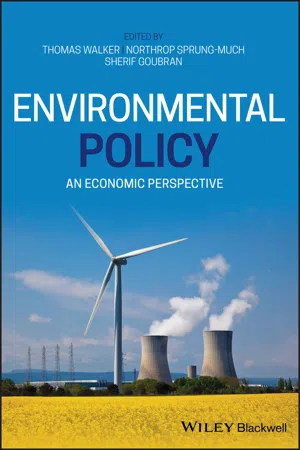
EXPAND YOUR UNDERSTANDING OF HOW ENVIRONMENTAL POLICY AFFECTS BUSINESS, THE ECONOMY, AND YOUR LIFE WITH THIS ESSENTIAL RESOURCE
Environmental Policy:An Economic Perspective offers readers a comprehensive examination of the ever-broadening scope and impact of environmental policy, law, and regulation. Editors Thomas Walker, Northrop Sprung-Much, and Sherif Goubran walk readers through a variety of subjects while maintaining a global perspective on the expanding role of environmental law.
This book takes a pragmatic and practical approach to its subject matter, showing readers the real impact across the world of different kinds of environmental policy. Among other topics, Environmental Policy:An Economic Perspective tackles:
Climate change legislation
Water conservation and pricing
Biodiversity of the marine environment
Wildlife ranching
Emission trading schemes
Green job strategies
Sustainable investing
Written for undergraduate and graduate students in any field affected by environmental legislation and policy, this book also belongs on the shelves of anyone who seeks to better understand the increasingly important role of environmental policy on their business and life.
1 An Introduction to the Current Landscape: Environmental Policy and the Economy
Tyler Schwartz1 and Sherif Goubran2
1 John Molson School of Business, Concordia University, Montreal, Quebec, Canada
2 Concordia University, Montreal, Quebec, Canada
1.1 Background
Global environmental challenges have caused a range of policy solutions, approaches, and models to emerge. As these challenges are expected to intensify in the near future, environmental policy and its instruments are increasingly becoming a topic of discussion, action, and disagreement in academic, professional, and mass media outlets. This fixation on the topic of policy is well‐justified considering the consequences policy can have on all levels of society – global, national, sectoral, organizational, and even personal. Policy has a vital role in reducing environmental damage, incentivizing positive environmental behavior, and guiding practice toward a more sustainable future. While most policies have economic repercussions, environmental policies, and specifically new environmental policy instruments, have exhibited a special and complex relation to the economy (Jordan et al. 2003). The environment can thus be considered an envelope encompassing and sustaining the economic system – much more than just a factor of production (Hawken et al. 1999).
Two main arguments relate to economic and environmental health. The first proposes that continuous growth is inevitably contradictory to improvements in environmental health, citing reasons such as geographical shifts in production, lock‐in, the social‐political feasibility of environmental agreements and policies, and obstacles to behavioral change, among others (Antal and Van Den Bergh 2016). The second proposes that economic growth can and will eventually lead to environmental improvements (Faure 2012), in what is commonly referred to as the Environmental Kuznets Curve (Kuznets 1995). This claim is usually supported by empirical evidence (Shen and Hashimoto 2004; Kong and Khan 2019). In the second argument, the relationship between regulation and environmental health is not direct. Instead, environmental health depends on external economic parameters: the macro (national economic performance) and the micro (personal income) (Faure 2012). It is important to note the broad agreement between the two views on the need to strengthen institutions and regulatory regimes to improve environmental performance (Faure 2012).
Table 1.1 The typology of environmental policy instruments
Source: Based on Russell and Powell (1996) and elaborated by Jordan et al. (2003).
Goals to be achieved
Specified
Not specified
Method to achieve goals
Specified
Command and control
Technology‐based regulatory standards
Not specified
Voluntary agreements
Market‐based instruments
The debates about the compatibility of economic growth, including “green growth,” with the imperative of climate change action create the underlying concerns of environmental policy design: Do we design policies to encourage growth or to slow it down? What are the policy instruments that can help reconcile the health of the environment and the economy?
Environmental policy can be broadly organized in a two‐by‐two matrix, first proposed by Russell and Powell (1996) and elaborated by Jordan et al. (2003) (reproduced in Table 1.1). This matrix categorizes the available environmental policy instruments based on their inclusion of the following: (i) the specific environmental goals to be achieved, and (ii) the specific means of improving environmental performance. This puts at opposite poles market‐based instruments (MBIs) and regulatory approaches (i.e. command and control) – two approaches which occupy a prominent role in debates today.
Faure (2012) provides an overview of the environmental policy instruments and their relevant empirical evidence. He pays specific attention to the interaction between the policy, on the one hand, and the economy and the private actors on the other, and identifies the following key policy instruments.
Liability rules: instruments that aim to hold polluters directly accountable for their impact on the environment. With regard to their success, Faure comments that stricter liabilities could result in higher rates of avoidance and insolvency. He proposes that policy packages should be considered with liabilities to address their unintended consequences (specifically related to the higher insolvency rates they create).
Regulation: minimum performance standards (based on absolute environmental goals or on effluent or emission levels). Faure indicates that these instruments usually present a risk since industry actors (especially the biggest polluters) will usually interfere in their development. An example of such interference is the “grandfather clauses” which exclude existing firms or products from regulations. Additionally, and as Nobel Prize winners Buchanan and Tullock proposed, many firms prefer standards and regulations because they create additional barriers to market entry.
Taxation: instruments designed to increase the cost of activities that have known impacts on the environment and could be levied on energy, transportation, or other activities. Considered as a command and control instrument, taxes present the same risk of interference seen in other regulatory approaches (Carl and Fedor 2016).
MBIs: frameworks set by regulators to induce market adjustment. This system has been considered successful in a number of cases – such as the SO2 trading scheme (Stavins 1998; Murray and Rivers 2015) where cost savings were achieved along with environmental goals. However, Faure highlights that such mechanisms can only be successful in locations where institutional and administrative structures are well established. Additionally, the process of setting emission or effluent allocations to existing firms tends could lead to overallocations.
Voluntary agreements: energy or emission reduction agreements, often between public and private sector actors. While Faure does not directly comment on voluntary agreements, their non‐legally binding nature makes them usually less effective on the environmental front (Bizer 1999), and only subgroups of economic actors will end up participating in, or abiding by, such agreements (Dawson and Segerson 2008).
In this complex landscape of instruments, environmental policies are seen to present a perfect case of wicked problems (Rittel and Webber 1973), where the actual framing of the problem becomes a complex and contested task (Coyne 2005). As Faure highlights, various combinations of instruments are usually required in order to ensure their success – for instance, regulatory, enforcement, and governance policies are needed to ensure the success of MBIs. In other words, there is no single instrument that could be successful for all envi...
Table of contents
Cover
Table of Contents
Title Page
Copyright Page
Preface
About the Editors
List of Contributors
Notes on Contributors
List of Figures
List of Tables
Acknowledgments
1 An Introduction to the Current Landscape
Section I: An Overview
Section II: Governing and Protecting Natural Resources
Section III: Energy, Emissions, and the Economy
Section IV: Financing the Environmental Transition
Index
End User License Agreement
Trusted by 375,005 students
Access to over 1.5 million titles for a fair monthly price.
Study more efficiently using our study tools.
Frequently asked questions
Yes, you can cancel anytime from the Subscription tab in your account settings on the Perlego website. Your subscription will stay active until the end of your current billing period. Learn how to cancel your subscription
No, books cannot be downloaded as external files, such as PDFs, for use outside of Perlego. However, you can download books within the Perlego app for offline reading on mobile or tablet. Learn how to download books offline
Perlego offers two plans: Essential and Complete
Essential is ideal for learners and professionals who enjoy exploring a wide range of subjects. Access the Essential Library with 800,000+ trusted titles and best-sellers across business, personal growth, and the humanities. Includes unlimited reading time and Standard Read Aloud voice.
Complete: Perfect for advanced learners and researchers needing full, unrestricted access. Unlock 1.5M+ books across hundreds of subjects, including academic and specialized titles. The Complete Plan also includes advanced features like Premium Read Aloud and Research Assistant.
Both plans are available with monthly, semester, or annual billing cycles.
We are an online textbook subscription service, where you can get access to an entire online library for less than the price of a single book per month. With over 1.5 million books across 990+ topics, we’ve got you covered! Learn about our mission
Look out for the read-aloud symbol on your next book to see if you can listen to it. The read-aloud tool reads text aloud for you, highlighting the text as it is being read. You can pause it, speed it up and slow it down. Learn more about Read Aloud
Yes! You can use the Perlego app on both iOS and Android devices to read anytime, anywhere — even offline. Perfect for commutes or when you’re on the go. Please note we cannot support devices running on iOS 13 and Android 7 or earlier. Learn more about using the app
Yes, you can access Environmental Policy by Thomas Walker, Sherif Goubran, Northrop Sprung-Much, Thomas Walker,Sherif Goubran,Northrop Sprung-Much in PDF and/or ePUB format, as well as other popular books in Politics & International Relations & Environment & Energy Policy. We have over 1.5 million books available in our catalogue for you to explore.