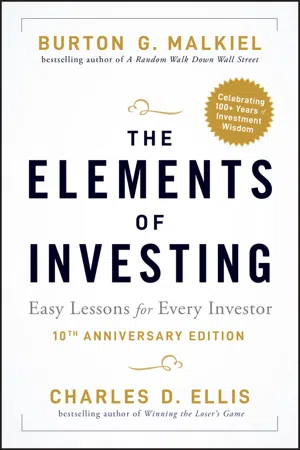
The Elements of Investing
eBook - ePub

The Elements of Investing

Easy Lessons for Every Investor

  1. English
  2. ePUB (mobile friendly)
  3. Available on iOS & Android
eBook - ePub

The Elements of Investing

Easy Lessons for Every Investor

About this book

Seize control of your financial future with rock-solid advice from two of the world's leading investment experts

Investors today are bombarded with conflicting advice about how to handle the increasingly volatile stock market. From pronouncements of the "death of diversification" to the supposed virtues of crypto, investors can be forgiven for being thoroughly confused.

It's time to return to the basics. In the 10th Anniversary Edition of The Elements of Investing: Easy Lessons for Every Investor, investment legends Burton G. Malkiel and Charles D. Ellis deliver straightforward, digestible lessons in the investment rules and principles you need to follow to mitigate risk and realize long-term success in the markets.

Divided into six essential elements of investing, this concise book will teach you how to:

  • Focus on the long-term and ignore short-term market fluctuations and movements
  • Use employer-sponsored plans to supercharge your savings and returns and minimize your taxes
  • Understand crucial investment subjects, like diversification, rebalancing, dollar-cost averaging, and indexing

So, forget the flavor of the week. Stick with the timeless and invaluable advice followed by the world's most successful retail investors.

Trusted by 375,005 students

Access to over 1.5 million titles for a fair monthly price.

Study more efficiently using our study tools.

Information

Publisher
Wiley
Year
2020
Print ISBN
9781119851417
9781119773733
eBook ISBN
9781119773788

IT ALL STARTS WITH SAVING

This is a short, straight‐talk book about investing. Our goal is to enhance your financial security by helping you make better investment decisions and putting you on a path toward a lifetime of financial success and, particularly, a comfortable and secure retirement.
Don't let anyone tell you that investing is too complex for regular people. We want to show you that everybody can make sound financial decisions. But it doesn't matter whether you make a return of 2 percent, 5 percent, or even 10 percent on your investments if you have nothing or too little to invest.
So it all starts with saving.
It doesn't matter whether you make a return of 2 percent, 5 percent, or even 10 percent on your investments if you have nothing to invest.

I
SAVE

Save. The amount of capital you start with is not nearly as important as organizing your life to save regularly and to start as early as possible. As the sign in one bank read:
Little by little you can safely stock up a small reserve here, but not until you start.
The fast way to affluence is simple: Reduce your expenses well below your income—and Shazam!—you are affluent because your income exceeds your outgo. You have “more”—more than enough. It makes no difference whether you are a recent college graduate or a multimillionaire. We've all heard stories of the schoolteacher who lived modestly, enjoyed life, and left an estate worth over $1 million—real affluence after a life of careful spending. And we know one important truth: She was a saver.
But it can also go the other way. A man with an annual income of more than $10 million—true story—kept running out of money, so he kept going back to the trustees of his family's huge trusts for more. Why? Because he had such an expensive lifestyle—private plane, several large homes, frequent purchases of paintings, lavish entertaining, and on and on. And this man was miserably unhappy.
In David Copperfield, Charles Dickens's character Wilkins Micawber pronounced a now‐famous law:
Annual income twenty pounds, annual expenditure nineteen pounds nineteen and six, result happiness. Annual income twenty pounds, annual expenditure twenty pounds ought and six, result misery.
Saving is good for us—for two reasons. One reason for saving is to prevent having serious regrets later on. As the poet John Greenleaf Whittier wrote: “Of all sad words of tongue and pen, the saddest are ‘It might have been.’”* “I should have” and “I wish I had” are two more of history's saddest sentences.
Another reason for saving is quite positive: Most of us enjoy the extra comfort and the feeling of accomplishment that comes with both the process of saving and with the results—having more freedom of choice both now and in the future. Sensible saving is a lot like maintaining good health. Bolster the process of saving through good habits and the results can generate positive feelings.
No regrets in the future is important, or will be, to all of us. No regrets in the present is important, too. Being a sensible saver is good for you, but deprivation is not. So don't try to save too much. You're looking for ways to save that you can use over and over again by making these new ways your new good habits.†
The real purpose of saving is to empower you to keep your priorities—not to make you sacrifice. Your goal in saving is not to “squeeze orange juice from a turnip” or to make you feel deprived. Not at all! Your goal is to enable you to feel better and better about your life and the way you are living it by making your own best‐for‐you choices about when to spend. Savings can give you an opportunity to take advantage of attractive future spending opportunities that are important to you. Saving also puts you on the road to a secure retirement, buying a new home, or sending your children to college. Think of saving as a way to get you more of what you really want, need, and enjoy. Let saving be your helpful friend.

FIRST DO NO HARM

The first step in saving is to stop dis saving—spending more than you earn, especially by running up balances on your credit cards. There are few, if any, absolute rules in saving and investing, but here's ours: Never, never, never take on credit card debt. This rule comes as close as any to being an inviolable commandment. Scott Adams, the creator of the Dilbert comic strip, calls credit cards “the crack cocaine of the financial world. They start out as a no‐fee way to get instant gratification, but the next thing you know, you're freebasing shoes at Nordstrom.”
Credit card debt is great—but not for you (or any other individual). Credit card debt is great for the lenders, and only the lenders. Credit cards are a wonderful convenience, but for every good thing there are limits. The limit on credit cards is not your announced “credit limit.” The only sensible limit on credit card debt is zero.
Credit card debt is seductive. It's all too easy to ease onto the slippery slope—and slide down into overwhelming debts. You never—well, almost never—get asked to pay off your debt. The bank will “graciously” allow you to make low monthly payments. Easy. Far too easy! Your obligations continue to accumulate and accumulate until you get The Letter, saying you have borrowed too much, your interest rate is being increased, and you are required to switch, somehow, from money going to you to money going from you to the bank. You are not just in debt, you are in trouble. If you don't do what the bank now says you must do, legal action will be taken. Be advised! Never, never, never use credit card debt.
START SAVING EARLY: TIME IS MONEY

The secret of getting rich slowly but surely is the miracle of compound interest. Albert Einstein is said to have described compound interest as the most powerful force in the universe. The concept simply involves earning a return not only on your original savings but also on the accumulated interest that you have earned on your past investment of your savings.
The secret of getting rich slowly, but surely, is the miracle of compound interest.
Why is compounding so powerful? Let's use the U.S. stock market as an example. Stocks have rewarded investors with an average return close to 10 percent a year over the past 100 years. Of course, returns do vary from year to year, sometimes by a lot, but to illustrate the concept, suppose they return exactly 10 percent each year. If you started with a $100 investment, your account would be worth $110 at the end of the first year—the original $100 plus the $10 that you earned. By leaving the $10 earned in the first year reinvested, you start year two with $110 and earn $11, leaving your stake at the end ...

Table of contents

  1. Cover
  2. Table of Contents
  3. PREFACE TO ANNIVERSARY EDITION
  4. FOREWORD TO ORIGINAL EDITION
  5. FOREWORD TO THE ANNIVERSARY EDITION
  6. INTRODUCTION
  7. IT ALL STARTS WITH SAVING
  8. A SUPER SIMPLE SUMMARY: KISS INVESTING
  9. APPENDIX: SAVE ON TAXES LEGALLY
  10. RECOMMENDED READING
  11. ACKNOWLEDGMENTS
  12. ABOUT THE AUTHORS
  13. INDEX
  14. End User License Agreement

Frequently asked questions

Yes, you can cancel anytime from the Subscription tab in your account settings on the Perlego website. Your subscription will stay active until the end of your current billing period. Learn how to cancel your subscription
No, books cannot be downloaded as external files, such as PDFs, for use outside of Perlego. However, you can download books within the Perlego app for offline reading on mobile or tablet. Learn how to download books offline
Perlego offers two plans: Essential and Complete
  • Essential is ideal for learners and professionals who enjoy exploring a wide range of subjects. Access the Essential Library with 800,000+ trusted titles and best-sellers across business, personal growth, and the humanities. Includes unlimited reading time and Standard Read Aloud voice.
  • Complete: Perfect for advanced learners and researchers needing full, unrestricted access. Unlock 1.5M+ books across hundreds of subjects, including academic and specialized titles. The Complete Plan also includes advanced features like Premium Read Aloud and Research Assistant.
Both plans are available with monthly, semester, or annual billing cycles.
We are an online textbook subscription service, where you can get access to an entire online library for less than the price of a single book per month. With over 1.5 million books across 990+ topics, we’ve got you covered! Learn about our mission
Look out for the read-aloud symbol on your next book to see if you can listen to it. The read-aloud tool reads text aloud for you, highlighting the text as it is being read. You can pause it, speed it up and slow it down. Learn more about Read Aloud
Yes! You can use the Perlego app on both iOS and Android devices to read anytime, anywhere — even offline. Perfect for commutes or when you’re on the go.
Please note we cannot support devices running on iOS 13 and Android 7 or earlier. Learn more about using the app
Yes, you can access The Elements of Investing by Burton G. Malkiel,Charles D. Ellis in PDF and/or ePUB format, as well as other popular books in Personal Development & Personal Finance. We have over 1.5 million books available in our catalogue for you to explore.