eBook - PDF
Advanced Testing and Characterization of Bituminous Materials, Two Volume Set
- 1,336 pages
- English
- PDF
- Available on iOS & Android
eBook - PDF
Advanced Testing and Characterization of Bituminous Materials, Two Volume Set
About this book
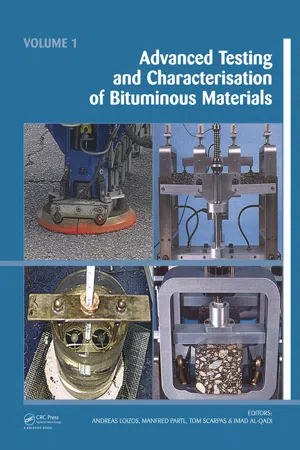
Bituminous materials are used to build durable roads that sustain diverse environmental conditions. However, due to their complexity and a global shortage of these materials, their design and technical development present several challenges. Advanced Testing and Characterisation of Bituminous Materials focuses on fundamental and performance testing
Information
Table of contents
- Front cover
- Table of contents
- Preface
- Organization
- 1. Evaluation of binder properties
- Laboratory study on interlayer bonding using cationic tack coats
- Factors affecting recovered asphalt binder properties: A theoretical and experimental study
- Influence of low temperature behaviour of PmB on life cycle
- Influence of granular polymer additives on the asphalt quality
- Phase angle determination and interrelationships within bituminous materials
- Evaluation of initial road performance correlating with different tests of binders
- Laboratory study of environmental performance of binders by headspace gas chromatography
- New fatigue test on bituminous binders and mastics using an annular shear rheometer prototype and waves propagation
- Functional forms for master curve analysis of bituminous materials
- Linear viscoelastic spectra of asphalt binders from DSR and BBR
- Principal component analysis of rheological and hardening data from bituminous binders
- Rheological and functional evaluation of the interactions between bitumen and rubber
- A thermodynamic approach to healing in bitumen
- Nanoclay for binder modification of asphalt mixtures
- First-principles investigation of the multiple phases in bituminous materials: The case of asphaltene stacking
- The morphology of SBS modified bitumen in binders and in asphalt mix
- 2. Testing and modeling the influence of climate and ageing effects
- Developing a test method for the accelerated ageing of bituminous mixtures in the laboratory
- Chemical characterization of laboratory and field bitumen aging in Porous Asphalt Concrete
- Influence of temperature and aging on laboratory fatigue performance of asphalt mixtures
- Aging of SBS polymer in hot and cold bituminous coatings. Relationship between microstructure and performances: Low temperature and cohesion properties
- Impact of freeze-thaw cycles on the performance of asphalt mixture based permeability
- Formulation of authoritative temperature gradients for an analytical design process of flexible pavements using statistical techniques
- Performance evaluation of prepared gelled hot sealant in cold climates
- Age hardening behaviour of bituminous stabilized materials
- Investigation of friction properties of various road surfaces affecting road safety
- Combined experimental and numerical analysis of moisture infiltration in the modified Lottman test
- Assessment of moisture effect on open graded mixes using water sensitivity and Cántabro after immersion tests
- Moisture damage on bituminous stabilized materials using a MIST device
- Determination of gradual reduction of the flexible pavement bearing capacity
- Testing of low temperature behaviour of asphalt mixtures in bending creep test
- Effect of beam size on the creep stiffness of asphalt mixtures at low temperatures
- Assessment of water sensitivity of asphalt rubber mixtures for wearing course
- Development of a laboratory bituminous mixtures ageing protocol
- 3. Hot bituminous mixtures characterization and design
- Optimum loading speed for deformation strength test of bitumen mixtures
- Enhanced algorithms for the derivation of material parameters from triaxial cyclic compression tests on asphalt specimen
- Reliability and suitability for standardization of methods for HMA density measurements: Experimental investigation on transve se vs longitudinal variations
- Research on coordinating deformation between Fiber Bragg Grating strain sensor and asphalt mixture
- Influence of treatments on the surface characteristics of aggregate
- Mix design of grouted porous asphalt concrete for wearing course layers
- “Liquefaction” of asphalt caused by cyclic loading, as a potential reason of extreme rutting
- Experimental investigation on the dynamic properties of asphalt concrete using filler with waste hydrated lime
- Monitoring and designing of wearing courses for orthotropic steel decks throughout the five-point bending test
- Evaluation of modified bitumen, High Modulus Asphalt Concrete and steel mesh as materials for road upgrading
- Theoretical investigation of the stress distribution in a Bimodular IDT specimen
- Investigation of Alkali-Silica Reaction in asphalt mixtures exposed to potassium acetate deicing solution
- Laboratory tests used in Cuba as low financial resources country for the evaluation of the mechanical properties of the asphal mix
- Polypropylene fiber modification of asphalt by using mechanical and optical means
- Evaluation of Petroleum-Contaminated Soil effect on the properties of hot-mix asphalt concrete using dynamic modulus |E*| and indirect tensile tests
- Overview of the LOT meso mechanical research into porous asphalt raveling
- Monitoring the introduction of Enrobé à Module Élevé class 2 onto UK roads
- On the fracture properties of epoxy asphalt mixture with SCB test
- Viscoelastic response of asphalt-aggregate mixes to transient confining conditions
- Evaluation of creep compliance of rubberized asphalt in compare with conventional hot mix asphalt
- Characterizing volumetric deformation behavior of naturally occurring bituminous sand materials
- Alternative materials for asphalt mixture—steel slags
- Evaluation on the shear performance of asphalt mixture through triaxial shear test
- Development of a Dog-Bone Direct Tension Test (DBDT) for asphalt concrete
- Evaluation of performance grading parameters for crumb rubber modified asphalt binders and mixtures
- 4. Warm and cold bituminous mixtures characterization
- Design method for cold and warm emulsion mixtures based on links between laboratory and field
- Fundamental property evaluation of styrene monomer modified warm-mix asphalt concrete
- An evaluation of use of synthetic waxes in warm mix asphalt
- Study of the mechanical behaviour of gravel-emulsions using triaxial tests
- Laboratory performance-based assessment of half-warm mix asphalts with high recycling rate by means of the factorial experimen design approach
- Evaluation of the rheological behaviour of Warm Mix Asphalt (WMA) modified binders
- Author index
- Table of contents
- Preface
- Organization
- 5. Cracking in bituminous pavement materials
- Modeling of Top-Down Cracking (TDC) propagation in asphalt concrete pavements using fracture mechanics theory
- The cracking device with temperature control for the laboratory identification of the road material performance
- Mode II cracking in asphalt concrete
- Experimental study on resistance to cracking of bituminous mixtures using the Fénix test
- Fatigue effects in uniaxial cyclic tensile stress test: The link between stiffness decrease and accumulation of irreversible s rain
- Experimental study of the waveform shape effect on asphalt mixes fatigue
- Experimental investigation of crack propagation in asphalt concrete
- Theoretical analysis of the 4 point bending test
- Investigation of the PH model as a prediction tool in fatigue bending tests with rest periods
- Fatigue behaviour of bitumen in tension-compression loading mode: Rheological analysis and comparison with mix fatigue
- Mixed-mode cracking in asphalt concrete
- Fatigue lines for asphalt mixtures used in wearing course
- Mechanism of fatigue crack growth and fracture behavior in bituminous roads
- Simplified fatigue performance modeling of ALF pavements using VECD+3-D Finite Element Modeling
- Size effect investigation on fracturing of asphalt concrete using the cohesive softening Discrete Element Model
- 6. Fundamental laboratory test methods and models
- On the importance of performing accurate material characterization tests for bituminous materials
- Prediction of rutting risk of bituminous concrete using complex modulus
- Application of simplified VECD modeling to the fatigue life prediction of asphalt concrete mixtures
- Experimental observation of asphalt mix characteristics in the range of low temperatures
- Calibration and validation of a visco-elasto-plastic constitutive model for bituminous conglomerates
- Modulus measurement: European standardisation possibilities
- The influence of the specimen shape on the results of the uniaxial tensile test
- Experience with triaxial loading systems for the testing of road construction materials
- The estimation of the dynamic modulus of asphalt mixture from creep test results
- Application of a balanced mix-design concept to thin asphalt overlay mixes: Minimizing rutting and reflective-cracking
- 3D finite element modeling of polymer modified asphalt base course mixes
- Neural networks in rheology: Theory and application
- 7. Test methods and models for permanent deformation
- Permanent deformation behaviour of bituminous mixtures containing incinerator bottom ash aggregates under uniaxial testing conditions
- A new performance related test method for rutting prediction: MSCRT
- Effect of binder type on the permanent deformation resistance of asphalt mix at different temperatures
- Rutting evaluation of asphalt binders and mixes
- An integrated approach to modeling rutting of flexible pavements
- Equiviscous temperature based on Low Shear Viscosity: Evaluation as binder indicator for rutting and critical discussion of the test procedure
- The effect of volumetric properties of asphalt concrete mixture to wheel track rutting with respect to EN and BS rutting test methods
- Rutting resistance of SMA determined with triaxial and wheel-tracking tests
- Rut resistance of asphalt concretes of different aggregate gradation
- 8. Field methods for structural behavior assessment
- Damage identification in flexible pavements using FWD technique
- Dynamic approach for the evaluation of the load carrying capacity and stability of flexible pavements with the Falling Weight Deflectometer
- Behavior of asphalt pavements subjected to non-standard heavy vehicles
- Field behavior of foamed bitumen pavement material
- Evaluation of cracking in overlays in Quebec: A case study
- 9. Recycling of bituminous pavement materials
- Utilization of aggregate production waste filler in cold recycling mix optimization
- Rehabilitation of an Italian highway by Cold In-Place Recycling techniques
- Fracture energy evaluation of Cold In-Place Recycling mixtures
- The use of marginal materials in road constructions: Proposal of an eco-compatible section
- Influence of active filler, curing time, and moisture content on the strength properties of emulsion and foamed bitumen stabilized mix
- An experimental study on the recycling of powder extinguishers into bituminous mixtures
- Key characteristics of materials stabilised with foamed bitumen
- In-plant aspalt cold recycling in rehabilitation of Babaei expressway project
- 10. Synthesis of international coordinated research initiatives
- RILEM interlaboratory test on interlayer bonding of asphalt pavements
- RILEM interlaboratory test on pavement performance prediction and evaluation
- New tests for polymer-modified binders: Results of a Belgian round robin test
- Comparative test on indirect tension modulus test
- Binder fatigue properties and the results of the Rilem Round Robin Test
- 11. Other topics
- Skid-resistance capability of two newly resurfaced runways in Israel
- Chemical spill tolerance of hot mix asphalts: New research and gaps identification
- Result of numerical analysis of efficacy geogrids on reinforced pavements' vertical and horizontal deformations
- Life cycle costs of typical asphalt pavement rehabilitation techniques in Colorado
- Performance of hot mix asphalt surface under high tire pressure aircraft landing gear configuration at the FAA National Airport Pavement Test Facility
- Quantification of the highway costs as a function of the road traffic and speed
- Author index
- Back cover
Trusted by 375,005 students
Access to over 1.5 million titles for a fair monthly price.
Study more efficiently using our study tools.
Frequently asked questions
Yes, you can cancel anytime from the Subscription tab in your account settings on the Perlego website. Your subscription will stay active until the end of your current billing period. Learn how to cancel your subscription
No, books cannot be downloaded as external files, such as PDFs, for use outside of Perlego. However, you can download books within the Perlego app for offline reading on mobile or tablet. Learn how to download books offline
Perlego offers two plans: Essential and Complete
- Essential is ideal for learners and professionals who enjoy exploring a wide range of subjects. Access the Essential Library with 800,000+ trusted titles and best-sellers across business, personal growth, and the humanities. Includes unlimited reading time and Standard Read Aloud voice.
- Complete: Perfect for advanced learners and researchers needing full, unrestricted access. Unlock 1.5M+ books across hundreds of subjects, including academic and specialized titles. The Complete Plan also includes advanced features like Premium Read Aloud and Research Assistant.
We are an online textbook subscription service, where you can get access to an entire online library for less than the price of a single book per month. With over 1.5 million books across 990+ topics, we’ve got you covered! Learn about our mission
Look out for the read-aloud symbol on your next book to see if you can listen to it. The read-aloud tool reads text aloud for you, highlighting the text as it is being read. You can pause it, speed it up and slow it down. Learn more about Read Aloud
Yes! You can use the Perlego app on both iOS and Android devices to read anytime, anywhere — even offline. Perfect for commutes or when you’re on the go.
Please note we cannot support devices running on iOS 13 and Android 7 or earlier. Learn more about using the app
Please note we cannot support devices running on iOS 13 and Android 7 or earlier. Learn more about using the app
Yes, you can access Advanced Testing and Characterization of Bituminous Materials, Two Volume Set by Andreas Loizos, Manfred N. Partl, Tom Scarpas, Imad L Al-Qadi, Andreas Loizos,Manfred N. Partl,Tom Scarpas,Imad L. Al-Qadi,Imad L Al-Qadi, Andreas Loizos, Manfred N. Partl, Tom Scarpas, Imad L. Al-Qadi in PDF and/or ePUB format, as well as other popular books in Technology & Engineering & Civil Engineering. We have over 1.5 million books available in our catalogue for you to explore.