- 240 pages
- English
- ePUB (mobile friendly)
- Available on iOS & Android
eBook - ePub
About this book
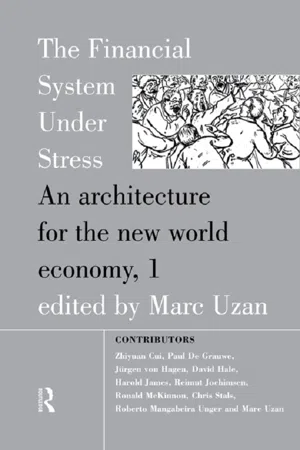
The collapse of Barings bank and the currency crisis in Mexico are just two instances of stress in an international financial system still largely governed by the institutions established by the Bretton Woods Committee in 1944. Here, the authors put forward an agenda for a new system of international economic institutions to fit the changes in inte
1
THE REALLY NEW BRETTON WOODS
DISCONTENTS AND SUPERSTITIONS
The animating impulse of this proposal for the reconstruction of the Bretton Woods system is the belief that the world economy needs more, not less, of all the benefits Bretton Woods was designed to provide through international coordination and supranational institutions. However, the world cannot get what it needs without a much bolder set of institutional innovations in the arrangements for international economic coordination than the global staffer class and its political patrons have so far been willing to countenance or even to imagine. There are two main problems with the present design.
The first problem is that in the aftermath of the breakdown of fixed-parity exchange the practices of the IMF have come to confuse the fundamental but minimalist task of keeping the world economy open in the presence of the balance of payments difficulties with the work of national turnaround – helping to rescue developing countries, or countries in radical transition, from bankruptcy and chaos. The result has been the system of the conditionality agreements: too meddlesome in some respects yet not meddlesome enough in others. This turnaround task, for its part, has been confused with the practice of fundamental development assistance. The consequence has been a failure of the World Bank to arrive at a credible and effective understanding of its mission.
The second trouble with the present system is that the unitary and bureaucratic character of the Fund and the Bank inhibit the fulfillment of both the turnaround and the developmental missions. The Bretton Woods organizations cannot act without taking sides in the contention among alternative national development strategies. To avoid taking sides too much – or to conceal the extent to which they do take sides – they find themselves forced to strike a paralyzing balance between interventionism and self-restraint. At the same time, the threshold responsibility of moderating the effects of transitory exchange rate volatility and balance of payments crises upon the world trading system becomes compromised by its association with more controversial activities.
The solution – I argue – is to disaggregate tasks and multiply agents. The threshold job should continue to be done by a far smaller and less interventionist version of the IMF. However, the turnaround and the development work should be undertaken by a multiplicity of competitive organizations, equipped financially, technically and intellectually to experiment with alternative assistance practices and to support alternative development strategies. Experimentalism and pluralism should take the place of dogma and uniformity.
These proposals stand in sharp opposition to the idea of gradual movement toward a world central bank, which, under unified bureaucratic direction, would combine the responsibilities I seek to distinguish. Like the staffs of the Bretton Woods organizations of today, such a bank would be doomed to live in a twilight world, shut off from the bright lights of uncompromising science and democratic politics. Unlike science, it would cling to consensus. Contrary to democratic politics, the consensus from which it drew life would remain undisciplined by open conflict.
In addressing the sources of trouble I have described, the argument of this paper makes two main intellectual moves. The first move is the generalization of supposedly specific problems. For example, “soft-budget constraint” issues, attributed to command economies, turn out to be pervasive in contemporary economic life. A chain of analogies (and dis-analogies) links turnaround problems in firms and in whole national economies, in poor countries and in rich countries. The second intellectual move is the extension to the public institutional framework – in this case, the framework of multinational or supranational institutions – of the themes of competitive pluralism we more often associate with market economies.
THE NEW REFORMERS AND THEIR AGENDA
Sachs and others have suggested that the Bretton Woods institutions in general, and the IMF in particular, should assume the role of international turnaround agents – a worldwide Chapter 11 (the part of American bankruptcy law dealing with debtor-in-possession reorganization as an alternative to the outright liquidation of a firm). The turnaround job would complement the development-assistance task to be undertaken, evermore decidedly, by the World Bank. It would help to shape an economic environment in which development assistance can prove effective. Such a program would supply the missing rationale for conditionality agreements in the long aftermath of the collapse of the fixed-parity system. It would also clarify the de facto allocation of functions between the Fund and the Bank. Finally, it would provide suport for efforts to assert greater independence on behalf of the Bretton Woods institutions and their staffs.
Discussion of this view helps to probe the limits and the contradictions of ideas and attitudes that are making a strong bid to become the working philosophy of the new Bretton Woods. Not new enough is my conclusion. Let me call it the emerging view.
The discussion advances in four steps. First, I comment on the pervasiveness of turnaround and soft-budget constraint problems in contemporary national economies. There are significant disanalogies betweeen the way these problems present themselves in national and international settings. The second stage of the analysis shows how and why the emerging view fails adequately to recognize these disanalogies. The emerging view would grant a measure of power to a centralized international technocracy that is politically illegitimate, practically unfeasible and lacking in coherent intellectual foundation. The third step in the argument explores the implications of ineradicable conflict over economic institutions and economic growth paths for the work of international institutions. The fourth part of the paper outlines the affirmative, more radical program of reconstruction of the Bretton Woods system that is implicit in my critical account.
FIRMS AND COUNTRIES: FLAWED ANALOGIES
The problem of selective turnaround and of soft-budget constraints is omnipresent in contemporary economies.1 For one thing, as a matter of both law and practice, firms are rarely allowed to suffer instant death as soon as they touch some hypothetical red line; the wastage of wealth and welfare in such inexorable punishment would be intolerable. For another thing, the red line is itself indistinct and moveable, generated as it is out of contingent legal arrangements about property, bankruptcy and relations among firms, banks and central banks. We cannot answer the questions: when and how to rescue firms, at what cost, and through which agents, by inferring rules and solutions from the abstract concept of a market economy. From the abstract concept we can infer only other equally empty and indeterminate abstractions. These are practical choices among competing interests and competing visions, and they are characteristically constrained by a very circumscribed understanding of alternative institutional arrangements.
Whole national economies may also need turnaround. There are, nevertheless, substantial dissimilarities from the turnaround of firms within a national economy. The emerging view comes to grief on some of the implications of these differences. Until we do justice to these differences the comparison to domestic debtor-in-possession reorganization remains a metaphor in the service of the illusion.
First, there is no uniform legal-institutional environment throughout the world, despite the orthodox hope of worldwide convergence toward the same institutions. The effective forms and the social and economic consequences of turnaround differ according to the legal-institutional context in which it takes place.
Second, national turnaround is directly linked to the controversial and conflictual problems of alternative national development strategies. The history of the disputes over the conditionality agreements of the IMF is, among other things, a history of confrontations between clashing development strategies and between conflicting programs of institutional change. The test of success for turnaround in governments and economies is far less clear and more contentious than the standard of success for turnaround in firms. The financial solvency that matters to governments is the one that brings a country to the threshold of a growth path it wants and can sustain.
Third, turnaround decisions in an international setting are not made by judges, bankers, creditors and debtors according to economic calculation and impersonal law. They are made by a supranational technocracy, largely funded and supported by the leading economic powers, relying upon economic ideas that are dominant but contested, and acting through a combination of rules-of-thumb and discretionary judgments.
BRETTON WOODS IN THE SERVICE OF DOGMA
The collapse of gold and fixed parity pushed the IMF and, by extension, the whole connected system of Bretton Woods institutions deeper into an uncharted sea of ideological and practical conflicts. It did so under the barely concealed disguise of alledged technical necessities. The full-scale and overt assumption of the turnaround role by the IMF and the World Bank would aggravate the conflicts while reinforcing the powers of the international economic technocracy and of the interests and ideas to which it has bound its fate.
Consider the infirmities of such a development. First, the centralized rescue machinery would enjoy little political legitimacy. It would be conducted by unelected officials under bureaucratic control. It would rely heavily upon big-power interests and controversial political–economic doctrines.
Second, it would be fiercely contested and its operations would be likely to become all the more what even the conditionality agreements of the IMF have already often been: the subject of bitter quarrels within national economies. The contest would probably be most ardent in the large marginalized countries – China, Russia, India, Indonesia, Brazil – according to the vicissitudes of national politics in each of them.
Third, this reconstructive mission would rest upon shaky intellectual foundations. It would represent a form of bureaucratic interventionism in real markets. Yet it would be a peculiarly truncated or arrested interventionism, given the centralized, controversial and relatively unaccountable character of the institutions serving as its instruments.
It is interesting to reconsider these problems from the standpoint of the proposals discussed, and the experiences undergone, during the foundational era of the Bretton Woods regime. Both the White Plan and Keynes’ rival scheme for an International Clearing Union limited the discretion to be accorded the newly empowered technocracy: the White Plan, by tying this discretion to the mechanics of gold-based fixed parity; Keynes’ blueprint, by appealing to relatively automatic rules and practices such as traders might use in a private clearing system. Despite these precautions, Keynes remained obsessed with the need to guarantee the practical political autonomy of the international technical experts who would be the enlightened agents of the moderate interventionism he favored.
Nothing is more revealing of the dependence of institutional proposals upon unavoidably controversial doctrines than the way in which the rules of Keynes’ ICU exhibited his characteristic concern to rescue the overspenders and to punish the oversavers in international trade. It is equally suggestive that the Marshall and the Dodge Plans – described by McKin-non as far more successful than the Bretton Woods institutions themselves – succeeded precisely because they did not need to feign impartiality or detachment. As schemes imposed by the victors upon the vanquished (as well as upon the impoverished victors) they conformed to clearly stated and comprehensive development strategies. The institutional vehicle imposed no constraint upon the substantive program, nor did the substantive program burst the limits of its institutional agent.
Nevertheless, when all is said and done, the world needs arrangements for international turnaround just as it needs development support. How can it get what it needs without having to please American professors of economics and French inspecteurs des finances as well as the United States Congress? How can it get what it needs without finding its needs victim to an unresolved conflict between an unfinished work and an unsuitable agent? The answer is: not without a more thoroughgoing reconstruction of the Bretton Woods system than the loyal opposition has so far been willing to consider.
ALTERNATIVE MARKET ECONOMIES, ALTERNATIVE DEVELOPMENT STRATEGIES
The argument about the controversial character of the turnaround and development work of the Bretton Woods organizations requires closer attention. Two theses are central to this argument. The first thesis is that conflict over economic institutions and economic growth paths is ineradicable. The second thesis is that a unitary structure of international organizations holds urgently needed international help hostage to national Submission to a partisan program in this conflict. These theses have far-reaching and misunderstood implications for economic theory, for practical economic policy and for the legal structure of the world economy. We need to explore the theses and their implications further before we can understand what needs to be done. The exploration takes us through a brief detour in some conundra of contemporary theory and policy.
A familiar and frustrating set of debates in political economy develops along the following lines. Selective industrial policy and protection for emerging industries may theoretically be better than dogmatic and flexible free trade. They may enable countries to escape an unfavorable and long-lasting niche in what is supposedly a single, inescapable evolutionary path toward more productive labor. The trouble is that in practice any attempt at selective industrial and trade policy creates opportunities for collusion and rent-seeking as well as for sheer bureaucratic dogmatism and stupidity. So the activist solution that may be preferable in principle rarely turns out to be best in practice.
Similarly, multiple exchange rates (distinguishing, for example, between imports of consumer and of capital goods) may be better in theory than either a unified pegged rate or a unified floating rate. For the same reason, however, multiple exchange rates are likely to be worse in practice. A parallel discussion arises in arguments about the differential allocation of credit to industry or the use of fiscal policy to influence, differentially, decisions to save and invest.
These discussions in turn have a strong family resemblance to a second set of arguments in political economy: the attractions of facilities to risk-bearing entrepreneurial activity such as the limited-liability corporation, or the availability of debtor-in-possession reorganization as an alternative to outright bankruptcy, must be weighed against the dangers of “moral hazard” – of the inducement to reckless and inadequately disciplined economic behavior all such facilities create. The difference is that in this second class of arguments, unlike the first set, about selective trade and industrial policy or multiple exchange rates, there are no identifiable second-best solutions.
We lack a formulaic device by which to distinguish beforehand and in general terms the good risks from the bad ones, or the hero of Schumpeterian entrepreneurialism from the villain of moral hazard. Consequently, we have no escape from the need to make rough-and-ready compromises, informed by our sense of the most promising path of institutional development. We must choose the arrangements most hospitable to the whole form of life, or ideal of civilization, we seek to sustain as well as those most conducive to economic growth and innovation. We cannot disentangle the design of economic institutions from the institutional character of society as a whole.
This conclusion sheds a revealing light upon the first set of discussions – the ones about the theoretical first-best of governmental activism and the practical second-best of governmental passivity. The retreat from activism in the strategic coordination among firms, or between firms and governments, to the safety of the practical second-best of an arm’s-length relation among firms or between firms and governments is neither a natural nor an eternal prescription. It is simply the consequence of the choices we must make among the institutional arrangements embodying, on one side, activism, selective policy or strategic coordination and, on the other, arm’s-length market relations. In every such discussion we come in the end to the point at which we must ask whether we must indeed choose among the available forms of market relations and of strategic coordination or whether, instead, we can broaden the repertory of available institutional arrangements.
Thus, for example, the susceptibility of selective trade policy or differential credit allocation to collusive rent-seeking and economic dogmatism is not an historical constant. It depends upon the institutional tools of the activism. Some such devices may be more decentralized and participatory, and more subject to democratic accountability and competitive pressure, than others. We may have in our minds the picture of a central bureaucracy, like a Ministry of Foreign Trade or a Ministry of Industry, as the agent of the strategic coordination. However, other much less centralized arrangements may be practicable. In fact, even the existing North-East Asian economies, supposedly the most successful practitioners of strategic coordination, differ significantly in the extent to which their methods of trade and industrial policy are elitist and collusive, disfavoring the happy serendipity of market-driven experimentalism. Taiwan, for example, has enjoyed a more decentralized version of industrial and financial assistance, one more friendly to small business, than has South Korea.
These established variations are best understood as a subset of a far broader and always ill-defined range of institutional possibilities. In practice and in imagination the institutional repertory broadens by analogical extension. Thus, we may imagine a form of industrial policy having the same relation to the Taiwanese version that the Taiwanese brand has to the South Korean. As we progress along this spectrum, the pressure to move from the theoretical best of active selection, differentiation and coordination to the practical second-best of governmental passivity and rigid contrasts between cooperation and competition diminishes. The arrangements of strategic coordination become less vulnerable to hijacking by privileged interests and bureacratic know-alls. In fact, the distance between the allegedly opposing tacks of the pure market and the guided market narrows.
If we move far enough in this direction we come to the idea of strategic coordination deployed by distinct and competing agencies, accountable both to firms and to governments while enjoying substantial independence from both. Such a regime may make it possible to try out, in particular sectors of the economy, different strategies of selective help and to assess empirically the results of each. It may therefore be more open and experimentalist than a regime which reduces the relations among firms to pure competition and the relations between governments and firms to arm’s-length regulation.
We arrive at a similar conclusion if we begin from the other end, thinking through the possible institutional forms of the market economy rather than the possible institutional arrangements for selective interventionism and strategic coordination. One of the major results of the work of legal thought since the mid-nineteenfh century has been to demonstrate that the market economy lacks a single natural and necessary legal form. No one system of rules and rights of property and contract, or of arrangements for the corporate organi2ation of business, or of labor-law regimes, defines a market economy. Private property itself turns out to be just a “bundle of rights.” We can disassemble and recombine it in any number of ways. We can pull apart its constituent powers and vest them in different types of right-holders.
Should the form of private property in a market economy emphasize the extension of access to productive resources, preferring whatever property regime broadens such access to the greatest number of economic agents? Or should we und...
Table of contents
- Cover
- Halftitle
- Title
- Copyright
- Contents
- List of Figures
- List of Tables
- Contributors
- Foreword: Objectives of the Reinventing Bretton Woods Committee
- Acknowledgements
- Introduction: The World Economy at the Turn of the Century: The search for a new paradigm 1944–95
- 1. The Really New Bretton Woods
- 2. The International Monetary Fund and the International Monetary Order Since 1945: An historical perspective
- 3. International Chapter 11 and SDR
- 4. Regionalism versus Globalism?: Globalism via regionalism!
- 5. Global Economic Integration after the Cold War: How will the economic order created at Bretton Woods adjust to three billion new members?
- 6. Dollar and Yen: The problem of financial adjustment between the United States and Japan
- 7. Monetary Union in Southern Africa
- 8. Credible Roads to EMU
- 9. Exchange Rates in Search of Fundamental Variables
- Appendix. Participants of the Reinventing Bretton Woods Conference
- Index
Trusted by 375,005 students
Access to over 1.5 million titles for a fair monthly price.
Study more efficiently using our study tools.
Frequently asked questions
Yes, you can cancel anytime from the Subscription tab in your account settings on the Perlego website. Your subscription will stay active until the end of your current billing period. Learn how to cancel your subscription
No, books cannot be downloaded as external files, such as PDFs, for use outside of Perlego. However, you can download books within the Perlego app for offline reading on mobile or tablet. Learn how to download books offline
Perlego offers two plans: Essential and Complete
- Essential is ideal for learners and professionals who enjoy exploring a wide range of subjects. Access the Essential Library with 800,000+ trusted titles and best-sellers across business, personal growth, and the humanities. Includes unlimited reading time and Standard Read Aloud voice.
- Complete: Perfect for advanced learners and researchers needing full, unrestricted access. Unlock 1.5M+ books across hundreds of subjects, including academic and specialized titles. The Complete Plan also includes advanced features like Premium Read Aloud and Research Assistant.
We are an online textbook subscription service, where you can get access to an entire online library for less than the price of a single book per month. With over 1.5 million books across 990+ topics, we’ve got you covered! Learn about our mission
Look out for the read-aloud symbol on your next book to see if you can listen to it. The read-aloud tool reads text aloud for you, highlighting the text as it is being read. You can pause it, speed it up and slow it down. Learn more about Read Aloud
Yes! You can use the Perlego app on both iOS and Android devices to read anytime, anywhere — even offline. Perfect for commutes or when you’re on the go.
Please note we cannot support devices running on iOS 13 and Android 7 or earlier. Learn more about using the app
Please note we cannot support devices running on iOS 13 and Android 7 or earlier. Learn more about using the app
Yes, you can access The Financial System Under Stress by Marc Uzan in PDF and/or ePUB format, as well as other popular books in Business & Business General. We have over 1.5 million books available in our catalogue for you to explore.