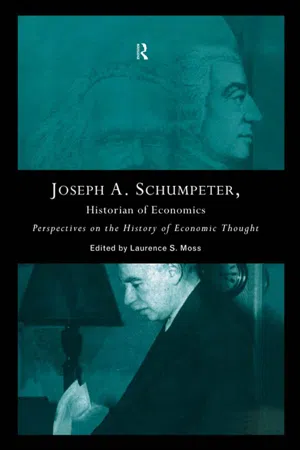
eBook - ePub
Joseph A. Schumpeter: Historian of Economics
Perspectives on the History of Economic Thought
- 336 pages
- English
- ePUB (mobile friendly)
- Available on iOS & Android
eBook - ePub
Joseph A. Schumpeter: Historian of Economics
Perspectives on the History of Economic Thought
About this book
Joseph A. Schumpeter was one of the great economists of the twentieth century. His History of Economic Analsyis is perhaps the greatest contribution to the history of economics, providing a magisterial account of the development of the subject from Ancient Greece to the mid-twentieth century. Schumpeter's views on his predecessors have proved to be
Part I
METHODS OF
SCHOLARSHIP
SCHOLARSHIP
1
ASSESSING THE REPRINTING
OF SCHUMPETER’S
HISTORY OF ECONOMIC
ANALYSIS
OF SCHUMPETER’S
HISTORY OF ECONOMIC
ANALYSIS
This is the fortieth anniversary of the original publication of Schumpeter’s History of Economic Analysis.1 Routledge, which holds the distribution rights exNorth America, has brought out a new printing and asked me to prepare an introduction for it.2 To dispose of my introduction quickly, let me say that it has five parts. The first two summarize Schumpeter’s place in the history of economic thought, and the place of the history of economic thought in Schumpeter’s own work. The third summarizes in moderate detail the contents of the book. The fourth surveys the critical reviews given the book, principally the opinions of George Stigler, Frank H. Knight, I.M.D. Little, Lionel Robbins, Mark Blaug, Ronald Meek, and Jacob Viner. And in the fifth section, I give my own assessment, an assessment which takes account of what others have thought, but which goes somewhat beyond their reactions.
In that fifth section I speculate on two points. Virtually all of the other reviewers comment on the breadth of the vision Schumpeter wanted the book to contain. I address myself to that point and raise some questions about that vision. And that is the first point I wish to discuss here.
My second point goes to some matters of judgment. As almost everyone in the field of the history of thought knows well, Schumpeter reserved his greatest praise for Léon Walras. Robbins thought this judgment a major error, since Robbins thought that it was David Ricardo who deserved the laurel wreath. In my printed essay I have tried to explain that difference in evaluation in terms of Schumpeter rejecting the Utilitarian Creed which underlay (and underlies) most of Anglo American economics. But, I went on to suggest that it was probably Vilfredo Pareto, rather than Walras, who truly deserved the laurel which Schumpeter intentionally awarded to Walras. It is my judgment, one flying somewhat in the face of the explicit assessment Schumpetermade in one of his last essays, the one on Pareto, which I shall try to explain in the second part of this chapter. As my two views, one relating to the vision and the other to the place of Pareto, eire related, let us turn first to the easier, the one about the vision.
THE FLAW IN SCHUMPETER’S VISION
When I wrote that I thought that there was a flaw in Schumpeter’s History of Economic Analysis vision, I certainly made it plain that the flaw was not fatal: the book remains as the outstanding achievement in the history of our field. Rather, Schumpeter, as Mark Blaug pointed out (Blaug 1962: 51), was unable to deliver the goods that he had promised. What set Schumpeter’s dream above the others was the multiplicity and complexity of its parts. But, assuming that Schumpeter sought to offer a vision, how can his vision be judged? Hayek, in some senses a product of the same Viennese Gymnasium-mold which produced Schumpeter, offers the beginnings of an interesting comparison and ultimate criticism. Hayek came to embrace the complex paradigm of individualism-utilitarianism. Accordingly, had he written of Schumpeter’s vision, he probably would have said (no doubt politely) that Schumpeter had it wrong.
But Hayek’s enthusiasm for the individualism-utilitarianism paradigm, emphasizing in his economics the centrality of Bernard Mandeville, Adam Smith, J.S. Mill and personal liberty, brings to my mind the question of various possible alternative paradigms (Hayek 1978: 249–66). I mention but three: the centrality of scarcity, the centrality of uncertainty, and the centrality of essential (i.e. stable) moral imperatives (i.e. values).
As we have seen, Schumpeter rejected the paradigm of individualism – utilitarianism (and personal liberty). He did not seriously consider the paradigm of uncertainty. But, in the absence of any other specification, it seems to me he was groping for some paradigm of fundamental social morality. He was easily sidetracked, and spent too much effort decrying ideology (although he never decried theology).
Meek noted in his Marxian interpretation that prior to the classical tradition, economics dealt with social (by which I suspect he might have meant stable imperatives) issues like the relationship between workers and their lords (Meek 1962: Iff). He went on to say that during the classical period that paradigmatic interest shifted away from an historically appropriate discussion about classes, people, and social organization to an historically inappropriate nexus between producers and goods. My suggestion is that the vision that Schumpeter really sought was one involving something akin to a theological paradigm – integrating fundamental, non-changing, ethical and social values and the dynamic workings of an evolutionary economy.
By fundamental human and social values I mean an absolute, true system which was exogenous to time and place. It was for this reason that so much of Schumpeter’s interest focused on medieval writers and Natural Law, buthis own remarriage after his divorce alienated him from the religion of his ancestors. Loran Allen asserts that while Schumpeter seemed to believe that conventional religious beliefs were for mortals lesser than he, he became increasingly mystical as he grew older – to the point of writing to and talking with his dead mother and his dead second wife (Allen 1991, 2: 199–200). My own assessment differs from Allen’s, who like many modern scientists offer their discussions and judgments of concepts of religion and religiosity on narrow, somewhat formalistic and institutionalized planes.
When he was a younger man he had thought that science could furnish answers covering all topics. By the time he had gotten to this work, he had less faith in science (note his bow to Hayek’s crusade against Scientism), replacing it with an interest in historical sociology (Hayek 1964). My point is simply that his sense of vision, great by comparative standards, was nonetheless admittedly incomplete. On the one hand, there was.from his religiosity a sense of timeless all-encompassing truth, which included but transcended science, for science was the name given to marvelous sets of analytical tools, when perfected timeless in nature, but certainly never as grand as the basic vision itself On the other, there was historical sociology which gave some limited system to the bodies of material, including methods of exposition, relating to ever-cha!1ging societies.
I think that there was genius in Schumpeter’s linkage of science and greater truth, but he knew of a flaw as well. He was aware that scientific advance in one area not only could be translated to work in other areas, but that in the process more was occasionally transferred than merely scientific method. The original area had its own Gestalt, and the transference often brought along pieces of that original Gestalt, which could be essentially alien to the new area. Isaac Newton, one of the inveritors of the calculus, was a physicist interested in mechanics and therefore concerned with equilibrium. Economists, appreciating the potential of the calculus, often were unaware that they were applying a physics-derived technique to a sociobiological type of discipline, where the one important truth was not movement towards an equilibrium but constant mutation.
Thus, I conclude that Schumpeter wanted a vision which embraced and bound together the permanent and exogenous with the sociological-transitory and indigenous, and he failed to find it. Had he chosen to build on the American Institutionalist writers such as John R. Commons and Wesley C. Mitchell as exemplars of the sociological-transitory with their inability to find the timeless truth, he could have shown the dilemma from the non “theoretical” side. Unlike many of the theorists of his time, Schumpeter expressed some, if limited, respect for what they were trying to do; but he did not go on to say what should have been said:
(a) | that they did not see beyond the Hobbes-Locke individualist-utilitarian paradigm; and |
(b) | that their ignorance of Pareto’s work on nonrational systems made their work far more barren theoretically than it should have been. |
WHY DID SCHUMPETER OVERLOOK PARETO’S
SOCIOLOGY?
SOCIOLOGY?
Why he overlooked these Institutionalists is one thing, but why did he generally overlook the relevance of Pareto’s sociology in the discussion of his own vision? Here is another dilemma. What explains this neglect – particularly since Schumpeter was part of the Harvard seminar in the 1930s which focused some-what productively on the English translation, Mind and Society, of the Tratatto de Sociologia Generale?3 Possibly, this problem haunted him, and, in one of the last and best of his essays, printed in 1949, he set out to evaluate Pareto, the man, his economics, and his theory, for what were clearly defensive, nonetheless competent purposes (Schumpeter 1965: 110–42).
Let me only note here that while Schumpeter chose to emphasize Walras and Pareto mostly as mathematical economists, each was also deeply steeped in historical, institutional, and even empirical detail. It is a tragedy that our students think of them as only abstractionists, but it is a tragedy easily prevented if they are told to look at the actual texts.
About Pareto the man, Schumpeter noted the obvious; how brilliant was Pareto’s mind as well as how difficult was his personality. More than that, Schumpeter took great care to show how much Pareto suffered from being misunderstood by those who should have known better, and how poorly understood he was by those who while claiming him as their guru distorted what he meant to say. It comes across clearly that in Schumpeter’s mind Pareto was a scientist sans pareil; unlike Walras, Pareto created a following, and unlike most leaders Pareto was ever conscious of his debt to Walras, whom apparently he disliked thoroughly.
The other point to make about Pareto, the man, was his passionate identification with Italy, a country whose political corruption then (like today) exasperated many who admired its creativity and cultural sophistication. Nonetheless, it is significant that Schumpeter, truly no more than a self-made quasi-aristocrat (some even allege something of a pseudo-aristocrat), judged Pareto to be a real aristocrat but one tarnished with a bourgeois reformist outlook. I wonder why Schumpeter included such obiter dicta.
As for Pareto, the economist, Schumpeter’s assessment is mixed. On the one side Schumpeter lists many but far from all of Pareto’s. innumerable “firsts.” Pareto’s Law of Income Distribution was one of the first empirically discovered regularities known to economics, and although the interpretation of the Law varies, its existence involving a fascinating stability is clearly a Paretian first. In Schumpeter’s words, “Pareto’s ’Law’ is pathbreaking in the literal sense even though in the end nothing whatever is left of its particular form” (Schumpeter 1965: 121).
And, Pareto’s ideas about pricing in a socialist economy presaged Barone’s famous paper. Schumpeter further identifies Pareto as the one who first drew, albeit awkwardly, the distinction between a “dynamics that studies successive equilibria and seems to me to denote comparative statics; and another dynamics that studies the mouvement du phénomène économique and seems to merge genuine dynamics with the problems of evolution” (Schumpeter 1965: 125).
Yet, for example, Schumpeter neglects Pareto’s concept of Ie sentier (“the path”), a construct more sophisticated than tâtonnement. Ie sentier is a construct involving path-dependent solutions–solutions relating to explicit terminal prices as well as relative power within both economic markets and social bargains.
Schumpeter credits Pareto with being the architect of the now-accepted non-cardinal u...
Table of contents
- Cover Page
- Title Page
- Copyright Page
- Contents
- Contributors
- Acknowledgements
- Introduction
- Part I Methods of scholarship
- Part II The “Great Gap” Thesis Revisited
- Part III Thoughts About Money, Credit, and Finance
- Part IV Themes of the Classical School
- Part V Expanding The Frontiers
- Part VI The Synthesis
- Index
Trusted by 375,005 students
Access to over 1.5 million titles for a fair monthly price.
Study more efficiently using our study tools.
Frequently asked questions
Yes, you can cancel anytime from the Subscription tab in your account settings on the Perlego website. Your subscription will stay active until the end of your current billing period. Learn how to cancel your subscription
No, books cannot be downloaded as external files, such as PDFs, for use outside of Perlego. However, you can download books within the Perlego app for offline reading on mobile or tablet. Learn how to download books offline
Perlego offers two plans: Essential and Complete
- Essential is ideal for learners and professionals who enjoy exploring a wide range of subjects. Access the Essential Library with 800,000+ trusted titles and best-sellers across business, personal growth, and the humanities. Includes unlimited reading time and Standard Read Aloud voice.
- Complete: Perfect for advanced learners and researchers needing full, unrestricted access. Unlock 1.5M+ books across hundreds of subjects, including academic and specialized titles. The Complete Plan also includes advanced features like Premium Read Aloud and Research Assistant.
We are an online textbook subscription service, where you can get access to an entire online library for less than the price of a single book per month. With over 1.5 million books across 990+ topics, we’ve got you covered! Learn about our mission
Look out for the read-aloud symbol on your next book to see if you can listen to it. The read-aloud tool reads text aloud for you, highlighting the text as it is being read. You can pause it, speed it up and slow it down. Learn more about Read Aloud
Yes! You can use the Perlego app on both iOS and Android devices to read anytime, anywhere — even offline. Perfect for commutes or when you’re on the go.
Please note we cannot support devices running on iOS 13 and Android 7 or earlier. Learn more about using the app
Please note we cannot support devices running on iOS 13 and Android 7 or earlier. Learn more about using the app
Yes, you can access Joseph A. Schumpeter: Historian of Economics by Laurence S. Moss in PDF and/or ePUB format, as well as other popular books in Business & Business generale. We have over 1.5 million books available in our catalogue for you to explore.