Despite their centrality to the operation of contemporary accredited zoo and aquarium institutions, the work of zoo veterinarians has rarely been the focus of a critical analysis in the social science and humanities. Drawing on in-depth interviews and observations of zoo and aquarium veterinarians, mainly in Europe and North America, this book highlights the recent transformation that has occurred in the zoo veterinarian profession during a time of ecological crisis, and what these changes can teach us about our rapidly changing planet.
Zoo vets, Braverman instructs us with a wink, have "gone wild." Originally an individual welfare-centered profession, these experts are increasingly concerned with the sustainability of wild animal populations and with ecological health. The story of zoo vets going wild—in their subjects of care, their motivations, and their ethical standards, as well as in their professional practices and scientific techniques—is also a story about zoo animals gone wild, wild animals encroaching the zoo, and, more generally, a wild world that is becoming "zoo-ified." Such transformations have challenged existing veterinary standards and practices. Exploring the regulatory landscape that governs the work of zoo and aquarium veterinarians, Braverman traverses the gap between the hard and soft sciences and between humans and nonhumans.
At the intersection of animal studies, socio-legal studies, and science and technology studies, this book will appeal not only to those interested in zoos and in animal welfare, but also to scholars in the posthumanities.
“Saving Species, One Individual at a Time” Zoo Veterinarians between Welfare and Conservation
I save species, one individual at a time.
So, Who Killed Marius?
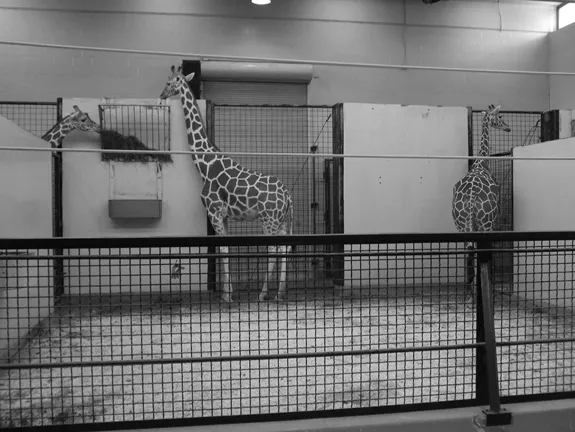
On February 9, 2014, 2-year old giraffe “Marius” was killed at the Copenhagen Zoo. Marius was not sick or old. He was killed because he was what zoo professionals refer to as a surplus animal. A member of the reticulated giraffe species (Giraffa camelopardalis reticulata; see, e.g., Figure 1.1), Marius was managed by the European Endangered Species Programme, or EEP. According to Bengt Holst, scientific director at Copenhagen Zoo: “our giraffes are all part of the European breeding programme for giraffes, and as a pure reticulated giraffe, this giraffe was one of a European population of a little more than one hundred giraffes distributed over 35 European zoos.” “Because he came from a genetic line that has bred very well over the past years,” Holst explained, “there was no space for him anywhere in the population, and he was declared ‘surplus’” (Holst 2014, 1). In addition to its concerns over limited space and other resources, the Copenhagen Zoo killed Marius to prevent in-breeding within the captive breeding program (CNN 2014).
Figure 1.1 Reticulated giraffes at the Buffalo Zoo, 2011. Photo by author.
The ethics of the Zoo’s decision to kill Marius have been widely discussed and dissected, both in the mainstream media (e.g., CNN 2014; The Guardian 2014; National Geographic 2014; New Yorker 2017) and in academia (Bekoff 2014; Braverman 2015; McCulloch and Reiss 2016). Rather than duplicate these efforts, I would like to highlight an underexplored detail of this event: the person who pulled the trigger of the Winchester rifle that killed Marius was the zoo’s veterinarian, Mads Bertelsen. This detail is not incidental, nor is it marginal: the role of zoo veterinarians has evolved considerably in the last several decades and, in fact, they are now the only professionals authorized to conduct serious medical procedures, including euthanasia, on animals at the zoo (see Chapter 4).
The rationale behind Marius’s killing is also important: the idea of a healthy genetic population that will be sustainable both at the zoo and as an insurance population for the wild-dwelling members of the species is now the zoo’s raison d’être and a major goal of the zoo vet’s work. Yet while all accredited zoos would agree that no Mariuses should exist in their populations, the means for accomplishing this differ: some zoos ensure that such animals aren’t born in the first place, and others kill them when they reach maturity. These variations in approach are the result of different balances that particular zoos strike between the welfare of their animal individuals. The zoo veterinarian is at the heart of the medical and ethical debates underlying the daily operations of zoos, and is central to such decision-making practices—both as the zoo animal’s major medical caregiver and as the individual who would typically be expected to execute such decisions.
This chapter explores the changing role of the zoo veterinarian in accredited zoos in certain developed countries, and what these changes tell us about the transformation of zoo animal management. Looking at zoos through the lens of the zoo vet brings to light not only the recent transformation of this institution into one that regards conservation as its central mission (hence, the vet’s relatively novel focus on the sustainability of populations), but also the intensification of wildlife management outside the zoo (hence the zoo vet’s increased involvement in in situ projects and the more individual-based, medicalized approach of wildlife managers). Taking population interests into account complicates the welfare calculus that the zoo vet must consider, making for a much more involved biopolitical project (Braverman 2015). In particular, this chapter discusses how the zoo veterinarian manages the tensions between animal health and welfare, on the one hand, and species and ecosystem conservation, on the other hand. But first, a brief historical note.
The Zoo Veterinarian: An Institutional Context
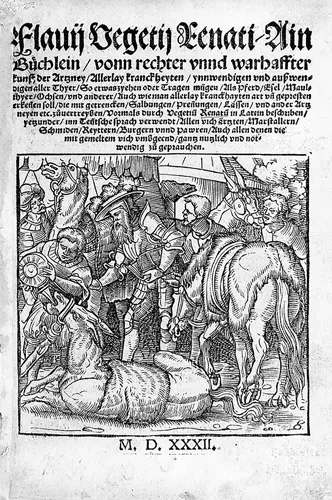
The word “veterinary” likely originates from the Latin veterinae, which means “working animals” (The Veterinary Student 1939, 6). The story of veterinary medicine dates back to Urlugaledinna, who lived in Mesopotamia in 3000 BCE and was an expert in healing animals (RCVS n.d.). The ancient Israelites, Egyptians, and Indians were already familiar with various forms of animal diseases. Moses established a system of meat inspection and Egyptian hieroglyphs recorded the uses of herbs to treat and promote good health in domesticated animals. The Kahun Papyrus from Egypt dates back to 1900 BCE. Vedic literature, which dates from around 1500 BCE, relates that India’s first Buddhist king, Asoka, referred to two kinds of medicine: one for humans and one for animals (Canidae 2014). Both texts are likely the first written accounts of veterinary medicine. Much later, Hippocrates (460-370 BCE) described hydrothorax in oxen, sheep, and swine and mentioned the dislocation of the hip joint of cattle following a difficult winter, and Aristotle (384-326 BCE) discovered a few diseases of swine, dogs, cattle, horses, asses, and elephants. Vegetius, who wrote in the 5th-century CE, is generally considered the father of veterinary medicine for his extensive writings on the diseases of horses and cattle (Wilkinson 1992, 13; see also Figure 1.2). Since then, there have been numerous literary references to veterinary practices. However, it was only with the founding of the veterinary school in France by Claude Bourgelat in 1761 that the modern veterinary profession was officially born (RCVS n.d.).
Figure 1.2 The title page of the first German edition of Vegetius’ veterinary art, from the Wellcome Institute Library, London. Wikipedia commons.
If the veterinary profession dates thousands of years back, the zoological veterinarian discipline is relatively new. The first recorded zoo veterinarian, Charles Spooner, was appointed to the London Zoo in 1829. In the United States, the first part-time zoo veterinarian, H. Amling Jr., worked at the Bronx Zoo in 1900. Zoo veterinarians created their own independent meeting venue in the Association of Veterinary Medicine in 1948, and in 1968 they formed their own organization: the American Association of Zoo Veterinarians, or AAZV (Fowler 2006).
The AAZV is the professional association for individuals and institutions who apply the principles of comparative veterinary medicine to zoo and wildlife species. With more than 1,000 individual and institutional members from 60 countries, the AAZV provides advocacy, collaboration, and partnerships for combined efforts in sustaining and improving the well-being of wildlife in all habitats (AAZV n.d.). The members work in clinical zoo medical practices, diagnostic laboratories, reproductive and pathological laboratories, pharmaceutical companies, and a wide range of governmental health and wildlife management agencies around the world. The first AAZV bylaws were written in 1974 and the most recent ones were approved in 2018.
If until the latter part of the 20th century, the health of zoo animals was administered by a variety of zoo professionals (and especially by zoo keepers), contemporary laws and standards have increasingly identified the zoo veterinarian as the exclusive medical provider for zoo animals. According to the 2009 AAZV Guidelines for Zoo and Aquarium Veterinary Medical Programs and Veterinary Hospitals: “zoological parks and aquariums have humane and legal obligations to provide proper husbandry, veterinary medical treatment, and preventive medical programs for their animals” (AAZV 2009, 2). To achieve this goal, “zoos and aquariums in the United States are required to employ an attending veterinarian to provide adequate veterinary care for the animal collection and to assure that certain minimal standards of veterinary care are in place according to the Animal Welfare Act of 1966” (AAZV 2009, 2). Specifically, the Guidelines state that “surgery can only be performed by a veterinarian,” and that “all zoos and aquariums must have an on-site area available for minor surgical procedures” (AAZV 2009, 6). These regulatory requirements also establish the obligation of every accredited zoo in the United States to have a veterinarian on staff and frame the work of the zoo veterinarian.
The Guidelines situate the zoo vet as operating within the dual framework of welfare and conservation. Accordingly, Article 2(e) provides that one of the AAZV’s central objectives is “to promote the general welfare and conservation of captive and free-ranging wildlife” (AAZV 2012, 1). The combination of welfare and conservation is best reflected in former AAZV President Kelly Helmick’s statement, which I quoted in the epigraph, that she “saves species, one individual at a time.” Executive director of AAZV Rob Hilsenroth explained along these lines that, “while the effort is on the individual animals, the overview is saving species” (interview). The dual welfare-conservation mission is reflected in the broader platform of accredited zoos (Braverman 2012).
This emphasis on conservation and care has brought about the collaborative management of specific animals among zoo institutions through programs such as the Species Survival Plans (SSPs) in North America and the EEPs in Europe. Currently, there are approximately 500 SSP programs, grouped according to taxa into Taxon Advisory Groups. According to the American Association of Zoos and Aquariums (AZA), each SSP “is responsible for developing a comprehensive population Studbook and a Breeding and Transfer Plan which identifies population management goals and recommendations to ensure the sustainability of a healthy, genetically diverse, and demographically varied AZA population” (AZA 2017). SSPs are collaborative breeding programs that coordinate between all relevant institutions and consider their animals under one managerial platform, which I have referred to as “zooland” (Braverman 2012). A variety of population management strategies serve both to enhance the sustainability within zooland and to create healthy populations for possible reintroductions into the wild. Such collectively-managed populations of zoo animals are often referred to by zoos as “insurance populations” (Braverman 2012).
Zoo veterinarians play a central role in the elaborate collaboration among accredited zoos. In North America, the AZA Guidelines provide the required industry standards for the 230 accredited institutions around the country. According to these Guidelines, a Veterinary Advisor (or VA) must be assigned to each SSP, while the Veterinary Advisory Group (VAG) coordinates between the Advisors (VAG 2001). The Guidelines identify a vast set of tasks for the Veterinary Advisor, ranging between responsibility for medical protocols, health provisions, disease prevention, monitoring and reporting, and providing information on conservation programs (VAG 2001). In certain instances, the responsibilities of Veterinary Advisors extend beyond captive zoo animals to incorporate healthcare for in situ animals as well (Deem 2007, 7).
Caring for Diverse Zoo Animals
The modern zoo institution prides itself on caring for a large variety of animals. Accordingly, perhaps the most notable feature of the zoo vets’ work is their care for a diverse range of species within the confines of what is usually a small urban space. In the words of Kelly Helmick: “You might see a hummingbird first thing in the morning and an elephant last thing in the afternoon and everything else in between. And you need to know what you’re doing” (interview). Helmick emphasized how this diversity carries over into medical practice: “We’re the last of the general practitioner. I am an anesthesiologist, I am a pathologist, I am an internist, I am a surgeon, I am an epidemiologist; I am an ophthalmologist, a cardiologist, and a neurologist” (interview).
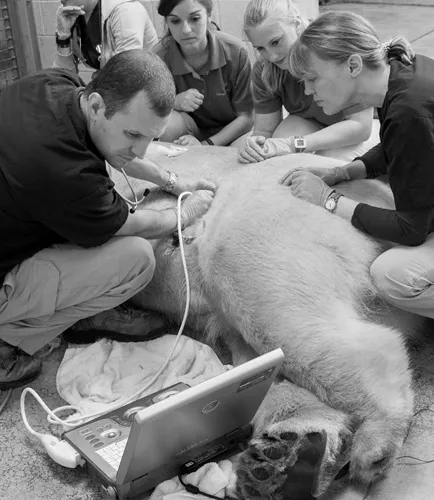
Michael Adkesson is a veterinarian at the Brookfield Zoo in Chicago. The images displayed here (see Figure 1.3Figure 1.4Figure 1.5Figure 1.6Figure 1.7) relay the vast array of animals he cares for on a daily basis, from polar bears through gorillas and penguins to pangolins and grey wolves. “For some animals, it’s very easy,” Adkesson told me. But when it comes to other animals, such as aardvarks and kangaroos, “there isn’t a close correlation with domestic or human animal data that would provide information on how to treat those diseases, what drugs are going to be most effective, how they metabolize those drugs, and what dosage is most appropriate” (interview).
Figure 1.3 Veterinarian Michael Adkesson of the Brookfield Zoo in Chicago performs a routine abdominal ultrasound on a polar bear in 201...
Table of contents
Cover
Half Title
Series Page
Title Page
Copyright Page
Dedication
Table of Contents
Acknowledgements
Introduction Zoo Veterinarians Gone Wild: Meddling as Methodology in Times of Crisis
1 “Saving Species, One Individual at a Time”: Zoo Veterinarians between Welfare and Conservation
2 Fluid Encounters: Aquariums and their Veterinarians on a Rapidly Changing Planet
3 Fleshy Encounters: The Corporeality of Bodies and Tools
4 Caring and Killing: Euthanasia in Zoos and Aquariums
Conclusion Planet Doctors: One Health from Koalas to Coronavirus
List of Interviews
References
Index
Trusted by 375,005 students
Access to over 1.5 million titles for a fair monthly price.
Study more efficiently using our study tools.
Frequently asked questions
Yes, you can cancel anytime from the Subscription tab in your account settings on the Perlego website. Your subscription will stay active until the end of your current billing period. Learn how to cancel your subscription
No, books cannot be downloaded as external files, such as PDFs, for use outside of Perlego. However, you can download books within the Perlego app for offline reading on mobile or tablet. Learn how to download books offline
Perlego offers two plans: Essential and Complete
Essential is ideal for learners and professionals who enjoy exploring a wide range of subjects. Access the Essential Library with 800,000+ trusted titles and best-sellers across business, personal growth, and the humanities. Includes unlimited reading time and Standard Read Aloud voice.
Complete: Perfect for advanced learners and researchers needing full, unrestricted access. Unlock 1.5M+ books across hundreds of subjects, including academic and specialized titles. The Complete Plan also includes advanced features like Premium Read Aloud and Research Assistant.
Both plans are available with monthly, semester, or annual billing cycles.
We are an online textbook subscription service, where you can get access to an entire online library for less than the price of a single book per month. With over 1.5 million books across 990+ topics, we’ve got you covered! Learn about our mission
Look out for the read-aloud symbol on your next book to see if you can listen to it. The read-aloud tool reads text aloud for you, highlighting the text as it is being read. You can pause it, speed it up and slow it down. Learn more about Read Aloud
Yes! You can use the Perlego app on both iOS and Android devices to read anytime, anywhere — even offline. Perfect for commutes or when you’re on the go. Please note we cannot support devices running on iOS 13 and Android 7 or earlier. Learn more about using the app
Yes, you can access Zoo Veterinarians by Irus Braverman in PDF and/or ePUB format, as well as other popular books in Social Sciences & Administrative Law. We have over 1.5 million books available in our catalogue for you to explore.