Norwegian: An Essential Grammar is a reference guide to the most important aspects of contemporary Norwegian as used by native speakers.
The Grammar presents a fresh and accessible description of the language. Explanations are clear, free from jargon and often accompanied by exercises. The book gives a simple, step-by-step presentation of the grammatical systems of Norwegian and demonstrates and explains usages which have proved difficult for those learning the language in the past. It is clearly laid-out for easy reference making it accessible for those at a beginner/intermediate level.
This is the ideal reference source for all learners, whether studying independently or in a class.
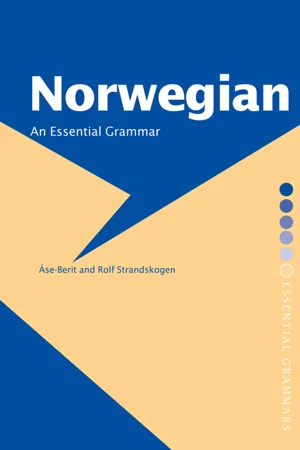
eBook - ePub
Norwegian: An Essential Grammar
- 202 pages
- English
- ePUB (mobile friendly)
- Available on iOS & Android
eBook - ePub
Norwegian: An Essential Grammar
About this book
Information
I Parts of speech
In Norwegian, words are traditionally classified by these 10 parts of speech. In recent years, there have been certain changes in Norwegian grammatical classification and terminology. The classification and terminology used in the present volume is straightforward and should be easily understood by everyone.
- VERBS– examples: gå (go), lese (read), snakke (talk)
- ARTICLES– examples: en, ei, ct (a, an)
- NOUNS– examples: hus (house), mat (food), bok (book)
- ADJECTIVES– examples: god (good), stor (big), ung (young)
- ADVERBS– examples: ute (out), hjemme (at home), nå (now)
- PRONOUNS– examples: jeg (I), meg (me), min (my, mine)
- CONJUNCTIONS– examples: hvis (if), fordi (because), og (and)
- INTERJECTIONS– examples: au (ouch), hei (hello), uff (oh)
- NUMERALS– examples: en (one), to (two), første (first), annen (second)
- PREPOSITIONS– examples: til (to), på (on, at), hos (by, with, at)
Verbs
Infinitive
Form:
Most infinitives end in a vowel, usually unstressed -e
Examples:
snakke (talk) | fortelle (tell) | gå (go) |
reise (travel) | synge (sing) | bo (live) |
spørre (ask) | danse (dance) | sy (sew) |
Some verbs end in -s
Examples:
trives (thrive, do well) | treffes (meet up) |
møtes (meet each other) | brukes (be used) |
Note: Verbs are always given in a dictionary in the infinitive form, often preceded by the infinitive marker å (to).
Function:
Infinitive form without «å»
- After modal auxiliaries:Examples:Jeg kan snakke norsk. (I can speak Norwegian.)Han vil ikke komme nå. (He doesn’t want to come now.)Du bør ikke gjøre det. (You shouldn’t do that.)De skulle også kjøpe et hus. (They were also going to buy a house.)Dere må spise nå. (You must eat now.)Jeg tør ikke gå ute når det er mørkt. (I don’t dare walk outside after dark.)
- After the verbs «be» (ask), «høre» (hear), «kjenne» (feel), «la» (let), «se» (see)Examples:Jeg bad ham komme. (I asked him to come.)Han lot oss være sammen. (He let us be together.)Jeg hørte noen snakke der ute. (I heard someone talking out there.)Jeg så dem løpe av sted i full fart. (I saw them run off at full speed.)Jeg kjente såret svi. (I felt the cut stinging.)
- In such expressions as:Hvorfor gråte når man kan le? (Why cry when you can laugh?)Hvorfor ikke gjøre det? (Why don’t we do that?)Nei, snakke, det kunne han ikke. (No, talk [was something] he couldn’t do.)
- In a string of infinitives:See under Infinitive form with «å», section f.
Infinitive form with «å»
- As the subject of a sentence:Examples:Å snakke norsk er litt vanskelig. (Speaking [literally: to speak] Norwegian is a bit difficult.)Å gå på ski er morsomt. (Skiing [literally: to walk on skis] is fun.)Å tale er sølv, men å tie er gull. (Speech is silver, but silence is golden [literally: to speak is silver, but to remain silent is golden].)
- As the object of a sentence:Examples:Jeg liker å danse. (I like to dance.)Han ønsket å fly. (He wanted to fly.)Hun prøvde å snakke. (She tried to talk.)
- As the complement of a sentence:Examples:Det er å gjøre for mye av ingenting. (That is making [literally: to make) too much out of nothing.)Det synes å ta lang tid. (It seems to be taking [literally: to take] a long time.)
- In infinitive clauses:Examples:Jeg har mye å fortelle fra den reisen. (I have a lot to tell from that trip.)Han ville gjerne ha noe å drikke. (He would like something to drink.)Det var ikke annet å gjøre. (There was nothing else to do.)
- After a preposition:Examples:Har du lyst til å gå nå? (Would you like to go now?)Det var et forsøk på å lure de andre. (It was an attempt to fool the others.)De hadde besternt seg for å gjøre det. (They had decided to do it.)
- In a string of infinitives:
- Coordinated infinitives: Å is usually omitted after og (and) and eller (or).Examples:Han lærte å snakke og (å) skrive. (He learned to talk and (to) write.)De likte å hoppe og (å) danse. (They liked to jump and (to) dance.)De skulle begynne å skrive eller (å) lese. (They were going to start to write or (to) read.)
- Uncoordinated infinitives: Å cannot be omitted.Examples:
 (He must learn to talk, (to) write and (to) read.)
Table of contents
- Cover Page
- Half Title page
- Title Page
- Copyright Page
- Contents
- Preface
- I Parts of speech
- II Sentence Elements
- III Sentence Structure
- IV Word Order
- Index
Trusted by 375,005 students
Access to over 1.5 million titles for a fair monthly price.
Study more efficiently using our study tools.
Frequently asked questions
Yes, you can cancel anytime from the Subscription tab in your account settings on the Perlego website. Your subscription will stay active until the end of your current billing period. Learn how to cancel your subscription
No, books cannot be downloaded as external files, such as PDFs, for use outside of Perlego. However, you can download books within the Perlego app for offline reading on mobile or tablet. Learn how to download books offline
We are an online textbook subscription service, where you can get access to an entire online library for less than the price of a single book per month. With over 1.5 million books across 990+ topics, we’ve got you covered! Learn about our mission
Look out for the read-aloud symbol on your next book to see if you can listen to it. The read-aloud tool reads text aloud for you, highlighting the text as it is being read. You can pause it, speed it up and slow it down. Learn more about Read Aloud
Yes! You can use the Perlego app on both iOS and Android devices to read anytime, anywhere — even offline. Perfect for commutes or when you’re on the go.
Please note we cannot support devices running on iOS 13 and Android 7 or earlier. Learn more about using the app
Please note we cannot support devices running on iOS 13 and Android 7 or earlier. Learn more about using the app
Yes, you can access Norwegian: An Essential Grammar by Ase-Berit Strandskogen,Rolf Strandskogen,ÅAse-Berit Strandskogen, Barbara White in PDF and/or ePUB format, as well as other popular books in Languages & Linguistics & Languages. We have over 1.5 million books available in our catalogue for you to explore.